Snowflake Business Model And How It Makes Money, Scales Cloud Data, and Became a Billion-Dollar SaaS Company

Snowflake follows a cloud-based SaaS business model built around data warehousing, cloud analytics, and usage-based pricing. Instead of charging fixed software licenses, customers pay for the computing power, storage, and cloud services they actually consume. This makes the platform scalable for startups and large enterprises alike, and it is a core reason Snowflake became one of the most closely watched cloud companies to go public.
What Is Snowflake?
Snowflake is a cloud-native data platform that lets companies store, manage, analyze, and share data without owning any physical infrastructure.
Key facts:
- Founded in 2012 by Benoit Dageville, Thierry Cruanes, and Marcin Żukowski
- Headquartered in Menlo Park, California
- Publicly traded on the NYSE under the ticker SNOW
- Known as the AI Data Cloud company
- Runs on top of AWS, Microsoft Azure, and Google Cloud
- Serves industries including banking, retail, healthcare, manufacturing, and government
Snowflake does not build its own data centers. It runs entirely on public cloud infrastructure, which keeps its operating model asset-light and highly scalable.
Snowflake at a Glance
| Category | Details |
|---|---|
| Founded | 2012 |
| Founders | Benoit Dageville, Thierry Cruanes, Marcin Żukowski |
| Headquarters | Menlo Park, California |
| CEO | Sridhar Ramaswamy |
| Industry | Cloud computing, data warehousing, AI infrastructure |
| Business Model | SaaS, consumption-based pricing |
| Revenue Model | Usage-based credits for compute and storage |
| Customers | Enterprises, banks, retailers, healthcare systems, government agencies, startups |
| Stock Symbol | SNOW (NYSE) |
| Website | snowflake.com |
What Is the Snowflake Business Model?
Snowflake operates as a cloud-native SaaS platform with a consumption-based pricing engine at its core.
The model rests on a few pillars:
- Cloud-native architecture. Snowflake was built from the ground up for the cloud, unlike legacy data warehouses that were adapted from on-premises systems.
- Data Cloud concept. Snowflake positions itself as a single platform where organizations can unify, govern, and share data internally and with partners.
- Consumption-based pricing. Customers pay for what they use rather than committing to fixed licenses.
- Multi-cloud strategy. The platform runs on AWS, Azure, and Google Cloud, so customers are not locked into one provider.
- Enterprise-grade software. Security, governance, and compliance features are built in for regulated industries.
This combination lets Snowflake serve a five-person startup and a global bank on the same underlying platform.
How Does Snowflake Work?
Snowflake separates storage and compute, which is one of its biggest technical differentiators. That separation allows customers to scale each independently instead of paying for both together.
The workflow generally looks like this:
Data ingestion. Data flows in from applications, databases, APIs, and third-party sources.
Storage layer. Data is stored in a compressed, columnar format in the cloud, independent of the compute used to query it.
Compute layer. Customers spin up virtual warehouses, which are independent compute clusters, to run queries without affecting other users.
Query processing. Snowflake’s engine optimizes and executes SQL queries at scale.
Data sharing. Organizations can securely share live data with partners or customers without copying or moving files.
AI and machine learning integration. Snowflake supports model training, vector search, and generative AI workloads directly on governed data.
Marketplace. Customers can access third-party data sets and applications directly inside the platform.
Snowflake Business Model Canvas
Customer segments: Enterprises, mid-market companies, data teams, developers, government agencies, and AI startups.
Value propositions: Scalable cloud data warehousing, pay-as-you-go pricing, secure data sharing, multi-cloud flexibility, and built-in AI capabilities.
Channels: Direct enterprise sales, cloud marketplaces (AWS, Azure, GCP), partner referrals, and inbound content and developer education.
Customer relationships: Dedicated account teams, technical support, customer success programs, and self-service onboarding for smaller accounts.
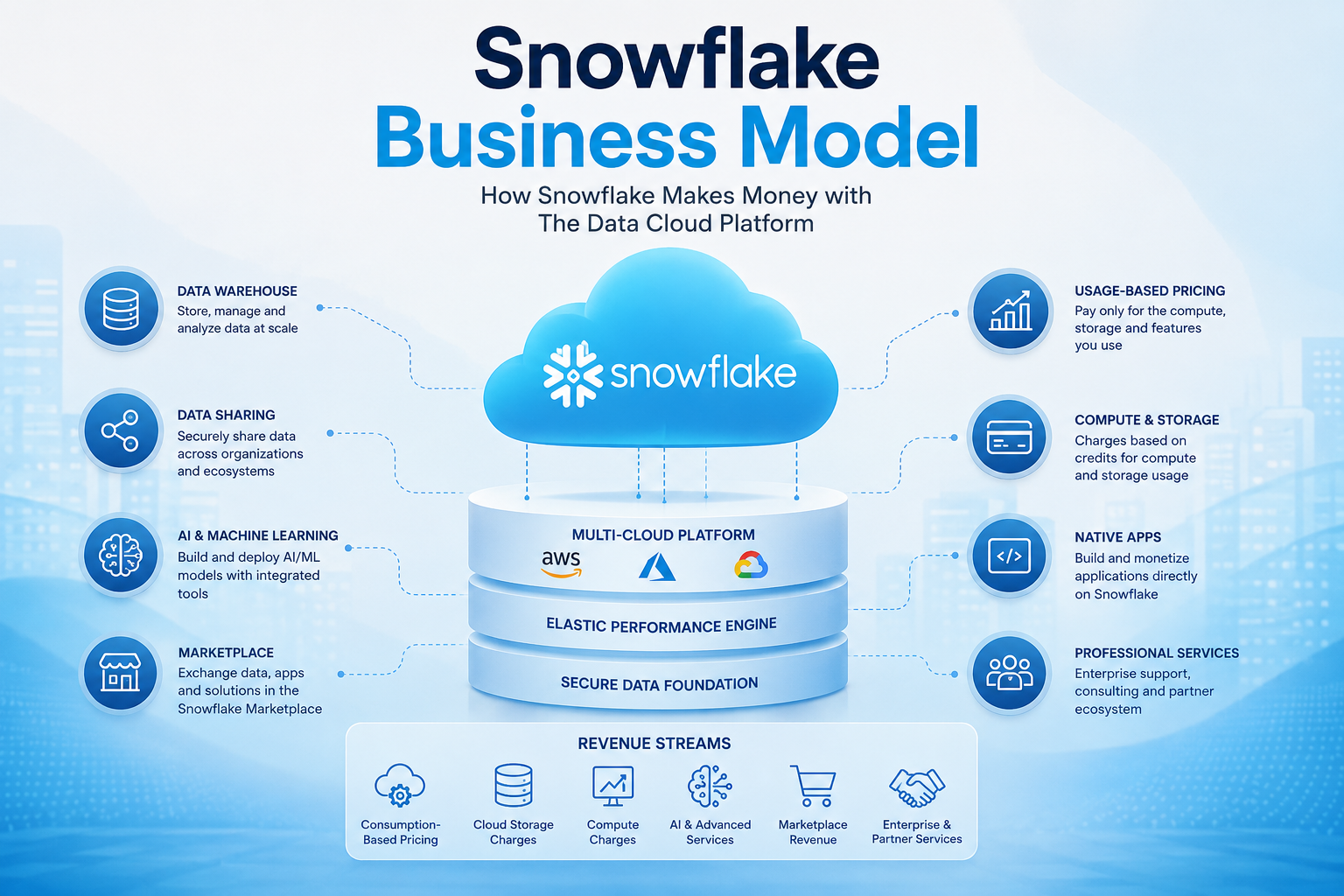
Revenue streams: Consumption-based compute and storage charges, professional services, and marketplace transaction fees.
Key resources: Proprietary cloud architecture, engineering talent, cloud partnerships, and enterprise trust and brand.
Key activities: Platform engineering, AI product development, enterprise sales, and partner ecosystem management.
Key partners: AWS, Microsoft Azure, Google Cloud, NVIDIA, and global systems integrators such as Deloitte and Accenture.
Cost structure: Cloud infrastructure costs paid to hyperscalers, research and development, sales and marketing, and customer support.
How Does Snowflake Make Money?
This is the core of the Snowflake business model, so it deserves a detailed breakdown.
Consumption-based pricing. Snowflake sells usage in the form of credits. A credit is consumed whenever a customer runs compute through a virtual warehouse. Larger warehouses or longer-running queries consume credits faster.
Cloud storage charges. Customers pay separately for the data they store, billed per terabyte per month.
Compute charges. This is the largest revenue driver. Every query, data load, or transformation job consumes compute credits.
Snowpark. Snowflake charges for compute used to run Python, Java, and Scala code directly inside the platform for data engineering and machine learning workloads.
AI services. Snowflake Cortex and related AI tools bill based on the compute and tokens used for tasks like summarization, search, and model inference.
Native apps. Developers can build and monetize applications inside Snowflake, and Snowflake takes a share of that revenue through its marketplace framework.
Marketplace revenue. Snowflake earns fees when customers buy or exchange third-party data sets and applications through the Snowflake Marketplace.
Professional services. Snowflake generates additional revenue from implementation, training, and consulting services, though this is a small share of total revenue compared to product revenue.
Enterprise contracts. Large customers often commit to minimum annual spend in exchange for discounted credit pricing, which gives Snowflake predictable revenue while customers still pay based on actual usage.
Government cloud. Snowflake offers dedicated environments for public sector and regulated customers, which command premium pricing due to compliance requirements.
Partner ecosystem. System integrators and consulting partners drive implementation revenue and expand Snowflake’s enterprise footprint, indirectly supporting platform adoption and usage growth.
Snowflake Pricing Model Explained
Snowflake pricing centers on credits, which are consumed based on compute usage and billed alongside separate storage charges.
Credits. A credit is the base unit of compute pricing. Credit cost varies by cloud provider, region, and Snowflake edition.
Storage pricing. Storage is billed per terabyte per month, separate from compute, and is generally lower cost than compute.
Compute pricing. Compute cost depends on the size of the virtual warehouse selected and how long it runs.
Serverless pricing. Certain features, including some AI and automation tasks, run on serverless compute that Snowflake manages automatically and bills based on usage rather than a manually sized warehouse.
Enterprise edition. Adds features like enhanced security and multi-cluster warehouses for larger organizations.
Business critical edition. Built for highly regulated industries needing advanced security, encryption, and disaster recovery.
Virtual warehouses. These are independent compute clusters that customers can resize, pause, or scale without affecting stored data or other users’ workloads.
Who Are Snowflake’s Customers?
Snowflake serves organizations across nearly every major industry.
- Enterprises: Large corporations using Snowflake for centralized analytics and reporting.
- Banks: Financial institutions using the platform for risk analysis, fraud detection, and regulatory reporting.
- Retail: Companies analyzing customer behavior, inventory, and supply chain data.
- Manufacturing: Businesses tracking production data and supply chain performance.
- Healthcare: Organizations managing patient data and research analytics under strict compliance requirements.
- Government: Public sector agencies using dedicated government cloud environments.
- Startups: Smaller companies drawn to the pay-as-you-go model that avoids large upfront commitments.
Snowflake’s customer base includes several hundred accounts with significant annual spend, along with thousands of smaller and mid-market customers, reflecting the platform’s ability to serve both ends of the market.
Why Companies Choose Snowflake
Scalability. Compute and storage scale independently, so customers are not forced to overpay for one to get more of the other.
Performance. Query performance remains consistent even as data volume grows, due to the platform’s architecture.
Pay only for usage. Businesses avoid large upfront software licenses and instead pay based on actual consumption.
Easy collaboration. Teams can share governed data internally without duplicating files across systems.
Secure sharing. Organizations can share live data externally with partners or customers without exposing raw infrastructure.
Multi-cloud flexibility. Customers are not locked into a single cloud provider.
AI-ready infrastructure. Built-in AI and machine learning tools reduce the need for separate AI infrastructure.
Snowflake’s Value Proposition
For businesses: A single, governed source of truth for enterprise data without the overhead of managing physical infrastructure.
For developers: Tools like Snowpark that allow building data applications directly inside the platform using familiar programming languages.
For data engineers: Simplified pipelines for ingesting, transforming, and managing large volumes of data.
For analysts: Fast, reliable access to clean data for reporting and business intelligence.
For executives: Predictable, usage-aligned costs and a platform that can scale with company growth without major re-architecture.
Snowflake Competitive Advantages (Moat)
Cloud-native architecture. Built specifically for the cloud rather than retrofitted from older systems, giving it a performance and flexibility edge.
Multi-cloud compatibility. Works across AWS, Azure, and Google Cloud, reducing vendor lock-in concerns for customers.
Data sharing. Native data sharing capabilities differentiate Snowflake from many traditional data warehouses.
Marketplace ecosystem. A growing library of third-party data sets and applications adds value without added engineering effort from customers.
Brand trust. Strong reputation among enterprise data teams and executives.
Enterprise adoption. A large base of high-spending enterprise customers creates switching costs once workloads are deeply integrated.
Network effects. As more organizations share data through Snowflake, the platform becomes more valuable to every participant.
Snowflake Marketing Strategy
Enterprise sales. A dedicated, high-touch sales motion targeting large organizations and complex deals.
Partner ecosystem. Close collaboration with consulting firms and systems integrators to drive implementation and adoption.
Cloud partnerships. Co-selling arrangements with AWS, Azure, and Google Cloud expand distribution.
Customer success. Dedicated teams help customers expand usage over time, which directly supports Snowflake’s consumption-based revenue model.
Events. Snowflake’s annual Summit conference and regional events build community and generate leads.
Community. Active user groups and forums support peer-to-peer learning and product advocacy.
Developer ecosystem. Documentation, free trials, and developer tools encourage bottom-up adoption alongside enterprise sales.
Certifications. Training and certification programs build a pipeline of skilled Snowflake practitioners, which supports long-term platform stickiness.
Snowflake Growth Strategy
International expansion. Continued investment in regions outside the United States, including EMEA and Asia-Pacific.
AI investments. Heavy focus on AI features to keep pace with enterprise demand for AI-ready data infrastructure.
Product innovation. Regular expansion into new workloads, including unstructured data, applications, and machine learning.
Marketplace growth. Expanding the number of data providers and native applications available to customers.
Acquisitions. Strategic acquisitions, including Streamlit for building data apps, Neeva for AI search technology, and more recently Crunchy Data for managed PostgreSQL services, have expanded Snowflake’s product surface.
Industry solutions. Tailored offerings for verticals like financial services, healthcare, and retail.
Partner-led growth. Reliance on consulting partners to drive implementation at scale, particularly for large enterprise deployments.
Snowflake AI Strategy
AI has become central to Snowflake’s product roadmap and marketing positioning as the AI Data Cloud company.
Cortex AI. Snowflake’s suite of AI functions for tasks like summarization, translation, and sentiment analysis, built directly into the platform.
Copilot. An AI assistant that helps users write and optimize SQL queries using natural language.
LLM integration. Support for running and querying large language models directly on governed enterprise data.
Vector search. Capabilities for semantic search and retrieval, which are core to modern AI applications.
AI Data Cloud. Snowflake’s broader positioning around being the governed data layer that powers enterprise AI initiatives.
Model hosting. Ability to host and serve machine learning models within the platform.
Generative AI. Tools that let customers build AI applications and chatbots on top of their own data without moving it elsewhere.
Snowflake Ecosystem Explained
AWS, Azure, and Google Cloud. Snowflake runs on all three major cloud providers, giving customers flexibility in where their data lives.
Partners. Consulting firms and technology partners extend Snowflake’s reach into new industries and use cases.
Developers. A growing developer community builds applications and extensions on top of the platform.
Data providers. Third parties contribute data sets that customers can access through the Marketplace.
Marketplace. The central hub connecting data providers, application developers, and Snowflake customers.
Snowflake SWOT Analysis
Strengths: Cloud-native architecture, strong enterprise adoption, multi-cloud flexibility, and a growing AI product suite.
Weaknesses: Reliance on hyperscaler infrastructure means margins are affected by underlying cloud costs, and the company has historically operated at a net loss on a GAAP basis.
Opportunities: Growing enterprise demand for AI infrastructure, expansion into new verticals, and international growth.
Threats: Intense competition from Databricks, hyperscaler-native tools like Microsoft Fabric and Google BigQuery, and customer efforts to optimize or reduce cloud spend.
Snowflake vs Databricks
| Category | Snowflake | Databricks |
|---|---|---|
| Business Model | SaaS, consumption-based | SaaS, consumption-based |
| Pricing | Credits for compute and storage | Compute units (DBUs) |
| Primary Strength | Data warehousing and governed analytics | Data lakehouse and machine learning workloads |
| Customers | Enterprises across all industries | Data science and engineering-heavy organizations |
| AI Capabilities | Cortex AI, Copilot, vector search | Native integration with machine learning pipelines and MLflow |
| Data Approach | Structured data warehouse, expanding into semi-structured and unstructured data | Data lakehouse combining structured and unstructured data natively |
| Scalability | Independent scaling of compute and storage | Scalable compute clusters for data engineering and AI workloads |
Snowflake vs Amazon Redshift
| Category | Snowflake | Amazon Redshift |
|---|---|---|
| Cloud Availability | Multi-cloud (AWS, Azure, GCP) | AWS only |
| Architecture | Fully separates storage and compute | Tighter coupling of storage and compute, though newer features add flexibility |
| Pricing | Consumption-based credits | Pay for provisioned clusters or serverless usage |
| Ease of Management | Largely automated with minimal tuning | Requires more manual tuning and management |
| Best Fit | Organizations wanting cloud flexibility | Organizations already deeply invested in AWS |
Snowflake vs Google BigQuery
| Category | Snowflake | Google BigQuery |
|---|---|---|
| Cloud Availability | Multi-cloud | Primarily Google Cloud |
| Pricing | Credit-based compute and separate storage | Pay per query or flat-rate slots |
| Architecture | Virtual warehouses for compute isolation | Serverless architecture with automatic scaling |
| AI Integration | Cortex AI and native LLM support | Tight integration with Google’s Vertex AI and Gemini models |
| Best Fit | Enterprises wanting multi-cloud flexibility | Organizations already using Google Cloud extensively |
Snowflake Financial Performance
Snowflake has shown consistent revenue growth since going public in 2020, driven by expanding usage among existing customers and steady growth in new accounts.
Annual revenue. Snowflake’s total revenue reached approximately 4.7 billion dollars in its most recent fiscal year, up nearly 30 percent from the prior year.
Product revenue. Product revenue, which reflects platform consumption, has consistently grown faster than overall revenue and remains the primary driver of the business.
Net revenue retention. Snowflake has maintained a net revenue retention rate above 120 percent in recent quarters, meaning existing customers are expanding their usage significantly year over year.
Customer growth. The company continues to add new customers each quarter, including a growing number of large enterprise accounts with significant annual spend.
Enterprise customers. Hundreds of customers now generate more than one million dollars in trailing twelve-month product revenue each.
Profitability. Snowflake has historically operated at a net loss on a GAAP basis, largely due to heavy investment in research and development and stock-based compensation, though non-GAAP operating margins have been improving.
Free cash flow. The company has generated positive free cash flow in recent years even as it continues to post GAAP net losses.
Key Partnerships
Snowflake’s growth depends heavily on strategic partnerships across the technology and consulting landscape.
- AWS: Core infrastructure partner and major distribution channel
- Microsoft Azure: Cloud infrastructure and enterprise co-selling partner
- Google Cloud: Third major cloud infrastructure partner
- NVIDIA: Partnership focused on AI and machine learning infrastructure
- ServiceNow: Integration partnership for enterprise workflow data
- Salesforce: Data sharing integration for customer relationship data
- Deloitte: Global consulting partner for enterprise implementations
- Accenture: Global systems integrator supporting large-scale deployments
Major Acquisitions
Snowflake has used acquisitions to expand its product capabilities beyond core data warehousing.
Neeva. Snowflake acquired the AI search startup Neeva in 2023, which brought AI search expertise into the company and led to the appointment of Neeva’s cofounder as Snowflake’s CEO.
Streamlit. Snowflake acquired Streamlit in 2022 to give customers an easier way to build and share data applications directly on top of their data.
Other strategic acquisitions. Snowflake has continued acquiring smaller companies to expand into areas like managed database services and AI-powered observability, reflecting its push to become a broader AI and data platform rather than a pure data warehouse.
Real-World Use Cases
Retail. Companies use Snowflake to analyze customer purchasing patterns and optimize inventory across locations.
Finance. Banks use the platform for fraud detection, risk modeling, and regulatory reporting.
Healthcare. Healthcare organizations use Snowflake to manage patient data and support research while meeting compliance requirements.
Media. Media companies use the platform to analyze audience engagement and optimize content strategy.
Manufacturing. Manufacturers use Snowflake to track production data and improve supply chain visibility.
Government. Public sector agencies use dedicated government cloud environments for secure data management.
AI startups. Startups building AI products use Snowflake as a governed data foundation for training and deploying models.
Challenges Facing Snowflake
Cloud competition. Hyperscalers offer their own competing data warehouse products, which creates pricing and feature pressure.
Rising infrastructure costs. Because Snowflake runs on top of AWS, Azure, and Google Cloud, its margins are sensitive to the underlying costs charged by those providers.
AI competition. Rapid innovation in the AI space means Snowflake must continuously invest to keep its AI offerings competitive.
Databricks. Databricks remains Snowflake’s closest and most direct competitor, especially in AI and machine learning workloads.
Microsoft Fabric. Microsoft’s integrated data platform poses a competitive threat, particularly among existing Microsoft enterprise customers.
Customer optimization reducing usage. As customers become more cost-conscious, some actively work to reduce their Snowflake consumption, which can slow revenue growth even as the customer relationship continues.
Lessons Entrepreneurs Can Learn from Snowflake
Usage-based pricing. Aligning price with value delivered can lower the barrier to adoption and build long-term trust with customers.
Product-led expansion. Making it easy for customers to increase usage organically drives revenue growth without requiring constant renegotiation.
Enterprise trust. Investing early in security and compliance opens the door to large, high-value customers.
Platform thinking. Building a platform that other companies can build on top of, rather than a single-purpose tool, creates durable competitive advantages.
Ecosystem building. A marketplace and partner network can extend a company’s value far beyond what it builds internally.
Long-term customer retention. Prioritizing net revenue retention, not just new customer acquisition, is often a better predictor of durable growth.
Future of Snowflake
AI. Snowflake is positioning itself as core infrastructure for the enterprise AI era, expanding its AI product suite aggressively.
Enterprise data. Continued investment in governance and security to remain the trusted data layer for large organizations.
Agentic AI. Snowflake has begun building support for AI agents that can act on enterprise data directly within governed environments.
Data cloud expansion. Ongoing efforts to unify structured, semi-structured, and unstructured data on a single platform.
Industry cloud. Expansion of industry-specific solutions tailored to sectors like financial services and healthcare.
Global growth. Continued international expansion, particularly in EMEA and Asia-Pacific markets.
Conclusion
Snowflake’s business model combines cloud-native architecture with usage-based pricing to serve customers ranging from early-stage startups to the largest global enterprises. Its revenue model rewards platform adoption and expanded usage over time, which shows up clearly in its strong net revenue retention numbers. The company’s competitive moat rests on multi-cloud flexibility, secure data sharing, a growing marketplace, and deep enterprise trust.
Looking ahead, Snowflake’s growth will depend heavily on how well it executes its AI strategy, expands internationally, and defends its position against well-funded competitors like Databricks and the major cloud providers. Even with ongoing profitability challenges, Snowflake remains one of the leading enterprise cloud data platforms and a widely studied example of a modern, consumption-based SaaS business model.
FAQs
Snowflake operates a cloud-based SaaS model where customers pay for the compute and storage they consume rather than fixed software licenses.
Snowflake earns revenue primarily through consumption-based compute and storage charges, along with marketplace fees, AI services, and professional services.
Yes, Snowflake is a SaaS company that delivers its data platform entirely through the cloud.
Snowflake separates storage and compute, runs natively on multiple public clouds, and scales elastically, unlike many traditional on-premises databases.
Snowflake has historically reported GAAP net losses due to heavy investment in growth and stock-based compensation, though it has generated positive free cash flow in recent years.
Snowflake’s main competitors include Databricks, Amazon Redshift, Google BigQuery, and Microsoft Fabric.
Companies use Snowflake for scalable analytics, secure data sharing, multi-cloud flexibility, and built-in AI capabilities.
No, Snowflake runs entirely on public cloud infrastructure provided by AWS, Azure, and Google Cloud.
Snowflake uses a credit-based pricing model where customers pay separately for compute and storage based on actual usage.
Snowflake is generally viewed as stronger for governed data warehousing and analytics, while Databricks is often preferred for data science and machine learning-heavy workloads.
The Data Cloud is Snowflake’s vision of a single platform where organizations can store, govern, share, and analyze data across departments and partners.
Snowflake now positions itself as an AI Data Cloud company, embedding AI features like Cortex and Copilot directly into its core data platform.
Discover more from Business Model Hub
Subscribe to get the latest posts sent to your email.