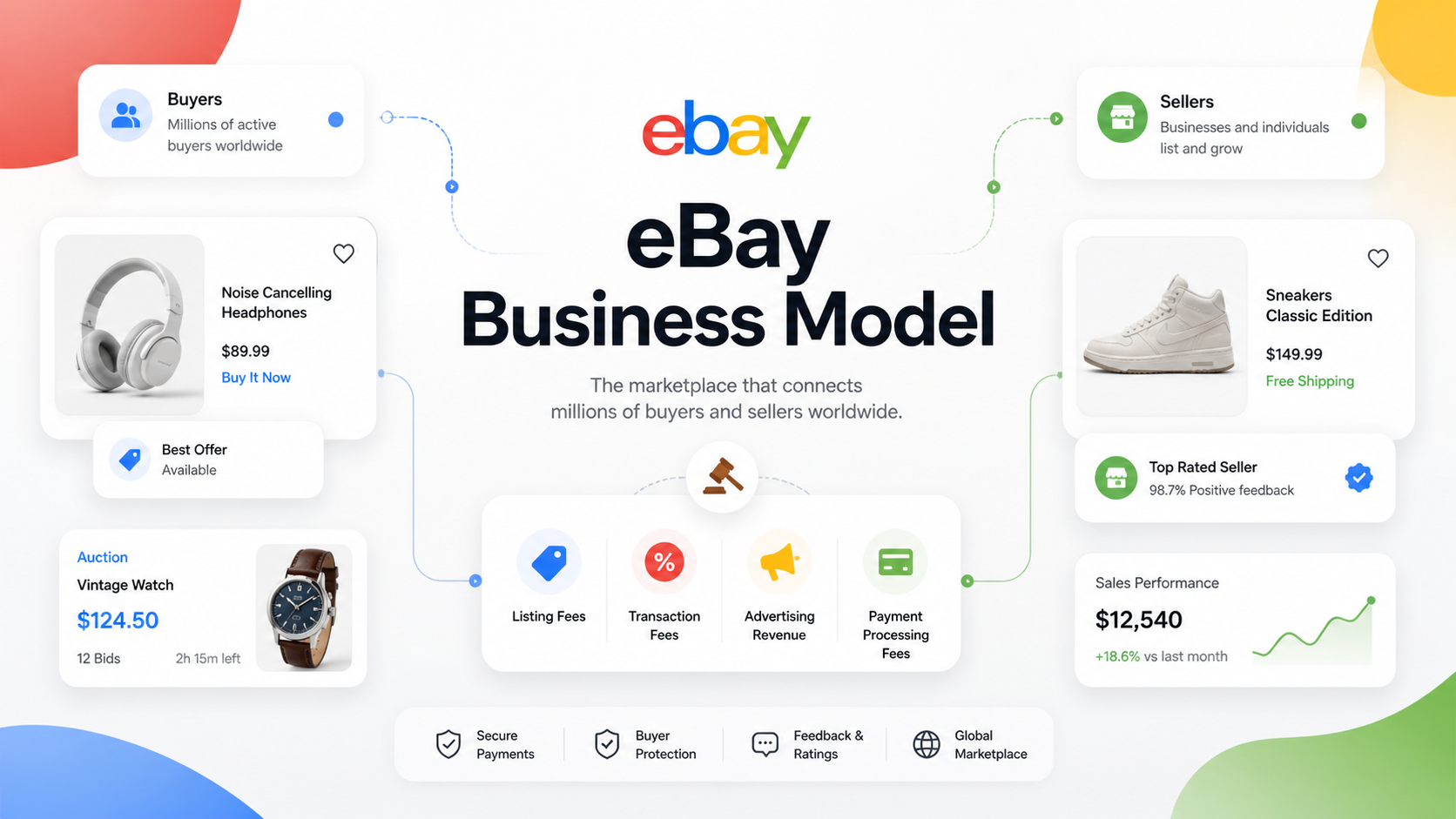

eBay operates as a two-sided online marketplace connecting buyers and sellers worldwide. Unlike retailers, eBay holds zero inventory. Instead, it earns revenue through transaction fees, listing fees, advertising products, and seller subscriptions. Its asset-light model makes it one of the most capital-efficient businesses in e-commerce history.
What is eBay
eBay was founded in 1995 by Pierre Omidyar in San Jose, California. The platform launched with a simple idea: let anyone buy and sell anything online. The first item ever sold on eBay was a broken laser pointer for $14.83. Omidyar was reportedly shocked someone actually bought it.
That moment captured exactly what eBay does best: it creates a market where one person’s junk is another person’s treasure.
The core problem eBay solves is a liquidity problem. Before eBay, if you wanted to sell a vintage baseball card or a used camera, your options were garage sales, classified ads, or pawn shops. eBay gave individual sellers access to a global buyer pool overnight.
Key categories on eBay include:
- Consumer electronics
- Collectibles and trading cards
- Fashion and apparel
- Auto parts and accessories
- Home and garden
- Industrial and business equipment
Two pricing models define eBay’s marketplace:
The auction model lets buyers bid on items over a set time period. The highest bidder wins. This is eBay’s original format and still its most distinctive feature.
The fixed price model (called “Buy It Now”) lets sellers set a firm price. Buyers purchase immediately without bidding. This now accounts for the majority of eBay’s transactions.
How eBay Works
Understanding eBay’s mechanics helps explain why its business model is so durable.
The Buyer Side
A buyer visits eBay and searches for a product. They filter by condition (new, used, refurbished), price range, location, and seller rating. They can choose to bid on an auction or buy at a fixed price. Once they purchase, they pay through eBay’s managed payments system. After receiving the item, buyers leave feedback.
The Seller Side
A seller creates a listing with photos, a description, and a price. They choose auction or fixed-price format. They set shipping options. When the item sells, eBay deducts its fees and deposits the remainder into the seller’s account. The seller ships the item.
The Platform Role
eBay’s job is to sit in the middle and make both sides trust each other. It does this through:
- Feedback and rating systems that signal seller reliability
- eBay Money Back Guarantee that protects buyers
- Managed payments that reduce fraud risk
- Search algorithms that match buyers with relevant listings
The platform doesn’t touch the product. It just facilitates the transaction and takes a cut.
Core Business Model of eBay
The Marketplace Model
eBay is a pure marketplace. It owns no inventory, runs no warehouses, and employs no delivery drivers. Every product on eBay belongs to a third-party seller.
This is called an asset-light model. eBay’s margins are structurally higher than a retailer like Walmart because it has no cost of goods sold. It generates revenue the moment a transaction happens, without needing to invest in physical infrastructure.
The model scales elegantly. Adding one million new sellers doesn’t require eBay to build new storage facilities. It just requires server capacity.
The Auction Model
The auction format is eBay’s clearest competitive differentiator. No other major e-commerce platform offers it at scale.
Auctions create price discovery. Neither the buyer nor the seller knows the true market price for a rare item. The auction format reveals it in real time. For collectibles, vintage goods, and one-of-a-kind items, this is enormously valuable.
Auctions also create engagement loops. A buyer who bids on an item checks back repeatedly. They get outbid. They bid again. That time-on-site behavior is a feature, not a bug.
The Fixed Price Model
eBay added “Buy It Now” pricing in 2000, largely in response to Amazon’s growing dominance. Today, fixed-price listings represent over 88% of eBay’s gross merchandise volume (GMV).
Fixed-price listings appeal to sellers who want predictability and buyers who want convenience. The format competes directly with Amazon and Walmart Marketplace, though eBay’s inventory skews heavily toward used, refurbished, and rare items rather than new retail goods.
How eBay Makes Money
This is the engine. eBay has five primary revenue streams.
Transaction Fees
When a seller completes a sale on eBay, eBay takes a percentage of the final transaction value. This is called the Final Value Fee (FVF).
The fee varies by category:
- Most categories: around 13.25% of the total sale amount
- Motors (vehicles): lower flat rates
- Select categories like books and music: around 14.95%
The FVF applies to the item price plus shipping charges. This is a critical detail many sellers overlook. eBay earns a cut of the entire transaction, not just the product price.
For high-volume sellers, this fee structure generates significant revenue for eBay at essentially zero marginal cost per transaction.
Listing Fees
Every eBay seller gets a set number of free listings per month. Standard non-store accounts get 250 free listings monthly. After that, sellers pay an insertion fee per listing, typically $0.35 per listing in most categories.
For sellers with large catalogs, these fees add up quickly. That’s by design. It incentivizes serious sellers to upgrade to an eBay Store subscription (covered below) to reduce per-listing costs.
Advertising and Promoted Listings
This is eBay’s fastest-growing revenue stream and the most misunderstood.
Promoted Listings is eBay’s advertising product. Sellers pay to have their listings appear higher in search results and in more prominent placements across the platform.
There are two ad formats:
Promoted Listings Standard works on a cost-per-sale model. The seller sets an ad rate (a percentage of the sale price). They only pay the ad fee when a buyer clicks the promoted listing and purchases within 30 days. No sale, no fee.
Promoted Listings Advanced works on a cost-per-click model. Sellers bid for top placement in search results and pay each time a buyer clicks. This mirrors Google’s search ad model.
Advertising revenue has grown substantially for eBay in recent years. It’s high-margin, scales with seller count, and doesn’t require eBay to hold any risk. In 2023, eBay’s advertising revenue surpassed $1.4 billion.
eBay Store Subscriptions
Sellers who want to scale on eBay can subscribe to an eBay Store. Plans range from Starter to Enterprise level, with monthly fees from roughly $7.95 to $2,999.95 per month.
Store subscribers get:
- More free listings per month
- Reduced final value fees
- Access to seller analytics and tools
- A branded storefront on eBay
- Promotional tools and email marketing features
For serious sellers, a store subscription pays for itself quickly through lower fees. For eBay, it creates recurring subscription revenue that is predictable and sticky. Sellers who invest in building an eBay Store are unlikely to abandon the platform.
Payment Processing Through Managed Payments
eBay historically relied on PayPal to process payments. After PayPal’s separation from eBay in 2015, eBay built its own payments infrastructure called Managed Payments, fully launched by 2021.
Under Managed Payments, eBay processes all transactions directly. Sellers receive payouts to their bank accounts. Buyers pay through credit cards, debit cards, Apple Pay, Google Pay, and other methods.
eBay earns a payment processing fee on each transaction, typically around 0.30% plus a fixed fee. While smaller than the final value fee, this adds incremental revenue on every sale at massive scale.
Managed Payments also gives eBay better data, better fraud detection, and direct relationships with both buyers and sellers.
eBay Business Model Canvas
Here is a structured breakdown of how eBay’s business model maps across all nine blocks of the Business Model Canvas.
Customer Segments
eBay serves two primary segments: individual buyers looking for value (especially used, rare, and discounted goods) and sellers ranging from individual resellers to small businesses and large retailers.
Value Propositions
For buyers: access to a massive, global inventory of new, used, collectible, and hard-to-find products often at competitive prices. For sellers: a ready-made buyer audience, seller tools, and global reach without needing their own storefront.
Channels
eBay reaches customers through its website, mobile app, email marketing, search engine traffic, and social media. Promoted Listings drive discovery within the platform itself.
Customer Relationships
eBay maintains relationships through its feedback system, buyer protection guarantees, seller performance metrics, and customer support. Seller account managers exist for high-volume sellers.
Revenue Streams
Final value fees, listing fees, Promoted Listings advertising, eBay Store subscriptions, and payment processing fees.
Key Resources
eBay’s platform technology, brand reputation, global user base, payment infrastructure, and data assets.
Key Activities
Platform development and maintenance, trust and safety enforcement, payment processing, seller tools development, and marketing.
Key Partnerships
Shipping carriers (USPS, FedEx, UPS), authentication services for high-value categories (watches, sneakers, trading cards), and payment networks.
Cost Structure
Technology infrastructure, trust and safety operations, customer support, marketing and sales, and payment processing costs.
Why eBay’s Model Works
No Inventory Risk
Every dollar of inventory a retailer holds is a liability. Products can be damaged, stolen, go out of style, or sit unsold. eBay carries none of that risk. Its sellers absorb it entirely.
A Global Seller Base Does the Heavy Lifting
eBay has over 130 million active buyers and roughly 19 million active sellers globally. Those sellers collectively manage, photograph, list, store, and ship every product on the platform. eBay’s infrastructure serves them all without owning a single product.
Long-Tail Inventory Is eBay’s Superpower
Amazon is great for buying a best-selling book or a popular phone case. eBay is where you find a specific 1987 Topps baseball card, a replacement part for a 1994 Kenmore refrigerator, or a vintage Polaroid camera. This long-tail inventory is nearly impossible to replicate because it depends on millions of individual sellers who hold unique items.
No competitor can warehouse the world’s collectibles. But eBay doesn’t need to.
Network Effects Are Self-Reinforcing
More buyers attract more sellers. More sellers attract more buyers. This is a classic two-sided network effect. Once a marketplace reaches critical mass, it becomes very hard for competitors to displace because neither side wants to go to a platform with fewer participants.
eBay has been running this flywheel since 1995.
eBay vs Amazon
These two companies are often compared, but their business models are fundamentally different.
| Factor | eBay | Amazon |
|---|---|---|
| Inventory | None | Holds significant inventory |
| Business Model | Pure marketplace | Hybrid (retail + marketplace) |
| Pricing Format | Auction and fixed price | Fixed price only |
| Seller Control | High | Limited by Amazon’s rules |
| Product Condition | New, used, and rare | Predominantly new |
| Competitive Advantage | Unique and rare items | Speed, Prime, and logistics |
| Revenue Model | Fees and ads | Retail margins + AWS + ads |
Amazon competes on speed, Prime benefits, and logistics. eBay competes on selection depth, especially in used and collectible categories. They target overlapping but distinct buyer behaviors.
A buyer who wants a new iPhone case shipped tomorrow goes to Amazon. A buyer who wants a specific vintage 1970s camera goes to eBay.
Challenges in eBay’s Business Model
Amazon and Shopify Apply Constant Pressure
Amazon continues to pull buyers away from eBay for new product purchases. Shopify enables sellers to build their own branded storefronts, reducing reliance on third-party marketplaces. eBay must fight on two fronts simultaneously.
Trust and Fake Listings Remain Persistent Problems
Counterfeit goods, misleading listings, and fraudulent sellers erode buyer trust. eBay invests heavily in authentication programs for high-value categories, but policing millions of daily listings is an ongoing operational challenge.
The Auction Format Is Declining
Auctions once defined eBay. Today, most buyers prefer the instant gratification of fixed-price purchasing. The auction format is becoming a niche tool for specific categories rather than the default shopping experience. eBay has adapted, but it has lost some of its original identity in the process.
Seller Churn in Competitive Categories
Sellers in high-volume categories like electronics and fashion have more platform options than ever. Between Amazon, Shopify, Facebook Marketplace, Poshmark, and others, eBay must work harder to retain sellers with valuable inventory.
eBay’s Growth Strategy
Doubling Down on Focused Categories
eBay has shifted its strategy toward what it calls “focus categories”: trading cards, sneakers, luxury watches, and auto parts. These are areas where eBay has dominant market share, buyers are highly engaged, and items are often unique. This strategy leans into eBay’s long-tail advantage rather than competing with Amazon on commodity goods.
Authentication and Trust Programs
eBay has launched authentication programs for sneakers, watches, handbags, and trading cards. Sellers ship high-value items to eBay’s authentication centers. eBay verifies authenticity and ships to buyers. This dramatically increases buyer confidence and supports higher average sale prices in premium categories.
AI-Powered Listing and Discovery Tools
eBay has integrated AI tools that help sellers create listings faster. Photo-based listing creation lets a seller photograph an item and have the listing title, description, and category pre-populated automatically. On the buyer side, AI improves search relevance and personalized recommendations.
Cross-Border Trade Expansion
eBay operates in dozens of countries and actively promotes cross-border selling. A seller in Ohio can reach a buyer in Germany without any additional effort. This global reach is a genuine advantage over most domestic-first platforms.
Key Takeaways
- eBay is a pure marketplace. It owns no inventory and has no warehouses.
- It makes money through five streams: transaction fees, listing fees, advertising, store subscriptions, and payment processing.
- The auction model is unique in e-commerce and creates price discovery advantages for rare items.
- eBay’s long-tail inventory of used, rare, and collectible goods is its most defensible competitive position.
- Network effects make the platform self-reinforcing once scale is achieved.
- eBay competes differently than Amazon. They are not the same kind of business.
- Authentication programs and focused categories are its current growth levers.
Wrapping Up
eBay is one of the most instructive business models in internet history. Not because it dominated everything, but because it found a specific angle and built something durable around it.
The core insight is this: you do not need to own what you sell to build a scalable business. eBay proved that in 1995 and continues to prove it today. Every marketplace startup owes something to that idea.
For founders, eBay’s playbook offers three lessons worth internalizing.
First, liquidity beats selection. eBay didn’t start with millions of products. It started by creating a liquid market for whatever people had lying around. Liquidity (the ability to actually buy and sell) is more valuable than the size of the catalog.
Second, trust is infrastructure. eBay’s feedback system, buyer protection, and authentication programs are not features. They are the foundation on which every transaction rests. A marketplace without trust mechanisms is just a classified ad board.
Third, find your unfair advantage and specialize. eBay tried to compete with Amazon across all of e-commerce and struggled. When it refocused on collectibles, rare goods, and unique items, its metrics improved. Specificity creates defensibility.
The lesson from eBay is not that marketplaces always win. The lesson is that the right marketplace model, applied to the right problem, with the right trust architecture, can outlast almost anything.
FAQs
Yes. eBay is consistently profitable. The company generates billions in annual revenue and maintains strong free cash flow due to its asset-light model. It does not carry inventory costs, which gives it structurally higher margins than traditional retailers.
eBay earns fees on every transaction that happens on its platform. When a seller lists and sells a product, eBay takes a percentage of the sale. It also charges for premium listing placements through advertising, and offers subscription plans for high-volume sellers. None of these revenue streams require eBay to own a single product.
Transaction fees (Final Value Fees) remain eBay’s largest revenue source. However, advertising through Promoted Listings has grown rapidly and now represents a significant and expanding portion of total revenue.
Yes, though its role has evolved. eBay is not the dominant force in new product e-commerce that it once appeared headed toward. But in specific categories like collectibles, auto parts, refurbished electronics, and luxury goods, eBay maintains a very strong market position. Its focus category strategy suggests it is intentionally choosing depth over breadth.
Three things separate eBay from other platforms: the auction format (which no major competitor offers at scale), the depth of used and collectible inventory (which is nearly impossible to replicate), and the global reach that allows cross-border buying and selling at scale. These three factors together create a product experience no other marketplace fully replicates.
Discover more from Business Model Hub
Subscribe to get the latest posts sent to your email.