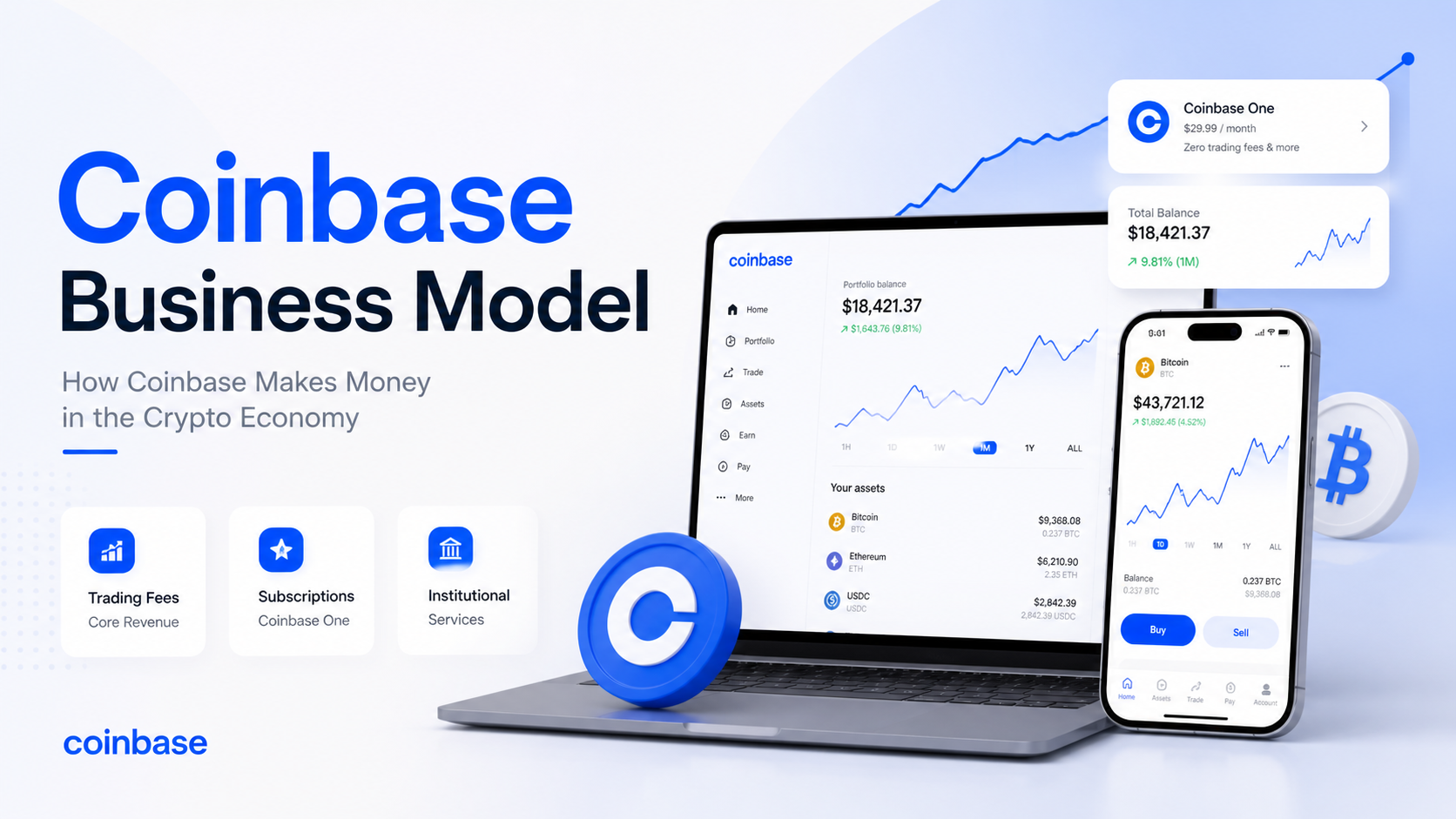

Coinbase makes money primarily through transaction fees, subscription services, and institutional trading tools. It acts as a bridge between traditional finance and crypto, earning revenue every time users buy, sell, or store digital assets. The more active the crypto market, the more Coinbase earns. Simple as that.
What Is Coinbase
Coinbase is a US-based cryptocurrency exchange founded in 2012 by Brian Armstrong and Fred Ehrsam. Its stated mission: make cryptocurrency accessible to everyone.
Think of it as a combination of three things most people already understand:
- A stock broker (like Fidelity, but for crypto)
- A digital wallet provider
- A financial services platform
The simplest analogy: Coinbase is a bank, stock exchange, and payment gateway rolled into one, but built entirely for crypto.
It sits between regular people and a confusing, volatile, technically complex market. That positioning is exactly what makes its business model work.
The Core Idea Behind How Coinbase Works
Before breaking down the revenue streams, it helps to understand the logic that makes Coinbase profitable in the first place.
The Trust Layer in a Complex Market
Crypto is overwhelming for most people. Wallets, seed phrases, gas fees, private keys, blockchain confirmations. The average person does not want to deal with any of it.
Coinbase strips all of that away. The interface is clean. The onboarding is beginner-friendly. Support exists. Funds are insured (up to a limit). It feels like a real financial product, not a sketchy tech experiment.
That feeling of safety is what people are actually paying for when they use Coinbase instead of a competitor.
The Fiat-to-Crypto Bridge
The most important function Coinbase serves is converting regular money (USD, EUR, and others) into crypto assets like Bitcoin and Ethereum. This is called on-ramping.
Most people cannot buy Bitcoin directly without going through a service like Coinbase. That dependency is the foundation of the entire business model. Every time someone converts dollars into crypto, Coinbase takes a cut.
This entry-point control is where the majority of revenue is generated.
Regulatory Positioning
Coinbase has leaned into compliance harder than almost any competitor. It holds money transmitter licenses across the US, has worked directly with the SEC and CFTC, and went public on NASDAQ in 2021.
That regulatory credibility is not just PR. It opens doors with institutional clients, reduces legal risk over time, and creates a trust premium that allows Coinbase to charge more than competitors without losing users.
The Coinbase Business Model Breakdown
Coinbase operates across three overlapping models simultaneously.
The Platform Model
At its core, Coinbase is a marketplace. Buyers and sellers come together on the platform, trades are matched, and Coinbase earns a percentage on every transaction. This is the most straightforward part of the model and the biggest revenue driver.
The platform earns from both sides of the market. Retail users pay a spread plus a flat or percentage-based fee. More advanced users on Coinbase Advanced Trade (formerly Coinbase Pro) pay maker-taker fees that are lower but still meaningful at scale.
The Custody Model
Coinbase stores crypto assets on behalf of users. For retail users, this is free and built into the product experience. For institutions, custody is a paid service.
Coinbase Custody Trust Company is a New York-regulated entity that holds digital assets for hedge funds, family offices, and corporations. These clients pay annual fees based on assets under custody. This is a recurring, sticky revenue stream that does not depend on trading activity.
The Financial Services Layer
Beyond trading and storage, Coinbase has built a growing stack of financial products:
- Staking services (earning yield on proof-of-stake assets)
- USDC interest income
- Crypto-backed lending (in select markets)
- Rewards programs
Each of these creates revenue without requiring a user to make a trade. That diversification matters a lot in bear markets when transaction volumes collapse.
How Coinbase Makes Money: The Revenue Streams Explained
Transaction Fees
This is the main engine. When retail users buy or sell crypto on Coinbase, they pay a fee that typically ranges from 0.5% to over 2.5% depending on the transaction size, payment method, and market conditions.
Here is how the fee structure actually works:
Spread: Coinbase quotes a slightly worse price than the actual market rate. The difference goes to Coinbase. This is hidden from most users.
Flat or percentage fee: On top of the spread, Coinbase charges an additional service fee. For small transactions, this can be a flat amount like $0.99 or $1.49. For larger transactions, it becomes a percentage.
Most retail users pay both the spread and the fee without realizing they are being charged twice.
This is intentional. The UX is designed around convenience, not fee transparency. And it works. Retail users, particularly beginners, prioritize ease over cost. That behavior is extremely profitable for Coinbase.
In Coinbase’s best quarters (during bull markets in 2020-2021), transaction revenue hit the billions. In bear markets, it drops sharply. This is the single biggest vulnerability in the business model.
Subscription and Services Revenue
Coinbase has been deliberately building subscription revenue to reduce its dependence on transaction fees.
Coinbase One is the flagship subscription product. For a monthly fee (around $29.99 in the US), subscribers get:
- Zero transaction fees on up to $10,000 in monthly trades
- Priority customer support
- Account protection coverage up to $1 million
- Advanced staking rewards
This is a direct attack on the fee volatility problem. Subscription revenue is predictable. It does not disappear when crypto markets slow down.
Beyond Coinbase One, the company earns subscription-style revenue from developers who use Coinbase Cloud infrastructure, from APIs, and from node services.
Institutional Revenue
Coinbase Prime is the institutional-facing product. It serves hedge funds, asset managers, corporations, and high-net-worth individuals who need:
- OTC (over-the-counter) trading with lower market impact
- Prime brokerage services (lending, margin, financing)
- Custody solutions
- Reporting and compliance tools
Institutional clients trade in much larger volumes than retail users, but they pay lower percentage fees. The revenue per trade is smaller, but the total volume more than compensates.
Custody fees from institutional clients are particularly valuable because they are not correlated with trading activity. A hedge fund that holds $500 million in crypto with Coinbase Custody pays a fee whether markets are up, down, or flat.
Staking Revenue
Proof-of-stake blockchains like Ethereum, Solana, and Cardano allow token holders to earn rewards by participating in network validation. Coinbase does this on behalf of users and keeps a commission on the rewards earned.
The commission typically ranges from 25% to 35% of staking rewards.
This is a growing revenue stream. As more assets move to proof-of-stake consensus and as more users hold crypto long-term instead of trading, staking revenue becomes a more significant portion of total income.
It is worth noting that staking revenue has also drawn regulatory attention. The SEC reached a settlement with Coinbase in 2023 related to its staking-as-a-service program, which is an ongoing consideration for this part of the business.
Interest Income and Other Revenue
Coinbase is one of the largest holders and distributors of USDC, a US dollar-backed stablecoin issued by Circle. Coinbase earns interest on USDC held on its platform.
When interest rates are high (as they were in 2022-2024), this becomes a meaningful revenue line. When rates are near zero, it shrinks.
Additional revenue comes from:
- Blockchain rewards for participating in network operations
- Partnerships with projects launching on Coinbase
- Venture investments through Coinbase Ventures
- Data and analytics products
The Coinbase Business Model Canvas
Understanding Coinbase through a business model canvas framework makes the interconnections clearer.
Key Partners
Coinbase does not operate in isolation. Its partners include blockchain networks (which provide the underlying infrastructure), regulated financial institutions (for banking relationships and fiat handling), payment processors, and regulators. These relationships are not optional. Without banking partners, Coinbase cannot accept fiat deposits. Without regulatory relationships, it cannot operate legally.
Key Activities
The company’s core activities are platform development and maintenance, security operations, compliance and legal work, and customer support at scale. The compliance function is particularly resource-intensive. Coinbase employs more lawyers and compliance officers than most crypto companies combined.
Value Proposition
For retail users: easy, safe, beginner-friendly crypto access. For institutions: compliant, regulated custody and trading infrastructure. For developers: tools to build on blockchain technology.
The value proposition differs significantly by customer segment, which is why Coinbase operates essentially three different product lines under one brand.
Customer Segments
Retail investors are the largest segment by user count. Institutional clients are the largest by revenue per client. Developers are the smallest but strategically important for long-term platform growth.
Revenue Streams
Transaction fees (largest), subscriptions, institutional services, staking commissions, interest income, and other services.
Cost Structure
The major costs are technology infrastructure, regulatory and compliance expenses, customer support, and sales and marketing. Coinbase’s cost structure is relatively lean for a financial services company because it does not hold significant inventory or physical assets. Its primary cost is people and technology.
Why Coinbase Is So Profitable in Bull Markets
High Margins on Retail Users
Retail transaction fees are Coinbase’s highest-margin business. The cost of executing a trade is minimal once infrastructure is built. The spread and fee revenue flows almost entirely to gross profit.
Beginners do not comparison shop for crypto fees the way they might compare stock brokerage commissions. They pick the platform that feels trustworthy and easy. Coinbase has spent a decade building exactly that perception.
Bull Market Revenue Amplification
When crypto prices rise, three things happen simultaneously that benefit Coinbase:
Trading volume increases dramatically as new investors enter the market and existing investors trade more frequently.
The dollar value of each transaction increases, which increases the dollar value of percentage-based fees even if the percentage stays the same.
New user acquisition surges as media attention brings in first-time buyers who gravitate toward the most recognizable brand.
In Q1 2021, Coinbase reported $1.8 billion in revenue and $800 million in net income. That quarter illustrates how powerful the bull market amplification effect can be.
Brand Trust Premium
People pay more to use Coinbase than to use competitors with lower fees. Binance charges significantly less. Several decentralized exchanges charge nothing beyond gas fees. Yet millions of US users choose Coinbase.
The reason is brand trust. When someone is putting real money into a volatile, unfamiliar asset class, they want to use a platform they have heard of, that looks legitimate, and that has some accountability structure. Coinbase charges for that trust.
The Challenges in the Coinbase Business Model
Revenue Volatility
The dependence on transaction fees creates massive revenue swings tied to crypto market cycles. In 2021, Coinbase earned $7.8 billion in revenue. In 2022, as crypto markets collapsed, revenue fell dramatically. This boom-bust pattern makes the company difficult to value and hard to plan around.
Coinbase’s subscription and services strategy is a direct response to this problem, but transaction fees still dominate total revenue.
Competition
Binance offers lower fees and a wider range of assets. Coinbase has been losing market share to Binance globally for years, particularly among more experienced traders.
Decentralized exchanges like Uniswap and dYdX remove the middleman entirely. Users who understand how to connect a wallet and interact with smart contracts can trade without paying Coinbase’s fees. As crypto literacy grows, this segment of users will expand.
Robinhood, PayPal, and traditional brokerages have also entered crypto trading, applying further pressure on the retail side.
Regulatory Risk
Coinbase has been more proactive about regulation than most crypto companies, but that does not protect it entirely. The SEC sued Coinbase in 2023 alleging it was operating as an unregistered securities exchange. The outcome of that case and similar regulatory actions globally could significantly impact the business model.
Different countries have different rules around what crypto services are legal. Coinbase has had to exit or limit operations in certain markets due to regulatory uncertainty.
Coinbase vs Competitors
| Platform | Core Strength | Core Weakness |
|---|---|---|
| Coinbase | Trust, brand, regulatory compliance, UX | High fees, US-centric |
| Binance | Low fees, wide asset selection, global reach | Regulatory problems, less US trust |
| Kraken | Security reputation, advanced tools | Smaller user base, less beginner-friendly |
| DEXs (Uniswap, etc.) | No middleman, censorship resistant | Steep learning curve, gas fees |
| Robinhood | Existing user base, stock/crypto combo | Limited crypto selection, no withdrawals to wallets |
Coinbase wins on trust and simplicity. It loses on cost. That tradeoff is sustainable as long as there is a large segment of users who prioritize safety over savings, which historically has always been the case in financial services.
The Real Insight: What Coinbase Actually Sells
Most people think Coinbase is a crypto company. That framing misses the point.
Coinbase is a financial infrastructure company that happens to operate in crypto.
The actual product is access. Coinbase controls the on-ramp between dollars and digital assets. It controls the custody layer where most retail crypto sits. It controls the institutional infrastructure that large investors depend on for compliance and security.
Bitcoin exists without Coinbase. Ethereum exists without Coinbase. But for the majority of US retail investors and a significant portion of institutional investors, accessing those assets in a safe, compliant, straightforward way requires going through Coinbase.
That access control is the business. The fees are just the price of access.
This is the same model that stock exchanges, clearinghouses, and custodian banks have operated on for decades. Coinbase is building the equivalent infrastructure layer for crypto finance. The long-term bet is that crypto becomes as mainstream as equities, and whoever owns the infrastructure layer captures enormous, recurring, compounding value.
Whether that bet pays off depends on whether crypto achieves that mainstream adoption and whether Coinbase maintains its infrastructure position against decentralized alternatives. Both are open questions.
Key Takeaways
What drives Coinbase’s revenue: Transaction fees on retail and institutional trades are the primary revenue driver, accounting for the majority of income in most quarters.
What makes the model defensible: Brand trust and regulatory compliance create a moat that is difficult for low-cost competitors to breach, especially with retail users and institutions that have strict compliance requirements.
What makes the model risky: Revenue is highly correlated with crypto market cycles. Bear markets cause dramatic revenue drops, creating pressure on the company’s cost structure and stock price.
Where the model is evolving: Coinbase is actively building subscription revenue (Coinbase One), developer infrastructure (Coinbase Cloud), and institutional services to reduce transaction fee dependence. These efforts are working but transaction fees still dominate.
The long-term thesis: Coinbase is positioning itself as the regulated financial infrastructure layer for crypto. If crypto becomes mainstream financial infrastructure, Coinbase’s position could be extraordinarily valuable. If it does not, the business remains a fee-dependent exchange with volatile revenue.
Conclusion
Coinbase does not mine Bitcoin. It does not create Ethereum. It does not build blockchains.
What it does is control access to all of them in a way that feels safe, simple, and legitimate to regular people and regulated institutions.
That access premium is the business model. Every fee, subscription, and service line is just a different way of charging for that access.
The lesson for anyone studying business models: you do not need to build the asset. You need to build the infrastructure that connects the asset to the people who want it. That is where platforms capture the most durable, compounding value.
Coinbase built that infrastructure for crypto. The question going forward is not whether the model works. It clearly does. The question is whether Coinbase can hold that infrastructure position as the market matures, competition intensifies, and decentralized alternatives become more accessible.
That is the real story of Coinbase’s business model. And it is still being written.
Discover more from Business Model Hub
Subscribe to get the latest posts sent to your email.