Zoox Business Model And How Amazon Is Building a Driverless Taxi Empire

Zoox is a self-driving vehicle company headquartered in Foster City, California. Amazon acquired it in 2020 for a reported $1.2 billion, and since then, it has been quietly building what could become one of the most disruptive transportation companies in American history.
But here’s the thing most people miss: Zoox is not just another self-driving car startup. It is not trying to retrofit a Tesla or slap sensors onto a Toyota. Zoox builds its vehicles from the ground up, specifically designed to operate without a human driver, without a steering wheel, and without any of the legacy car architecture that most autonomous vehicle companies are forced to work around.
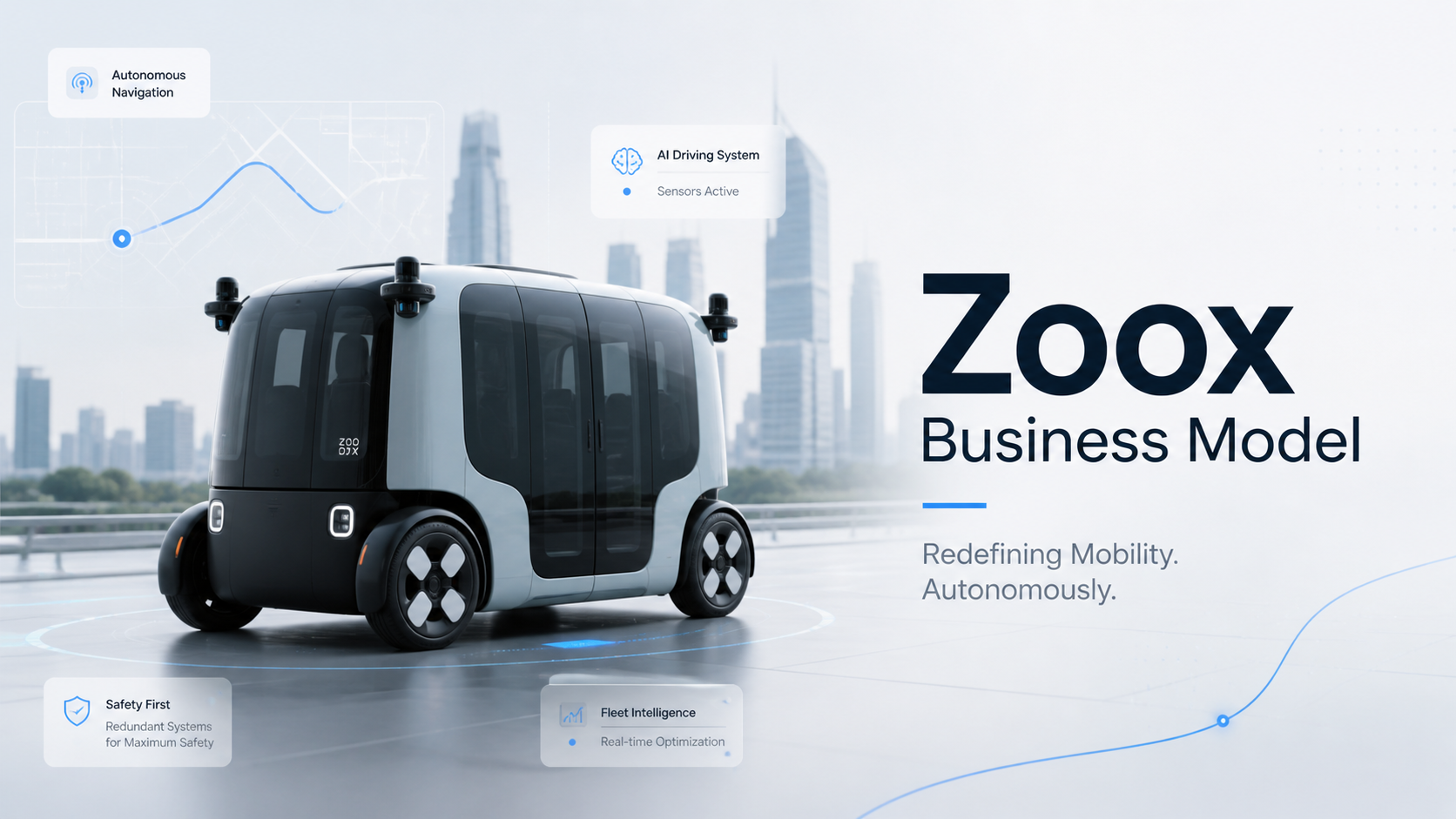
The vehicle itself is bidirectional, meaning it can travel in either direction without turning around. The cabin is designed for passengers, not drivers. There are no pedals. No dashboard. Just four seats facing each other and a ride that handles itself.
That is the foundation of everything Zoox is building.
The Core Business Model: Transportation as a Service
Zoox does not sell cars. It sells rides.
This distinction is critical and it changes everything about how you evaluate the business.
The model is called Transportation as a Service, or TaaS. Instead of manufacturing vehicles and selling them to consumers or fleet operators, Zoox builds, owns, and operates its own autonomous fleet. Passengers book rides through an app, get picked up, get dropped off, and pay a fare. That is the revenue engine.
This is a fundamentally different structure than anything that currently exists in the ride-hailing industry.
Uber and Lyft own no vehicles. They depend entirely on independent contractors who bring their own cars, their own insurance, and their own fuel costs. The platform collects a cut of each fare, but the actual delivery of the service is outsourced to millions of individual drivers.
Zoox flips that model completely. It owns the hardware, the software, the fleet, and the service layer all at once. That means it controls everything and is responsible for everything.
Why Full Stack Ownership Matters
When a company owns the entire stack, it captures value at every layer.
In Zoox’s case, that means it captures revenue from the ride itself, collects all the data generated during that ride, controls the cost structure of the vehicle, and can optimize the entire system without being dependent on the behavior of third-party drivers.
The tradeoff is that this requires massive capital investment upfront. You have to build the vehicles. You have to develop and maintain the autonomous driving software. You have to manage a fleet. You have to handle regulatory approvals city by city.
But if you can get it to scale, the margins are structurally superior to any driver-dependent model. No driver costs means the largest variable expense in traditional ride-hailing simply disappears.
That is the long-term bet Zoox is making.
How Zoox Makes Money
Let’s break down the actual revenue model in practical terms.
Ride Fares
The primary revenue stream is straightforward: passengers pay per ride. Zoox operates like a robotaxi service. You open an app, request a pickup, the vehicle arrives, and you pay at the end of the trip.
Dynamic pricing is the likely long-term direction. During peak hours, fares go up. During off-peak periods, pricing becomes more competitive to maintain utilization. This is the same basic logic Uber uses, but without the driver-income considerations that constrain Uber’s pricing decisions.
Subscription Mobility
This is a future revenue stream that makes a lot of sense given the target customer base.
Urban commuters who ride daily or multiple times a week represent a high-value segment. A monthly subscription plan, similar to a transit pass but with the convenience of a private vehicle, could drive predictable recurring revenue and build customer loyalty.
Zoox has not publicly launched a subscription product yet, but the business model practically demands it. Subscription revenue is more predictable, more stable, and generally commands higher lifetime value per customer than pure pay-per-ride models.
Fleet Optimization Revenue
Because Zoox controls its fleet completely, it can optimize vehicle deployment in ways that driver-dependent platforms cannot.
Vehicles can be rerouted in real time based on demand data. Maintenance can be scheduled proactively to minimize downtime. Fleet size in specific areas can be adjusted based on historical and predictive demand patterns.
This operational efficiency is not a separate revenue stream, but it directly improves margins on every ride. Fewer idle vehicles, lower downtime, better utilization rates all compound into significantly better unit economics over time.
Data Monetization
This is the long-term play that most analysts undervalue.
Every mile Zoox’s fleet drives generates sensor data, mapping data, traffic data, and behavioral data. At scale, this becomes one of the most valuable mobility datasets in existence.
Potential applications include selling anonymized traffic and urban mobility insights to city governments and urban planners, licensing mapping and sensor data to logistics companies, and using the data internally to improve the autonomous driving system itself, which reduces costs and improves safety over time.
Data monetization is not Zoox’s core business today, but it is a meaningful future revenue layer that does not require significant additional investment to unlock.
Zoox vs. Uber: The Real Difference
Most people compare Zoox to Uber because both are ride-hailing platforms. The comparison is valid at the surface level but misleading at the strategic level.
The Driver Question
Uber’s entire model depends on drivers. Without drivers, Uber has no service to offer. This dependency creates several structural constraints.
Uber has to keep drivers happy enough to stay on the platform. It has to price fares high enough that drivers earn acceptable income. It has to manage driver supply and demand in every market. It has to deal with regulatory pressure around worker classification and labor rights.
Zoox eliminates all of that. There are no drivers to recruit, retain, or manage. There are no labor disputes. There are no driver shortages during high-demand periods. The fleet is available whenever the software and hardware are operational.
The Cost Structure Question
Uber is asset-light. It owns no vehicles and carries minimal fixed costs. This makes it easy to scale geographically because expansion just means activating more drivers in a new market.
Zoox is asset-heavy. Expansion requires deploying vehicles, which requires capital. But that capital expense translates into long-term margin advantage because the ongoing operating cost per ride is significantly lower once the fleet is in place.
The simplest way to think about it: Uber pays out 70 to 80 percent of gross revenue to drivers and related expenses. Zoox’s equivalent cost is vehicle depreciation, maintenance, software, and operations, which at scale should be substantially lower as a percentage of revenue.
The Control Question
Uber cannot control the quality or consistency of its service very well because humans deliver it. A bad driver creates a bad ride. Supply fluctuates based on how many drivers choose to log on. Surge pricing is as much a supply management tool as a demand tool.
Zoox controls all of it. The vehicle always shows up on time because it is dispatched by software. The in-cabin experience is consistent because the cabin itself is purpose-built. Pricing can be managed without the complexity of driver income considerations.
Control is not just a philosophical advantage. It is a practical competitive moat.
The Amazon Angle: Why This Acquisition Changes Everything
Understanding Zoox purely as a ride-hailing company is too narrow. To understand the full strategic picture, you have to understand why Amazon bought it.
Amazon is the largest e-commerce company in the world. It processes hundreds of millions of packages annually. Its last-mile delivery costs are enormous and growing. Every year, the “last mile” problem, getting a package from a regional warehouse to a customer’s front door, becomes more expensive and more complex as delivery volumes increase.
Autonomous vehicles are the obvious long-term solution to that problem.
Last-Mile Logistics Automation
Zoox’s technology platform is designed for autonomous urban mobility. The same core technology that lets a vehicle navigate city streets to pick up a passenger can, with appropriate vehicle configuration, navigate city streets to deliver a package.
Amazon does not need Zoox to build a delivery van tomorrow. What Amazon needs is the autonomous driving capability, the regulatory relationships, the sensor technology, and the operational expertise that Zoox is developing right now.
Reducing Delivery Costs at Scale
Amazon’s logistics costs run into the tens of billions of dollars annually. Even a modest reduction in last-mile delivery costs through autonomy represents billions in savings.
If Zoox’s technology matures to the point where autonomous delivery vehicles can handle even a portion of Amazon’s last-mile volume, the return on the acquisition price is massive. The $1.2 billion acquisition cost looks very different when evaluated against the potential to reduce logistics expenses by even a few percent at Amazon’s scale.
Owning Transportation Infrastructure
The bigger, longer-term play is infrastructure.
Amazon Web Services became dominant not because Amazon needed cloud computing for its own operations, but because Amazon built cloud infrastructure and then offered it to everyone else. The same logic could apply to transportation.
If Zoox builds a successful autonomous mobility platform, Amazon could operate it as a service available to other businesses, to cities, to logistics companies, and to consumers. Transportation infrastructure becomes a platform business, similar to how AWS turned server capacity into a trillion-dollar business.
This is speculative, but it is the kind of strategic thinking that explains why Amazon paid what it did for a company that had not yet deployed a commercial product.
The Zoox Business Model Canvas
Customer Segments
Zoox’s primary customers in the near term are urban commuters, specifically people living in dense metropolitan areas who rely on ride-hailing regularly. The target user is tech-comfortable, lives in a city, does not own a car or prefers not to drive, and takes multiple rides per week.
Secondary segments include business travelers in urban markets, corporate accounts that need reliable transportation for employees, and eventually logistics and delivery clients if Zoox expands into that space.
Value Propositions
The core value proposition has several distinct components.
First, fully autonomous rides mean no driver-related variability. You do not get a driver who is having a bad day, does not know the route, or makes the ride uncomfortable. The experience is consistent every time.
Second, safety. Zoox’s autonomous system does not get tired, does not get distracted, and does not make the kinds of split-second errors that cause most traffic accidents. Statistically, human error is responsible for the vast majority of vehicle accidents. Eliminating the human driver should, over time, translate into a meaningfully safer product.
Third, the in-cabin experience. The Zoox vehicle is designed specifically for passengers. The bidirectional design, the face-to-face seating, the absence of a front dashboard all create a different kind of interior space. It is closer to a private lounge than a typical car.
Fourth, pricing consistency. Without driver-income requirements shaping the fare structure, Zoox has more flexibility to offer stable, predictable pricing that passengers can plan around.
Key Resources
Zoox’s competitive moat lives in a few critical assets.
The autonomous driving technology stack is the most important. Years of development, billions of miles of simulation data, and real-world driving experience represent a significant barrier to entry for competitors.
The custom vehicle itself is a resource. Because Zoox built the vehicle from scratch for autonomous operation, it does not carry the compromises that come with retrofitting existing vehicle platforms. That matters for performance, safety, and cost efficiency.
Sensor and mapping data accumulated through testing and deployment is another resource. Better maps mean better route planning, better decision-making, and better safety outcomes.
Finally, Amazon’s backing provides capital access, cloud computing infrastructure through AWS, and operational expertise in logistics and technology at scale. Most autonomous vehicle startups do not have that kind of institutional support.
Key Activities
Vehicle manufacturing is a core activity, which is unusual for a software-first tech company but essential for Zoox’s full-stack model.
Software development, specifically the continuous improvement of the autonomous driving system, is the other core activity. The AI models that power Zoox’s vehicles need constant refinement based on new data, new edge cases, and new environments.
Fleet management involves deployment, maintenance scheduling, real-time monitoring, and utilization optimization across every active market.
Regulatory compliance is an ongoing activity that requires dedicated resources in every city and state where Zoox operates. Autonomous vehicle regulation varies significantly by jurisdiction and is still evolving nationally.
Key Partnerships
City and state governments are the most critical partners. Zoox cannot deploy without regulatory approval, and building productive relationships with municipal governments is essential to expansion.
Hardware suppliers for sensors, batteries, and vehicle components are another key partnership category. Supply chain reliability matters significantly when you are manufacturing your own vehicles.
Amazon Web Services provides the cloud infrastructure that supports Zoox’s data processing, mapping, and operational systems. This is a natural partnership given the corporate relationship, but it also means Zoox benefits from one of the most robust cloud platforms in the world.
Cost Structure
Zoox’s cost structure is heavily weighted toward a few categories.
Research and development is the largest cost center by far. Building autonomous driving technology is one of the most expensive engineering challenges in the industry. Zoox has spent years and enormous resources reaching its current capability level, and R&D costs will remain high as the technology continues to evolve.
Vehicle production costs are significant and somewhat unique to Zoox compared to software-only autonomous vehicle companies. Manufacturing is capital intensive.
Fleet operations include insurance, maintenance, charging infrastructure, and the human operations staff needed to monitor and manage the fleet.
Regulatory and safety compliance costs, including testing, documentation, legal, and government affairs, are ongoing and cannot be minimized.
Where Zoox Is Right Now
As of recent reporting, Zoox has been conducting public testing of its autonomous vehicles in San Francisco and Las Vegas. The company has been taking select riders on supervised autonomous trips as part of its early commercial rollout.
This is not full commercial deployment yet. Zoox is still in the phase of building regulatory trust, refining the technology in real-world conditions, and demonstrating safety performance to the public and to city authorities.
The pace of autonomous vehicle commercialization across the industry has been slower than early optimists predicted. Waymo, which is generally considered the most advanced autonomous vehicle company in the US, has been operating commercial robotaxi service in a limited number of cities for several years and is still working on broader deployment.
Zoox is behind Waymo in terms of commercial deployment but is arguably ahead of most other competitors in terms of vehicle design and full-stack integration.
Challenges and Risks Worth Understanding
Honest evaluation of Zoox requires acknowledging the real obstacles.
Regulatory Approvals
This is the single biggest bottleneck in the industry. Autonomous vehicle regulation in the United States is a patchwork of state and local rules, and federal standards are still developing. Getting approval to operate commercially in any given city requires extensive testing, documentation, and relationship-building with local government.
Every new market Zoox enters requires navigating this process from the beginning. At scale, this becomes a significant operational constraint.
Capital Requirements
Building vehicles, developing AI systems, and managing a fleet all require sustained capital investment well before the business reaches profitability.
Amazon’s backing mitigates this risk significantly compared to standalone startups. But the capital requirement is still real and substantial. Zoox will need to demonstrate clear progress toward commercial viability to justify continued investment.
Technology Maturation
Autonomous driving technology has improved dramatically over the past decade, but it is still not perfect. Edge cases, unusual weather conditions, complex urban environments, and unpredictable human behavior continue to challenge autonomous systems.
Zoox needs its technology to be safe enough not just to operate, but to operate at a standard that maintains public trust. A high-profile safety incident would be damaging not just to Zoox but to the entire autonomous vehicle industry.
Deployment Complexity
Scaling from limited testing to full commercial operations in multiple cities is operationally complex. Infrastructure needs, staffing, maintenance capacity, and customer support all need to scale together. Doing this well while maintaining safety and quality is genuinely difficult.
The Long-Term Vision
Zoox is a 10 to 20 year play. That is not a criticism. It is a realistic assessment of the timeline required to build what Zoox is building.
The near-term goal is commercial deployment in initial US markets, likely starting with San Francisco and Las Vegas where testing is already underway.
The medium-term goal is expanding to additional major US cities, building fleet scale, and achieving the utilization rates needed to demonstrate viable unit economics.
The long-term vision, if it plays out, is a combination of urban ride-hailing at scale and integration with Amazon’s logistics infrastructure, creating a transportation platform that touches both personal mobility and commercial delivery.
The potential market is enormous. Ride-hailing in the US alone is a multi-billion dollar industry. Global autonomous mobility is projected by various analysts to become a market worth trillions of dollars over the next two decades. Last-mile logistics, if Zoox moves in that direction, adds another massive addressable market.
None of that is guaranteed. But the strategic logic is sound, the backing is strong, and the technology, while still maturing, is further along than most people outside the industry realize.
Key Takeaways for Anyone Following This Space
Zoox is not competing with Uber on Uber’s terms. It is building a structurally different business with different cost economics, different margin potential, and different long-term strategic value.
The Amazon acquisition is not just a financial investment. It is a strategic bet on autonomous technology as the future of both urban mobility and commercial logistics.
The full-stack model, owning vehicle manufacturing, autonomous software, and fleet operations together, creates a defensible competitive position that is very difficult for marketplace-model companies to replicate.
The timeline is long. The capital requirements are high. The regulatory environment is complex. But the potential outcome, a profitable, scalable autonomous transportation platform integrated with the largest e-commerce logistics operation in the world, is one of the most significant business opportunities being built in the US right now.
Zoox is not building a better taxi app. It is building the infrastructure layer for how cities might actually move people and goods in the coming decades. Whether it fully delivers on that vision remains to be seen, but the model it is pursuing is the right one to bet on if autonomous vehicles do what the technology suggests they eventually will.
FAQs
Zoox is an autonomous vehicle company owned by Amazon. It designs, manufactures, and operates fully self-driving electric vehicles built specifically for urban ride-hailing. Unlike traditional car companies, Zoox does not sell vehicles to consumers. It runs its own fleet and charges passengers per ride, similar to Uber but without any human drivers involved.
Amazon acquired Zoox in June 2020 for approximately $1.2 billion. Zoox operates as an independent subsidiary under Amazon, meaning it runs its own operations but benefits from Amazon’s capital, cloud infrastructure through AWS, and strategic resources.
The core difference is ownership and control. Uber and Lyft own no vehicles and rely entirely on independent drivers who supply their own cars. Zoox owns its vehicles, builds its own autonomous driving software, and operates its own fleet. There are no drivers on the Zoox platform at all. This gives Zoox full control over the ride experience, cost structure, and service quality in ways that Uber and Lyft simply cannot achieve.
Zoox’s primary revenue comes from ride fares. Passengers pay per trip through a mobile app. Future revenue streams include subscription mobility plans for frequent riders, data monetization from fleet-generated mapping and traffic insights, and potential integration with Amazon’s logistics and delivery operations.
Zoox has been conducting autonomous vehicle testing and limited public rides in San Francisco, California and Las Vegas, Nevada. These are the two primary markets where the company has received testing permits and has been building operational experience ahead of broader commercial rollout.
No. Waymo is a separate autonomous vehicle company owned by Alphabet, which is Google’s parent company. Waymo currently operates commercial robotaxi services in several US cities and is generally considered the most commercially advanced autonomous vehicle company in the US. Zoox and Waymo are competitors, but they use different vehicle designs and operate under different parent companies.
The Zoox vehicle is purpose-built for autonomous passenger transport. It is bidirectional, meaning it drives equally well in either direction without needing to turn around. It has no steering wheel, no pedals, and no traditional dashboard. The interior seats four passengers facing each other, more like a private lounge than a standard car. No other mass-market vehicle is designed quite like it.
No, not yet. Zoox is in the investment and development phase. Building autonomous vehicles, developing AI driving systems, manufacturing a custom fleet, and navigating regulatory approvals all require substantial capital before any meaningful revenue is generated. Zoox is a long-term bet, not a near-term profit story.
Discover more from Business Model Hub
Subscribe to get the latest posts sent to your email.