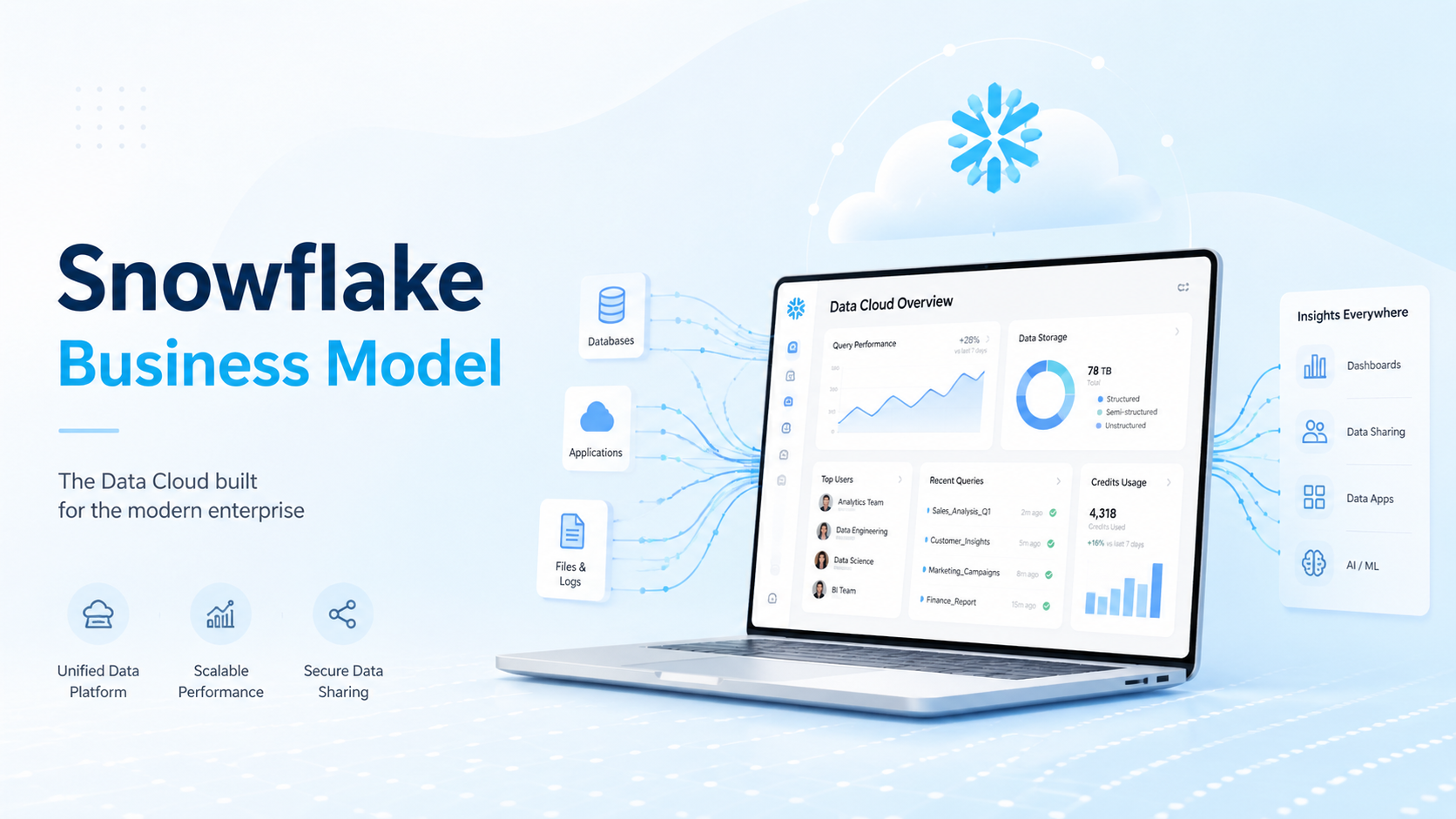

Snowflake Inc. is a cloud-based data platform that lets companies store, process, and share massive amounts of data without managing physical infrastructure. It makes money through a consumption-based model where customers pay for what they actually use, not flat subscription fees. Its customers range from Fortune 500 enterprises to fast-growing startups that need scalable, flexible data infrastructure.
What is Snowflake?
Snowflake is a cloud data platform founded in 2012 by Benoit Dageville, Thierry Cruanes, and Marcin Zukowski. It launched its first commercial product in 2014 and went public in September 2020 in one of the largest software IPOs in history.
The company built something it calls the “Data Cloud,” which is essentially a global network where organizations can store and analyze data, share it with partners, and build data-driven applications, all from a single platform running on the world’s biggest cloud providers.
In simple terms, think of it like electricity. You do not build a power plant to run your house. You plug in and pay for what you use. Snowflake does that for data.
Why it gained rapid adoption:
Snowflake hit the market at the exact moment companies were drowning in data but struggling with outdated tools. It offered speed, simplicity, and scalability without forcing IT teams to manage servers or configure complex infrastructure. That combination proved irresistible to data engineers, analysts, and CIOs across industries.
The Problem Snowflake Solves
Before Snowflake, enterprise data management was a mess. Most companies stored data in isolated systems that could not talk to each other. Fixing that required expensive middleware, complex ETL pipelines, and constant maintenance.
Data silos: Different departments used different databases. Marketing had its own tools. Finance used another system. Getting a unified view of the business required weeks of manual work.
Scaling issues: Traditional on-premise databases had hard limits. When data volume exploded, companies had to buy more hardware, which took months to procure and install, and cost a fortune.
Infrastructure complexity: Running a data warehouse meant hiring specialized database administrators, managing licenses, patching software, and handling hardware failures. That is expensive and distracting from actual business work.
Slow decision-making: When accessing data requires submitting a ticket and waiting three days for an analyst to pull a report, business leaders make decisions based on gut feel rather than facts. That is a competitive disadvantage.
Snowflake addressed all of these at once. It eliminated hardware management, broke down data silos through its sharing architecture, and made scaling automatic. Companies could go from a concept to a fully functional data pipeline in days instead of months.
Snowflake’s Core Product
Snowflake markets itself as a Data Cloud. That phrase sounds like marketing speak, but it actually describes something specific and useful.
Data Warehousing
This is where Snowflake started. A data warehouse is a central repository where structured data from multiple sources gets loaded, cleaned, and made available for analysis. Snowflake’s warehouse is fully managed, which means no tuning, no indexes to configure, and no storage limits to worry about.
Data Lakes
Data lakes store raw, unstructured data like logs, images, JSON files, and event streams. Snowflake extended its platform to support semi-structured data natively, which means companies do not need a separate system just for raw data. Everything lives in one place.
Data Sharing
This is arguably the most underrated Snowflake feature. Companies can share live data with partners, vendors, and customers without copying it, without building APIs, and without setting up complex integrations. A retailer can share live inventory data with its suppliers in real time. A healthcare company can share patient trends with research partners while maintaining compliance controls.
Data Applications
Snowflake now supports building applications directly on top of its platform through Snowpark and Native Apps. Developers can write code in Python, Java, or Scala and run it inside Snowflake’s environment, turning the platform from a data store into an application runtime.
How Snowflake Works
Snowflake does not run its own physical data centers. It runs on top of the three major cloud providers: Amazon Web Services, Microsoft Azure, and Google Cloud Platform.
The genius of Snowflake’s architecture is the separation of three layers:
Storage layer: Data is stored in a compressed, columnar format on cloud object storage like Amazon S3 or Azure Blob. Storage is cheap and scales infinitely without customer involvement.
Compute layer: Snowflake calls its compute units “virtual warehouses.” These are clusters of cloud compute resources that process queries. You can spin up multiple warehouses simultaneously, scale them up or down instantly, and pause them when not in use. You stop paying the moment they pause.
Services layer: This handles query optimization, metadata management, authentication, and access control. It runs continuously but is shared across customers, which keeps costs low.
This separation is what makes Snowflake fundamentally different from traditional databases. Storage costs and compute costs are completely independent. You can store petabytes of data without running any compute, and you can run massive queries without increasing storage costs.
Snowflake Business Model Explained
Snowflake operates on a consumption-based pricing model. This is the core of everything that makes its business model unique and, frankly, brilliant.
Core idea: Pay for what you use
There are no upfront software licenses. No hardware purchases. No long-term commitments required to get started. Customers purchase “credits” which are consumed as they run queries and store data. When the query finishes, the compute shuts down. The credits stop being consumed.
This is radically different from how enterprise software was sold for decades. Traditional vendors like Oracle charged massive upfront license fees plus annual maintenance. Customers paid regardless of whether they actually used the software.
Snowflake flipped the model. Usage drives revenue. When customers succeed and use the platform more, Snowflake makes more money. When customers cut back, Snowflake earns less. That alignment of incentives is a key reason enterprise buyers are comfortable signing large contracts.
Revenue Streams
Compute credits are the primary revenue driver. Every query run on Snowflake consumes credits based on the size and duration of the virtual warehouse used. A customer running complex analytics across billions of rows will consume far more credits than someone running lightweight reports.
Storage fees are a secondary but meaningful revenue stream. Customers pay a monthly fee per terabyte of data stored. Snowflake compresses data aggressively, which reduces storage costs for customers, but the billing is based on compressed size.
Data transfer charges apply when customers move data out of Snowflake across cloud regions or providers. These are relatively small but add up at enterprise scale.
Business Model Canvas of Snowflake
Key Partners
Snowflake’s partnerships are not optional add-ons. They are structural requirements for the business to exist.
Cloud providers: AWS, Azure, and Google Cloud are simultaneously Snowflake’s infrastructure suppliers and distribution channels. Snowflake is available on all three major cloud marketplaces, which means enterprise procurement teams can buy Snowflake using existing cloud committed spend. That removes a massive sales barrier.
Data integration tools: Partners like Fivetran, dbt, Informatica, and Talend connect source systems to Snowflake. Without these connectors, getting data into Snowflake would require custom engineering work. The partner ecosystem solves that problem and extends Snowflake’s reach into the broader data stack.
Consulting and enterprise partners: System integrators like Accenture, Deloitte, and Slalom build Snowflake practices that drive enterprise adoption. When a large bank wants to migrate its data infrastructure to Snowflake, it often does that through a consulting partner. These relationships generate significant indirect revenue.
Key Activities
Platform development and innovation: Snowflake invests heavily in R&D to maintain performance advantages and add new capabilities. Recent investments in AI, machine learning, and Snowpark reflect a push to expand beyond data warehousing into the broader application layer.
Data infrastructure management: Even though customers do not manage infrastructure, Snowflake does. Maintaining availability, performance, and reliability across three cloud providers is an enormous operational undertaking.
Security and compliance: Enterprise customers require SOC 2, HIPAA, FedRAMP, and GDPR compliance. Snowflake maintains certifications and continuously updates its security posture. For regulated industries like healthcare and finance, this is a hard requirement before any procurement decision.
Enterprise sales and onboarding: Snowflake runs a sophisticated outbound sales motion targeting large enterprises. The sales cycle can be long, but contracts are significant. Once a company migrates its data infrastructure, switching costs are extremely high, which creates durable revenue relationships.
Key Resources
Proprietary architecture: The separation of compute and storage is not patented in a way competitors cannot replicate, but Snowflake’s years of optimization give it a performance and reliability edge that is genuinely difficult to match quickly.
Engineering talent: Snowflake competes for the same database and distributed systems engineers that Google, Amazon, and Meta want. Its compensation packages and technical challenges attract elite engineering talent that sustains its product advantages.
Enterprise customer base: Snowflake has hundreds of customers generating over one million dollars in annual product revenue. This base is not just a revenue asset but a network effect driver. When one company in an industry moves to Snowflake, sharing data with partners on the same platform becomes dramatically easier.
Cloud infrastructure: Snowflake does not own this, but access to AWS, Azure, and GCP compute and storage at scale is a critical resource. Snowflake negotiates volume pricing with cloud providers that it can partially pass through to customers.
Value Propositions
Scalable data platform: Customers can start small and scale to petabytes without architectural changes, migrations, or re-engineering.
Pay only for usage: There is no penalty for having large data sets that are infrequently queried. Storage is cheap. Compute only costs money when it runs.
Multi-cloud flexibility: Data can live in multiple cloud regions and providers simultaneously. Companies with multi-cloud strategies do not have to compromise.
Real-time data access: Near real-time data ingestion through Snowpipe and streaming integrations means business users can query data that is minutes old rather than waiting for overnight batch loads.
Easy data sharing: The Snowflake Marketplace lets companies publish and subscribe to live data sets. A financial services firm can buy live economic data directly from a provider without downloading files, setting up servers, or building pipelines.
Customer Relationships
Long-term enterprise contracts: Most large customers sign multi-year committed spending agreements. They pre-purchase credits at a discount, which gives Snowflake revenue visibility and gives customers a lower effective price per credit.
Self-service onboarding for developers: Any developer can create a free Snowflake account and start running queries within minutes. This bottom-up adoption motion seeds enterprise accounts from the inside. A data engineer who uses Snowflake in a personal project will advocate for it when their company evaluates platforms.
Dedicated support for large clients: Enterprise accounts get dedicated customer success managers, technical account managers, and priority support. Snowflake invests heavily in customer success because retention is everything in a consumption model. A churned customer costs far more than the implementation investment.
Channels
Direct sales: Snowflake’s primary revenue comes through a direct enterprise sales force. Account executives target large companies in financial services, healthcare, retail, technology, and the public sector.
Partner ecosystem: Consulting partners and technology partners drive a significant portion of new customer acquisition. A Deloitte team recommending Snowflake during a digital transformation engagement carries enormous weight with enterprise decision-makers.
Cloud marketplaces: AWS Marketplace, Azure Marketplace, and Google Cloud Marketplace list Snowflake as a purchasable product. Enterprise buyers can use existing cloud spend commitments to buy Snowflake, which simplifies procurement significantly.
Customer Segments
Large enterprises: Fortune 500 companies with massive data volumes and complex compliance requirements are Snowflake’s primary target segment. These customers generate the highest contract values and are the most durable.
Data teams and analysts: Business intelligence teams, data scientists, and analytics engineers are the day-to-day users. Their satisfaction with the product drives internal advocacy and expansion.
Developers and startups: The free tier and developer-friendly tooling attract early-stage companies. Some of today’s small accounts become tomorrow’s enterprise customers as they scale.
Cost Structure
Cloud infrastructure costs: Snowflake pays AWS, Azure, and GCP for compute and storage. These costs scale directly with customer usage, which is why gross margin management is a key focus for Snowflake’s finance team.
R&D and engineering: Building and maintaining a globally distributed data platform requires hundreds of world-class engineers. Snowflake’s R&D spend is one of its largest cost categories.
Sales and marketing: Enterprise sales is expensive. Customer acquisition costs are high, but lifetime value justifies the spend given the stickiness of infrastructure software.
Customer support: Dedicated customer success teams for enterprise accounts represent a meaningful cost, but they drive retention and expansion revenue that far outpaces the expense.
Revenue Streams
Compute usage is the dominant revenue driver. Storage fees provide a stable baseline. Data transfer charges add incremental revenue at scale. Marketplace transactions, where Snowflake takes a cut of data product sales, represent a growing and strategically important revenue stream.
Pricing Strategy
Snowflake’s pricing feels almost too good at the start. A small team can run significant analytics workloads for a few hundred dollars a month. That is genuinely cheap compared to buying, configuring, and maintaining a traditional database system.
No upfront infrastructure: There are no servers to buy, no licenses to negotiate, and no hardware refresh cycles to plan. The zero-infrastructure cost is particularly appealing to startups and digital-native companies.
On-demand scaling: Virtual warehouses scale instantly. A company can run a massive end-of-quarter financial analysis using a large cluster for two hours, then shut it down. They pay for those two hours, not for the capacity to run that analysis whenever needed.
Transparent usage-based billing: Snowflake provides detailed credit consumption reports. Teams can see exactly which queries cost the most, which warehouses are running inefficiently, and where optimization opportunities exist.
Where pricing scales fast: Here is the honest insight most articles skip. While entry costs are low, Snowflake can become expensive quickly at scale. Poorly written queries, improperly sized warehouses, and lack of cost governance can generate surprisingly large bills. Companies that migrate large workloads from on-premise systems sometimes experience sticker shock in their first few months. The platform rewards well-architected data pipelines and punishes lazy ones.
Snowflake vs Traditional Data Warehouses
Legacy on-premise systems: Traditional databases like Teradata and IBM Netezza required enormous capital investment. Hardware procurement cycles took months. Scaling required physical expansion. Maintenance required specialized administrators. Snowflake eliminates all of that.
Amazon Redshift: Redshift is AWS’s native data warehouse service. It is cheaper for AWS-only workloads and integrates tightly with the AWS ecosystem. However, it requires more tuning, does not support multi-cloud deployments, and its data sharing capabilities are less mature than Snowflake’s. Redshift is a strong option for companies already deeply committed to AWS.
Google BigQuery: BigQuery is arguably Snowflake’s most technically capable competitor. It uses a fully serverless model where there are no virtual warehouses to configure. Billing is per query. BigQuery excels for ad hoc analytics on massive datasets. However, it is Google Cloud only, which limits it for multi-cloud strategies. Its data sharing and application development capabilities are less developed than Snowflake’s.
The key distinction is that Snowflake is a platform, not just a query engine. Redshift and BigQuery are primarily analytical databases. Snowflake is building an ecosystem where data flows between companies, applications run natively, and the platform becomes the connective tissue of the modern data stack.
Competitive Advantage
Multi-cloud approach: No competitor offers seamless data access across AWS, Azure, and GCP simultaneously with the same performance and feature parity. This is a genuine moat for enterprises that operate in multi-cloud environments, which is most large enterprises.
Strong performance: Snowflake’s query engine is highly optimized for analytical workloads. Automatic clustering, result caching, and intelligent query planning deliver consistent performance without manual tuning.
Seamless scalability: Spinning up a 128-node cluster for a massive data processing job and shutting it down thirty minutes later is a routine operation in Snowflake. No other system makes that as operationally simple.
Data sharing ecosystem: The Snowflake Marketplace and secure data sharing features create network effects. As more companies adopt Snowflake, the value of being on the platform increases because data exchange becomes frictionless between Snowflake customers. This is a genuine competitive moat that databases like Redshift and BigQuery have not matched.
Dependence on cloud providers as both strength and risk: Snowflake’s reliance on AWS, Azure, and GCP is a double-edged situation. The strength is that Snowflake inherits world-class infrastructure without building it. The risk is that AWS, Azure, and GCP all compete with Snowflake directly through Redshift, Synapse, and BigQuery. They set the infrastructure pricing that determines Snowflake’s gross margins. If cloud providers raise prices or prioritize their own competing products in marketplace rankings, Snowflake’s economics get squeezed.
Growth Strategy
Enterprise expansion: Snowflake pursues a land-and-expand motion. Initial contracts are often small, but as more teams within a company adopt the platform, consumption grows dramatically. The net revenue retention rate, which measures how much existing customers spend compared to the prior year, has consistently been above 120%, meaning the average customer spends at least 20% more each year.
Partnerships with cloud giants: Despite competing with their native data products, Snowflake maintains close partnerships with AWS, Azure, and GCP. Being listed on their marketplaces and counting toward enterprise committed spend is worth more than the competitive friction.
Data Marketplace growth: Snowflake’s marketplace, where companies can buy and sell live data products, is a long-term strategic bet. If it becomes the default place where data changes hands between companies, Snowflake earns transaction fees and becomes infrastructure as critical as payment rails.
AI and analytics integration: Snowflake is investing heavily in Cortex, its AI layer that lets customers run large language models and machine learning workloads directly on their Snowflake data. Rather than exporting data to a separate AI platform, companies can bring the model to the data. This reduces complexity, improves security, and keeps customers inside the Snowflake ecosystem.
Challenges and Risks
Heavy competition: Microsoft, Google, and Amazon all want the same enterprise data budgets. They have deeper pockets, existing customer relationships, and the advantage of native integration with their broader cloud ecosystems. Snowflake’s independence is valuable, but it is fighting against trillion-dollar companies.
Dependence on cloud providers: Snowflake’s gross margins are fundamentally constrained by what AWS, Azure, and GCP charge for compute and storage. While Snowflake negotiates significant volume discounts, it will never have the infrastructure cost advantage that a company owning its own hardware could achieve.
Cost control issues for customers: As noted earlier, Snowflake can generate unexpectedly large bills for customers without proper cost governance. When procurement teams see surprise cost overruns, they sometimes reduce usage or negotiate harder at renewal. This dynamic limits how fast some customers expand their Snowflake consumption.
Slowing growth: Snowflake grew revenue at extraordinary rates in its early public years. As the company gets larger, maintaining those growth rates becomes mathematically harder. Enterprise sales cycles are long, and market saturation in certain segments is real.
Future Outlook
AI plus Data Cloud integration: Snowflake’s Cortex AI features position the platform as the place where enterprise AI runs on enterprise data. As companies struggle with how to use AI safely on sensitive business data, Snowflake’s governed, compliant environment becomes more valuable. The AI trend is a tailwind for Snowflake’s core value proposition.
Real-time data collaboration: Data sharing is evolving from batch transfers to live, real-time collaboration. Supply chains, financial markets, and healthcare networks all benefit from real-time data access. Snowflake is building the infrastructure for that future.
Expansion into the apps layer: Snowflake Native Apps, which launched in 2023, let developers build and distribute applications that run inside customers’ Snowflake accounts. This transforms Snowflake from a data platform into an application distribution channel. If successful, it adds a new revenue stream and deepens customer lock-in significantly.
Key Takeaways
Snowflake is not just a data warehouse. It is a consumption-priced data platform that sits at the center of how modern enterprises store, process, and share information.
Its business model works because it aligns Snowflake’s revenue with customer success. When customers get more value from data, they use the platform more, and Snowflake makes more money.
Its competitive position is strong because of multi-cloud flexibility, data sharing network effects, and deep enterprise relationships. Its risks are real because it competes with its own infrastructure providers and faces pricing pressure from well-resourced cloud natives.
The companies that use Snowflake effectively treat it as strategic infrastructure, not just a database tool. The ones that struggle often underestimate the importance of cost governance and query optimization.
For enterprises serious about becoming data-driven, Snowflake represents one of the most complete platforms available today.
FAQs
Snowflake is often described as a SaaS product because customers do not manage infrastructure, but it operates more like a PaaS. Customers write SQL, build data pipelines, and develop applications on the platform. The fully managed nature puts it closer to SaaS, but the programmability and extensibility are PaaS characteristics. Most analysts call it a managed cloud data platform and leave the category debate to academics.
Customers purchase credits upfront or on demand. Credits are consumed when virtual warehouses run. The rate depends on warehouse size and cloud region. Storage is billed separately per terabyte per month. Committed-use contracts offer significant discounts over on-demand pricing.
Amazon Redshift, Google BigQuery, Microsoft Azure Synapse Analytics, Databricks, and legacy players like Teradata and IBM. Databricks is increasingly the most direct competitive threat because it targets the same enterprise data engineering and AI workloads.
The most common reasons are eliminating on-premise infrastructure maintenance, enabling cross-departmental data access, supporting multi-cloud data strategies, and leveraging data sharing capabilities with partners. Performance and scalability improvements over legacy systems are also frequently cited.
For companies with significant data volumes and complex analytics needs, yes. For small teams running simple queries, cheaper alternatives exist. The value scales with data complexity and organizational maturity. Companies that invest in building a proper data governance and architecture practice get the most value from the platform.
Discover more from Business Model Hub
Subscribe to get the latest posts sent to your email.