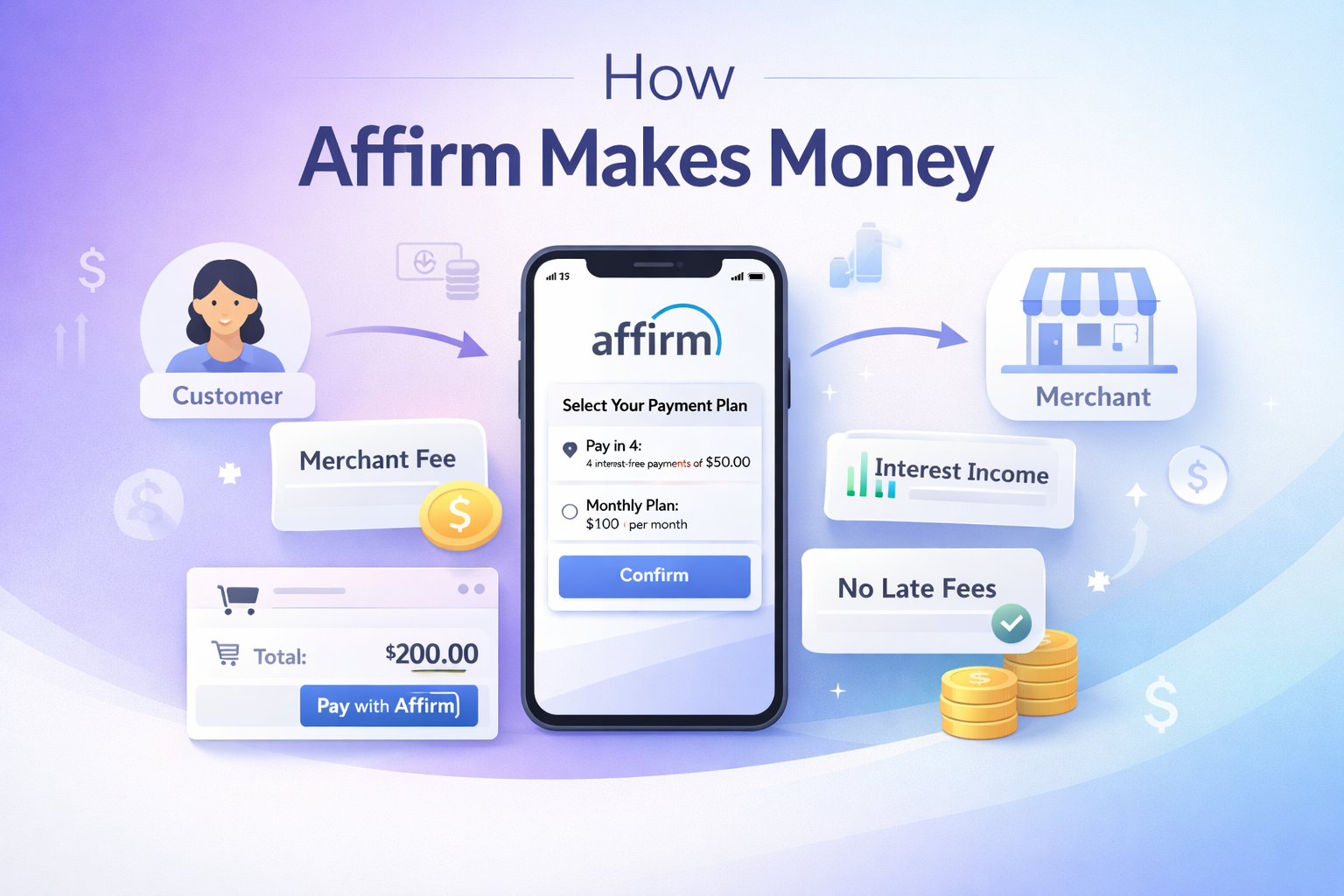

Affirm makes money through merchant fees, interest on consumer loans, interchange fees, and loan securitization. Unlike most financial products, Affirm does not charge late fees. Instead, it monetizes both sides of every transaction, the merchant and the consumer, making it one of the more efficient business models in fintech today.
This breakdown covers every revenue stream, the full business model canvas, unit economics, competitive positioning, and what founders can learn from how Affirm is built.
What Is Affirm?
Affirm is a Buy Now, Pay Later (BNPL) platform founded by Max Levchin, one of the original co-founders of PayPal. The platform lets consumers split purchases into fixed installment payments at checkout, either interest-free or with a stated APR, depending on the plan and merchant.
What separates Affirm from most credit products is its commitment to transparency. No hidden fees, no penalty charges, no revolving debt traps. Every term is disclosed upfront before the user agrees to anything.
Affirm operates primarily in the US but has been scaling its merchant network and financial infrastructure aggressively over the past few years.
How Affirm Works
The user flow is straightforward.
A shopper adds items to their cart on a partner merchant site. At checkout, they select Affirm as their payment method. Affirm runs a real-time credit decision using its proprietary underwriting model. If approved, Affirm pays the merchant the full purchase amount immediately. The consumer then repays Affirm in fixed installments over a set period, anywhere from a few weeks to 36 months depending on the plan.
Affirm removes friction at the most sensitive point in the purchase journey: the moment a consumer decides whether to complete a transaction or abandon the cart. That is the core product insight. It is not just a payment method. It is a checkout conversion tool that also happens to be a lending product.
Core Revenue Streams
Merchant Fees
Merchant fees are Affirm’s primary revenue engine. Every time a consumer completes a purchase using Affirm, the merchant pays Affirm a fee, typically ranging from three to six percent of the transaction value.
This might seem expensive for the merchant, but the value proposition is clear. Merchants that integrate Affirm consistently report higher conversion rates and increased average order values. Consumers who might have abandoned a purchase due to upfront cost are far more likely to complete the transaction when they can spread payments over time.
The mental shift here is important. Merchants are not paying for a payment processor. They are paying for more completed sales. Affirm essentially functions as a revenue accelerant for merchants, and the fee reflects that value, not just the cost of moving money.
This is why Affirm has been able to land major partnerships with Amazon and Shopify. The ROI on merchant fees is measurable and direct.
Interest Income
Interest income is the second major revenue stream and, for longer-term loan products, it can be the most significant.
Affirm charges consumers an APR that ranges from zero percent to thirty percent, depending on the loan duration, the merchant agreement, and the consumer’s credit profile. Short-term, smaller-ticket purchases offered by certain merchants may be interest-free for the consumer, with the merchant subsidizing that cost through higher fees on their end. Longer-term plans on bigger purchases often carry an APR.
Affirm’s underwriting model is built to price risk accurately at the individual loan level. The goal is to set an APR that reflects the actual probability of repayment without overcharging consumers to the point of creating credit stress. When that model works correctly, interest income is highly predictable.
Interest income scales directly with loan volume and loan duration. As Affirm grows its merchant network and consumer base, this revenue stream grows proportionally.
Interchange Fees from the Affirm Card
Affirm launched a physical and virtual debit card called the Affirm Card. This product functions similarly to a traditional debit or credit card but with Affirm’s installment model built in. Consumers can use the card anywhere Visa is accepted, and they can choose to convert eligible purchases into installment plans after the fact.
Every time the Affirm Card is used at a point-of-sale terminal, Affirm earns an interchange fee, the same type of fee that Visa, Mastercard, and card-issuing banks have collected for decades. These fees are typically a small percentage of the transaction plus a flat amount, and they add up quickly at scale.
The Affirm Card is significant because it expands Affirm’s reach beyond its partner merchant network. Instead of being limited to checkouts on Shopify stores or Amazon, Affirm can now participate in virtually any retail transaction the consumer makes. That is a massive expansion of addressable volume.
Loan Servicing and Platform Fees
Affirm also earns revenue from servicing loans that it has sold to third-party investors and from platform fees charged to partners who integrate its technology into their checkout infrastructure.
Loan servicing fees are charged for managing the ongoing collection, reporting, and administration of loan portfolios. Even after Affirm sells a pool of loans to an outside investor, it often retains the servicing rights, meaning it continues to collect payments and manage the relationship with the borrower. The servicer earns a fee for this ongoing work.
Platform fees come from enterprise partners and financial institutions that use Affirm’s technology stack to power their own BNPL or installment offerings. This is a software-layer revenue stream that carries high margins and grows as Affirm’s underlying infrastructure becomes more widely adopted.
Loan Securitization
Securitization is the least-talked-about revenue mechanism in Affirm’s model, but it is one of the most important for understanding how the company scales without requiring infinite capital.
Here is how it works. Affirm originates consumer loans using its own capital or capital from banking partners. Those loans are then bundled together into pools based on risk characteristics and sold to institutional investors as asset-backed securities. Investors receive the interest payments from consumers. Affirm receives cash upfront for the loans it originated.
This cycle allows Affirm to continuously recycle capital. Instead of holding every loan it originates on its balance sheet until maturity, it sells the loans, frees up cash, and uses that cash to fund new loans. The gain-on-sale revenue, the difference between what Affirm sold the loans for and the carrying value on its books, shows up as revenue.
Securitization is how fintechs like Affirm grow loan volumes dramatically without proportionally increasing their capital requirements. It is the mechanism that makes the business model viable at scale.
Business Model Canvas
Understanding Affirm’s individual revenue streams is useful. Understanding how those streams connect to create a durable multi-sided platform is what separates surface-level analysis from strategic insight.
Customer Segments
Affirm serves three distinct customer groups simultaneously.
The first is online shoppers, primarily millennials and Gen Z consumers who prefer transparent payment terms and are skeptical of traditional credit card products. These consumers value knowing exactly what they will pay before they commit.
The second is e-commerce merchants ranging from small Shopify stores to large enterprise retailers like Amazon. These merchants need checkout solutions that reduce cart abandonment and increase average order value.
The third is enterprise platforms and financial partners who use Affirm’s infrastructure to power installment products within their own ecosystems.
Value Proposition
For consumers, Affirm offers no hidden fees, no late penalties, a clear repayment schedule, and instant approval decisions. The value is not just financial flexibility. It is psychological clarity. Knowing exactly what a purchase will cost, with no risk of surprise charges, removes a major source of purchase anxiety.
For merchants, Affirm offers higher conversion rates, larger basket sizes, and a better checkout experience. Studies across multiple merchant categories have shown that offering installment payment options at checkout meaningfully increases both the percentage of carts that convert and the size of the average order.
For enterprise partners, Affirm offers a battle-tested underwriting engine, a consumer-facing brand with high trust scores, and a technology integration that can be deployed relatively quickly.
Channels
Affirm reaches consumers primarily through embedded checkout integrations on partner merchant sites and through its mobile app. The merchant partnership channel is the most important. Every merchant that integrates Affirm exposes the product to their entire customer base at the exact moment those customers are ready to buy.
The Affirm Card expands the channel reach to physical retail and any digital merchant that accepts Visa, which is effectively everywhere.
Customer Relationships
Affirm operates on a self-service digital model. Credit decisions are made in seconds using automated underwriting. Consumers manage their loan accounts through the app. Communication is digital and transparent.
The relationship is built on trust rather than lock-in. Consumers are not trapped in a revolving credit product. They choose Affirm transaction by transaction because the experience is better, not because switching costs are high.
Key Resources
Affirm’s most valuable resources are its risk assessment algorithms, its merchant distribution network, and its access to capital markets.
The underwriting model is proprietary and has been trained on millions of loan outcomes. Its ability to accurately price risk at the individual transaction level is what determines whether Affirm earns money or loses it on any given loan.
The merchant network creates a distribution moat. Every new merchant partnership increases the number of touchpoints where consumers encounter Affirm, which grows the consumer base, which in turn makes Affirm more attractive to additional merchants.
Access to capital markets, meaning the ability to securitize loans and attract institutional investors, determines how fast Affirm can grow its loan book without burning through its own capital.
Key Activities
The four critical activities inside Affirm are loan underwriting, risk management, merchant acquisition, and platform development.
Loan underwriting is the core function. Every transaction requires a real-time credit decision. The accuracy of that decision determines profitability at the individual loan level.
Risk management at the portfolio level determines whether Affirm’s overall loss rates stay within acceptable ranges across different economic conditions.
Merchant acquisition drives growth. Adding new merchant partners expands both consumer reach and transaction volume.
Platform development ensures that the checkout integration, the consumer app, and the enterprise infrastructure remain fast, reliable, and better than alternatives.
Key Partnerships
Affirm’s most important external partnerships fall into three categories.
Banking partners provide the regulatory infrastructure and in some cases the capital that funds loans. Affirm is not a bank itself, so these partnerships are structurally necessary.
Payment networks, specifically Visa, enable the Affirm Card to function anywhere card payments are accepted. This partnership dramatically extends the reach of Affirm’s product beyond its owned merchant network.
Merchant and platform partners, including Amazon and Shopify, drive transaction volume at scale. The Amazon and Shopify partnerships alone represent access to an enormous share of US e-commerce.
Cost Structure
The largest costs in Affirm’s model are the cost of capital, credit losses, technology infrastructure, and marketing and partnerships.
Cost of capital is what Affirm pays to borrow money to fund loans before those loans are securitized or repaid. This is directly tied to interest rate environments, which is one reason Affirm faced significant pressure during the rate hike cycles of recent years.
Credit losses are loan defaults. When a consumer stops repaying, Affirm absorbs the loss. Managing default rates through accurate underwriting is the most important lever for controlling this cost.
Technology and infrastructure costs cover the engineering team, cloud computing, data systems, and the ongoing development of the underwriting model.
Unit Economics
A simple example illustrates how the math works on an individual transaction.
A consumer makes a one thousand dollar purchase using Affirm. The merchant pays Affirm a fee of four to six percent, so forty to sixty dollars goes to Affirm immediately at the point of sale.
If the consumer is on an interest-bearing plan, Affirm also collects APR-based interest over the life of the loan. On a twelve-month plan at fifteen percent APR, that adds roughly eighty to ninety dollars in interest revenue.
Against that, Affirm pays its cost of capital to fund the loan and absorbs any expected credit loss. If the consumer defaults, Affirm loses the outstanding principal minus any recovered payments.
The net margin on any given loan depends on three variables: the merchant fee collected, the interest income earned, and the credit loss experienced. Get the underwriting right, and the unit economics are strong. Misprice the risk, and the economics fall apart fast.
BNPL is fundamentally a risk-adjusted margin business. Volume matters, but margin per unit matters more.
Why Affirm Does Not Charge Late Fees
This is a deliberate strategic choice, not just a brand positioning decision.
Late fees create adversarial relationships with consumers. They generate complaints, chargebacks, and regulatory scrutiny. They also concentrate revenue on the consumers least able to pay, which increases credit risk at the portfolio level.
Affirm made the bet that removing late fees would increase consumer trust, which would increase adoption, which would increase transaction volume, which would grow revenue through merchant fees and interest at a rate that more than compensates for the lost late fee revenue.
The strategy is: reduce friction at every point, grow volume significantly, and earn through the structural mechanics of the business rather than through penalty extraction. This is a different philosophy than most credit products, and it has proven to be a viable one.
Risks in Affirm’s Business Model
Credit Default Risk
The most fundamental risk is that consumers do not repay their loans. If Affirm’s underwriting model misprices risk, loss rates exceed projections, and the economics break down. This risk is amplified during economic downturns when consumers face income shocks.
Interest Rate Sensitivity
Affirm borrows money to fund loans. When interest rates rise, the cost of that borrowing increases. If Affirm cannot pass those costs on to consumers through higher APRs quickly enough, its margins compress. The rate hike environment of 2022 and 2023 hit Affirm’s financials meaningfully for exactly this reason.
Regulatory Pressure
BNPL is attracting increasing attention from the Consumer Financial Protection Bureau and other regulatory bodies. Rules around credit disclosures, underwriting standards, and consumer protections could increase Affirm’s compliance costs or constrain certain products.
Competitive Pressure
Klarna, Afterpay, PayPal, and increasingly the large card networks are all competing for the same checkout real estate. Affirm’s merchant fee rates face downward pressure as competition increases.
How Affirm Scales
Affirm’s growth strategy is built on embedded finance and distribution partnerships.
Rather than trying to acquire consumers through direct marketing campaigns, Affirm embeds itself into existing purchase journeys at the point of highest intent. This is far more efficient than consumer acquisition at the top of the funnel.
The Shopify integration means every merchant on Shopify can offer Affirm with minimal friction. The Amazon partnership means Affirm has access to one of the highest-volume retail environments in the world. These are not marketing wins. They are distribution infrastructure that compounds over time.
The Affirm Card extends this model into physical retail and non-partner digital merchants. As card adoption grows, Affirm’s revenue becomes less dependent on any single merchant relationship.
Affirm vs Credit Cards
| Feature | Affirm | Traditional Credit Cards |
|---|---|---|
| Late Fees | None | High penalties |
| Pricing Transparency | Full upfront disclosure | Often confusing |
| Repayment Structure | Fixed installments | Revolving minimum payments |
| Approval Speed | Seconds, per transaction | One-time application |
| Consumer Psychology | Clear, predictable | Can encourage overspending |
Affirm wins on simplicity and clarity. Credit cards remain dominant on rewards and widespread acceptance. The two products serve overlapping but distinct consumer needs.
Affirm vs Klarna vs Afterpay
Each BNPL player has carved out a distinct positioning.
Klarna leans heavily into lifestyle and shopping discovery. Its app functions as a commerce and media product in addition to a payment tool. Klarna has a stronger consumer brand in Europe and a heavy focus on fashion and beauty categories.
Afterpay built its model around a simple pay-in-four structure with no interest ever, covering its costs entirely through merchant fees. This simplicity has strong appeal but limits the loan duration and size of purchases it can serve.
Affirm takes a more structured and transparent approach. It supports longer loan durations, larger purchase amounts, and more complex underwriting. It is particularly strong in high-ticket categories like furniture, fitness equipment, travel, and electronics where a four-payment structure is not enough.
The Future of Affirm
Affirm is moving toward becoming a full consumer financial platform, not just a checkout payment option.
The Affirm Card is the clearest signal of this direction. A card product that works everywhere, with installment capabilities built in, is a much larger and more defensible product than a merchant-embedded BNPL widget.
Banking and savings products are a natural adjacency. Once Affirm has a deep relationship with a consumer around credit and payments, offering savings accounts or other financial tools becomes logical.
Global expansion is the longest-term growth lever. BNPL adoption is growing across Europe, Australia, and emerging markets. Affirm’s underwriting infrastructure is built to adapt across credit environments.
Regulatory evolution will shape the product. Clearer rules around BNPL credit disclosures may actually benefit Affirm relative to competitors, because Affirm’s transparent-by-design model already aligns with what regulators appear to want.
Key Lessons for Founders
Monetize both sides of the transaction. Affirm earns from merchants and consumers simultaneously. If your business model only earns from one side, you are leaving money on the table and increasing your dependence on a single revenue stream.
UX is a revenue driver. Affirm’s clean, transparent checkout experience is not just a product virtue. It directly increases conversion rates for merchants, which justifies the merchant fee, which funds the business. Great UX creates business model leverage.
Trust compounds. The no-late-fee policy costs Affirm some short-term revenue. But the trust it builds with consumers increases adoption and lifetime value in ways that are hard to quantify but very real. Trust is a growth asset.
Distribution beats product in the long run. Affirm’s Amazon and Shopify partnerships are worth more than any product feature. Getting embedded into high-volume distribution channels is how you grow efficiently. If you are building a fintech or commerce product, your most important hires and deals are the ones that get you into existing consumer purchase journeys.
Securitization is infrastructure, not finance. Understanding how to access capital markets and recycle loan capital is what separates fintechs that hit a ceiling from those that scale continuously. If your model involves any kind of lending or credit, learn how securitization works early.
Conclusion
Affirm is not simply a payment tool. It is a multi-sided financial platform where merchants fund growth through fees, consumers drive loan volume, and proprietary risk models determine whether that volume is actually profitable.
The business works because Affirm identified the highest-friction moment in e-commerce, the checkout decision, and built a product that removes that friction for consumers while delivering measurable ROI to merchants. It earns through structural mechanics, merchant fees, interest, interchange, and securitization, rather than through penalty extraction.
For anyone building in fintech, payments, or embedded finance, Affirm is one of the clearest examples of how to design a business model that aligns incentives across all parties. The consumer wins through transparency. The merchant wins through conversions. Affirm wins through volume and risk-adjusted margin.
If you understand how Affirm makes money, you understand how embedded finance actually works at scale.
FAQs
Yes, on many plans. APR ranges from zero percent to thirty percent depending on the merchant agreement, the purchase size, and the consumer’s credit profile. Some merchant-funded offers are zero percent for the consumer.
Primarily through merchant fees charged on every transaction and through interest income on consumer loans. The no-late-fee positioning increases consumer adoption and transaction volume, which more than compensates for the absence of penalty revenue.
Profitability depends heavily on credit loss rates, interest rate environments, and loan volume. Affirm has reported adjusted operating profitability in certain periods but faces ongoing pressure from cost of capital and credit losses. The path to consistent GAAP profitability runs through scale and tighter underwriting.
Affirm is integrated into Shopify, Amazon, and thousands of individual e-commerce merchants across furniture, fitness, travel, electronics, and apparel categories. The Affirm Card extends acceptance to any Visa merchant.
Affirm offers fixed installment payments with full upfront disclosure and no late fees. Credit cards offer revolving credit with variable minimum payments and penalty fee structures. Affirm is purpose-built for specific purchases, while credit cards are general-purpose revolving instruments.
Discover more from Business Model Hub
Subscribe to get the latest posts sent to your email.


[…] long-term competitive picture puts Klarna alongside PayPal, Apple Pay, and Affirm rather than just other BNPL providers. Each of these players is trying to own the checkout moment […]