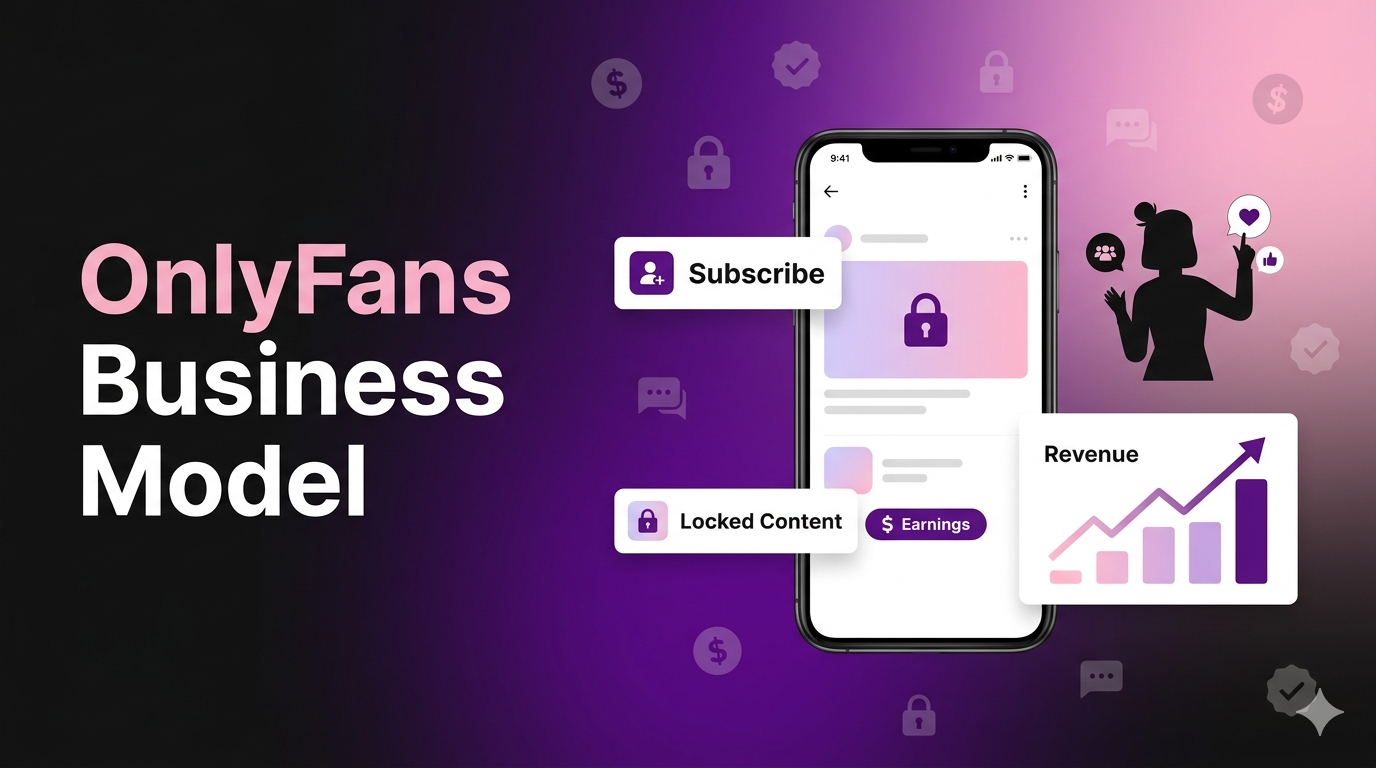

OnlyFans makes billions by taking a 20% commission from every dollar creators earn. It runs on a direct-to-consumer subscription model, zero ads, and no middlemen.
But the real reason behind its $6.3B success isn’t just subscriptions. It’s the psychology, platform control, and monetization design most people completely overlook.
OnlyFans at a Glance
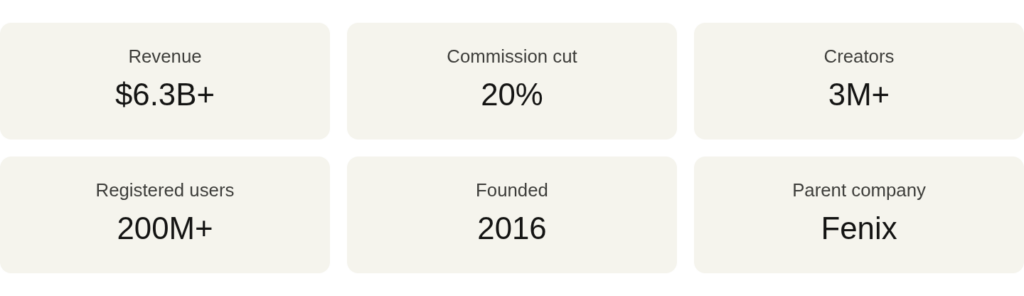
It’s not a social media platform. It’s a monetization engine disguised as one.
The Core Business Model
Subscription economy
Creators set their own monthly price. Fans pay it directly. That’s the foundation. No algorithm deciding who gets seen. No brand deal needed. Just recurring revenue that compounds every month a subscriber stays.
Commission-based revenue
OnlyFans keeps 20 cents of every dollar earned on the platform. Creators keep 80%. The platform has no ad inventory to sell, no sponsor relationships to manage. Its entire business lives inside that 20% cut.
Creator-first monetization
Instagram and YouTube built their empires on ad revenue. Creators were never the customer. OnlyFans flipped that entirely.
On OnlyFans, a creator with 500 subscribers paying $15/month earns more than most mid-tier YouTubers with hundreds of thousands of views. Monetization starts on day one, not after years of grinding for algorithmic favor.
How OnlyFans Actually Makes Money
Subscriptions
The primary engine. Fans pay a monthly fee set entirely by the creator. These are recurring charges, so the platform earns passively as long as subscribers stay active.
Pay-per-view content
Creators lock individual posts behind an additional paywall. Photos, videos, and voice messages can each carry a separate price tag. A subscriber paying $10/month might spend another $50 on locked content that month.
Tips and donations
Fans can tip directly on any post or inside messages. There’s no cap. High-value fans regularly tip amounts that exceed monthly subscription costs by a wide margin.
Live streams
Paid live interactions layer on top of subscriptions. Fans pay to watch in real time, and they can tip during the stream. It’s a compounding revenue event.
It’s not just content. It’s attention monetization layered with intimacy.
The Hidden Growth Engine
This is what the business press mostly skips over.
Ownership of audience
On TikTok, your audience belongs to the algorithm. If TikTok changes how it distributes content, your reach drops overnight. On OnlyFans, creators own their subscriber list. That relationship is direct, portable, and durable.
Artificial scarcity
Locked content creates urgency. When a fan knows something is behind a paywall that other fans have already unlocked, the psychological pull is strong. Scarcity isn’t a feature. It’s a revenue driver built into the product architecture.
Parasocial relationships
Fans develop a sense of personal connection with creators. That connection drives spending well beyond what rational economics would predict. When someone feels like they personally know a creator, $20 for a locked video feels different than $20 for a Netflix subscription.
No middlemen
No advertisers to please. No brand approvals. No content strikes for saying the wrong thing on a sponsored video. Creators operate without the external constraints that govern every other major platform.
Why Creators Choose OnlyFans Over Traditional Platforms
The comparison isn’t even close on a per-follower earnings basis.
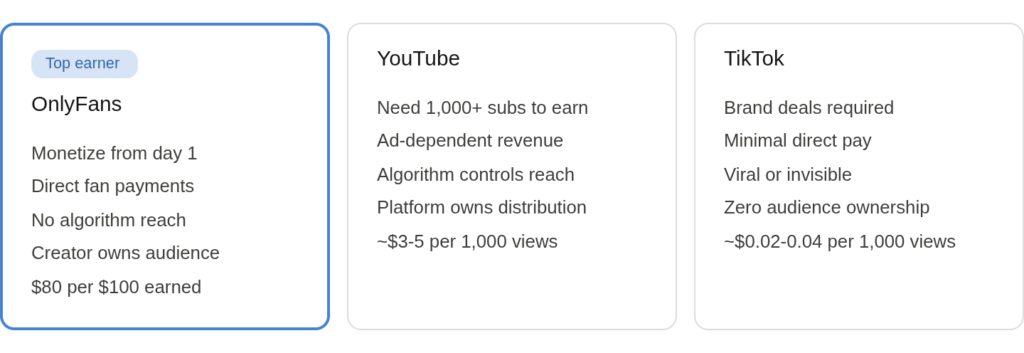
10,000 loyal fans on OnlyFans can out-earn 1 million followers on Instagram. That’s not hype. That’s math.
The Growth Strategy Breakdown
Creator-led growth
OnlyFans doesn’t acquire users. Creators do. Every creator who joins brings their existing audience from Instagram, Twitter, Reddit, or TikTok. The platform gets a pre-warmed audience at zero acquisition cost.
Viral loops via social media
Creators tease content publicly on other platforms and funnel traffic to OnlyFans for the full version. Every piece of teaser content is essentially a free ad for the platform. Millions of these micro-funnels run simultaneously.
Near-zero customer acquisition cost
Most platforms spend heavily on paid ads to grow their user base. OnlyFans largely skips that. Creators are the acquisition channel. The platform’s marketing budget is effectively distributed across 3 million creator accounts.
Controversies and Risks
Content moderation
The platform has faced ongoing pressure over how it handles potentially harmful content. Verification processes and reporting systems have improved, but moderation at scale remains a persistent challenge.
Payment and banking challenges
Major payment processors have at times restricted or threatened to restrict services to the platform. In 2021, OnlyFans briefly announced it would ban explicit content before reversing the decision within days after enormous creator backlash. The reversal exposed just how dependent the business model is on that specific content category.
Brand reputation concerns
Mainstream advertisers and enterprise partnerships remain limited. The platform’s association with adult content makes brand deals in traditional industries nearly impossible, which paradoxically reinforces its dependence on the commission model.
The Real Business Insight
Strip away the controversy and a few core principles emerge clearly.
Monetization beats attention. Having 10 million followers who don’t pay you is worth less than 1,000 subscribers who pay you $15 a month.
Niche beats mass. A dedicated, paying audience is more durable than a broad, passive one. OnlyFans built its entire architecture around this insight.
Control beats algorithms. Platform-independent audience ownership is the most valuable asset a creator can have. OnlyFans gives creators that. Other platforms actively prevent it.
OnlyFans didn’t invent content. It reinvented how content gets paid.
Lessons for Founders and Marketers
Build direct monetization into the product. Don’t build an audience and figure out money later. Design the payment mechanism from the start.
Reduce platform dependency. Any business that lives entirely inside someone else’s algorithm is one policy change away from collapse. Direct relationships with customers are more defensible.
Chase high-value users, not volume. A smaller base of paying customers compounds faster than a large base of free users. Volume is vanity. Revenue per user is the metric that matters.
Build exclusive ecosystems. When your audience can only access you through your channel, your leverage over pricing and distribution is absolute. Exclusivity is the moat.
What’s Next for OnlyFans
The platform has made public moves to expand beyond adult content into fitness, cooking, music, and other creator categories. Whether mainstream creators adopt it at scale remains to be seen. The stigma attached to the platform creates real friction for that transition.
The creator economy is also getting more competitive. Patreon, Substack, Beehiiv, and newer platforms are all competing for the same direct-monetization creator dollar. OnlyFans has a first-mover advantage and a massive existing user base, but network effects in creator economies are weaker than in social platforms.
The existential question isn’t whether direct monetization works. It clearly does. The question is whether OnlyFans can expand its brand without alienating the creator base that built it.
Final Take
OnlyFans isn’t controversial because of its content. It’s controversial because it exposes just how powerful direct monetization really is, and how badly traditional platforms have underserved creators by keeping that power for themselves.
Every major platform built its empire by capturing the value creators generate and paying them back a fraction through ad revenue splits and brand deals. OnlyFans cut that loop short. It handed creators the pricing power, the audience relationship, and the revenue stream directly.
The real takeaway? The future of the internet isn’t free content. It’s paid attention.
Every platform fighting for creator loyalty is essentially fighting to answer the same question OnlyFans already answered in 2016: who does the money flow to first?
FAQs
OnlyFans makes money by taking a 20% commission from everything creators earn on the platform, including subscriptions, tips, and pay-per-view content. The remaining 80% goes directly to creators.
OnlyFans is highly profitable because it has:
Low operational costs
No content production expenses
A creator-driven model where users bring their own audience
This allows OnlyFans to scale without heavy spending.
No, OnlyFans is not limited to adult content. While it is widely known for it, the platform also hosts:
Fitness trainers
Musicians
Chefs
Educators
However, adult content has been its primary growth driver.
Unlike Instagram or YouTube:
OnlyFans offers direct monetization
No reliance on ads or algorithms
Creators earn directly from fans instead of brands
The key revenue streams include:
Monthly subscriptions
Pay-per-view (locked content)
Tips and donations
Paid live streams
OnlyFans takes a percentage from each transaction.
Yes, it’s highly scalable because:
Content is created by users
No inventory or logistics needed
Revenue grows as creators grow
This makes it a high-margin platform business.
Discover more from Business Model Hub
Subscribe to get the latest posts sent to your email.