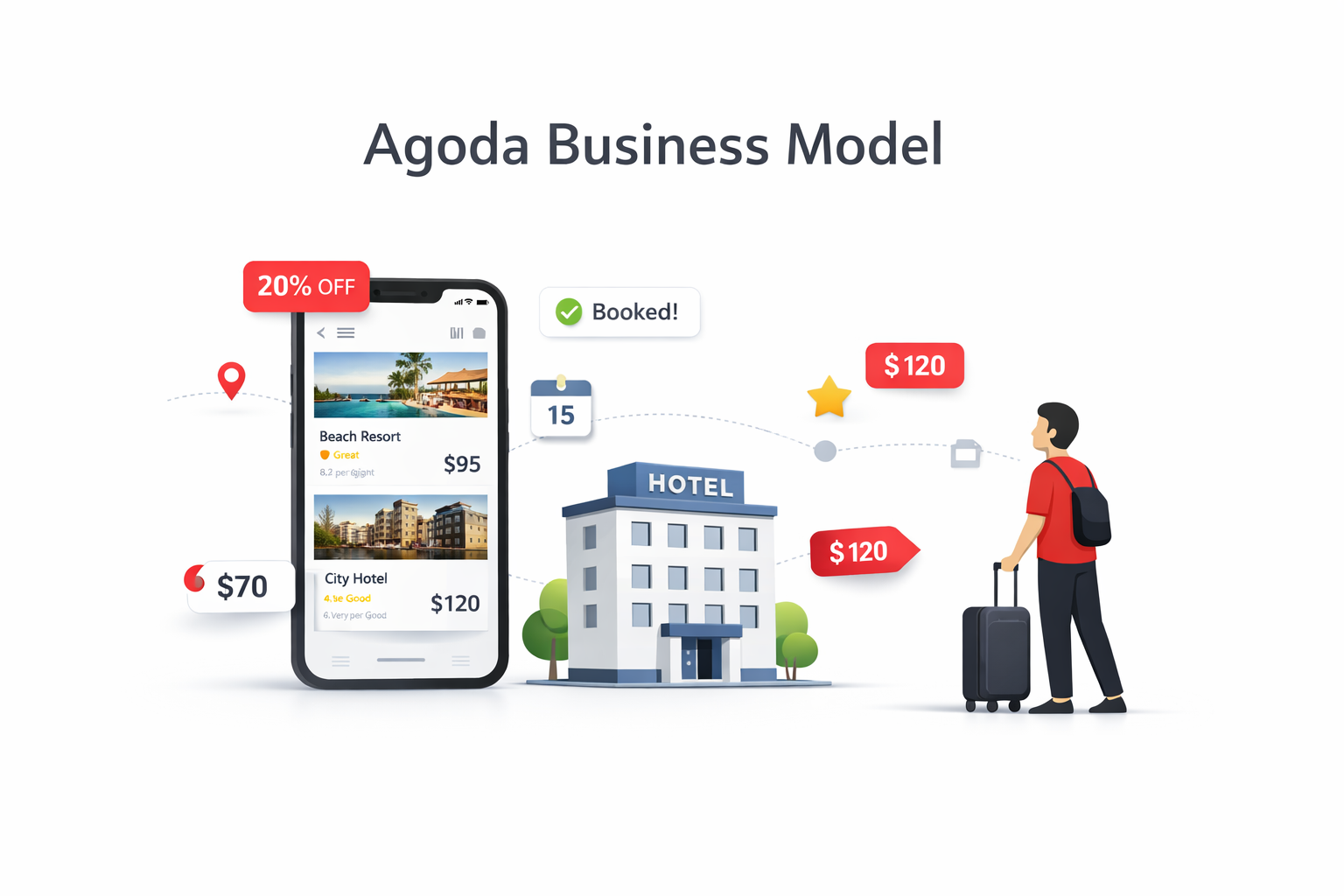
Agoda Business Model And How Agoda Became One of Asia’s Largest Online Travel Platforms

Agoda operates a two-sided online travel marketplace that connects travelers with hotels, flights, and travel services across the globe. It primarily earns revenue through commissions on bookings, merchant model margins, and advertising placements. What truly sets it apart is its combination of powerful pricing algorithms and a dominant position across Asia-Pacific markets.
What Is Agoda?
If you have ever searched for a budget hotel in Bangkok, a resort in Bali, or a last-minute deal in Tokyo, chances are Agoda has appeared in your search results. But most people only see it as a booking website. The real story is far more interesting.
Agoda is a full-scale online travel agency (OTA) that was founded in 2005 and later acquired by Booking Holdings, the same parent company behind Booking.com, Priceline, and Kayak. That acquisition gave Agoda enormous technological resources, global infrastructure, and the financial muscle to compete aggressively in one of the world’s most competitive industries.
Here is what Agoda offers:
- Hotel and resort bookings
- Flight bookings
- Vacation rentals and apartments
- Activities and experiences
- Complete travel packages
But reducing Agoda to just a “hotel booking site” misses the point entirely. At its core, Agoda is a pricing and inventory optimization engine dressed up as a travel platform. Understanding that distinction is the key to understanding its business model.
The Core Business Model of Agoda
The Two-Sided Marketplace Structure
Agoda runs what business strategists call a two-sided marketplace. This means it serves two distinct groups simultaneously and creates value by connecting them.
On the supply side:
- Hotels and resorts
- Independent property owners
- Vacation rental hosts
- Airlines and transport providers
On the demand side:
- Individual travelers
- Business travelers
- Travel agencies using Agoda’s API
The genius of this structure is what happens when both sides grow together. More hotels joining the platform means better pricing and more variety for travelers. More travelers using the platform means more bookings for hotels. More bookings attract more hotels. And the cycle continues.
This is a classic network effect loop, and it is one of the most powerful growth mechanisms in modern business. Agoda did not invent this concept, but it has executed it exceptionally well in a region where many global platforms struggled to gain traction.
The Merchant Model
The merchant model is arguably Agoda’s most important and profitable operating mechanism. Here is how it works:
- Agoda negotiates directly with hotels to purchase room inventory at discounted wholesale rates
- It then sells those rooms to travelers at a marked-up retail price
- The difference between the two prices is Agoda’s margin
Why does this model work so well?
- Agoda has full control over the final price the traveler sees
- It can run promotions and discounts without needing hotel approval each time
- Margins are generally higher than in pure commission arrangements
- It creates flexibility to offer “best price guarantees” convincingly
The merchant model also allows Agoda to move fast. When there is low demand for a destination, Agoda can drop prices immediately to stimulate bookings. When demand spikes, it can adjust upward. This real-time pricing flexibility is something many traditional travel agencies simply cannot match.
The Agency Model
Alongside the merchant model, Agoda also operates on an agency basis. This is a more straightforward arrangement:
- The hotel lists its rooms on Agoda’s platform
- Agoda markets and processes the booking
- After a successful booking, Agoda takes a commission of approximately 15 to 30 percent
This model works best for:
- Large international hotel chains with established pricing structures
- Properties with very high booking volumes
- Hotels that want to maintain control over their own pricing
The agency model scales easily because Agoda does not need to front any capital or take on inventory risk. It simply facilitates the transaction and earns a cut. The downside is that margins are thinner than in the merchant model, and Agoda has less pricing flexibility.
The Hybrid Model Advantage
What makes Agoda strategically savvy is that it does not rely on one model exclusively. It combines both:
- Merchant model for higher margins and pricing control
- Agency model for scalability and broad inventory coverage
This hybrid approach lets Agoda optimize simultaneously for growth and profitability. It can take the merchant route with smaller, independent properties where it has more negotiating power, and switch to the agency route with major chains where the volume justifies a commission-only relationship.
Very few OTAs manage this balance as effectively as Agoda, and it is one of the structural reasons behind its sustained growth in Asia.
How Agoda Makes Money: Revenue Streams Explained
Hotel Booking Commissions
This is the primary revenue engine. Every time a traveler completes a booking through Agoda, the platform earns a commission from the hotel. The exact percentage varies based on the hotel’s size, location, and negotiated agreement, but typically falls in the 15 to 30 percent range.
The sheer volume of bookings Agoda processes across Asia-Pacific makes this a substantial revenue source even at moderate commission rates.
Margin from the Merchant Model
When Agoda operates under the merchant model, it earns the difference between what it pays hotels (wholesale rate) and what it charges travelers (retail price). This margin varies but tends to be higher than standard agency commissions.
This is where Agoda’s pricing algorithms play a crucial role. By dynamically adjusting the retail price based on demand, competition, and booking patterns, Agoda can maximize its margin without losing the traveler to a competitor.
Advertising and Sponsored Listings
Hotels and travel brands can pay Agoda to appear more prominently in search results. This works similarly to how Google Ads works for search results, or how Amazon sellers pay for sponsored product placements.
Sponsored listings typically appear:
- At the top of search result pages
- In curated “recommended” sections
- In email marketing campaigns to users
For hotels, this is a way to drive more bookings during slow seasons or to promote a new property. For Agoda, it is pure advertising revenue layered on top of commission income.
Flight and Package Bookings
Agoda has increasingly moved beyond just hotels. By adding flights and bundled travel packages, it increases the revenue it earns from each traveler relationship.
A traveler who books a hotel through Agoda and then also books a connecting flight creates double the revenue opportunity. When they add an airport transfer or a guided tour on top of that, the total revenue per customer climbs significantly.
This cross-selling strategy is a key reason Agoda has been investing heavily in expanding its non-hotel travel inventory.
Affiliate Partnerships
Agoda runs a well-structured affiliate program. Third-party websites, travel bloggers, and comparison platforms can send traffic to Agoda in exchange for a share of the booking commission.
This creates a distributed marketing network that drives bookings without Agoda needing to invest in acquiring every user directly. Partners earn a percentage of each completed booking, and Agoda gains a customer it might not have otherwise reached.
Agoda’s Pricing Strategy: The Hidden Growth Engine
If there is one area where Agoda truly differentiates itself, it is pricing strategy. Most travelers think of Agoda as simply offering cheap hotels. The reality is that Agoda has built a sophisticated pricing intelligence system that shapes how travelers perceive and respond to prices.
Dynamic Pricing Algorithms
Agoda’s systems adjust prices in real time based on:
- Current demand levels for a destination
- Competitor pricing across other OTAs
- Historical booking patterns for similar dates
- Time remaining before the check-in date
- Overall supply of available rooms
This is not manual price management. It is algorithmic pricing at scale, operating across millions of listings simultaneously.
Geo-Based Pricing
Agoda shows different prices to users in different countries. A traveler in Singapore might see a different price for the same Bangkok hotel than a traveler browsing from the United States. This allows Agoda to optimize pricing based on local purchasing power, competition, and regional demand patterns.
Device-Based Pricing
Agoda has long offered exclusive deals for mobile app users. Mobile pricing is often lower than desktop pricing for the same property and dates.
Why does this strategy exist?
- It drives app downloads and mobile engagement
- Mobile users tend to book more impulsively, especially for last-minute travel
- App users have higher retention rates than website visitors
By creating a price incentive to use the app, Agoda builds a more loyal and engaged user base.
Flash Deals and Secret Deals
Agoda regularly runs time-limited promotions that create urgency:
- Flash deals are available for a short window, often just a few hours
- Secret deals offer discounts to users who sign in to their account, rewarding loyalty
- Last-minute deals target travelers with immediate booking intent
These tactics do more than just drive bookings. They create the perception that Agoda always has the best prices available, even when that is not always the case. Price perception is as powerful as actual price in the travel industry.
Key insight: Agoda does not just sell hotel rooms. It sells price perception and urgency.
Customer Segments Agoda Serves
Agoda serves a broad range of travelers, but its approach is deliberately tailored to specific segments where it has a competitive advantage.
Budget travelers:
- Price-sensitive and comparison-focused
- Respond strongly to discounts and flash deals
- Represent the largest segment of travelers across Asia
Frequent travelers:
- Often enrolled in loyalty programs
- Value convenience and reliable booking experiences
- Higher lifetime value as repeat customers
Business travelers:
- Need flexible booking and cancellation options
- Require proper invoicing and expense management features
- Less price-sensitive but highly convenience-driven
Last-minute bookers:
- High urgency, low patience for complicated booking flows
- Respond to mobile-first experiences and instant confirmation
- Often willing to pay slightly more for guaranteed availability
Agoda’s strongest and most loyal segment remains price-sensitive travelers across Asia. This group is enormous, growing rapidly as middle-class income rises across Southeast Asia, India, and East Asia, and deeply digital-native in their booking behavior.
Value Proposition: What Agoda Offers Both Sides
For Travelers
- Lowest price guarantee backed by dynamic pricing systems
- Massive inventory spanning over two million properties globally
- Instant booking confirmation with multiple payment options
- Localized experience including regional currencies and languages
- Strong mobile experience with app-exclusive deals
For Hotels and Property Owners
- Access to a massive pool of global travel demand
- Revenue optimization tools and booking analytics
- Increased visibility through the platform’s marketing reach
- Sponsored listing options for additional exposure
- Seamless integration with property management systems
The value proposition on both sides is strong, which is why the network effect works so well for Agoda. Each side gets tangible, concrete benefits from participating in the marketplace.
Key Business Model Components
Key Partners
Agoda’s business depends on a carefully maintained web of partnerships:
- Hotels, resorts, and independent property owners
- Airlines and transportation providers
- Payment gateway providers
- Affiliate websites and travel bloggers
- Technology and infrastructure partners
- Booking Holdings’ sister platforms for shared resources
Key Activities
The activities that keep Agoda’s business running and growing include:
- Continuous platform development and user experience improvement
- Real-time pricing optimization and algorithm refinement
- Customer acquisition through paid search, SEO, and partnerships
- Partner onboarding and hotel relationship management
- Fraud detection and payment security
- Data analysis and demand forecasting
Key Resources
The assets that give Agoda its competitive edge:
- Proprietary pricing and recommendation algorithms
- Brand recognition across Asia-Pacific markets
- Deep supplier relationships with regional hotel chains
- Large and growing user data set for personalization
- Access to Booking Holdings’ global infrastructure and technology
Agoda vs Competitors: Where It Stands
Agoda competes in one of the most intensely competitive industries on earth. Its main rivals include:
Booking.com: The global leader in OTA bookings with broader international coverage but less Asia-specific optimization.
Expedia: Strong in Western markets with a comprehensive travel ecosystem but limited regional dominance in Southeast Asia.
Airbnb: Focuses on unique and alternative accommodations, increasingly competing with traditional OTAs but with a different model.
Trip.com and Traveloka: Regional competitors with strong local presence in China and Southeast Asia respectively.
Where Agoda wins:
- Deeper penetration in Southeast and East Asian markets
- More aggressive and frequent discount campaigns
- Better localization across languages, currencies, and payment methods
- Stronger mobile-first approach tailored to Asian user behavior
- Pricing strategies specifically designed for price-sensitive Asian travelers
Agoda does not try to win everywhere. It focuses its energy on the region it knows best and dominates it through price advantage, local knowledge, and relentless optimization.
Growth Strategy: How Agoda Keeps Expanding
Expansion in Emerging Markets
Agoda has been systematically expanding into markets that global OTAs often underserve. Countries across South and Southeast Asia, including Vietnam, Indonesia, the Philippines, and Bangladesh, represent enormous growth opportunities as internet penetration and disposable income both rise simultaneously.
Being early in these markets means Agoda can establish brand trust before competitors gain a foothold.
Mobile-First Approach
Unlike many Western OTAs that built desktop-first and adapted for mobile later, Agoda has long prioritized mobile as its primary channel. This aligns perfectly with user behavior across Asia, where mobile internet usage dominates and many users access the internet primarily through smartphones.
The result is a mobile app experience that drives higher engagement, better conversion rates, and stronger repeat booking behavior than desktop-focused competitors.
Heavy Discounting as Strategy
Agoda uses discounts not just as a tactic but as a fundamental strategic tool. By consistently offering lower prices than competitors, it trains travelers to check Agoda first. Over time, this becomes a habit, and habits drive sustainable customer lifetime value.
The risk is margin compression, but Agoda manages this through volume. Millions of bookings at slightly thinner margins can generate more total profit than fewer bookings at higher margins.
Localization at Every Level
Agoda invests heavily in making the platform feel local for every market it serves:
- Localized pricing in regional currencies
- Translated interfaces across dozens of languages
- Region-specific payment methods including cash-based options
- Locally relevant promotions tied to regional holidays and festivals
- Customer support in local languages
This level of localization is expensive and operationally complex, but it creates a competitive moat that is extremely difficult for global platforms to replicate quickly.
Challenges in Agoda’s Business Model
No business model is without its weaknesses, and Agoda faces some genuine structural challenges.
Thin margins from aggressive discounting:
Constant promotions and price guarantees put pressure on profitability. Agoda must balance its discount-driven customer acquisition strategy against the need to maintain healthy margins.
Intense competition:
Every major global OTA is also trying to win in Asia. Booking.com, Trip.com, and regional players like Traveloka are all investing aggressively in the same markets.
Dependency on hotel supply:
Agoda’s model depends on hotels continuing to list their inventory on its platform. As hotels develop stronger direct booking capabilities through their own websites and apps, OTAs like Agoda may face pressure on both volume and commission rates.
Weak customer loyalty:
Because Agoda attracts many users primarily on price, those users are quick to switch if a competitor offers a better deal. Building loyalty beyond price is an ongoing challenge in a marketplace where travelers are naturally comparison-driven.
Is Agoda Profitable?
Agoda operates under Booking Holdings, which does not break out individual brand profitability in public filings. However, the structural factors that drive profitability are clearly present:
- Massive booking volume across high-demand Asian markets
- A hybrid model that balances commission income with higher-margin merchant sales
- Advertising revenue layered on top of transaction income
- Shared infrastructure and technology costs across Booking Holdings’ portfolio of brands
The combination of volume, pricing optimization, and operational leverage from being part of a larger group makes Agoda a commercially strong unit within the Booking Holdings ecosystem.
The Future of Agoda’s Business Model
AI-Driven Personalization
The next frontier for Agoda is using artificial intelligence to personalize the travel discovery and booking experience at an individual level. Rather than showing the same listings to every user, future versions of the platform will use behavioral data to surface properties, deals, and destinations that align with each traveler’s specific preferences, travel history, and budget patterns.
Building a Full Travel Ecosystem
Agoda has been steadily moving from being a hotel booking platform to becoming a full travel ecosystem. This means deeper investment in flights, activities, transfers, and eventually experiences and itinerary planning. The goal is to own more of the traveler’s journey, not just the accommodation piece.
Bundled Travel Experiences
Bundling flights, hotels, and activities into seamless packages creates higher average order values and makes it harder for travelers to comparison shop individual components. This reduces the price sensitivity that currently drives a lot of switching behavior.
Deeper Mobile Integration
As mobile payment ecosystems mature across Asia, including super apps, digital wallets, and buy-now-pay-later services, Agoda has significant opportunities to integrate more deeply with how Asian consumers manage and spend money digitally.
Key Takeaways for Founders and Business Strategists
Agoda’s rise from a 2005 startup to one of Asia’s largest online travel platforms contains several lessons that apply far beyond the travel industry.
Marketplace plus pricing control is a powerful combination:
Owning both the platform and the pricing mechanism gives Agoda leverage that pure commission-based marketplaces cannot match.
Discounts can be a growth strategy, not just a tactic:
When backed by strong data and volume, aggressive discounting builds market share and habit formation that pays off long-term.
Localization beats global standardization:
A platform built for Asia outperforms a global platform adapted for Asia. The nuance matters, and Agoda invested in getting those details right.
Distribution is everything in travel:
The best hotel inventory in the world means nothing if travelers cannot find it or trust the platform selling it. Agoda built distribution first and deepened its offering from there.
Regional dominance creates defensibility:
By owning the Asia-Pacific OTA space deeply rather than spreading thin across global markets, Agoda built a position that is genuinely hard to displace even for well-funded global competitors.
Discover more from Business Model Hub
Subscribe to get the latest posts sent to your email.