Wolt Business Model And How This Food Delivery Company Wins in Competitive Markets

Wolt is one of the most interesting food delivery companies out there. Not because it’s the biggest. But because it’s figured out how to actually win in markets where everyone else is struggling.
Let me break down exactly how Wolt works, how it makes money, and why its strategy is smarter than most people realize.
Quick Answer
Wolt runs a three-sided marketplace. It connects customers, restaurants, and delivery couriers all through one app.
It makes money through restaurant commissions, delivery fees, service fees, and subscriptions. Simple model. But the execution is what sets it apart.
What Is Wolt? (And Why Should You Care?)
Wolt was founded in 2014 in Helsinki, Finland. A small Nordic startup that decided to take on the food delivery world.
Today, it operates across Europe and parts of Asia. And in 2022, DoorDash acquired it which tells you a lot about how valuable Wolt’s model really is.
Here’s what makes Wolt different from day one:
It never tried to be everywhere at once. It picked cities, dominated them, and then moved on. That patience is rare in tech.
Most delivery apps grow fast and burn cash. Wolt grew smart.
How Wolt’s Business Model Actually Works
Think of Wolt as the middleman that makes everything smooth.
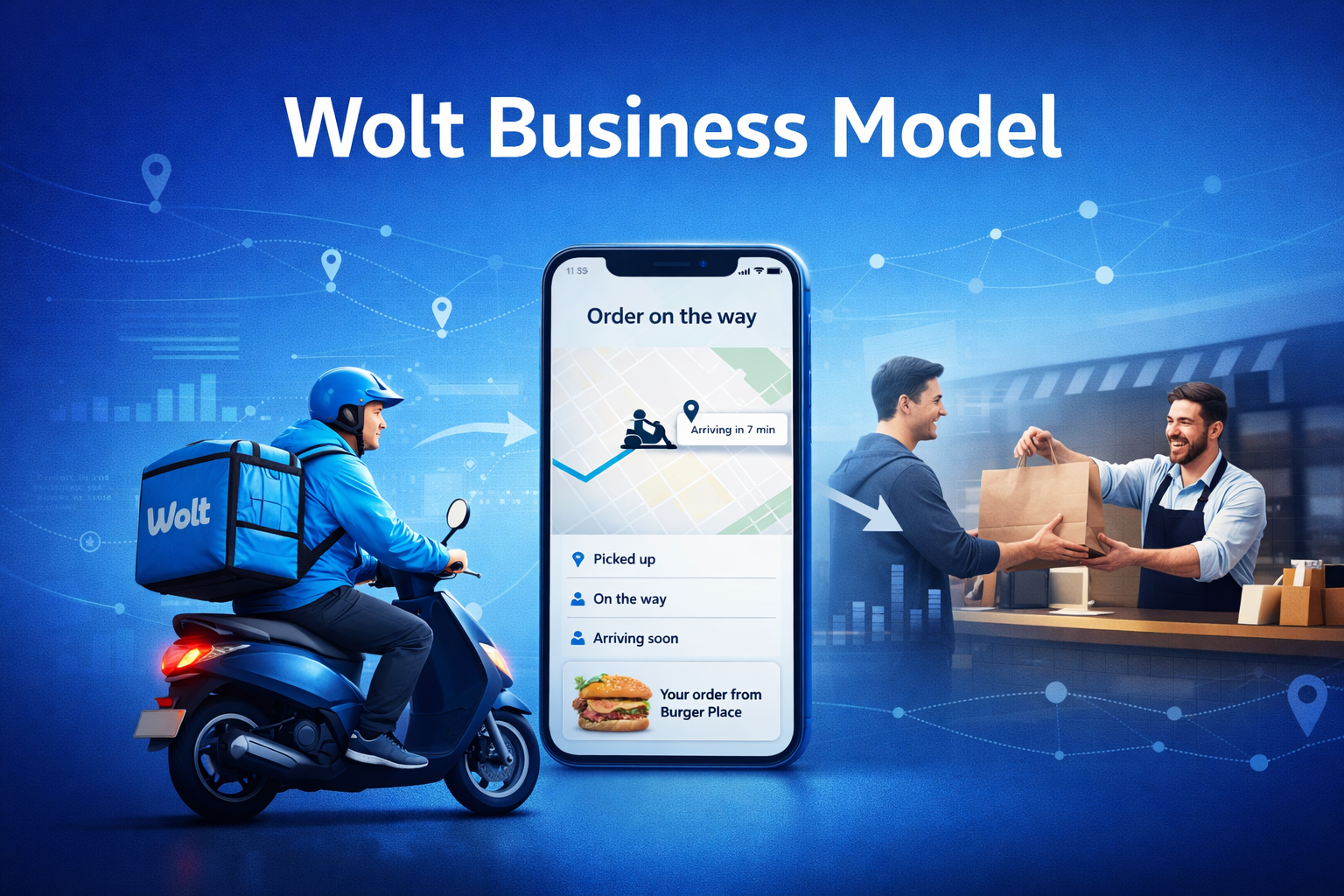
You open the app. You pick a restaurant. You place your order. Wolt handles the rest routing the order to the restaurant, dispatching a courier, tracking the delivery in real time, and processing your payment.
The step-by-step flow looks like this:
- Customer places an order on the app
- Restaurant gets the order and starts preparing
- Wolt’s system dispatches the nearest courier
- Courier picks up and delivers the food
- Wolt takes its cut from the transaction
Simple, right? But the magic is in that last step. Wolt sits in the middle of every transaction. That’s where the money is.
The Three Sides of Wolt’s Marketplace
This is the core of everything. Wolt isn’t just a delivery app. It’s a platform with three groups of users — and all three need each other.
Side 1: Customers
These are people like you and me. We want food fast, with a clean app experience and reliable delivery.
Wolt nails this. The app is genuinely well-designed. Deliveries are usually under 30 minutes. And the experience feels premium compared to a lot of competitors.
Why this matters: Happy customers order more. More orders = more revenue for everyone on the platform.
Side 2: Restaurants
Restaurants join Wolt to reach more customers. Many small restaurants don’t have the budget to build their own delivery system.
Wolt gives them instant access to thousands of local customers. Plus, they get data — order patterns, peak hours, what’s selling. That’s genuinely useful for a small restaurant owner.
The trade-off: They pay Wolt a commission. Usually 20%–30% per order. That’s not cheap. But the alternative is no delivery at all.
Side 3: Couriers
Couriers are the engine of the whole operation. No couriers = no delivery = no business.
Wolt uses independent contractors, not full-time employees. This keeps costs flexible. Couriers sign up through the app, get assigned orders, and earn per delivery.
The appeal for couriers: Flexible hours. No fixed schedule. You work when you want.
The downside which is a real challenge for Wolt is managing supply and demand. You need enough couriers during peak hours. But not so many that they’re all sitting idle.
How Wolt Makes Money (All 5 Revenue Streams)
Let’s talk money. This is where it gets interesting.
1. Restaurant Commission (The Big One)
This is Wolt’s main revenue driver. Every time a restaurant gets an order through Wolt, they pay a commission.
That commission sits between 20% and 30% per order.
On a $30 order, Wolt takes roughly $6–$9. Multiply that by millions of orders, and you see why this is the core of the business.
2. Delivery Fees
Customers pay a delivery fee on most orders. This varies by distance, demand, and whether you’re a subscriber.
Dynamic pricing kicks in during busy hours. Late Friday night? You might pay more. Slow Tuesday afternoon? Probably less.
This fee goes partly to Wolt and partly to the courier. The split depends on the market and the contract structure.
3. Service Fees
On top of delivery, Wolt charges a small platform fee per order. Usually $1–$2.
It sounds small. But across millions of orders, it adds up fast.
4. Wolt+ Subscription
This is one of Wolt’s smartest moves. Wolt+ is a subscription plan that gives members free or reduced delivery fees.
Why is this smart?
Because subscribers order more often. They’ve already paid for the service, so there’s no friction to placing another order. Retention goes up. Order frequency goes up. Revenue goes up.
It’s the same logic Amazon Prime uses. And it works.
5. Advertising and Promotions
Restaurants can pay to be featured at the top of search results in the app. Or run promotions and deals to attract more customers.
This is a growing revenue stream. As Wolt’s user base grows, the advertising space becomes more valuable.
Think of it like Google ads — but inside the Wolt app.
Wolt’s Value Proposition: Why People Actually Choose It
A business model only works if people want to use it. So what does Wolt offer that keeps customers, restaurants, and couriers coming back?
For Customers
- Fast delivery — usually under 30 minutes
- Clean, intuitive app — easy to use, easy to track
- Reliable service — the order shows up when it says it will
That last point is underrated. Reliability builds trust. And trust builds habit.
For Restaurants
- Access to a large customer base instantly
- No need to build their own delivery infrastructure
- Data and analytics on orders and demand
A small local restaurant can’t compete with a big chain on marketing. But on Wolt, they’re right next to everyone else. That’s a big deal.
For Couriers
- Flexible schedule — work when you want
- Simple onboarding — get started quickly
- Predictable earnings per delivery
It’s not a perfect deal for couriers. But for people who want flexible income, it works.
The Real Secret: Wolt Controls the Experience Layer
Here’s something most people miss.
Wolt doesn’t just move food from Point A to Point B. It controls the entire customer experience. The app design. The real-time tracking. The payment flow. The customer support.
When something goes wrong — and in delivery, things do go wrong — Wolt is the face of that problem. Not the restaurant. Not the courier.
That’s risky. But it’s also where the real power is.
By owning the experience, Wolt owns the relationship with the customer. And in business, that relationship is everything.
Wolt’s Growth Strategy: Slow and Steady Wins
Most tech startups grow fast and figure out the details later. Wolt took a different approach.
City-by-City Expansion
Wolt enters one city. It focuses on quality. It builds a strong local reputation. Then it moves to the next city.
This is called a hyperlocal strategy. And it works because food delivery is fundamentally local. What works in Helsinki might not work in Warsaw. Wolt adapts.
Quality Over Speed
A lot of Wolt’s competitors raced to grab market share. They flooded markets, spent heavily on discounts, and burned cash.
Wolt said no to that. It focused on being the most reliable option in each market it entered. That’s a longer game. But it builds a more durable business.
Merchant Relationships
Wolt invests in its restaurant relationships. It doesn’t just sign them up and forget them.
Strong merchant relationships mean more menu variety for customers. And more engaged restaurants mean better food quality — which means happier customers.
Wolt+ for Retention
I already mentioned Wolt+. But it’s worth repeating in the context of growth.
Subscriptions are a retention engine. A subscriber is harder to lose than a casual user. They’ve committed. They’re less likely to switch to a competitor for a $1 cheaper delivery fee.
That stickiness is gold in a competitive market.
Wolt’s Competitive Advantages (What Actually Sets It Apart)
Let’s be honest. The food delivery space is brutal. Uber Eats is massive. DoorDash dominates the US. Glovo is aggressive in Europe.
So how does Wolt stay competitive?
1. Better User Experience
Wolt’s app is widely considered one of the cleanest in the space. The UI is simple. The tracking is reliable. The support is responsive.
In a market where the product is similar across platforms, UX becomes a real differentiator.
2. Local Execution
Wolt doesn’t try to apply a one-size-fits-all global strategy. It adapts to each market.
Different countries have different restaurant cultures, different customer expectations, and different logistics challenges. Wolt takes that seriously.
3. Logistics as a Moat
Efficient logistics is incredibly hard to replicate. Wolt has spent years building and optimizing its dispatch algorithms, delivery routes, and courier management systems.
That’s not easy to copy overnight. It’s a real competitive moat.
4. Focus on Reliability
Customers don’t just want fast. They want consistent. Wolt’s reputation for reliability keeps users coming back even when competitors offer lower prices.
Wolt vs. Competitors: How It Stacks Up
| Feature | Wolt | Uber Eats | DoorDash |
|---|---|---|---|
| Core Focus | Quality & UX | Scale & brand | US market depth |
| Strategy | Local-first | Global | Market dominance |
| Strength | Reliability | Network size | Logistics scale |
| Subscription | Wolt+ | Uber One | DashPass |
| Geographic Focus | Europe & Asia | Global | North America |
The honest take: Wolt isn’t trying to be DoorDash or Uber Eats. It’s playing a different game. And in the markets it operates in, that game is working.
The Real Challenges Wolt Faces
Let’s not sugarcoat it. Wolt’s model has real problems.
Thin Profit Margins
Food delivery margins are brutal. Between paying couriers, offering discounts, and covering tech costs, there isn’t much left over.
This is an industry-wide problem. Not just Wolt’s.
High Operational Costs
Managing a real-time logistics network is expensive. Couriers, dispatch technology, customer support — it all adds up.
Scaling doesn’t always make this cheaper. Sometimes it makes it more complex.
Gig Worker Dependency
Wolt depends on independent couriers. That creates challenges.
Courier availability during bad weather or off-peak hours is unpredictable. And regulatory pressure around gig worker classification is growing across Europe.
If governments force platforms to classify couriers as employees, the cost structure changes dramatically.
Competition Never Sleeps
Uber Eats is aggressive. Glovo is expanding. And local competitors pop up in every new market Wolt enters.
Staying ahead requires constant investment in technology, relationships, and quality.
How Wolt Has Evolved Over Time
Wolt didn’t start with the model it has today. It evolved.
It started as a restaurant delivery app. Just food. Pretty simple.
Then it expanded into grocery delivery. Then retail products. Now you can order all kinds of things through Wolt — not just dinner.
This shift into quick commerce (q-commerce) is huge. The same logistics infrastructure that delivers a burger can deliver a carton of milk or a phone charger.
That’s a bigger total market. And it makes Wolt more valuable.
The DoorDash Acquisition
In 2022, DoorDash acquired Wolt for about $8.1 billion. That’s a big number for a company most Americans haven’t heard of.
But DoorDash saw something smart: Wolt had cracked markets that DoorDash couldn’t easily enter on its own.
Now Wolt operates within the DoorDash ecosystem but largely keeps its own brand and approach in its home markets. That independence has been key to maintaining the quality and local focus that made Wolt successful.
Is Wolt Profitable? (The Honest Answer)
Not yet. At least not in the way traditional businesses are profitable.
Like most delivery platforms, Wolt operates at a loss in many markets. The focus is on building market share, growing order volume, and improving logistics efficiency.
The bet is that scale brings profitability. As order volume grows, the cost per delivery drops. As the subscription base grows, revenue becomes more predictable.
It’s a familiar Silicon Valley playbook. And it works eventually if you can survive long enough.
DoorDash’s backing gives Wolt more runway to make that happen.
What Founders Can Learn from Wolt
Whether you’re building a delivery app or a SaaS product, Wolt’s story has real lessons.
1. Win locally before going global. Don’t spread yourself thin. Dominate one market. Then expand. Wolt’s city-by-city approach is a masterclass in disciplined growth.
2. UX is a competitive advantage. If your product is easier to use, people will choose it — even if a competitor is cheaper. Wolt proved this in market after market.
3. Logistics is the real moat. It’s boring. It’s expensive. It’s hard to build. But once you have an efficient logistics system, it’s very hard for others to copy.
4. Subscriptions build retention. Wolt+ didn’t just add revenue. It changed customer behavior. A subscriber is a loyal customer. And loyalty is the best growth strategy.
5. Quality takes patience. Wolt could have scaled faster. It chose not to. That restraint is part of why it’s still standing while some faster-growing competitors have struggled.
The Future of Wolt’s Business Model
Where does Wolt go from here?
Quick commerce is the big bet. Delivering groceries and everyday items in under 30 minutes is a massive opportunity. Wolt has the infrastructure. Now it’s a matter of expanding the product catalog.
More automation is coming. Smarter dispatch algorithms. Better demand forecasting. Possibly even drone or robot delivery in certain markets down the road.
Integration with DoorDash will deepen over time. Shared technology, shared data, shared logistics learnings. That’s a real advantage versus standalone competitors.
And profitability will become the main focus. The era of “growth at all costs” in tech is over. Investors want to see a path to real earnings. Wolt will need to show that.
The fundamentals are strong. The brand is trusted. The technology works. Now it’s about execution.
Summary
Wolt built something genuinely impressive. A three-sided marketplace that connects customers, restaurants, and couriers with a focus on reliability, UX, and local market execution.
It makes money through commissions, delivery fees, service fees, subscriptions, and advertising. None of these are revolutionary. But the combination executed well creates a durable business.
The real insight from Wolt’s story:
Being the most reliable option in your market beats being the biggest option. Wolt knew that from day one. And it’s why the company is still growing while others have stumbled.
FAQs
Wolt uses a three-sided marketplace model. It connects customers, restaurants, and couriers through a single platform and takes a cut from each transaction.
Wolt earns through restaurant commissions (20–30% per order), delivery fees, service fees, the Wolt+ subscription, and in-app advertising from restaurants.
Uber Eats, DoorDash, and Glovo are the biggest competitors. In specific local markets, regional delivery apps also compete with Wolt directly.
Yes. DoorDash acquired Wolt in 2022 for approximately $8.1 billion. Wolt still operates largely independently in its core markets.
Wolt’s focus on user experience, local market execution, and reliability sets it apart. It prioritizes quality over aggressive expansion which builds stronger customer loyalty.
Not fully yet. Like most delivery platforms, Wolt is focused on growing order volume and market share before optimizing for profitability. DoorDash’s backing gives it the runway to get there.
Discover more from Business Model Hub
Subscribe to get the latest posts sent to your email.