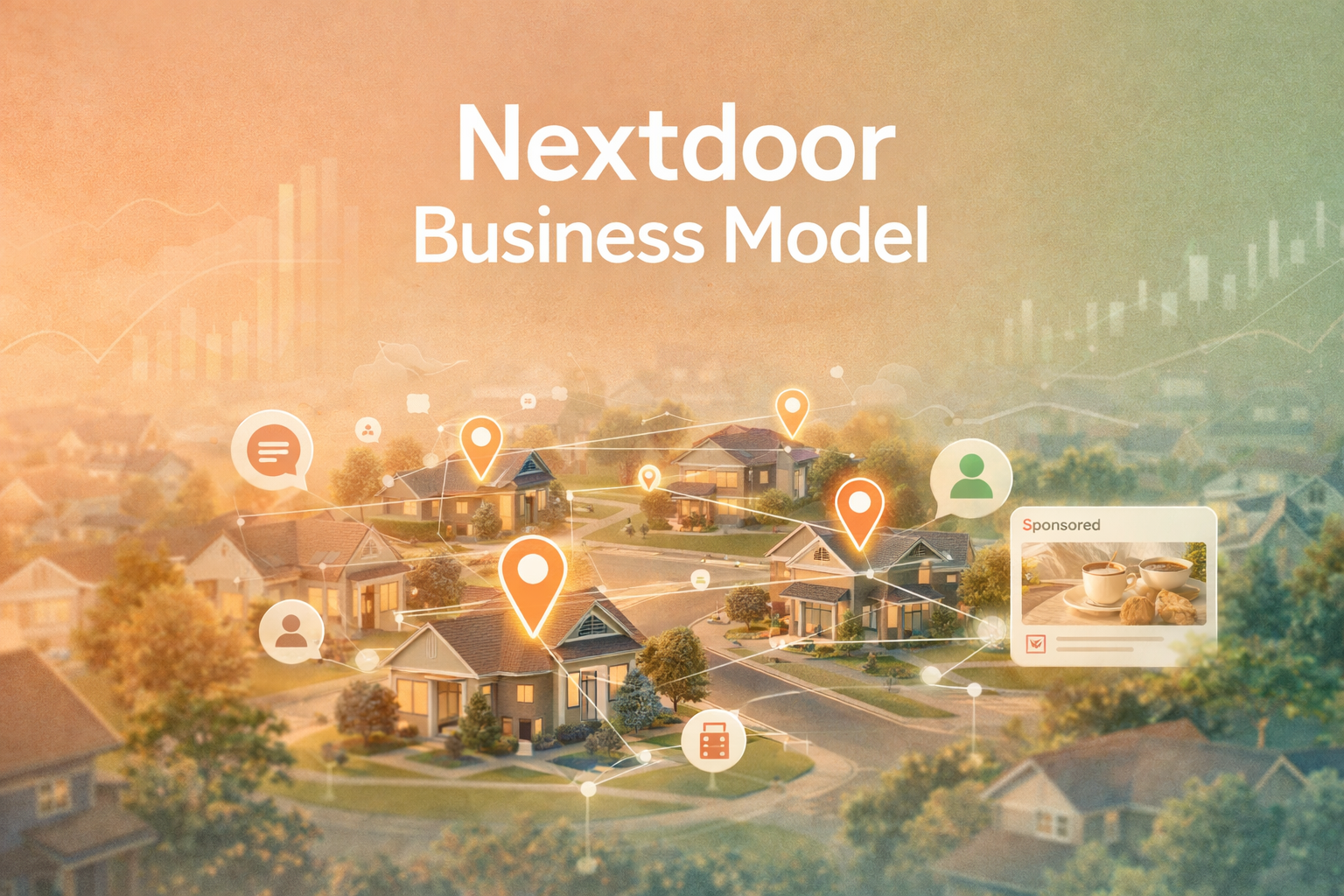

Short answer: Nextdoor makes money mainly through local advertising, sponsored posts, and partnerships with brands and government agencies. It uses its hyperlocal, trust-based network to deliver highly targeted ads to verified neighborhood residents.
If you’ve ever used Nextdoor to find a good plumber or warn neighbors about a suspicious car, you already know how powerful it feels.
But have you ever wondered how does Nextdoor actually make money from all of this?
It’s not charging users. There’s no subscription fee. Yet it’s a publicly traded company with millions of users across 11+ countries.
That’s what makes Nextdoor’s business model so interesting. Let me break it all down for you.
What Is Nextdoor?
Nextdoor is a hyperlocal social network built around neighborhoods.
Unlike Facebook or Twitter, Nextdoor isn’t trying to connect you with the whole world. It connects you with the people who live within a few miles of your home.
It was founded in 2011 by Nirav Tolia and a team of co-founders in San Francisco. The core idea was simple give neighborhoods a private, trusted place to talk.
You can’t just sign up with any address. Nextdoor verifies where you live. That single feature changed everything about how the platform works and how it makes money.
How Nextdoor Works
Getting Started
When you join Nextdoor, you go through a location verification process.
You can verify via postcard, credit card, or phone. This ensures every single user is a real person in a real neighborhood.
That’s a big deal. Most social platforms have fake accounts and bots. Nextdoor’s verified model builds a layer of trust most platforms can’t offer.
Once You’re In
Your feed shows posts from neighbors nearby.
You can discuss local news, ask for recommendations, buy and sell items, report safety concerns, or find lost pets. It feels like a digital version of your neighborhood notice board but smarter.
Local businesses can also create pages, collect reviews, and run ads to reach people within a specific zip code or neighborhood.
Nextdoor Business Model Canvas
Before we get into revenue, let’s look at who Nextdoor serves and what it offers them.
Customer Segments
Nextdoor serves four main groups:
- Residents — everyday users who want to stay connected with their neighborhood
- Local businesses — plumbers, salons, restaurants, real estate agents
- National/enterprise brands — companies wanting to reach specific regions or demographics
- Public agencies — local governments, police departments, emergency services
Value Propositions
For residents: A safe, trusted space to connect with people nearby.
For businesses: Access to a high-intent, verified local audience. If someone in your zip code is looking for a contractor, that’s a warm lead not a random click.
For public agencies: A direct communication channel to reach citizens during emergencies or community updates.
Channels
Nextdoor reaches its users through:
- Mobile app (primary)
- Website
- Email notifications
The app is where most of the action happens. People check it daily for local updates, which keeps engagement high.
How Nextdoor Makes Money – The Core Section
Okay, here’s what you came for. Let’s dig into the actual revenue model.
6.1 Local Advertising — The Primary Revenue Driver
This is where most of Nextdoor’s money comes from.
Local businesses can run geo-targeted ads directly inside the Nextdoor feed. These ads appear to users in a specific neighborhood, zip code, or city.
Imagine you own a pizza shop in Austin, Texas. You can run an ad that only shows to people who live within 5 miles of your location. That’s incredibly powerful targeting.
Sponsored posts work similarly. A local business pays to have their content shown to neighbors who might not already follow them.
The reason this works so well? People on Nextdoor are already in a local mindset. They’re not there to scroll entertainment. They’re looking for local services, deals, and recommendations.
That makes the ad intent much higher than platforms like Instagram or TikTok.
6.2 National and Enterprise Advertising
Big brands want local reach too.
A national home improvement chain might want to target homeowners in suburban zip codes. A major insurance company might want to reach new families in specific cities.
Nextdoor lets these enterprise advertisers run campaigns at scale while still keeping the targeting hyperlocal.
This is a key part of Nextdoor’s pitch to big advertisers — you get national reach with neighborhood-level precision.
That’s a combination most platforms genuinely can’t offer.
6.3 Self-Serve Ads Platform
Not every advertiser has a big marketing budget or a dedicated team.
Nextdoor built a self-serve ad platform for small and mid-sized businesses (SMBs). It’s designed to be simple. You don’t need to be a marketing expert to run an ad.
You pick your neighborhood or zip code, set a budget, write your ad, and launch.
This opened the door for thousands of small local businesses — independent gyms, landscaping companies, home cleaners — who couldn’t afford complex ad platforms.
SMBs are a huge growth driver for Nextdoor. There are millions of them across the U.S. alone, and most of them want to reach local customers without wasting money on national ad waste.
6.4 Partnerships and Civic Solutions
This one is unique to Nextdoor. No other major social platform really does this.
Nextdoor partners with local governments, police departments, and public agencies.
These agencies use Nextdoor to:
- Send emergency alerts
- Share public safety updates
- Announce road closures or community events
- Connect with residents during natural disasters
In the U.S., thousands of public agencies are active on Nextdoor. During wildfires, floods, or crime waves, Nextdoor becomes a critical communication tool.
Some agencies pay for premium features — like the ability to reach all residents in a region quickly, not just those who follow them.
This civic revenue stream is small compared to advertising, but it adds real credibility to the platform. And credibility brings more users. More users bring more advertisers. It’s a flywheel.
Key Features That Drive Revenue
Nextdoor’s business model works because of a few specific features. These aren’t accidents. They’re by design.
Verified Identities
Every user is a real, verified person at a real address.
This makes the audience far more valuable to advertisers. You’re not buying clicks from bots. You’re buying attention from real homeowners, renters, and local consumers.
Hyperlocal Targeting
No other platform can target as precisely by location.
You can reach people in a single neighborhood. Not just a city, not just a state. A specific neighborhood. That level of granularity is extremely valuable for local businesses.
Community Trust
Neighbors trust each other more than they trust influencers or brand accounts.
When a neighbor recommends a plumber on Nextdoor, people listen. That peer trust carries over to businesses that advertise on the platform.
A business with strong reviews and a local presence on Nextdoor benefits from that neighborhood trust in a way that a Facebook ad simply can’t replicate.
Nextdoor’s Competitive Advantage
Let’s be real — Nextdoor operates in a tough space.
Facebook, Craigslist, and Yelp all compete for local attention and local ad dollars. So what makes Nextdoor different?
Network Effects at the Neighborhood Level
Nextdoor doesn’t need to win the whole internet.
It just needs to be the go-to app for your street, your block, your neighborhood. Once it reaches critical mass in a local area, it becomes nearly impossible to replace.
If all your neighbors are already on Nextdoor, you’re going to be on Nextdoor too.
That’s the power of neighborhood-level network effects.
Higher Engagement Compared to Traditional Social Media
People actually pay attention on Nextdoor.
The content is relevant to their daily life — their street, their community, their local businesses. That kind of relevance drives real engagement, not just passive scrolling.
Advertisers care about this. Higher engagement = more attention = better ad performance.
Trust + Proximity = Better Ad Performance
This is Nextdoor’s real secret weapon.
When you combine verified identities + local intent + community trust, you get an advertising environment where ads actually feel helpful, not intrusive.
A plumber ad on Nextdoor feels like a neighbor recommendation. A plumber ad on a random website feels like spam.
That’s a massive difference in how users perceive and respond to ads.
Competitor Comparison
| Platform | Local Focus | Verified Users | Ad Targeting |
|---|---|---|---|
| Nextdoor | Neighborhood-level | Yes | Hyperlocal |
| Facebook Groups | City/interest level | No | Broad to regional |
| Craigslist | City-level | No | No real ad platform |
| Yelp | Business reviews | Partial | Business-category |
Nextdoor’s edge is clear. It’s the only platform that combines real-world identity verification with true neighborhood-level targeting.
Facebook Groups can be local, but they’re not verified. Craigslist has no ad sophistication. Yelp is great for reviews but not for community conversations.
Nextdoor sits in its own lane.
Challenges in Nextdoor’s Business Model
I want to be honest here. It’s not all perfect.
Privacy Concerns
The same thing that makes Nextdoor powerful — knowing exactly where you live — also makes some people uncomfortable.
The platform collects a lot of location data. Users have raised concerns about how that data is stored and used. In a world where people are increasingly cautious about data privacy, this is a real challenge for Nextdoor to manage.
Content Moderation
Nextdoor has faced serious criticism for racially biased reporting behavior among users.
In early years, neighbors were using the “suspicious person” feature to flag people of color without real reason. Nextdoor has worked hard to redesign these features, but it was a significant trust and PR issue.
Content moderation on a hyperlocal platform is tricky. You can’t just let communities self-police, but over-moderating feels invasive too.
Monetization vs. User Experience
More ads = more revenue. But more ads also = worse user experience.
Nextdoor has to walk a careful line. Push too many ads, and you kill the organic neighborhood feeling that makes the platform valuable in the first place.
Finding that balance is an ongoing challenge for any ad-supported social platform — and Nextdoor is no exception.
Future Growth Opportunities
Here’s where things get exciting.
Expanding Into Emerging Markets
Nextdoor is still heavily U.S.-focused.
But the hyperlocal social network concept works anywhere. Countries with dense urban neighborhoods, strong community culture, or limited local media could be huge opportunities.
Europe, Southeast Asia, and Latin America all have massive potential for neighborhood-based platforms.
AI-Powered Local Recommendations
Imagine Nextdoor using AI to surface the exact local business or service you need — before you even ask.
Moving into a new home? AI could proactively suggest the best local contractors, schools, and services based on what your neighbors use and recommend.
This kind of AI-driven personalization could dramatically increase both user value and ad revenue.
Local E-Commerce Integration
Nextdoor already has a basic marketplace feature for buying and selling.
But there’s a much bigger opportunity here — deep local e-commerce.
Think same-day delivery from neighborhood businesses. Local grocery orders. Commission on neighborhood transactions. If Nextdoor can build a robust local commerce layer, it unlocks an entirely new revenue stream.
Conclusion: The Quick Summary
Here’s the simple version, if you want to skip to the end:
- Nextdoor makes money primarily through local advertising geo-targeted ads and sponsored posts aimed at verified neighborhood residents
- It also earns from national brands wanting regional, hyperlocal reach
- Its self-serve ad platform opens the door for small businesses to advertise affordably
- Civic partnerships with governments and public agencies add a unique, trust-building revenue stream
- The combination of verified identities, hyperlocal targeting, and community trust gives Nextdoor an advertising advantage that’s hard to copy
Nextdoor isn’t the biggest social network. It probably never will be.
But it doesn’t need to be. It just needs to be the most trusted one in your neighborhood. And that’s a business model worth paying attention to.
Frequently Asked Questions (FAQs)
Yes. Nextdoor is completely free for residents. The platform makes money from businesses and advertisers, not regular users.
As of recent financial reporting, Nextdoor has been working toward profitability. It went public via SPAC in 2021 and has been focused on growing revenue while managing costs. Like many social platforms, profitability at scale remains a key goal.
Facebook Groups, Craigslist, and Yelp are the closest competitors. But none of them offer the same combination of verified users, neighborhood-level targeting, and community trust that Nextdoor does.
It varies. Local business ads can start with small budgets sometimes as low as a few hundred dollars. National enterprise campaigns cost significantly more. The self-serve platform lets SMBs set their own budgets.
Discover more from Business Model Hub
Subscribe to get the latest posts sent to your email.