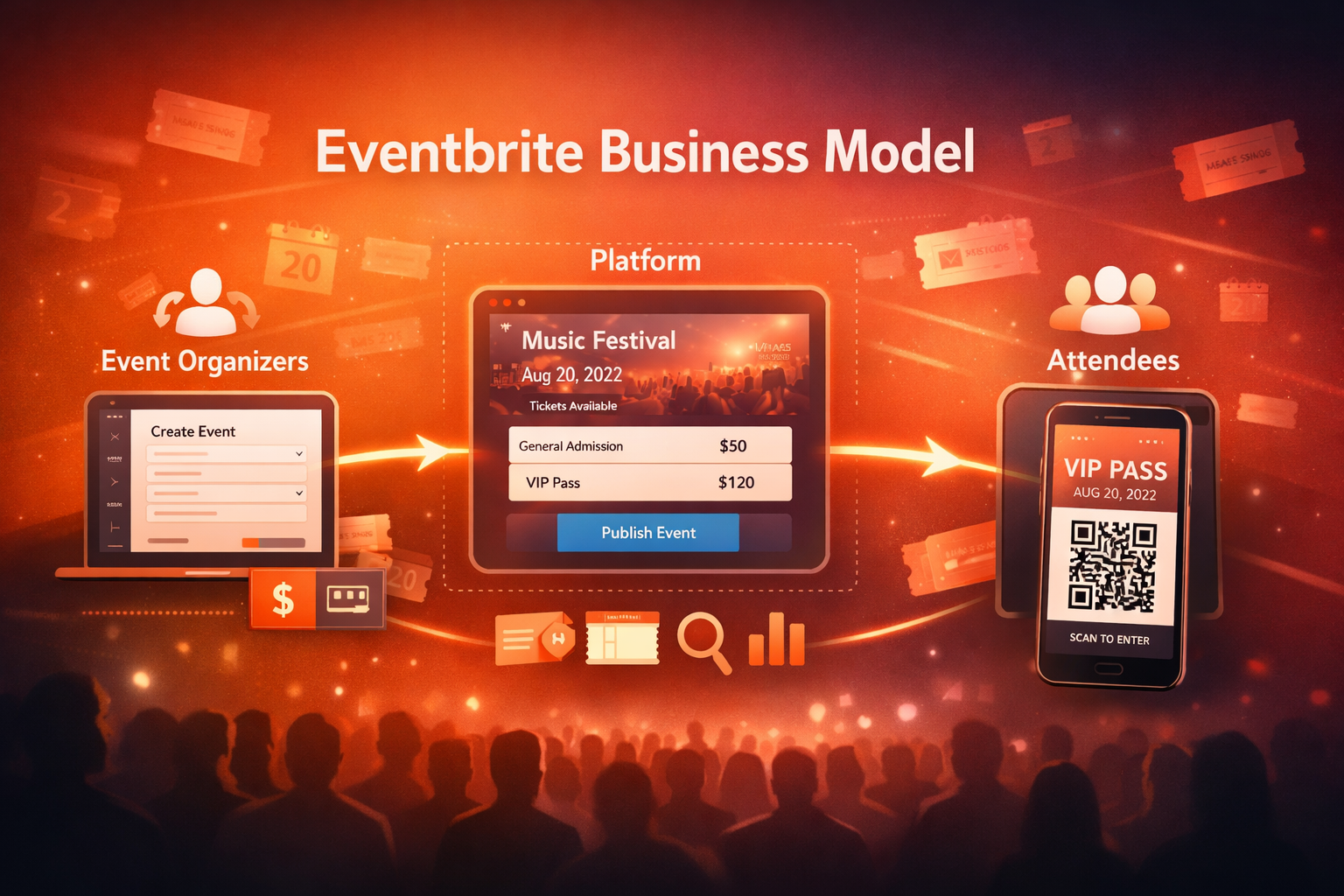

Eventbrite is a two-sided marketplace. It connects event organizers with attendees and makes money through ticketing fees, service charges, and payment processing fees. Simple, powerful, and surprisingly smart.
Let me be honest with you.
When most people think of Eventbrite, they think “oh, it’s just a ticketing app.” But that’s like saying Amazon is just an online store.
Eventbrite is way more than that. It’s a full marketplace a platform where supply meets demand every single day. And the business model behind it? Pretty clever once you break it down.
Let’s dig in.
What Is Eventbrite?
Eventbrite launched in 2006. Julia Hartz, Kevin Hartz, and Renaud Visage built it to solve one annoying problem: organizing events is hard.
Think about it. Before Eventbrite, event organizers had to deal with:
- Building a registration page from scratch
- Collecting payments manually
- Tracking attendees in spreadsheets
- Promoting on their own with zero tools
It was a mess. Eventbrite cleaned it all up in one place.
Today, it’s used by millions of event organizers worldwide from local yoga teachers to big corporate conferences. And on the other side, millions of attendees use it to discover and book events near them.
It solves a real problem for two very different groups. That’s the foundation of a great marketplace.
How Eventbrite Actually Works
Let me walk you through both sides of the platform.
For Organizers (The Supply Side)
Here’s how simple it is:
- Create your event page
- Set ticket prices (free or paid)
- Publish the event
- Promote it through Eventbrite and your own channels
- Manage attendees and check-ins on the day
That’s it. No coding. No payment setup. No complex software.
A first-time event organizer can get up and running in under 30 minutes. That’s a massive unlock for small creators and businesses.
For Attendees (The Demand Side)
On the other side:
- Browse or search for events
- Book a ticket
- Get a digital confirmation (email or app)
- Show up and enjoy
The experience is clean and fast. Eventbrite removed all the friction from both sides. That’s why it grew so fast.
The Core Business Model: Marketplace Logic
Here’s the big picture.
Eventbrite is a two-sided platform. One side is event creators. The other side is event-goers. Eventbrite sits in the middle and facilitates the transaction.
| Side | Who They Are | What They Want |
|---|---|---|
| Supply | Organizers | Reach + tools + easy payments |
| Demand | Attendees | Discovery + convenience + trust |
Eventbrite gives both sides exactly what they need.
Organizers get a built-in audience and powerful tools. Attendees get a safe, easy way to find and book events.
Key insight: Eventbrite isn’t just a ticketing tool. It’s a demand-generation engine for events.
That’s a subtle but important difference. When you list an event on Eventbrite, you’re not just using software — you’re tapping into a platform that millions of people already search on.
How Eventbrite Makes Money
This is where it gets interesting.
1. Ticketing Fees
Every time a paid ticket is sold, Eventbrite takes a cut. This is usually a percentage of the ticket price. It varies based on the region and plan type.
For example, in the US, Eventbrite charges around 3.7% + $1.79 per ticket for paid events (numbers vary by plan).
The organizer can choose to absorb this fee or pass it on to the attendee. That flexibility matters a lot to creators.
2. Service Fees
On top of ticketing fees, Eventbrite also charges service fees per transaction. These are additional fixed or variable charges that cover platform usage.
Think of it as the “platform tax” for using Eventbrite’s infrastructure.
3. Payment Processing Fees
Every digital transaction has a processing cost. Eventbrite charges around 2.9% + $0.30 per order to cover this.
These three fee types stack together. On a $50 ticket, Eventbrite might collect $3–6 in total fees. It doesn’t sound like much. But multiply that by millions of tickets — and it adds up fast.
4. Premium Plans and Add-Ons
Eventbrite has a free tier — but to unlock the full power of the platform, organizers upgrade.
Premium features include:
- Advanced analytics (understand your audience better)
- Email marketing tools (reach past attendees)
- Reserved seating maps (great for conferences and concerts)
- Custom branding (remove Eventbrite’s logo)
This is a classic freemium model. Get organizers hooked on the free version. Then upsell them on tools that save time and grow their events.
5. Flexible Fee Structure
One smart design choice: Eventbrite lets organizers decide who pays the fees.
Option A: Organizer absorbs the fee (ticket price stays clean for buyers).
Option B: Fees are passed to the attendee (organizer keeps the full ticket revenue).
This flexibility removes a major objection from organizers. They don’t feel “forced” to swallow costs they don’t want to.
Key Features That Drive Growth
Eventbrite’s model works because the product is genuinely useful. Here’s what makes it sticky:
Discovery Engine
Eventbrite isn’t just a hosting platform. It’s a search engine for events.
When you search “comedy shows in Austin” or “startup networking NYC” — Eventbrite pages often rank on Google’s first page.
That organic traffic is gold for organizers. They get visibility they couldn’t build on their own.
Marketing Tools
Paid plan users get access to email campaigns, social sharing tools, and retargeting features. This helps organizers promote events without needing a separate marketing stack.
Mobile Experience
The Eventbrite app handles everything on event day. Ticket scanning, real-time check-ins, capacity management. It’s the kind of tool that makes organizers look professional — even if it’s their first event.
Analytics Dashboard
Organizers can track ticket sales, audience demographics, and revenue in real time.
Data is a big reason people stay on Eventbrite. Once you’ve built a history of events and audience data on the platform — leaving feels risky.
Who Uses Eventbrite? (Customer Segments)
Event Creators
- Small business owners hosting workshops
- Artists and musicians selling show tickets
- Corporate teams organizing conferences
- Nonprofits running fundraising events
- Community builders hosting meetups
The common thread? They all want to run an event without becoming a tech company.
Attendees
- Curious local residents exploring what’s nearby
- Professionals looking for networking events
- Hobbyists finding niche communities (running clubs, book clubs, etc.)
- Travelers looking for unique experiences in a new city
Both groups are massive. And both groups benefit from the same platform. That’s the beauty of a well-designed marketplace.
Value Proposition: Why People Choose Eventbrite
For Organizers
- Zero technical setup — just fill in a form and you’re live
- Built-in audience — Eventbrite brings discovery to you
- Payments handled — no merchant account needed
- Tools that scale — works for 50-person workshops and 5,000-person conferences
For Attendees
- One place to find all kinds of events
- Secure checkout — no sketchy payment pages
- Easy refunds and ticket management
- Reminders and event updates
Both groups feel the value immediately. That’s why the platform grew through word of mouth for years.
The Growth Strategy: What Really Drives Scale
The Marketplace Flywheel
Here’s the core growth loop:
More events → more attendees → more data → more organizers → more events.
Once this loop starts spinning, it’s hard to stop. Each new event makes the platform more valuable to attendees. Each new attendee makes the platform more attractive to organizers.
This is the marketplace flywheel. It’s one of the most powerful growth engines in tech.
Eventbrite built this flywheel early — and it’s a huge part of why they’re still the default choice for independent event organizers.
SEO as a Growth Channel
This one is underrated.
Every event page on Eventbrite is a public, indexed web page. Thousands of event pages go live every day. Eventbrite’s domain authority is massive — so those pages rank well on Google.
That means organizers get free organic traffic without doing any SEO themselves.
Eventbrite essentially built a content machine powered by its own users. Every new event is a new SEO asset.
Community-Led Growth
Local events build local habits. When someone attends a great Eventbrite event in their city, they come back to check for more.
Over time, Eventbrite becomes the default discovery layer for local experiences. That’s a habit that’s hard to break.
Partnerships and Integrations
Eventbrite integrates with:
- Facebook and Instagram (for social sharing and discovery)
- Mailchimp (for email marketing)
- Stripe and PayPal (for payments)
- Zoom and other platforms (for virtual events)
These integrations make the platform stickier. Organizers don’t need to leave Eventbrite’s ecosystem to run a full event.
Competitive Moat: Why Eventbrite Is Hard to Beat
Let’s be real — building a ticketing tool isn’t hard. There are dozens of competitors.
So why does Eventbrite still dominate the independent events space?
Four things protect them:
- Brand recognition — when people think “event ticketing,” they think Eventbrite
- Supply volume — millions of events means millions of reasons for attendees to visit
- Network effects — more events attract more attendees; more attendees attract more organizers
- Distribution advantage — SEO presence + app store presence + social integrations
Founder insight: Switching costs are low — but distribution advantage is the real moat.
Any organizer can technically switch to a competitor. But they’d lose their Eventbrite event history, audience data, and organic search traffic. That’s a real cost — even if it feels invisible.
Competitors: Who’s Trying to Take Eventbrite’s Place?
| Competitor | Strength | Weakness |
|---|---|---|
| Ticketmaster | Live nation scale | Not friendly to indie organizers |
| Meetup | Community focus | Limited ticketing features |
| Facebook Events | Massive reach | No ticketing infrastructure |
| Cvent | Enterprise events | Too complex for small creators |
None of them perfectly replace Eventbrite for the independent creator segment. That’s the gap Eventbrite owns.
The Challenges: Where the Model Breaks Down
No business model is perfect. Here are Eventbrite’s real weaknesses:
Dependence on Event Volume
Eventbrite’s revenue is directly tied to how many events happen. During COVID-19, live events collapsed — and so did Eventbrite’s revenue. They laid off a significant portion of their team.
This is a concentration risk. When the world stops going outside, Eventbrite bleeds.
Low Switching Costs
I mentioned this earlier. Organizers can leave. Tools like Luma, Splash, and even Stripe + a landing page can replace Eventbrite’s basic features.
The platform needs to keep improving to stay relevant.
High Competition
Free tools are everywhere. Many organizers ask: why pay Eventbrite fees when I can collect payments via PayPal and manage RSVPs on Google Forms?
Eventbrite’s answer has to be: we give you distribution, not just tools. But that argument weakens if their discovery engine loses traffic.
Profitability Has Been a Struggle
Historically, Eventbrite has not been consistently profitable. They went public in 2018. They’ve focused heavily on cutting costs and doubling down on their creator ecosystem.
Profitability depends on event volume, fee optimization, and how many organizers move to paid plans.
How Eventbrite Has Evolved
Eventbrite didn’t start out with all these features. Let’s see how it grew:
2006–2012: Basic ticketing and registration. Simple, focused product.
2013–2016: Expanded into event discovery. Built the mobile app.
2017–2019: Added marketing tools. Went public. Launched Eventbrite Music for concerts.
2020: COVID-19 hit hard. Pivoted fast to virtual events.
2021–present: Rebuilt focus on independent creators. Simplified pricing. Added more self-service tools.
The lesson? They evolved with their creators. They didn’t stick to one product idea. They listened and adapted.
Key Metrics That Matter
If you were running Eventbrite, these are the numbers you’d obsess over:
- Number of events hosted — health of supply side
- Tickets sold — volume of transactions
- Gross Ticket Value (GTV) — total revenue flowing through the platform
- Revenue per event — monetization efficiency
- Active creators — retention of organizers
The most important metric? Probably active creators. If organizers keep coming back to host events, everything else follows.
The Future of Eventbrite (2026 and Beyond)
Here’s where things get interesting.
Hybrid events are the new normal. Post-COVID, many events now have both in-person and online components. Eventbrite needs to be the go-to platform for both.
AI-powered recommendations are coming. Imagine Eventbrite suggesting the perfect networking event based on your job title, interests, and past attendance. That’s a killer feature waiting to happen.
Creator-focused monetization is the smart play. Indie creators are the heart of Eventbrite. Giving them better tools to grow and monetize their audience is the right direction.
Niche community expansion is a huge opportunity. Fitness, gaming, cooking, professional development — there are thousands of micro-communities that run events. Owning those niches is worth billions.
Final Takeaway: What Founders Can Learn from Eventbrite
Eventbrite is a textbook marketplace business. It’s not flashy. It’s not AI-first. But it works because it solved a real problem for two real groups of people — and built a flywheel that keeps spinning.
The biggest lesson?
Don’t just build a tool. Build a platform where supply meets demand.
A tool replaces one task. A platform creates a new ecosystem. Tools get replaced. Platforms become habits.
Eventbrite monetizes transactions and attention. Every ticket sold is a transaction fee. Every event page is an SEO asset. Every attendee is a future buyer. That’s the model.
Simple. Scalable. Smart.
Summary
- Eventbrite is a two-sided marketplace for events
- Makes money via ticketing fees, service fees, and processing charges
- Grows through marketplace flywheel, SEO, and community habits
- Real moat is distribution advantage, not just product features
- Faces challenges from low switching costs and event-volume dependence
- Future lies in hybrid events, AI recommendations, and niche communities
FAQs
Yes, for free events. For paid events, Eventbrite charges ticketing and processing fees. Organizers can absorb or pass on these fees.
It doesn’t free events don’t generate ticketing revenue. But free events bring attendees to the platform, which builds the discovery engine that attracts paid event organizers.
It’s been a struggle historically. Eventbrite has focused on cost-cutting and creator-focused growth. Profitability depends heavily on event volume and plan upgrades.
Ticketmaster dominates large venues. Meetup owns community events. Facebook Events has reach but no real ticketing. For independent creators, Eventbrite still leads.
Eventbrite uses a two-sided marketplace (platform) business model, combined with a transaction-based revenue model.
Discover more from Business Model Hub
Subscribe to get the latest posts sent to your email.


[…] Eventbrite focuses on one-off events and ticket sales rather than recurring community building. It monetizes differently, primarily through ticketing fees charged to organizers per transaction. Meetup is subscription-based and community-focused. They serve overlapping but distinct use cases. […]