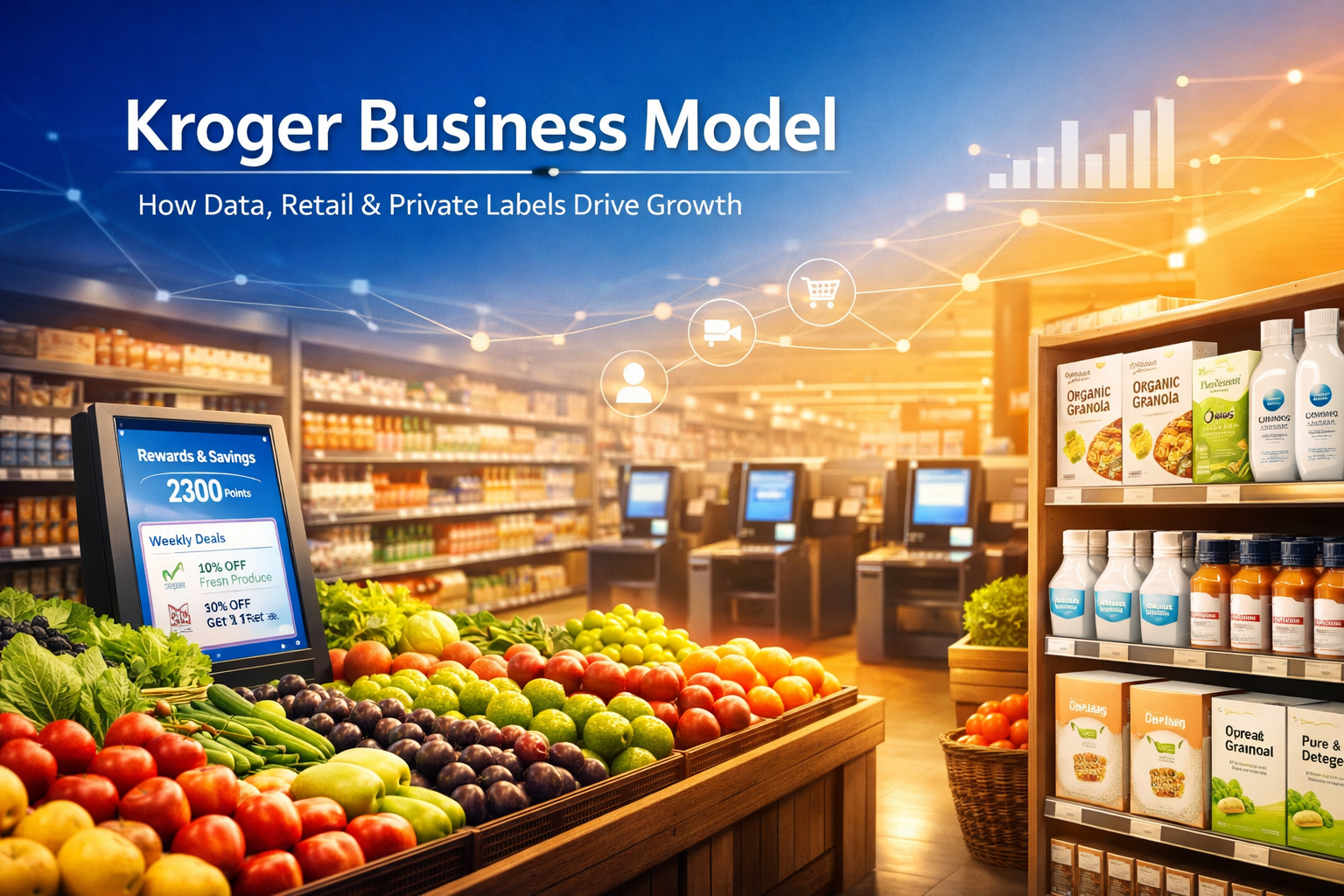
Kroger Business Model And How America’s Largest Supermarket Chain Really Makes Money

Kroger is not just a grocery store. It is a data company, a media platform, a pharmacy network, and a private label powerhouse all wrapped inside a supermarket.
At its core, Kroger operates a retail grocery business model built on high-volume, low-margin product sales. But the real money comes from layering high-margin revenue streams on top of that foundation. These include private label brands, customer loyalty data monetization, retail media advertising, and vertically integrated supply chains.
The company’s secret weapon is simple: it collects data from 60 million+ households every time someone swipes their Kroger Plus card and uses that data to generate revenue from advertisers, suppliers, and personalized promotions.
Selling groceries is how Kroger gets customers in the door. Data, private labels, and advertising is how it actually makes money.
Company Overview
Kroger was founded in 1883 by Barney Kroger in Cincinnati, Ohio. Starting with a single store, Kroger grew over 140 years into the largest supermarket chain in the United States.
Quick Facts:
- Founded: 1883, Cincinnati, Ohio
- Stores: 2,700+ across 35 US states
- Employees: ~430,000
- Annual Revenue: $150B+
- Stock: NYSE: KR
Key store banners under the Kroger umbrella:
- Kroger
- Fred Meyer
- Harris Teeter
- King Soopers
- Ralphs
- Mariano’s
- Smith’s Food and Drug
Each banner operates with some regional autonomy but shares Kroger’s centralized supply chain, loyalty infrastructure, and data systems.
Core Business Model: How Kroger Makes Money
1. Retail Grocery Sales
This is the foundation. Kroger sells food, beverages, household goods, and personal care products across its 2,700+ stores.
Key categories include:
- Fresh produce, meat, and dairy
- Packaged and frozen foods
- Household and cleaning products
- Baby and personal care items
- Organic and natural foods
Grocery retail is a razor-thin margin business. Net margins hover around 1.5 to 2 percent. Volume is everything. Kroger compensates for thin margins by layering in higher-margin revenue streams on top of grocery sales.
2. Private Label Brands
This is one of Kroger’s most profitable plays.
Kroger owns a full portfolio of store brands that sit alongside national brands on shelves but carry significantly higher margins. Customers pay less than national brands, but Kroger earns far more per unit sold.
Kroger’s private label portfolio:
- Simple Truth — organic and natural products, now a $3B+ brand
- Kroger Brand — everyday essentials at value pricing
- Private Selection — premium tier products
- HemisFares — international and specialty foods
- Home Chef — meal kit and prepared food line
Private label products typically carry gross margins of 25 to 35 percent compared to 10 to 15 percent on national brands. The more customers buy store brands, the more profitable each transaction becomes.
3. Pharmacy and Health Services
Kroger operates more than 2,200 in-store pharmacies, making it one of the largest pharmacy chains in the country.
Revenue streams within this segment:
- Prescription drug sales
- Over-the-counter medications
- Immunizations and health screenings
- Specialty pharmacy services
The pharmacy drives repeat visits on a schedule. Customers picking up prescriptions often add groceries to their basket, increasing average transaction value.
4. Fuel Centers
Kroger operates approximately 1,600 fuel centers attached to its stores.
Fuel is not a high-margin business on its own. The real value is strategic. Kroger’s fuel rewards program ties fuel discounts to grocery spending, which:
- Incentivizes larger grocery baskets
- Drives repeat store visits
- Deepens loyalty program engagement
Customers earn fuel points by spending on groceries, pharmacy, and gift cards. It is one of the most effective loyalty mechanics in retail.
Business Model Canvas
1. Key Partners
- CPG and FMCG Suppliers (P&G, Unilever, Kraft Heinz, Nestle) for product supply
- Ocado Group for robotics-powered e-commerce fulfillment infrastructure
- Microsoft Azure for cloud computing and AI capabilities
- Mastercard for the Kroger Rewards co-branded credit card
- Brand Advertisers who pay to appear on Kroger Precision Marketing
2. Key Activities
- Grocery retail operations across physical and digital channels
- Private label product development and manufacturing
- Customer data collection, processing, and monetization via 84.51
- Supply chain management across 40+ distribution centers
- Retail media advertising through Kroger Precision Marketing
- Pharmacy dispensing and healthcare services
- E-commerce order fulfillment via Ocado Customer Fulfillment Centers
3. Key Resources
- Store network: 2,700+ locations across 35 states
- Loyalty database: 60M+ household profiles via Kroger Plus
- 84.51: Proprietary data analytics subsidiary
- Manufacturing plants: 35+ owned facilities for private label production
- Distribution network: 40+ warehouses and logistics centers
- Kroger Precision Marketing: First-party retail ad platform
- Brand equity: 140 years of consumer trust
4. Value Propositions
For everyday shoppers:
- One-stop shop for groceries, pharmacy, and fuel
- Personalized deals and digital coupons based on purchase history
- Fuel rewards that reduce gas bills
For health-conscious consumers:
- Simple Truth organic and natural product line
- In-store pharmacy and immunization services
For budget shoppers:
- Kroger Brand private label at lower price points than national brands
For CPG brand advertisers:
- Access to first-party purchase data from 60M+ households
- Highly targeted, measurable ad placements via KPM
For suppliers:
- Shelf space and promotional access to one of the largest shopper networks in the US
5. Customer Segments
- Mass-market grocery shoppers (primary segment)
- Health and wellness consumers seeking organic and natural options
- Budget-conscious families prioritizing value
- Pharmacy and healthcare customers using in-store services
- CPG and FMCG brands as B2B advertising clients
- Suppliers seeking consumer insights from 84.51
6. Customer Relationships
Kroger invests heavily in building sticky, long-term customer relationships.
Key mechanisms:
- Kroger Plus Card: The foundation. Members get personalized discounts and earn fuel points with every purchase.
- Digital coupons via the Kroger app: Clip and save coupons tied directly to your loyalty profile.
- Fuel Points program: Gamified savings loop. Spend more groceries, save more on gas.
- Boost by Kroger: Paid delivery subscription offering free delivery and extra fuel points.
- Prescription auto-refill: Keeps pharmacy customers returning automatically.
Each touchpoint generates more data, which feeds back into better personalization, which deepens loyalty further.
7. Channels
Physical:
- 2,700+ supermarkets in various formats (standard, multi-department, marketplace)
- 1,600+ fuel centers
- 2,200+ in-store pharmacies
Digital:
- Kroger.com for online grocery ordering
- Kroger mobile app for coupons, ordering, and loyalty management
- Kroger Delivery powered by Ocado CFCs
Third-Party:
- Instacart for same-day delivery
- DoorDash for on-demand orders
8. Revenue Streams
| Revenue Stream | Type | Margin Profile |
|---|---|---|
| Grocery and merchandise sales | Product sales | Low (~2%) |
| Private label products | Product sales | High (~25-35%) |
| Pharmacy sales | Product + service | Medium |
| Fuel sales | Product sales | Low-medium |
| Kroger Precision Marketing | Advertising | Very high (~70%) |
| Kroger Personal Finance | Financial services | Medium-high |
| 84.51 supplier insights | Data and analytics | High |
| Boost subscription | Subscription | Medium |
The magic of Kroger’s model is this: grocery volume brings the customers, but the high-margin streams (ads, data, private label) deliver the real profit.
9. Cost Structure
Major cost categories:
- Cost of goods sold (COGS): Largest single cost. Includes all product inventory across 2,700+ stores.
- Labor and wages: ~430,000 employees, many covered by union agreements.
- Store operations: Rent, utilities, equipment, and maintenance for thousands of locations.
- Logistics and distribution: Running 40+ distribution centers and a national delivery fleet.
- Technology and digital: Ongoing capex for Ocado CFC buildout, app development, and cloud infrastructure.
- Marketing and promotions: Loyalty program discounts, fuel rewards, and digital coupon redemptions.
Kroger operates on thin EBITDA margins in its core grocery business. This is why growing high-margin revenue lines like retail media and private label is critical to the overall financial health of the business.
The Loyalty and Data Flywheel
This is Kroger’s most underappreciated asset and its most powerful competitive moat.
How It Works
- Customer shops at Kroger and uses their Plus card
- Purchase data is captured at the item level
- 84.51 analyzes that data to build a rich household profile
- Kroger uses the profile to serve personalized deals and coupons
- Customer sees relevant offers and shops more frequently
- More data is collected, making the profile even richer
- Advertisers and suppliers pay Kroger to access those insights
The loop compounds over time. The more data Kroger collects, the better the personalization. The better the personalization, the more loyal the customer. The more loyal the customer, the more valuable the data becomes to advertisers.
84.51: Kroger’s Data Engine
84.51 is Kroger’s wholly owned data analytics subsidiary. The name refers to the longitude of Kroger’s Cincinnati headquarters.
What 84.51 does:
- Analyzes purchase behavior from 60M+ households
- Builds predictive models for customer behavior
- Helps Kroger’s own merchants make smarter buying and pricing decisions
- Sells insights to CPG brands so they can understand their actual shoppers
- Powers the personalization engine behind Kroger’s digital coupons
84.51 operates almost like a data-as-a-service business sitting inside a supermarket. This is an extremely high-margin revenue stream that most grocery competitors simply do not have.
Kroger Precision Marketing (KPM)
KPM is Kroger’s retail media network. It allows brands to advertise directly to Kroger shoppers using first-party purchase data for targeting.
Why it matters to advertisers:
- Targeting is based on actual purchase behavior, not cookies or demographics
- Ads can be linked directly to in-store or online sales for closed-loop measurement
- CPG brands can reach buyers of competitive products with switch offers
Retail media is one of the fastest-growing ad categories in the world. Kroger sits alongside Walmart Connect and Amazon Advertising as a top-tier retail media network in the US.
KPM margins are estimated at 60 to 70 percent. It is by far the highest-margin revenue stream in Kroger’s portfolio.
Private Label Strategy
Kroger’s private label operation is genuinely one of the best in American retail.
The Portfolio
- Simple Truth: Organic and natural line. Became a standalone $3B+ brand. One of the largest natural food brands in the US.
- Kroger Brand: The everyday staples tier. Designed to undercut national brand prices while maintaining quality.
- Private Selection: Premium positioning. Competes with specialty and gourmet offerings.
- HemisFares: International foods and global flavors.
- Home Chef: Meal kits and ready-to-cook products, expanding into prepared foods.
Why Private Label Wins
- Higher margins per unit than national brands
- Builds direct brand loyalty to Kroger rather than to CPG companies
- Insulates Kroger from national brand price increases
- Data from 84.51 tells Kroger exactly where customers want a private label alternative
Post-pandemic, private label perception has shifted significantly. Consumers no longer view store brands as inferior. Simple Truth in particular has achieved genuine brand equity on its own.
Supply Chain and Vertical Integration
Kroger controls more of its supply chain than most grocery competitors.
Manufacturing
Kroger owns and operates 35+ manufacturing and processing plants, including:
- Dairy processing facilities
- Bakeries and deli production
- Grocery and packaged goods plants
- Meat processing operations
Owning manufacturing gives Kroger cost control, quality assurance, and speed-to-shelf advantages for private label products.
Distribution
- 40+ distribution centers nationwide
- Dedicated logistics fleet
- Fresh and temperature-controlled supply chain for perishables
Ocado Partnership
In 2018 Kroger partnered with UK-based Ocado to build a network of highly automated Customer Fulfillment Centers (CFCs) across the United States.
These robotic warehouses:
- Use AI-driven robotic systems to pick and pack online grocery orders
- Operate at significantly lower labor costs than manual fulfillment
- Enable faster and more accurate home delivery
The Ocado partnership is Kroger’s bet on winning the e-commerce grocery race at scale.
Digital and E-Commerce Strategy
Grocery e-commerce is no longer optional. Kroger is investing aggressively to compete.
Key Digital Assets
- Kroger.com and mobile app: Core online ordering platforms with millions of active users
- Boost by Kroger: Subscription membership. Annual or monthly fee. Benefits include free delivery and 2x fuel points.
- Digital coupons: Personalized offers clipped directly to loyalty accounts via the app
- In-store pickup: Available at most locations
E-Commerce Challenges
- Grocery delivery unit economics are brutal
- Competing with Amazon Fresh and Walmart+ on speed and pricing is expensive
- The Ocado CFC buildout requires significant capital expenditure
Kroger’s strategy is to win on personalization and loyalty, not just price and speed.
Competitive Positioning
| Factor | Kroger | Walmart | Amazon Fresh | Aldi |
|---|---|---|---|---|
| Store Count | High | Very High | Low | Growing |
| Private Label | Very Strong | Strong | Moderate | Very Strong |
| Loyalty and Data | Best in class | Strong | Strong | Minimal |
| Retail Media | Very Strong | Very Strong | Best in class | None |
| E-Commerce | Growing | Strong | Strong | Minimal |
| Price Competitiveness | Moderate | Very Strong | Moderate | Very Strong |
Kroger’s clearest advantage over Walmart is the depth of its loyalty data and the maturity of KPM. Its advantage over Amazon is its physical store footprint and established customer trust. Its disadvantage against Aldi and Lidl is on pure price.
Financial Snapshot
Revenue: $150B+ annually, making Kroger one of the 10 largest companies in the US by revenue.
Net margin: ~1.5 to 2 percent on core grocery. This sounds thin but generates $2 to 3B in net income on the volume.
Why margins are thin in core grocery:
- Intense price competition
- High labor and logistics costs
- Perishables shrinkage
- Promotional and loyalty program spend
Where real profit comes from:
- Private label products (25 to 35% gross margin)
- Kroger Precision Marketing (~70% margin)
- 84.51 data services (high margin)
- Pharmacy (medium-high margin)
- Kroger Personal Finance (financial services margins)
The strategic implication is clear: Kroger uses grocery volume as customer acquisition. The ancillary high-margin businesses are where value is actually created.
Growth Strategy and Future Outlook
1. Scaling Kroger Precision Marketing
Retail media is growing at 20%+ annually industry-wide. Kroger is investing to grow KPM into one of the top 3 retail media networks in the US alongside Walmart Connect and Amazon Advertising.
2. Expanding Ocado CFCs
Kroger continues to roll out automated fulfillment centers to improve delivery economics and scale its e-commerce operation nationally.
3. AI and Personalization
Investment in AI tools across:
- Dynamic pricing
- Demand forecasting
- Personalized marketing at scale
- Supply chain optimization
4. Post-Albertsons Strategy
Kroger’s attempted $25B merger with Albertsons was blocked by regulators in 2024. The focus now shifts to:
- Organic store growth
- Improving existing store performance
- Investing the capital that would have gone to acquisition into digital and supply chain
5. Health and Wellness Expansion
Growing the pharmacy and health services segment as a higher-margin complement to grocery retail.
Challenges and Risks
Razor-Thin Core Margins
Any disruption to volume, whether from competition, recession, or consumer behavior shifts, hits the bottom line quickly.
Labor Costs and Union Relations
Kroger employs hundreds of thousands of unionized workers. Wage negotiations are frequent, and labor costs are rising across the board.
Competition from All Sides
- Walmart: Wins on price and scale
- Amazon: Wins on convenience and Prime ecosystem
- Costco: Wins on bulk value and loyalty
- Aldi and Lidl: Win on ultra-low pricing and efficient private label
Regulatory Scrutiny
The failed Albertsons deal signals that regulators are watching grocery consolidation closely. Future M&A will face headwinds.
Consumer Price Sensitivity
Inflation has pushed more consumers toward discount formats. Kroger must compete on price without destroying its margin structure.
Key Takeaways
Kroger’s business model is far more sophisticated than it appears from the outside.
Here is the one-paragraph summary:
Kroger is a grocery retailer that uses its massive store footprint and loyalty program to collect purchase data from 60M+ households, which it monetizes through retail media advertising (KPM) and supplier analytics (84.51), while simultaneously capturing higher margins through its private label brand portfolio and vertically integrated manufacturing. Grocery sales bring the traffic. Data, private label, and advertising deliver the profit.
The five pillars of Kroger’s moat:
- Scale: 2,700+ stores and national brand recognition
- Loyalty data: 60M+ household profiles built over decades
- Private label: $3B+ Simple Truth brand and a full portfolio of owned products
- Retail media: KPM as a 70% margin revenue line
- Vertical integration: Owned manufacturing and a growing automated fulfillment network
Frequently Asked Questions
Kroger earns revenue primarily from grocery retail but generates its best margins from private label products, retail media advertising, pharmacy services, and customer data monetization.
Through Kroger Precision Marketing (advertising), 84.51 data analytics services sold to CPG brands, private label manufacturing, fuel centers, pharmacy, and financial services.
84.51 is Kroger’s wholly owned data analytics subsidiary. It analyzes purchase behavior from 60M+ loyalty program households and sells insights to consumer goods brands. The name references the longitude of Kroger’s Cincinnati, Ohio headquarters.
KPM is Kroger’s retail media network. It allows brands to advertise to Kroger shoppers using first-party purchase data for targeting. It is one of the highest-margin businesses in Kroger’s portfolio.
The main ones are Simple Truth (organic/natural), Kroger Brand (everyday value), Private Selection (premium), HemisFares (international), and Home Chef (meal kits and prepared foods).
Customers sign up for a free Kroger Plus card. Every purchase earns fuel points redeemable at Kroger fuel centers. The card also unlocks personalized digital coupons and exclusive member pricing. Kroger uses the data to improve personalization and sell advertising to CPG brands.
Discover more from Business Model Hub
Subscribe to get the latest posts sent to your email.