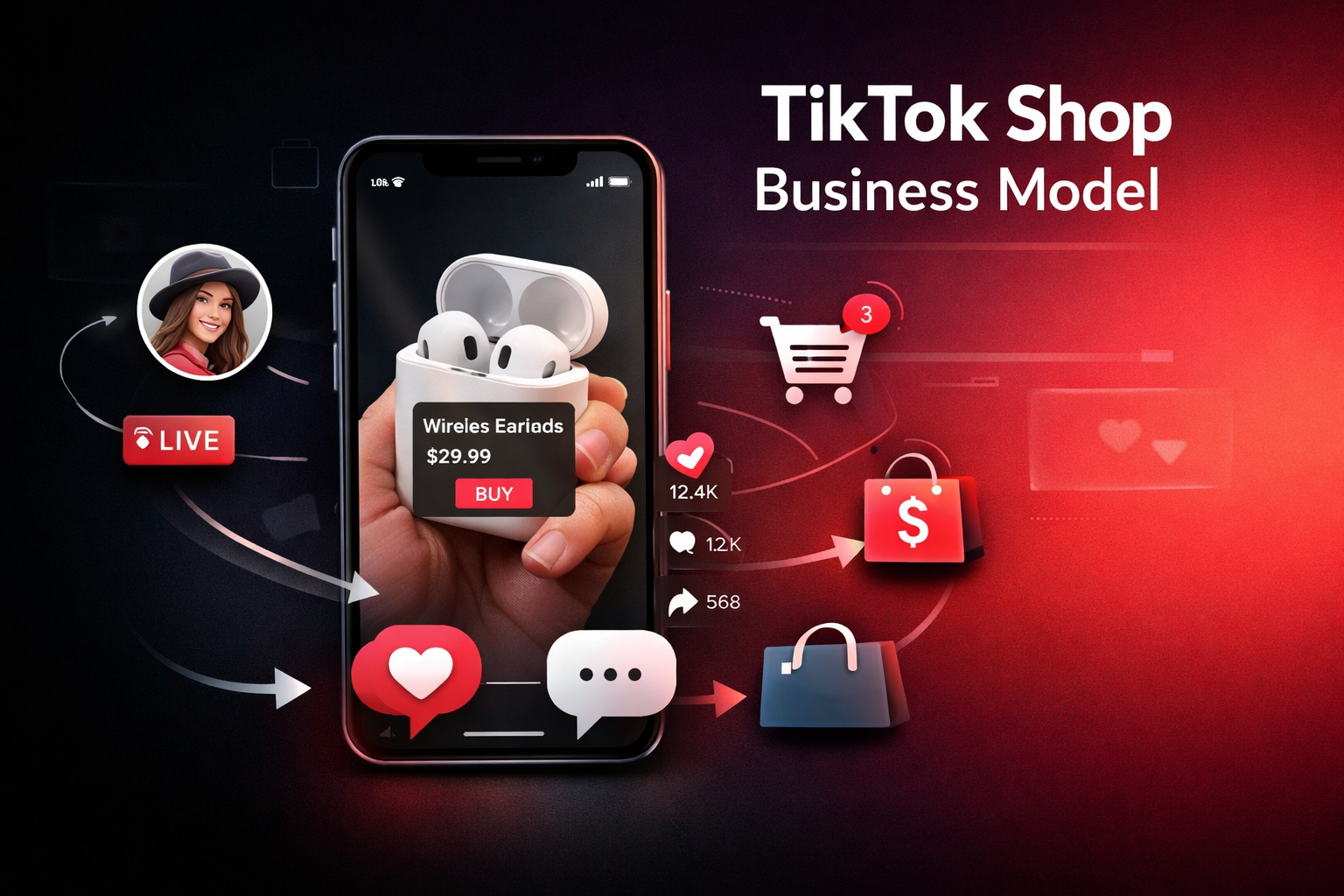

TikTok Shop’s business model is built on social commerce. It allows creators, brands, and sellers to sell products directly within the app through videos, live streams, and affiliate marketing, while earning revenue via commissions, ads, and seller fees.
The Shopping Revolution Nobody Saw Coming
For decades, online shopping followed a predictable pattern. You need something, you search for it, you buy it.
Amazon built an empire on that behavior. Flipkart, Myntra, and hundreds of other platforms followed the same playbook. The entire system was designed around intent. You show up already wanting something.
TikTok broke that model entirely.
On TikTok, nobody opens the app thinking “I need a new kitchen gadget today.” But millions of people end up buying kitchen gadgets anyway, because a 30-second video made them feel like they couldn’t live without one.
That is not an accident. It is a carefully engineered commerce system dressed up as entertainment.
This is the story of how TikTok Shop works, why it is reshaping global eCommerce, and what it means for sellers, creators, and consumers alike.
What Is TikTok Shop?
TikTok Shop is an in-app shopping feature that lets users discover, browse, and purchase products without ever leaving the TikTok platform.
It launched in the UK in 2021 before expanding rapidly across Southeast Asia, the United States, and other markets. Since then, it has grown into one of the most disruptive forces in global retail.
Here is what TikTok Shop actually offers:
For consumers:
- Discover products through entertaining short videos
- Watch live shopping streams where hosts demonstrate products in real time
- Purchase with a few taps, no external website needed
- Access reviews, creator demonstrations, and social proof all in one place
For sellers:
- List products directly through the TikTok Seller Center
- Collaborate with creators who promote products to their audiences
- Run targeted ads linked directly to product pages
- Access a built-in audience of over one billion active users
For creators:
- Earn commissions by promoting products they genuinely like
- Monetize content without building their own product or brand
- Use TikTok’s affiliate marketplace to find products that match their niche
The result is an ecosystem where content, commerce, and community feed into each other constantly.
The Core Business Model Breakdown
The Key Players in the Ecosystem
TikTok Shop is not a simple two-sided marketplace. It operates across four distinct groups, each playing a specific role.
Creators drive attention. They produce the content that makes people stop scrolling, watch, trust, and eventually buy. Without creators, TikTok Shop is just another product catalog.
Sellers and brands supply the products. These range from individual dropshippers and small businesses to major global brands running their own TikTok storefronts.
Consumers are the buyers. They come to TikTok for entertainment and leave with purchase decisions they did not plan on making.
TikTok as a platform sits in the middle, connecting all three groups, taking a cut of transactions, and continuously optimizing the algorithm to maximize engagement and sales simultaneously.
The Value Proposition for Each Group
What makes TikTok Shop sticky is that every participant gets something genuinely valuable.
Users get entertainment. The shopping feels like a byproduct of watching content they already enjoy. There is no cold browsing experience, no overwhelming product grid, no decision fatigue.
Creators get a monetization path that requires zero upfront investment. No warehouse, no inventory, no customer service. Just content creation and commission earnings.
Sellers get access to the algorithm. On TikTok, a brand-new seller with one viral video can outsell an established competitor overnight. The playing field is more level than almost anywhere else in eCommerce.
The Core Loop That Powers Everything
The engine underneath TikTok Shop follows a repeating cycle:
Content → Engagement → Trust → Purchase → Repeat
A creator posts a video demonstrating a product. The algorithm pushes it to users who are likely to engage. Those users watch, comment, share, and save the video. That engagement builds social proof. Social proof builds trust. Trust reduces hesitation. One-tap checkout removes friction. The sale happens.
The customer’s positive experience then becomes content. Reviews, reposts, “my TikTok made me buy it” videos. The cycle starts again, now with more momentum.
This loop is self-reinforcing. The more it runs, the stronger it gets.
How TikTok Shop Works Step by Step
Product Listing
Every product journey begins in the TikTok Seller Center. Sellers create an account, verify their business, upload product listings with photos, descriptions, pricing, and inventory details.
The Seller Center also manages orders, tracks analytics, and connects sellers with the affiliate creator marketplace. It is the operational backbone of the entire system.
Content Creation
Once products are listed, the content layer begins.
Sellers can create their own content. But the more powerful route is working with creators through TikTok’s affiliate system. Creators receive product samples or browse the affiliate marketplace, then produce:
- Product demonstration videos
- Problem-solving content that shows how the product fixes a specific pain point
- Review-style videos that feel authentic and unscripted
- “Before and after” content showing tangible results
- Storytelling videos where the product plays a natural role
The format matters enormously. Short-form video compresses the entire customer journey into 30 to 60 seconds. A consumer sees the problem, sees the solution, sees proof it works, and sees how to buy, all before they can consciously decide to scroll away.
Algorithm Distribution
This is where TikTok’s real power activates.
Unlike Instagram or YouTube, TikTok’s algorithm is not primarily follower-based. A creator with 500 followers can produce a video that reaches 5 million people if the early engagement signals are strong.
The algorithm evaluates:
- Watch time and completion rate
- Likes, comments, shares, and saves
- Follower growth triggered by the video
- Click-through rate on the product link
- Conversion rate on the product page
Crucially, TikTok is optimizing for engagement and commerce simultaneously. Videos that drive sales get pushed to more people. This creates a feedback loop where great content earns greater distribution.
In-App Purchase
When a viewer decides to buy, they tap the product link embedded in the video. The product page opens inside TikTok. Payment is processed through TikTok’s own checkout system.
The user never leaves the app.
This single design decision dramatically increases conversion rates. Every redirect in a purchase journey is a potential exit point. Keeping everything native eliminates those exits.
Fulfillment
After purchase, the seller ships the product. In certain markets, TikTok has begun offering logistics support and fulfillment services, moving toward a more Amazon-like model where it controls more of the supply chain.
TikTok also manages the dispute and return process, protecting consumer trust while holding sellers accountable for product quality.
Revenue Streams of TikTok Shop
TikTok does not just facilitate commerce. It monetizes it from multiple directions simultaneously.
Commission Fees
The primary revenue stream is a percentage commission on every sale made through TikTok Shop. Commission rates vary by category and market, but the platform takes its cut automatically from each transaction. Sellers receive the balance after deductions.
Advertising Revenue
Sellers who want more visibility can pay for it. TikTok’s advertising platform allows sellers to run:
- In-feed video ads linked directly to product pages
- Spark Ads that boost existing organic content from creators
- Shopping ads that appear across the For You page
The advertising revenue layer is separate from transaction commissions. TikTok earns whether or not the ad leads to a direct sale, though its algorithm favors ads with strong conversion performance.
Transaction and Payment Processing Fees
Every payment processed through TikTok’s checkout system carries a small transaction fee. Individually minor, collectively these fees represent significant revenue at TikTok’s scale.
Creator Affiliate Commissions
When a creator drives a sale and earns a commission, TikTok takes a percentage of that commission. The platform enables the creator economy while profiting from it at the same time.
This is an elegant revenue design. TikTok effectively gets paid three times from a single sale: the seller’s commission, the advertising spend used to boost the content, and a cut of the creator’s affiliate earnings.
The Creator Economy Integration
This is arguably the single biggest innovation inside TikTok Shop’s model.
TikTok’s affiliate marketplace lets any creator, regardless of follower count or niche, browse thousands of products and apply to promote them. Once approved, they receive a unique affiliate link. When their content drives a sale, they earn a commission.
What this unlocks is remarkable:
Zero inventory risk. Creators do not buy or hold stock.
Zero upfront cost. There is no fee to join the affiliate marketplace.
Zero customer service. Sellers handle fulfillment and returns.
Zero website needed. Everything lives inside TikTok.
A creator needs only one thing: the ability to make content that resonates.
This has opened the door for a new kind of micro-entrepreneur. People who previously had no path into eCommerce are now building income streams purely through content creation. A fitness creator promotes resistance bands. A home organization enthusiast promotes storage solutions. A cooking content creator promotes kitchen tools.
The fit feels natural because the products genuinely connect to the content. That authenticity is what makes the whole system work so much better than traditional influencer marketing.
Why TikTok Shop Is So Powerful
Algorithm-Driven Commerce
Traditional eCommerce rewards those with the biggest marketing budgets or the strongest SEO. TikTok rewards those with the best content.
Because the algorithm does not prioritize follower count, the barrier to entry is genuinely low. A new seller or creator with compelling content can achieve significant reach without paid promotion. This democratizes commerce in a way that Amazon or Shopify simply cannot replicate.
Impulse Buying Behavior
Impulse purchases are driven by emotion, not logic. And nothing activates emotion faster than short-form video with a strong hook, a relatable problem, and an entertaining solution.
TikTok’s content format is optimized, almost accidentally, for triggering impulse buys. The entertainment value lowers the viewer’s rational guard. The social proof from comments and view counts accelerates trust. The seamless checkout captures the purchase before the impulse fades.
Native Checkout Experience
Every friction point in a checkout flow costs conversions. Redirecting a buyer from TikTok to a brand website, where they need to create an account and re-enter payment details, introduces multiple exit opportunities.
TikTok Shop removes all of that. Saved payment methods, one-tap purchase, in-app confirmation. The gap between desire and transaction is measured in seconds.
Short Video Format
Product understanding used to require long-form content. Detailed product pages, lengthy reviews, comparison articles. All of it required sustained attention that most consumers are unwilling to give.
A well-made 30-second TikTok video can communicate:
- What the product is
- What problem it solves
- How it works in practice
- Who else is using it and loving it
- Where to buy it right now
That is an entire marketing funnel compressed into half a minute.
TikTok Shop vs Traditional eCommerce
| Factor | TikTok Shop | Traditional eCommerce |
|---|---|---|
| Discovery | Algorithm-driven | Search-driven |
| Buyer Intent | Low (impulse) | High (planned) |
| Trust Mechanism | Creator-based | Review-based |
| Conversion Path | Native, frictionless | Multi-step redirect |
| Entry Barrier | Very low | Moderate to high |
| Content Role | Central | Secondary |
| Audience Reach | Algorithm-distributed | Budget-dependent |
The core difference is not just technical. It is psychological. Traditional eCommerce meets buyers where they already have intent. TikTok Shop creates intent where none existed before.
The Business Model Flywheel
TikTok Shop operates as a classic flywheel business model, where each element of growth reinforces every other element.
Here is how the flywheel spins:
More creators join the affiliate program. This means more content about more products across more niches.
More content means more engagement. The algorithm has more high-quality material to distribute, keeping users on the platform longer.
More engagement means more sales. As trust builds and impulse purchase triggers accumulate, conversion rates improve.
More sales attract more sellers. As brands and businesses see the commercial potential, they invest more in TikTok Shop listings and advertising.
More sellers bring more products. Creators have more to promote. Content quality and volume increase further.
The flywheel accelerates.
What makes this particularly powerful is that each rotation is not just maintaining momentum. It is adding to it. The network effects compound over time.
Advantages of TikTok Shop
Low entry barrier. Any seller can list products. Any creator can join the affiliate program. The infrastructure is built. The audience is already there.
No website required. Small businesses and individual sellers do not need to invest in building their own eCommerce site. TikTok provides the storefront, the checkout, and the audience simultaneously.
Fast virality potential. One strong piece of content can generate thousands of sales overnight. No other eCommerce platform offers this kind of sudden, algorithm-driven demand generation.
Built-in social proof. Comments, shares, view counts, and creator authenticity all function as trust signals. They are baked into the content experience rather than bolted onto a product page.
Authentic discovery. Buyers do not feel marketed to. They feel like they stumbled upon something great. That perception, whether accurate or not, increases purchase satisfaction and reduces returns.
Challenges and Risks
No business model is without weaknesses. TikTok Shop has several that sellers and creators should understand clearly.
Algorithm dependency is total. When the algorithm changes, traffic can disappear overnight. Sellers who rely exclusively on organic TikTok reach have no fallback. Diversification matters.
Product quality inconsistency. The low entry barrier that empowers small sellers also opens the door to poor quality or counterfeit products. Negative experiences damage platform trust for everyone.
Intense competition. As more sellers flood the platform, standing out requires increasingly sophisticated content and faster trend response. The cost of attention rises as supply increases.
Logistics gaps. In many markets, TikTok’s fulfillment infrastructure is still developing. Sellers managing their own shipping face challenges with customer expectations around speed and reliability.
Regulatory uncertainty. TikTok operates under ongoing regulatory scrutiny in multiple markets, particularly the United States. Business continuity risk is real for sellers who build their entire operation on the platform.
Real-World Examples That Show the Model in Action
The TikTok Shop model is not theoretical. It plays out in concrete, measurable ways every day.
Small sellers who six months earlier had no eCommerce presence at all are hitting six-figure monthly revenues after one or two videos achieve significant reach. Kitchen gadgets, skincare serums, organizational tools, and fashion accessories repeatedly demonstrate the model’s effectiveness.
The “TikTok made me buy it” phenomenon is not just a cultural meme. It is a documented consumer behavior pattern. Products that trend on TikTok sell out in retail stores within days. Brands that master TikTok content generation see sales spikes that outperform their entire paid advertising spend.
Creators in highly specific niches, cleaning, woodworking, skincare routines, minimalist living, discover that their engaged audiences convert at rates most traditional marketers would find extraordinary.
How Founders Can Use This Model
TikTok Shop is one of the most accessible business opportunities available to early-stage founders right now. Three clear entry paths exist.
Start as a creator. Zero cost, zero risk. Pick a niche you genuinely know. Browse the affiliate marketplace for products that fit. Create honest, helpful content around those products. Build audience and commission income simultaneously.
Start as a dropshipper. Source products, list them in TikTok Seller Center, create or commission content. No warehouse needed for many dropshipping arrangements. Test products quickly without significant inventory commitment.
Start as a brand builder. Use TikTok Shop as the primary distribution channel while building brand equity. The algorithm can replace early-stage paid acquisition, keeping costs low while reach scales.
Regardless of entry path, certain principles apply consistently:
Content quality matters more than product quality initially. A mediocre product with outstanding content will outsell an excellent product with weak content every time.
Problem-solving videos outperform feature-showcasing videos. Show the problem. Show the frustration. Then show the solution. Make the viewer feel the before and after.
Hooks are everything. The first two seconds determine whether anyone watches the next 28. Invest disproportionately in crafting openers that create immediate curiosity or emotional response.
Consistency compounds. One viral video is luck. Twenty consistent videos over two months is a strategy. The algorithm rewards regular content creators with better baseline distribution.
The Future of TikTok Shop
The trajectory of TikTok Shop points toward several significant developments that will reshape it further over the next few years.
Live commerce will grow substantially. In China, where TikTok’s parent company ByteDance operates Douyin, live shopping already accounts for a massive portion of total eCommerce. The Western markets are following the same trajectory, just on a delay. Live shopping events with charismatic hosts, exclusive deals, and real-time audience interaction are becoming a primary sales format.
AI-driven product recommendations will become more sophisticated. TikTok’s algorithm already does this implicitly, but dedicated AI shopping assistants within the app, capable of understanding a user’s style preferences, past purchases, and current interests, are the logical next step.
Geographic expansion will continue. TikTok Shop’s rollout is still incomplete. Markets like India, where TikTok is banned, represent enormous unrealized potential if regulatory situations shift. Existing markets will see deeper infrastructure investment, particularly in logistics.
Competition with Amazon and Shopify will intensify. These are platforms that have watched TikTok’s commerce ambitions develop with genuine concern. The response will likely involve both platforms attempting to incorporate short-form video more deeply into their own discovery systems. TikTok, meanwhile, may move further into warehousing and fulfillment to close the infrastructure gap.
Creator tools will become more powerful. Better analytics, better product matching, better content performance data. TikTok has every incentive to help creators succeed because creator success directly drives platform revenue.
Key Takeaways
TikTok Shop is not simply a new eCommerce platform. It is a fundamentally different commercial model built on an insight that most retailers have still not fully absorbed.
Attention is the asset, not inventory.
In traditional commerce, competitive advantage comes from product selection, price, or logistics efficiency. In TikTok’s model, competitive advantage comes from the ability to capture and hold human attention long enough to trigger a purchase impulse.
The creator economy is not a marketing add-on to TikTok Shop. It is the product. Creators are the sales force, the content studio, the media channel, and the trust mechanism all in one.
The core loop, content driving engagement, engagement building trust, trust enabling purchase, purchase generating data, data improving the algorithm, is a machine that improves itself continuously.
For sellers, the implication is clear. On TikTok Shop, you are not primarily in the product business. You are in the content business. Products that cannot be made compelling on camera will struggle regardless of their objective quality.
For creators, the opportunity is genuinely unprecedented. A monetization path that requires no capital, no inventory, and no technical infrastructure is historically rare. The only real requirement is the ability to communicate authentically on camera.
For the broader eCommerce industry, TikTok Shop represents both a challenge and a signal. Discovery-based shopping is not a trend. It is a behavioral shift driven by an entire generation that learned to make purchase decisions from 30-second videos rather than search results pages.
The brands and entrepreneurs who internalize this shift early will have a significant advantage over those still optimizing for intent-driven search.
TikTok did not just build a shop. It built a new way of connecting products to people, and in doing so, it may have permanently changed what eCommerce looks like.
Discover more from Business Model Hub
Subscribe to get the latest posts sent to your email.