
If you are a startup trying to figure out where to sell, here is the simplest version of the truth:
- D2C (Direct-to-Consumer) gives you better brand control, higher margins over time, and direct access to your customers.
- Marketplace models give you faster reach, built-in traffic, and a much lower barrier to getting your first sale.
The best approach? Most early-stage startups benefit from starting on marketplaces and then building their own D2C channel as they grow. But the full picture is more nuanced than that, and the wrong choice at the wrong stage can quietly kill your business.
Let us break it down practically.
The Founder Dilemma Nobody Talks About Honestly
Imagine you have just built a product. It works. People who have tried it love it. Now what?
Do you build a Shopify store, run Facebook ads, and try to build a brand? Or do you list it on Amazon or Flipkart and start selling immediately?
This is one of the most consequential decisions an early-stage founder makes, and most people get it wrong because they make it emotionally rather than strategically.
Some founders fall in love with the idea of owning a brand before they have validated whether anyone actually wants to buy. Others get comfortable on marketplaces and never take the harder step of building something that belongs to them.
Both paths have built billion-dollar companies. Both paths have also buried startups that had genuinely good products.
The decision affects your cost structure, your growth speed, your marketing requirements, your margins, and ultimately whether your business becomes an asset or just a hustle.
This guide will not tell you what sounds good in theory. It will tell you what actually matters, stage by stage.
What Is D2C (Direct-to-Consumer)?
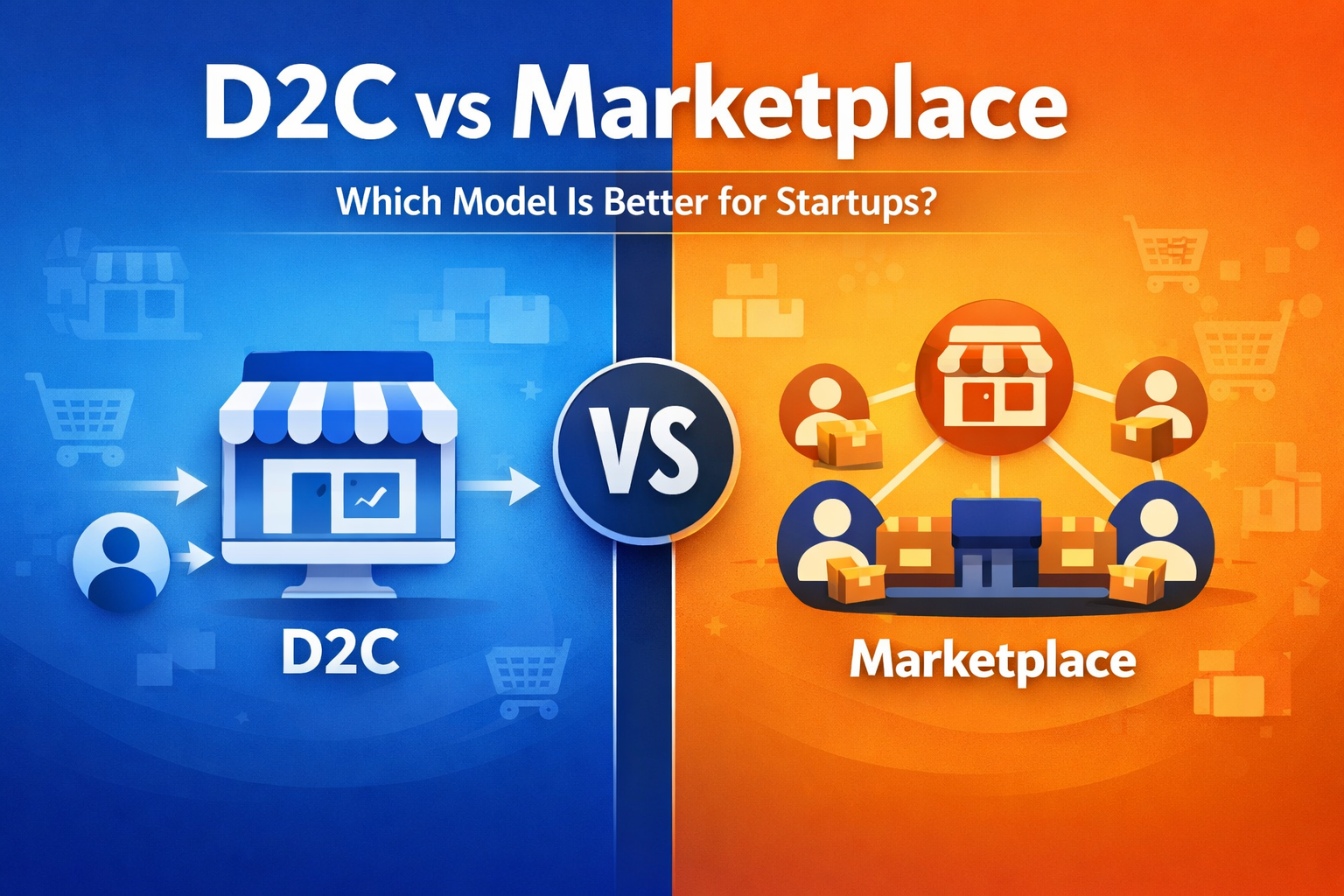
D2C is a model where a brand sells its products directly to end customers without going through a third-party retailer or platform.
The flow looks like this:
Brand → Own Website or App → Customer
You control the entire experience. You choose the design, the messaging, the pricing, the packaging, the post-purchase email, the loyalty program, and every other touchpoint between your brand and the person who bought from you.
Real-world examples:
- Nike famously pulled back from Amazon and pushed customers toward its own website and app. The goal was to own the customer relationship and collect data that no retailer could give them.
- Warby Parker built a billion-dollar eyewear brand entirely on the D2C premise, offering home try-ons and cutting out the middleman completely.
- Mamaearth in India launched with a strong D2C identity before expanding into marketplaces and retail.
The core idea of D2C is simple: you own the customer relationship. Their email address, their purchase history, their preferences, their lifetime value. All of it belongs to you.
What Is a Marketplace Model?
A marketplace is a platform that connects buyers and sellers. You, as a seller, plug into an existing audience that the platform has already built.
The flow looks like this:
Platform (Amazon, Flipkart, Meesho) → Customer → Your Product Listed There
You are renting access to someone else’s audience. The platform handles discovery. You handle inventory and fulfillment (or sometimes even that, if you use FBA or a similar program).
Real-world examples:
- Amazon is the world’s largest marketplace, with hundreds of millions of active buyers who go there specifically to shop.
- Flipkart dominates large portions of Indian e-commerce and gives sellers access to Tier 2 and Tier 3 city buyers that would be expensive to reach independently.
- Etsy connects independent creators to buyers already looking for handmade and unique products.
The core idea of a marketplace is also simple: the platform owns the traffic. You plug into it.
D2C vs Marketplace: The Core Differences
Here is a side-by-side breakdown of how the two models compare across the factors that matter most to startups:
| Factor | D2C Model | Marketplace Model |
|---|---|---|
| Ownership | Full control | Platform controls |
| Traffic | You generate it | Platform provides it |
| Branding | Strong, customizable | Limited, generic |
| Margins | Higher (long-term) | Lower (commissions cut in) |
| Setup Speed | Slower | Faster |
| Customer Data | Owned by you | Owned by platform |
| Trust Factor | You must build it | Platform lends trust |
| Risk | Marketing-dependent | Algorithm-dependent |
Neither column is better across the board. Each advantage comes with a corresponding vulnerability. The right model depends on where you are, what you are selling, and how much runway you have.
The Advantages of D2C for Startups
When D2C works, it works powerfully. Here is what you gain:
Full brand control
You decide everything. The visual identity, the tone of communication, the unboxing experience, the post-purchase flow. When someone buys from your D2C store, they remember your brand, not the platform they bought it on.
Higher margins over time
There are no commission fees to pay on every order. You set your own prices. As your customer acquisition cost decreases with better SEO, content, and repeat buyers, your unit economics improve significantly.
Direct access to customer data
This is genuinely underrated. When you own the transaction, you own the data. You know who bought, when, what, how often, and from which channel. This data is the foundation of personalization, retention, and smart product development.
Long-term asset building
A D2C brand is an asset that compounds. A marketplace seller account is not. Brand equity, email lists, community, and loyal customers all belong to you and grow in value over time.
One honest reality check: D2C is powerful, but only if you can consistently drive traffic. Without a real strategy for acquisition, an empty D2C store is just an expensive website.
The Challenges of D2C (That Founders Underestimate)
High customer acquisition cost
Paid ads on Facebook and Google are expensive and getting more expensive. SEO takes six to twelve months to show results. Content marketing requires consistency and skill. None of it is free, and all of it takes time.
Requires real marketing capability
D2C is a marketing-intensive business model. If you do not have someone on your team who genuinely understands performance marketing, conversion rate optimization, or content strategy, you will bleed cash.
Slower initial growth
You are starting from zero traffic. That means slower validation, fewer early sales, and more time before you have enough data to know if your product is actually working.
Tech and logistics setup
You need a website that converts. You need payment gateways, return policies, customer support, and a logistics partner. None of this is impossible, but all of it takes time and money to set up properly.
The Advantages of the Marketplace Model
Instant access to a massive customer base
Amazon India has hundreds of millions of registered users. Flipkart reaches deep into Tier 2 and Tier 3 cities. You do not build that audience. You borrow it. For an early-stage startup, that is a significant advantage.
Faster sales and faster validation
If your product is listed properly and priced competitively, you can start getting orders within days. That speed of feedback is invaluable when you are still figuring out product-market fit.
Lower marketing effort initially
You do not need to run ads or write content to get your first sales on a marketplace. The platform drives traffic. You focus on your product, pricing, and fulfillment.
Built-in trust
Customers already trust Amazon and Flipkart. They have used them before. They know returns are easy. Selling on these platforms means your product is wrapped in that trust before the customer even sees it.
The Challenges of the Marketplace Model
High competition and price wars
On most marketplaces, your product is listed right next to dozens of alternatives. Customers can sort by price in one click. This puts constant pressure on your pricing, which destroys margins.
Commission fees eat into every sale
Amazon typically charges between 8% and 15% in referral fees depending on the category, plus fulfillment fees if you use FBA. Flipkart has similar structures. By the time you account for all fees, your net margin can be surprisingly thin.
No real brand ownership
A customer who buys your product on Amazon remembers Amazon, not you. They go back to Amazon for their next purchase and discover a cheaper alternative. You did the work of winning the first sale but cannot retain them directly.
Dependency risk
Your entire business can be disrupted overnight. Algorithm changes can push you off the first page. A policy violation (even a mistaken one) can suspend your account. A competitor can report you falsely. You have built on someone else’s land.
When Should Startups Choose D2C?
D2C makes sense when:
- You are building a strong brand identity and want customers to associate the product with your name, not a platform
- Your product is unique, niche, or premium, where brand story matters to the purchase decision
- You or someone on your team genuinely understands digital marketing, SEO, or content creation
- You are thinking long-term and willing to invest in slower initial growth for better unit economics later
- You have a product with strong repeat purchase potential, where owning customer data is critical to retention
When Should Startups Choose Marketplace?
Marketplace makes sense when:
- You need to validate your product quickly and cheaply before investing in brand building
- You have limited budget and cannot afford the marketing spend that D2C requires
- You are still testing pricing, packaging, and product-market fit
- You are selling in a category where marketplace search intent is high (electronics, home goods, fashion basics)
- You do not have the team bandwidth to manage a full D2C operation alongside everything else
The Hybrid Strategy: What the Smartest Startups Actually Do
Here is the honest truth: the best-performing startups do not choose one. They use both, but in a specific sequence.
The smartest approach looks like this:
Phase one: Launch on marketplaces for early traction
Get your product in front of real customers. Get your first hundred reviews. Understand what people love and what they complain about. Validate that there is real demand.
Phase two: Use marketplace data to sharpen your brand
Which products sell best? At what price points? What questions do customers ask? What complaints come up repeatedly? This data is gold. Use it to shape your D2C positioning.
Phase three: Build your D2C channel alongside the marketplace
Start a website. Start an email list. Start a content strategy. You do not need to abandon the marketplace. You just start building the asset that belongs to you.
Phase four: Retarget and retain via owned channels
Use ads to retarget people who have interacted with your brand. Build an email list. Create a loyalty program. Every customer you convert to a direct buyer is worth significantly more over their lifetime than a one-time marketplace purchase.
Real Indian examples of this strategy:
- Mamaearth launched with a mix of D2C and marketplace presence, used both to scale rapidly, and built a brand strong enough to go public.
- boAt scaled using both channels, leveraging marketplace volumes for revenue while building brand equity through strong marketing.
- Nykaa built a hybrid model that includes its own marketplace, private label products, and physical retail, showing how the lines blur at scale.
The Cost Comparison: What You Are Actually Paying For
D2C cost structure:
- Website setup: Shopify or a custom build typically costs between a few thousand to several lakhs depending on complexity
- Paid ads: Facebook and Google campaigns for D2C brands often require a minimum of Rs. 50,000 to Rs. 1,00,000 per month to get meaningful data
- Logistics: Courier partners, return handling, and warehousing all add per-order costs
- Content and SEO: Either your time or money, usually both
Marketplace cost structure:
- Referral/commission fees: Typically 8% to 20% per order depending on category and platform
- Listing and promotional fees: Sponsored ads within the marketplace to get visibility
- Fulfillment charges: If using FBA or FBF (Fulfilled by Flipkart), per-unit storage and shipping fees apply
- Return handling: Returns on marketplaces tend to be higher, and some of that cost lands on sellers
Neither model is cheap. D2C front-loads your costs into acquisition. Marketplaces spread costs across every transaction but permanently reduce your per-unit margin.
Long-Term vs Short-Term Thinking
This is the framework that actually resolves the D2C vs marketplace debate for most founders.
Marketplace is your short-term growth engine.
It gets you sales, data, reviews, and cash flow faster. It validates that people want what you are selling. It keeps you alive in the early months when everything is uncertain.
D2C is your long-term brand asset.
It compounds. Every email you collect, every loyal customer you retain, every piece of content that ranks on Google, every review on your own platform, all of it builds something that belongs to you and grows in value over time.
The mistake most founders make is treating this as an either/or decision permanently rather than a sequencing decision.
Marketplace helps you start. D2C helps you scale.
Common Mistakes Startups Make With Both Models
Going D2C without a traffic strategy
Building a beautiful Shopify store and expecting customers to show up is one of the most common and expensive mistakes in e-commerce. D2C without a clear answer to “how will people find us?” is just an expensive exercise in web design.
Relying only on marketplace with no brand building
Many sellers do well on Amazon for two or three years and then find themselves completely exposed when fees go up, a competitor undercuts them, or their account gets flagged. They have revenue but no asset.
Ignoring margins while scaling
Growing GMV on a marketplace feels great until you look at your net margin per order and realize you are barely breaking even after fees, ads, and returns. Scale without margin awareness creates a treadmill, not a business.
Not collecting customer data
Even if you sell primarily on marketplaces, there are ways to start building customer relationships. Inserts in packaging with QR codes, warranty registrations, referral programs, all of these can help you start building a direct relationship even when the transaction happens on someone else’s platform.
Trying to do everything at once
Launching D2C, marketplace, offline retail, and international all in the first year is a recipe for doing none of them well. Pick a primary channel based on your stage and resources, execute it properly, then expand.
The Final Verdict: Which Model Is Actually Better?
After breaking down every angle, here is the clear answer:
If you are early-stage: Start with marketplace. Get your first sales. Validate your product. Generate cash flow. Learn what your customers actually want.
If you are scaling: Invest seriously in D2C. Start building the brand asset, the email list, the content, the community. This is where your long-term margin and equity come from.
If you want the best possible outcome: Use both, intentionally and in sequence. Do not treat them as competitors. Treat them as different tools for different jobs.
The simple takeaway is this:
Do not choose one. Use marketplaces for growth and D2C for control.
Closing Thoughts
The “best model” debate misses the point entirely when founders treat it as a fixed, permanent choice.
The real question is not D2C or marketplace. The real question is: what does my business need right now, and what does it need to become?
Early on, you need validation and cash flow. Marketplaces give you that faster and cheaper than anything else. Later, you need margins, brand equity, and customer ownership. D2C gives you that, but only if you have built the marketing capability and customer base to sustain it.
The founders who win are not the ones who made the “right” philosophical choice about distribution. They are the ones who thought clearly about their stage, their resources, and their long-term vision, and then moved decisively.
The smartest startups do not pick sides. They build systems that evolve as they grow.
Start where you are. Build toward where you want to be.
FAQs
The main difference is ownership and control. In a D2C model, you sell directly to customers through your own website, while in a marketplace model, you sell through platforms like Amazon that provide traffic and infrastructure but control the ecosystem.
It depends on your stage. Early-stage startups benefit from marketplaces for quick sales and validation, while D2C is better for long-term brand building and higher margins.
Yes, D2C can be more profitable in the long run because you avoid platform commissions and control pricing. However, it requires higher upfront investment in marketing and customer acquisition.
Startups use marketplaces like Amazon or Flipkart because they provide instant access to millions of customers, reducing the need for heavy marketing in the beginning.
The biggest risks include high competition, dependency on platform policies, commission fees, and lack of customer ownership, which limits long-term brand growth.
D2C brands face challenges like high customer acquisition costs, the need for consistent marketing, and managing logistics, technology, and customer support independently.
Yes, many successful startups use a hybrid strategy selling on marketplaces for reach while building their own D2C website for branding and higher margins.
Many brands like boAt and Mamaearth use both models selling on marketplaces for scale while building their own direct channels.
Discover more from Business Model Hub
Subscribe to get the latest posts sent to your email.