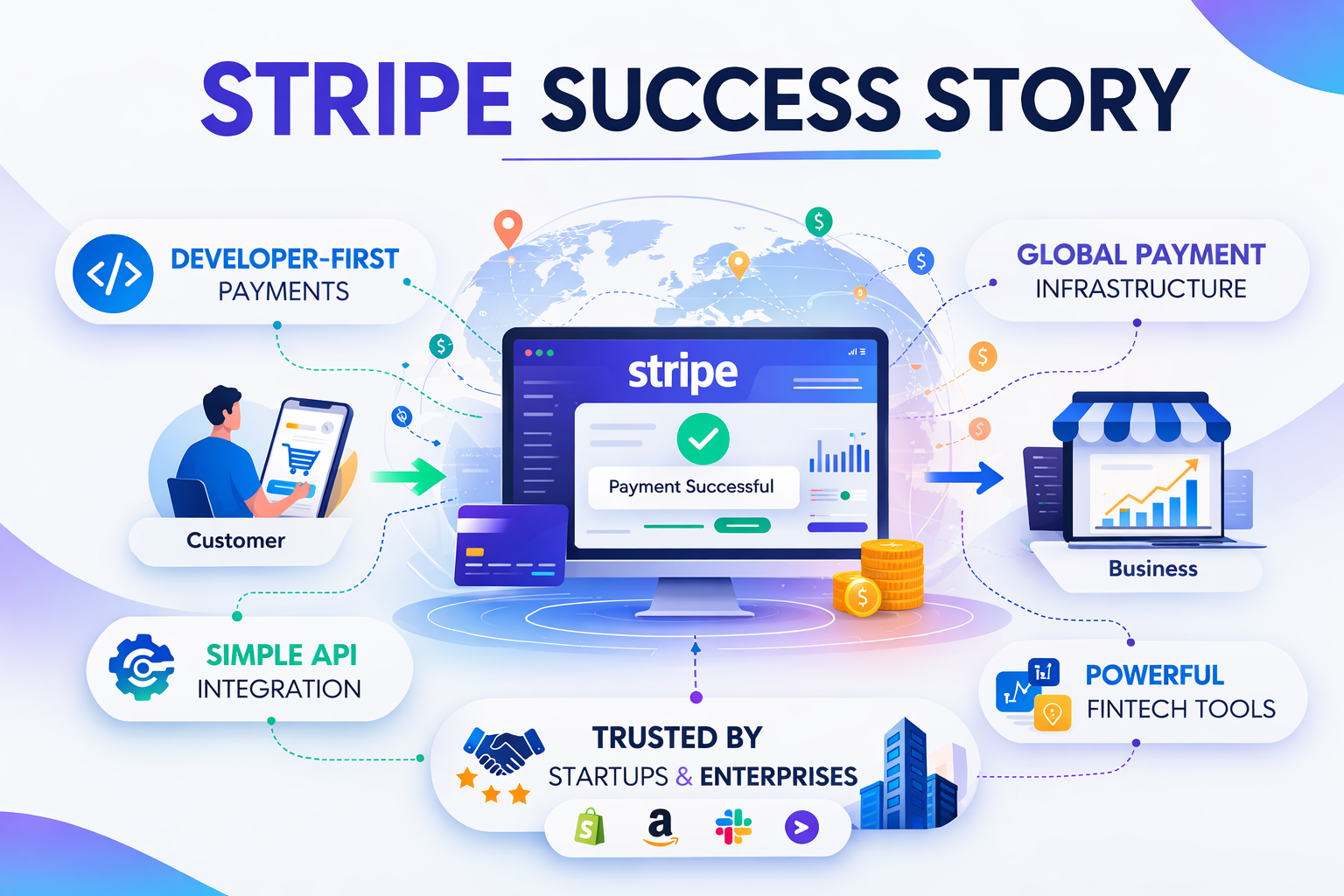

Stripe is a fintech company that powers online payments for millions of businesses worldwide. Founded in 2010 by Irish brothers Patrick and John Collison, Stripe turned a complicated, weeks-long process into something developers could set up in minutes. Today it serves companies ranging from early-stage startups to Amazon and Shopify.
The Internet Had a Payments Problem
Before Stripe existed, accepting money online was genuinely painful. Not mildly inconvenient. Painful.
A startup founder who wanted to accept payments on their website had to navigate a maze of merchant accounts, banking partnerships, gateway integrations, and compliance requirements. The process could take weeks, sometimes months. And after all that work, the developer experience was still terrible.
Here is what the pre-Stripe world looked like:
- Setting up a merchant account required lengthy approval processes
- Payment gateway integrations involved outdated, poorly documented APIs
- Developers had to handle complex banking relationships themselves
- Testing payments in a development environment was frustrating and inconsistent
- International payments added another layer of complexity
The irony was stark. The internet was enabling people to build software and reach global audiences faster than ever before. But actually charging those audiences for anything? That remained stuck in the past.
Stripe was built specifically to fix this.
Who Built Stripe
Patrick and John Collison grew up in Dromineer, a small village in County Tipperary, Ireland. Both brothers showed an early interest in programming. They were not just enthusiastic hobbyists either. They were genuinely talented, competitive programmers from a young age.
Before Stripe, they built a company called Auctomatic, a tool that helped eBay sellers manage their listings and sales more efficiently. They built it while Patrick was at MIT and John was still in secondary school. They sold Auctomatic in 2008 for around $5 million. John was 17 years old at the time.
After selling Auctomatic, both brothers continued building things and paying close attention to what other developers were struggling with. One frustration kept coming up over and over again: online payments were needlessly hard to integrate.
Patrick later described the founding insight as almost embarrassingly simple. Developers just wanted to accept money. Why did it require so much effort?
That question became Stripe.
How Stripe Started
Stripe launched in 2010, originally under the name “dev/payments.” The name itself told you everything about the intended audience. This was not a product built for finance teams or CFOs. It was built for developers.
The core promise was radical in its simplicity: add a few lines of code, and your application can accept payments.
Early traction came quickly within developer communities. Word spread that there was finally a payment tool that did not make you want to throw your laptop out a window. Y Combinator backed the company early, which gave Stripe access to a steady stream of startup founders who were exactly the kind of customers Stripe wanted.
What made developers fall in love with Stripe early on:
- Clean, well-written documentation that actually explained how things worked
- Simple API design that followed logical, predictable patterns
- A sandbox environment that made testing payments easy
- Fast integration that could genuinely be done in an afternoon
- Transparent pricing with no hidden fees or complicated tier structures
Stripe understood something that most financial companies had missed entirely. Developers are not just the people who build products. In a startup, developers often make purchasing decisions. Win the developer, and you win the company.
The Developer-First Philosophy That Changed Everything
Most payment companies in 2010 thought about their customers as businesses. Stripe thought about their customers as builders.
This distinction drove every product decision Stripe made in its early years. The API had to be elegant. The documentation had to be clear. The error messages had to be helpful. The onboarding had to be fast.
Stripe hired exceptional technical writers alongside engineers. They treated documentation as a product, not an afterthought. Developers who picked up Stripe for the first time often remarked that it felt like the API had been designed by someone who actually used APIs.
That sounds like a low bar. In the world of financial software in 2010, it was revolutionary.
The developer-first approach created a powerful growth loop:
- A developer integrates Stripe into their startup
- The startup grows and processes more payments
- Stripe earns more in transaction fees
- Stripe reinvests in making the product better for developers
- More developers choose Stripe
This flywheel spun fast. And it kept spinning.
Stripe’s Product Ecosystem
Stripe did not stay a simple payments API for long. The company expanded methodically, adding products that addressed adjacent problems businesses encountered as they grew.
Today Stripe’s product lineup covers nearly every financial operation an internet business might need.
Core Payment Products
- Stripe Payments — The foundation. Accepts cards, bank transfers, and dozens of local payment methods across the globe.
- Stripe Checkout — A prebuilt, hosted payment page that handles the entire checkout experience without custom development.
- Stripe Billing — Subscription and recurring revenue management for SaaS companies and membership businesses.
- Stripe Connect — Payment infrastructure for platforms and marketplaces that need to move money between multiple parties.
- Stripe Radar — A machine learning-powered fraud detection system that analyzes transactions in real time.
Financial Infrastructure Products
- Stripe Atlas — Helps founders incorporate a US company and set up a bank account from anywhere in the world.
- Stripe Issuing — Lets businesses create and manage physical or virtual debit cards for their own customers or employees.
- Stripe Treasury — Banking-as-a-service infrastructure that lets platforms offer financial accounts to their users.
- Stripe Capital — Provides fast, data-driven financing to Stripe-powered businesses based on their payment history.
Each new product followed a similar logic. Stripe would identify a financial problem that its existing customers were struggling with, build a clean solution, and layer it into the existing infrastructure.
The result was not just a payment processor. Stripe became something closer to a financial operating system for internet businesses.
How Stripe Makes Money
Stripe’s business model is straightforward, which is part of what makes it trustworthy.
Transaction Fees
The primary revenue source. Stripe charges a percentage of each transaction processed through its platform, typically around 2.9% plus a small flat fee per transaction for standard card payments. As the businesses using Stripe grow, Stripe’s revenue grows proportionally.
Billing and Subscription Tools
Stripe charges an additional fee for businesses using its subscription and recurring billing infrastructure. For SaaS companies managing hundreds or thousands of subscriptions, this is a meaningful product that saves significant engineering time.
Stripe Connect Fees
Platforms and marketplaces using Stripe Connect pay fees for routing payments between multiple parties. Uber, for instance, uses Connect-style infrastructure to move money from riders to drivers. This is a complex use case and Stripe charges accordingly.
Stripe Issuing
When businesses use Stripe to issue cards to their customers or employees, Stripe earns revenue from interchange fees on card transactions.
Stripe Capital
Stripe earns returns on the financing it provides to small businesses through Stripe Capital. Because Stripe already has visibility into a business’s payment volume and history, it can underwrite loans quickly and with lower risk than traditional lenders.
The model scales naturally. As more businesses choose Stripe, and as those businesses process more payments, Stripe’s revenue grows without requiring a corresponding increase in sales effort.
Why Stripe Targeted Startups First
Stripe’s early focus on startups was not accidental. It was a deliberate strategic choice that paid off enormously.
Startups are price-sensitive but speed-obsessed. They need to move fast. A payment solution that takes three weeks to integrate is simply not viable for a team of five people trying to launch in a month. Stripe fit perfectly.
More importantly, startups grow. The company that processes ten thousand dollars a month through Stripe today might process ten million dollars a month in three years. By building deep loyalty among early-stage companies, Stripe was making a long-term bet on those companies’ futures.
The strategy worked. Many of the businesses that started using Stripe as scrappy startups became large enterprises that continued using Stripe because switching infrastructure is painful and because Stripe kept improving fast enough that there was no compelling reason to leave.
Stripe also benefited from the Y Combinator relationship in ways that went beyond early funding. Y Combinator companies often recommended tools to each other. Getting Stripe into the Y Combinator ecosystem meant getting it in front of hundreds of well-funded startups every year.
Stripe’s Global Expansion
Building a global payments product is not a simple engineering problem. Every country has different regulations, banking relationships, preferred payment methods, and compliance requirements.
Stripe approached international expansion carefully, doing the hard work of building proper local infrastructure in each market rather than taking shortcuts.
Key elements of Stripe’s global expansion:
- Building support for local payment methods like SEPA in Europe, iDEAL in the Netherlands, and Alipay in China
- Navigating financial licensing requirements in each country individually
- Supporting payouts in dozens of currencies
- Hiring local teams who understood regional financial regulations
- Expanding Stripe Atlas to help founders globally incorporate businesses
Today Stripe operates in dozens of countries and supports payments in more than 135 currencies. For many international startups, Stripe is the easiest path to accepting payments globally from day one.
Funding and Valuation
Stripe attracted backing from some of the most respected investors in venture capital.
Early investors include:
- Sequoia Capital — One of Silicon Valley’s most storied venture firms
- Andreessen Horowitz — Marc Andreessen and Ben Horowitz’s firm, known for backing major tech companies
- Tiger Global — A major growth-stage investor
- Elon Musk and Peter Thiel — Both were early investors with backgrounds in payments through PayPal
Over multiple funding rounds, Stripe raised billions of dollars. At its peak valuation during the 2021 funding environment, Stripe was valued at $95 billion, making it one of the most valuable private companies in the world.
Valuations fluctuated with the broader market in 2022 and 2023. Stripe raised a subsequent round at a lower valuation in 2023 as market conditions tightened across the tech industry. But even through those adjustments, Stripe remained one of the most valuable private companies in fintech.
Major Companies That Use Stripe
Stripe’s customer list reads like a who’s who of the internet economy.
Large enterprises:
- Amazon uses Stripe for certain payment flows
- Shopify built significant infrastructure on Stripe
- Lyft relies on Stripe to handle rider payments and driver payouts
- Slack used Stripe for its subscription billing
- Instacart processes customer payments through Stripe
- Notion handles its subscription business through Stripe
Why large companies trust Stripe:
- Stripe’s reliability and uptime record is exceptional
- The fraud detection (Stripe Radar) is sophisticated and data-rich
- Stripe handles compliance and PCI requirements, reducing engineering burden
- The global infrastructure means a single integration works across markets
- New payment methods get added to Stripe without companies rebuilding their integrations
The fact that enterprise companies trust Stripe is significant. Payment infrastructure is not the place where businesses like to take risks. Stripe’s consistent performance over more than a decade has built genuine trust at the institutional level.
What Makes Stripe Difficult to Compete With
Stripe has built a competitive position that is hard to replicate quickly.
Developer brand loyalty. Stripe’s reputation among developers is exceptional. Many developers actively prefer Stripe and will advocate for it internally. This kind of brand loyalty in a technical audience is rare and extremely valuable.
Data network effects. Every transaction Stripe processes improves Stripe Radar’s fraud detection models. The more transactions, the better the models. This means Stripe’s fraud detection gets better as it gets bigger, creating a widening advantage over smaller competitors.
Switching costs. Once a company has built its payment infrastructure on Stripe, switching to a competitor means rebuilding significant amounts of code and retraining teams. This creates natural retention.
The product ecosystem. A company using Stripe Payments is likely to also use Stripe Billing, Radar, and possibly Connect. The more Stripe products a company uses, the harder it becomes to switch, because leaving means finding replacements for multiple products simultaneously.
Speed of innovation. Stripe consistently ships new features and products faster than competitors. This constant improvement makes it harder for alternatives to gain ground.
Challenges Stripe Has Faced
Stripe’s story is not without obstacles.
Payment fraud. Online fraud is a constant, evolving threat. Stripe invests heavily in fraud detection and machine learning, but staying ahead of sophisticated fraud operations is an ongoing arms race.
Competition. Stripe operates in a market with formidable competitors:
- PayPal has enormous consumer and merchant reach built over decades
- Adyen serves large enterprise clients with deep relationships
- Square (now Block) dominates in-person payments and has strong small business penetration
- Braintree (owned by PayPal) competes directly on developer tools
Regulatory complexity. Financial services are among the most heavily regulated industries in the world. Expanding into new countries means navigating different regulatory regimes, obtaining licenses, and maintaining compliance across dozens of jurisdictions simultaneously.
Infrastructure complexity at scale. Processing billions of dollars in payments reliably requires extraordinary engineering. Outages or reliability issues are not just inconvenient. They can directly cost Stripe’s customers money. Maintaining high uptime at global scale is an enormous ongoing engineering challenge.
Valuation pressure. The down round in 2023 attracted significant media attention. While Stripe remained healthy as a business, managing investor expectations and employee morale through a valuation adjustment required careful internal communication.
Lessons Entrepreneurs Can Take From Stripe
Stripe’s journey from a startup hack to global financial infrastructure contains genuinely useful lessons for anyone building a company.
Solve a problem that technical people experience directly.
Patrick and John Collison were developers. They experienced the payments problem personally. This gave them an authentic understanding of what the solution needed to feel like. Founders who solve problems they have lived tend to build better solutions.
The user experience of developer tools is a product decision, not a documentation decision.
Stripe’s early success came from treating developer experience as a core product value. Clean APIs, excellent documentation, and sensible error messages were not nice-to-haves. They were the product. Many B2B companies still treat documentation as an afterthought and lose customers because of it.
Start with a niche, then expand.
Stripe did not try to serve every type of business from day one. It focused on developers and startups. Once it had that market, it expanded upward into enterprises and outward into new product categories. Focused early traction is much easier to build than broad early traction.
Build infrastructure, not just features.
Stripe built something that other businesses could build on top of. This created compounding value. Every company that built on Stripe’s infrastructure became both a customer and an advocate. Infrastructure businesses tend to be stickier and more valuable than feature businesses.
Distribution through community is powerful.
Stripe grew significantly through word of mouth among developers. A positive experience shared in a developer forum or a Slack community is worth more than most paid advertising. Building a product that people genuinely want to talk about is a distribution strategy.
Long-term thinking beats short-term optimization.
Stripe could have raised prices or taken shortcuts with international expansion. Instead it invested in building proper infrastructure in each market and keeping pricing transparent and fair. These choices cost money in the short term and built loyalty in the long term.
Where Stripe Stands Today
Stripe is one of the defining infrastructure companies of the internet era.
The company processes hundreds of billions of dollars in payments annually. Millions of businesses around the world use at least one Stripe product. The platform supports payments in over 135 currencies across dozens of countries.
Beyond payments, Stripe has built meaningful businesses in financial services:
- Stripe Capital has provided financing to thousands of small businesses
- Stripe Atlas has helped tens of thousands of founders incorporate companies
- Stripe Issuing and Treasury are enabling a new generation of fintech products built on Stripe’s infrastructure
Stripe has also invested significantly in artificial intelligence, incorporating machine learning throughout its fraud detection, financial insights, and product recommendations. Stripe’s data advantage means AI applications built on its platform have access to an enormous, rich dataset of transaction patterns.
The company continues to operate as a private company, despite significant speculation over the years about a potential IPO. Staying private has given Stripe the flexibility to make long-term investments without the quarterly earnings pressure that public markets create.
Where Stripe Is Likely Headed
The direction of Stripe’s future investments is visible in its current product lineup.
AI-powered financial tools. Stripe is well-positioned to use AI to help businesses understand their financial performance, predict cash flow, identify fraud patterns, and optimize checkout conversion. Expect this to expand significantly.
Embedded finance. The trend toward financial services being embedded into non-financial products is accelerating. Stripe’s infrastructure products like Treasury and Issuing are positioned to power this wave. Platforms that want to offer banking or lending products to their users can build on top of Stripe without becoming financial institutions themselves.
Deeper enterprise relationships. Stripe has already moved upmarket significantly. Continuing to build enterprise-grade features around security, compliance, and dedicated support will open more large contract opportunities.
Banking infrastructure. Stripe is already in the business of providing infrastructure to other financial companies. This could expand into more direct competition with core banking infrastructure providers.
Continued geographic expansion. There are still major markets where Stripe’s presence is limited. Expanding properly into markets like India, Southeast Asia, and Africa represents significant long-term opportunity.
The Bigger Picture
Stripe’s story is ultimately about what happens when you take a problem seriously that most people had accepted as just the way things are.
Online payments being complicated was treated as an inevitable fact of the internet economy. Patrick and John Collison looked at it and saw an engineering problem with an engineering solution. They built that solution with exceptional care for the people who would actually use it. And they kept improving it for more than a decade.
The result is infrastructure that powers a meaningful percentage of global internet commerce. Millions of businesses that would have struggled to accept payments online can now do it in an afternoon. Startups in Lagos and Bangalore and Tallinn can incorporate US companies and start selling to global customers through tools Stripe built.
That is what great infrastructure does. It disappears into the background, does its job reliably, and enables other people to build things that would not have been possible otherwise.
Conclusion
Stripe succeeded because it started with a real problem, built a solution that developers actually loved, and never stopped improving.
The core lessons from Stripe’s journey:
- Solve a problem you understand firsthand
- Treat developer experience as a product, not an afterthought
- Start focused, expand deliberately
- Build infrastructure others can build on
- Invest in the long term even when short-term shortcuts are available
Today Stripe powers a significant portion of the internet economy. It is the kind of company that does not always make headlines but is quietly essential to how the modern world works. That is exactly what the Collison brothers set out to build in 2010 when they asked a simple question: why is accepting money online so hard?
FAQs
Stripe is a fintech company that provides payment processing and financial infrastructure for internet businesses of all sizes.
Stripe was founded by Patrick Collison and John Collison, two Irish brothers who previously sold a startup called Auctomatic before they were 20 years old.
Stripe earns revenue primarily through transaction fees on payments processed, plus additional fees for products like Stripe Billing, Connect, Issuing, and Capital.
Stripe offers clean, well-documented APIs, fast integration, a good sandbox testing environment, and a developer experience that consistently outperforms competitors.
No. As of 2025, Stripe remains a private company, despite years of speculation about a potential IPO.
Stripe competes primarily with PayPal, Adyen, Square, and Braintree, each of which serves overlapping but distinct market segments.
Stripe became successful mainly because it made online payments extremely easy for developers and businesses. Before Stripe, integrating payment systems into websites was complex and time-consuming.
Stripe solved this problem by offering:
Simple APIs that developers could integrate quickly
Developer-friendly documentation that reduced setup time
Global payment infrastructure for international businesses
Advanced fintech tools like subscriptions, fraud protection, and marketplace payments
Another key factor was Stripe’s focus on startups and internet businesses early on. As those startups grew into major companies, Stripe grew with them. Today, millions of businesses use Stripe to process payments worldwide.
Stripe was founded in 2010 by Irish brothers Patrick Collison and John Collison.
Before starting Stripe, the Collison brothers were entrepreneurs who had already built and sold a startup called Auctomatic.
While working on online businesses, they noticed a major problem:
Setting up online payments was extremely complicated for developers.
Existing payment systems required:
lengthy banking approvals
complicated merchant accounts
complex integrations
So they built Stripe with a simple idea:
“Payments should be easy to integrate with just a few lines of code.”
This developer-first approach helped Stripe quickly gain traction among startups and tech companies, eventually turning it into one of the world’s most important fintech infrastructure companies.
Yes, Elon Musk invested in Stripe indirectly through venture capital funds.
Musk was an early investor in companies connected to Stripe’s ecosystem and reportedly participated in Stripe’s early funding rounds through investment groups.
However, Stripe was primarily funded by major venture capital firms such as:
Sequoia Capital
Andreessen Horowitz
Tiger Global Management
These investors helped Stripe raise billions of dollars and scale its payment infrastructure globally.
Stripe has not officially announced a confirmed IPO date yet.
For several years, investors and analysts have expected Stripe to eventually go public because it is one of the most valuable private fintech companies in the world.
However, Stripe has focused on:
expanding its global payment infrastructure
building new fintech products
strengthening its financial services platform
The company has raised enough private funding to continue operating without rushing into a public listing. When Stripe does go public, it could become one of the largest fintech IPOs in the tech industry.
Discover more from Business Model Hub
Subscribe to get the latest posts sent to your email.