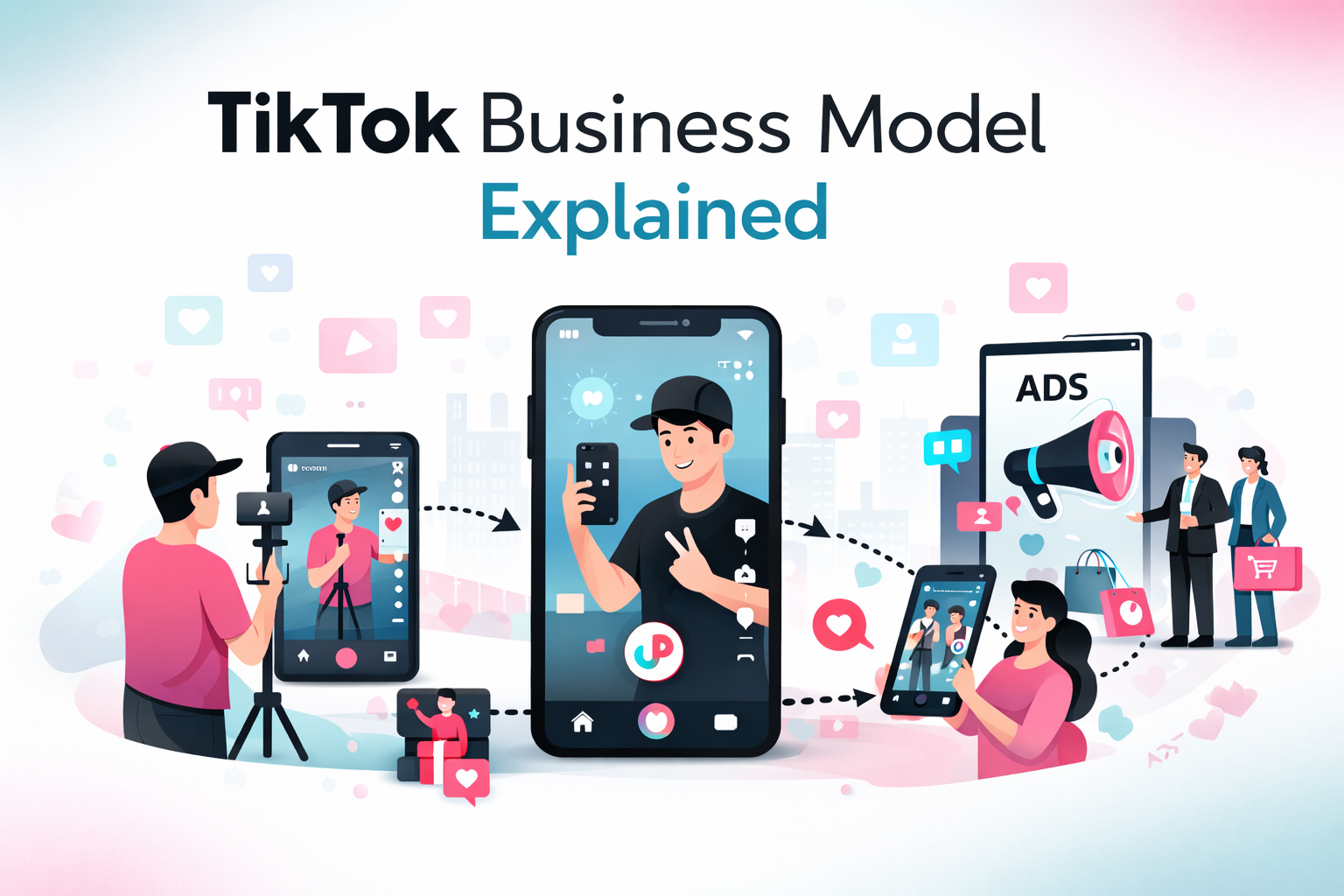
TikTok Business Model and How It Makes Money By Showing Short Videos

TikTok is arguably one of the most disruptive technology stories of the past decade. What started as a short-video app primarily aimed at teenagers doing lip-syncs has evolved into a global content powerhouse with over one billion active users. Its rise from a niche Chinese app to a dominant force in Western social media happened at a pace that left even industry veterans stunned.
The secret behind TikTok’s explosive growth is not just great content. It is a powerful machine that combines a deeply personalized algorithm, a thriving creator economy, and multiple layered revenue streams. This blog breaks down exactly how TikTok’s business model works and how the platform turns attention into profit.
What is TikTok?
TikTok is a short-form video platform that allows users to create, share, and discover videos typically ranging from 15 seconds to 10 minutes. Launched internationally in 2017 after its parent company ByteDance merged it with the lip-sync app Musical.ly, TikTok quickly outpaced many of its rivals by focusing on one thing: keeping users glued to their screens.
ByteDance, a Chinese tech giant founded in 2012, remains TikTok’s parent company. ByteDance built its reputation on AI-driven content recommendation and applied that same technology to TikTok’s core experience. The result is a feed that learns your preferences so quickly that users often describe their For You Page (FYP) as eerily accurate.
TikTok is not just a content platform. It is an ecosystem where creators, viewers, brands, and advertisers all participate in a mutually reinforcing loop.
The Core Idea Behind TikTok’s Business Model
At its heart, TikTok is a three-sided marketplace:
- Creators produce content and attract audiences
- Viewers consume content and drive engagement metrics
- Brands and advertisers pay to reach those engaged audiences
The platform itself sits in the middle, facilitating these relationships while monetizing the attention and data generated by millions of daily interactions. TikTok does not need to create content. It simply creates the conditions for others to create content and then sells access to that audience.
This model is powered by a recommendation algorithm that is widely considered the most sophisticated in the social media industry. Unlike platforms that primarily show you content from people you follow, TikTok’s algorithm surfaces content based purely on engagement signals, meaning even a brand-new creator with zero followers can go viral overnight.
Here is how TikTok connects its three key groups:
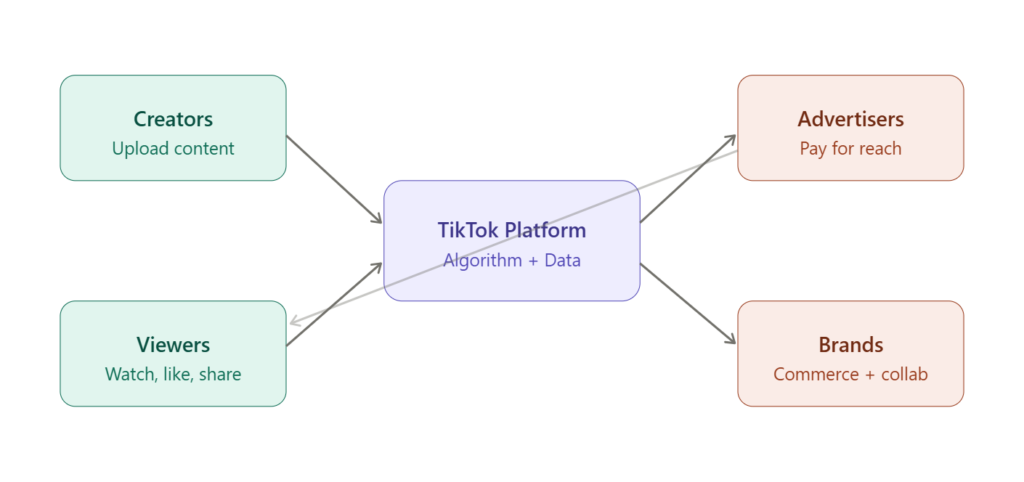
How TikTok Works: The Platform Model
Understanding TikTok’s business model starts with understanding how the platform operates from end to end.
- Step one: A creator films and uploads a short video. TikTok’s system immediately begins testing that video with small audience samples.
- Step two: The algorithm analyzes early engagement signals (watch time, replays, shares, comments) and decides how widely to distribute the video.
- Step three: Users engage with the content, generating valuable behavioral data for TikTok.
- Step four: Brands and advertisers appear within the content stream, reaching highly engaged audiences.
- Step five: TikTok collects revenue from ad placements, in-app purchases, and commerce tools.
This loop is self-reinforcing. More content attracts more viewers. More viewers attract more advertisers. More ad revenue funds platform improvements that attract more creators.
TikTok’s Value Proposition
TikTok delivers a distinct promise to each group in its ecosystem.
For users: The For You Page offers a stream of personalized, endlessly scrollable content. Users do not need to curate who they follow. The algorithm does the work for them, surfacing relevant and entertaining content within minutes of a new user opening the app.
For creators: TikTok is one of the few platforms where organic reach is not dead. A creator with 100 followers can produce a video that reaches 10 million people if the content resonates. This democratization of reach is a powerful incentive for new creators to join and stay on the platform.
For businesses: TikTok offers access to one of the most engaged user bases in digital advertising. The platform skews younger, with strong representation among Gen Z and Millennial audiences who are notoriously difficult to reach through traditional media. High engagement rates and immersive full-screen ad formats make TikTok especially attractive to brands.
TikTok Revenue Streams
This is where the business model becomes especially interesting. TikTok does not rely on a single revenue source. Instead, it has built a diversified income engine with multiple streams that reinforce each other.
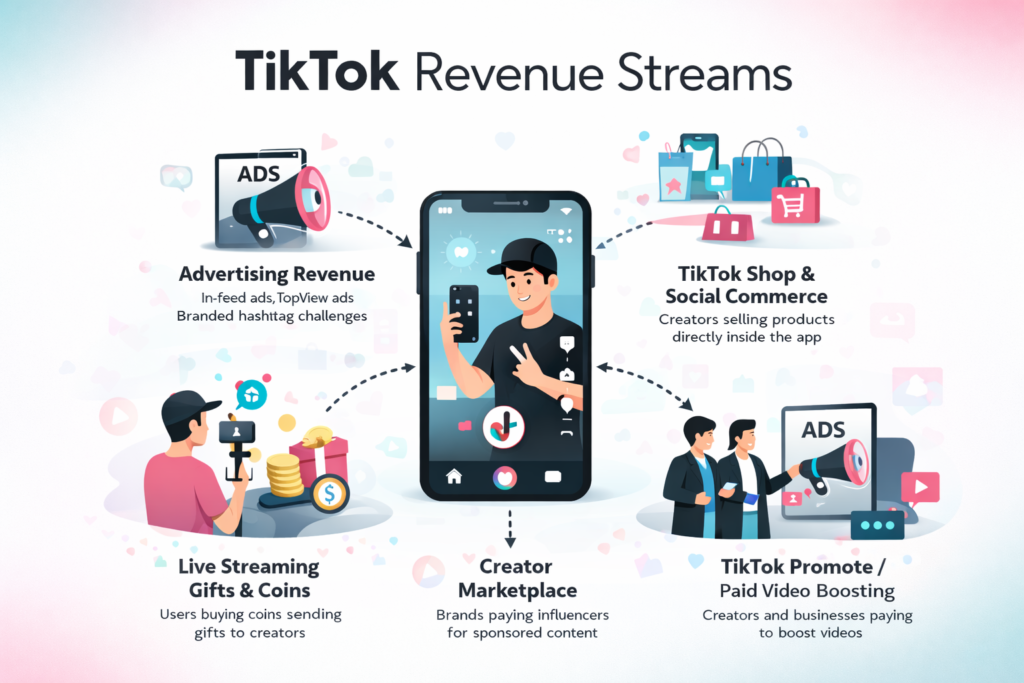
Advertising Revenue
Advertising is TikTok’s largest and most significant revenue source. The platform offers several distinct ad formats:
- In-feed ads: These are video ads that appear between organic content as users scroll through their For You Page. They blend naturally with user-generated content and often include call-to-action buttons.
- Brand takeover ads: Full-screen ads that appear the moment a user opens the app. These are high-impact placements with significant reach and premium pricing.
- TopView ads: Similar to brand takeovers but slightly less intrusive. These appear as the first in-feed video a user sees after opening the app and can run up to 60 seconds.
- Branded hashtag challenges: Brands sponsor challenges that encourage users to create content around a specific hashtag. This generates enormous amounts of user-generated content and organic brand exposure.
TikTok’s advertising business reportedly generated over $18 billion in revenue in 2023, making it one of the fastest-growing digital ad platforms in the world.
TikTok Shop and Social Commerce
TikTok Shop is one of the most strategically important parts of TikTok’s evolving business model. Launched aggressively in key markets including the US and Southeast Asia, TikTok Shop allows users to purchase products directly within the app.
- Creators can tag products in their videos and earn affiliate commissions on sales.
- Brands can set up storefronts and run live shopping events.
- The in-app checkout experience keeps users inside the TikTok ecosystem rather than sending them to third-party websites.
This is TikTok’s bid to become the next great commerce platform, blending entertainment and shopping in a way that no other social platform has successfully scaled.
Virtual Gifts and Coins
TikTok has developed one of the most profitable gifting ecosystems in social media, particularly around live streaming.
- Users purchase TikTok Coins using real money
- Those coins can be converted into virtual gifts
- Gifts are sent to creators during live streams
- Creators convert gifts into Diamonds, which can be exchanged for real money
This system creates a direct and emotional financial relationship between fans and creators. For popular live streamers, this can generate significant income. TikTok takes a cut of the coin transactions, making this a high-margin revenue stream that scales directly with platform engagement.
Creator Marketplace
The TikTok Creator Marketplace is a formal platform where brands and creators can find each other and negotiate collaboration deals. Brands search for creators whose audience matches their target demographic, and TikTok takes a percentage of the transactions facilitated through the marketplace.
This professionalizes influencer marketing and keeps it within TikTok’s ecosystem rather than allowing deals to happen off-platform.
TikTok Promote
TikTok Promote is a self-serve paid boosting tool that allows both creators and businesses to amplify their existing videos to a wider audience. It operates similarly to Facebook’s “Boost Post” feature. A creator can pay to push a video to more people in a specific demographic, making it a simple but effective revenue stream that taps into the creator’s desire for more reach.
TikTok Business Model Canvas
Customer Segments
TikTok serves four core groups. General social media users form the largest segment, spanning Gen Z and Millennials who use the app for daily entertainment. Content creators ranging from hobbyists to professional influencers are the second group, as they supply the content that keeps users engaged. Advertisers and brands form the third and fourth segments, paying to reach TikTok’s highly engaged audience through ads, sponsorships, and direct commerce.
Value Proposition
For users, TikTok delivers an endlessly personalized entertainment feed that requires no active curation. For creators, it offers organic reach that is unmatched on any competing platform, meaning even accounts with zero followers can go viral. For advertisers, it provides access to a young, highly engaged audience through immersive full-screen formats. For e-commerce brands, TikTok Shop offers a direct path from content discovery to purchase without ever leaving the app.
Channels
TikTok reaches its customers primarily through its mobile app on iOS and Android. Advertisers are served through TikTok for Business, a self-serve ad platform. Creators and brands connect through the Creator Marketplace. Commerce happens through TikTok Shop, which functions as both a storefront and a live shopping channel.
Customer Relationships
TikTok maintains relationships with users through its algorithm, which personalizes the experience so effectively that users feel the platform understands them. Creators are retained through monetization tools, analytics dashboards, and the Creator Marketplace. Advertisers are managed through account teams and self-serve tools. The platform largely automates its relationships at scale rather than relying on human touchpoints.
Revenue Streams
TikTok earns money through five main streams. Advertising is the largest, covering in-feed ads, TopView ads, brand takeovers, and branded hashtag challenges. Virtual gifts and TikTok Coins form the second stream, where users spend real money on coins to send gifts to live streamers. TikTok Shop generates commission revenue from product sales facilitated through the app. The Creator Marketplace takes a cut of brand-creator deal transactions. TikTok Promote lets creators and businesses pay to boost video reach.
Key Resources
The AI recommendation algorithm is TikTok’s most valuable asset. Without it, the platform is just another video app. User behavioral data feeds that algorithm and grows more valuable with every interaction. The creator ecosystem is the third critical resource, as the platform has no product without content. Global server infrastructure and ByteDance’s engineering talent round out the key resources.
Key Activities
TikTok’s most important activity is continuously improving its recommendation algorithm. Content moderation at scale is another core activity, requiring both automated systems and human review teams. Platform development keeps the creator tools, commerce features, and ad products competitive. Regulatory compliance has become an increasingly significant operational activity given the scrutiny TikTok faces in multiple markets.
Key Partners
Creators are TikTok’s most important partners because they supply the content for free. Advertisers provide the majority of revenue. E-commerce brands power the TikTok Shop ecosystem. Music labels license the sounds that are central to TikTok’s culture. Cloud infrastructure providers, including Google and Oracle in some markets, support platform operations. Regulatory bodies in various countries are increasingly becoming stakeholders that TikTok must work with.
Cost Structure
TikTok’s largest costs are cloud infrastructure and data center operations, which scale with user growth. Content moderation requires significant investment in both technology and human reviewers. Research and development, particularly for AI and algorithm improvement, is another major expense. Creator Fund and Creativity Program payouts represent a direct cost of keeping creators on the platform. Legal, compliance, and lobbying costs have grown substantially as regulatory pressure has increased globally.
TikTok’s Growth Strategy
TikTok’s rapid ascent is not accidental. The platform has executed a deliberate set of growth levers that have proven remarkably effective.
AI-powered recommendation engine. The algorithm is TikTok’s crown jewel. By prioritizing content signals over social signals, TikTok removed the biggest barrier to discovery on older social platforms: you needed followers to get reach. TikTok eliminated that requirement entirely.
Creator-first platform philosophy. TikTok has consistently invested in tools that make creation easier and more rewarding. Effects libraries, duet and stitch features, and the Creator Fund (later replaced by the Creativity Program) all serve to keep creators active and motivated on the platform.
Viral trends and challenges. TikTok built a culture where trends spread rapidly and participation is easy. Branded hashtag challenges turn marketing into a game, encouraging millions of ordinary users to become voluntary brand ambassadors.
Short-form content as the default. The short-form format lowers the barrier to content creation significantly. You do not need expensive equipment or extensive editing skills. A phone and a good idea are enough, which dramatically expands the pool of potential creators.
TikTok’s Competitive Advantage
TikTok competes directly with YouTube, Instagram Reels, and Snapchat Spotlight. Here is how it stacks up:
| Platform | Primary Content Format | Discovery Model | Monetization Focus |
|---|---|---|---|
| TikTok | Short-form video | Algorithm-first | Ads, commerce, gifting |
| YouTube | Long-form + Shorts | Search + algorithm | Ads, memberships |
| Photo + Reels | Social graph + algo | Ads, shopping | |
| Snapchat | Stories + Spotlight | Social graph | Ads, subscriptions |
What genuinely differentiates TikTok is the combination of three things no competitor has fully replicated:
- Algorithm strength: The For You Page algorithm is widely regarded as superior to equivalent features on competing platforms. Users consistently report that TikTok’s recommendations feel more accurate and engaging.
- Viral discovery: Because reach is decoupled from follower count, every video has a chance to blow up. This creates a lottery dynamic that keeps creators posting consistently.
- Culture-making capacity: TikTok does not just reflect culture. It creates it. Sounds, dances, slang, and challenges originate on TikTok and spread outward to every other platform and media format.
Challenges in TikTok’s Business Model
No business model is without its vulnerabilities, and TikTok faces several serious ones.
Government regulations and bans. TikTok’s relationship with ByteDance has attracted intense regulatory scrutiny in multiple markets. The United States has had ongoing debates about forced divestiture over national security concerns. India banned TikTok outright in 2020. Operating in this environment of regulatory uncertainty creates real business risk.
Content moderation at scale. With over a billion users generating content every day, moderating harmful, misleading, or illegal content is an enormous operational challenge. Failures in content moderation create brand safety concerns for advertisers and reputational damage for the platform.
Competition from established players. YouTube Shorts, Instagram Reels, and even LinkedIn and Pinterest have introduced short-form video features. While none have matched TikTok’s algorithm, the resources these companies can deploy in competition are substantial.
Creator economy sustainability. TikTok’s Creator Fund was widely criticized for paying creators poorly. The shift to the Creativity Program addresses some of these concerns but maintaining creator loyalty remains an ongoing challenge.
The Future of TikTok’s Business Model
Several trends point toward where TikTok’s business model is heading.
Social commerce will continue to be a major growth area. TikTok Shop is the clearest signal of TikTok’s long-term ambitions. The platform wants to own the entire path from discovery to purchase. If it succeeds, it could rival Amazon and Shopify as a commerce destination, not just Meta and Google as an advertising platform.
Creator monetization tools will expand. TikTok has an incentive to keep its best creators on the platform. Expect more direct monetization tools including subscriptions, exclusive content tiers, and enhanced live monetization features to roll out over the next few years.
AI content discovery will become even more precise. As AI technology advances, TikTok’s recommendation engine will only become more accurate and more predictive. The platform is likely to move toward anticipatory content delivery, surfacing videos users did not know they wanted before they realized they wanted them.
Expansion into new markets. TikTok continues to push into emerging markets in Southeast Asia, Latin America, and Africa where smartphone adoption is growing rapidly but the social media landscape is less entrenched.
Key Takeaways
- TikTok is a creator-driven platform built on an algorithm that prioritizes engagement over social connections.
- The platform monetizes primarily through advertising, followed by virtual gifting and an increasingly important commerce layer.
- The algorithm is TikTok’s single greatest competitive advantage and the primary reason for its user retention and creator growth.
- TikTok is actively evolving from a pure advertising business into a full commerce ecosystem through TikTok Shop.
- Regulatory risk and creator monetization remain the most significant challenges to its long-term business model.
FAQs
TikTok generates revenue through a mix of advertising formats, virtual gifts and coins, TikTok Shop commerce commissions, Creator Marketplace fees, and its TikTok Promote paid boosting tool. Advertising is by far the largest single revenue stream.
ByteDance, TikTok’s parent company, is reportedly profitable as a whole. However, TikTok’s specific profitability varies by market and is impacted by heavy investment in content moderation, infrastructure, and regulatory compliance. The company has not publicly disclosed segment-level financial details.
TikTok is owned by ByteDance, a Chinese technology company headquartered in Beijing and founded by Zhang Yiming in 2012. ByteDance has made structural moves to distance TikTok’s operations from China, including establishing headquarters in Los Angeles and Singapore, but the ownership structure remains a point of regulatory controversy.
Digital advertising is TikTok’s primary revenue source, accounting for the vast majority of its earnings. In-feed ads, TopView ads, brand takeovers, and branded hashtag challenges collectively drive the bulk of platform revenue.
TikTok’s global advertising revenue reportedly surpassed $18 billion in 2023, with projections placing it on a trajectory toward $30 billion or more by 2026. This growth positions TikTok as one of the top three digital advertising platforms globally, alongside Google and Meta.
Discover more from Business Model Hub
Subscribe to get the latest posts sent to your email.


[…] TikTok as a platform sits in the middle, connecting all three groups, taking a cut of transactions, and continuously optimizing the algorithm to maximize engagement and sales simultaneously. […]
[…] TikTok is the biggest threat right now. Its algorithm is arguably better at hooking new users. It’s captured the Gen Z audience in a big way. […]
[…] TikTok changed everything. Short-form video exploded in popularity, and for a while, younger users were choosing TikTok over Instagram and Facebook. […]
[…] TikTok Creator Tools […]