Angi Business Model and How It Makes Money Connecting Homeowners with Service Professionals

Home repairs do not wait for a convenient time. A pipe bursts on a Sunday morning. The HVAC stops working in the middle of summer. A homeowner finally decides to renovate the kitchen and has no idea where to start. These moments create immediate, urgent demand for reliable professionals.
Angi exists to solve exactly that problem.
Angi is a home-services marketplace that connects homeowners with local contractors, repair specialists, and service professionals. Whether someone needs a plumber, an electrician, a landscaper, or a full home renovation team, Angi gives them a single platform to search, compare, and hire.
But Angi is more than a directory. It is a full marketplace with lead generation, instant booking, advertising tools, and a contractor ecosystem built around the constant demand for home services.
This guide breaks down how Angi works, how it makes money, and why its business model has proven to be one of the more durable models in the home-services industry.
What Angi Is
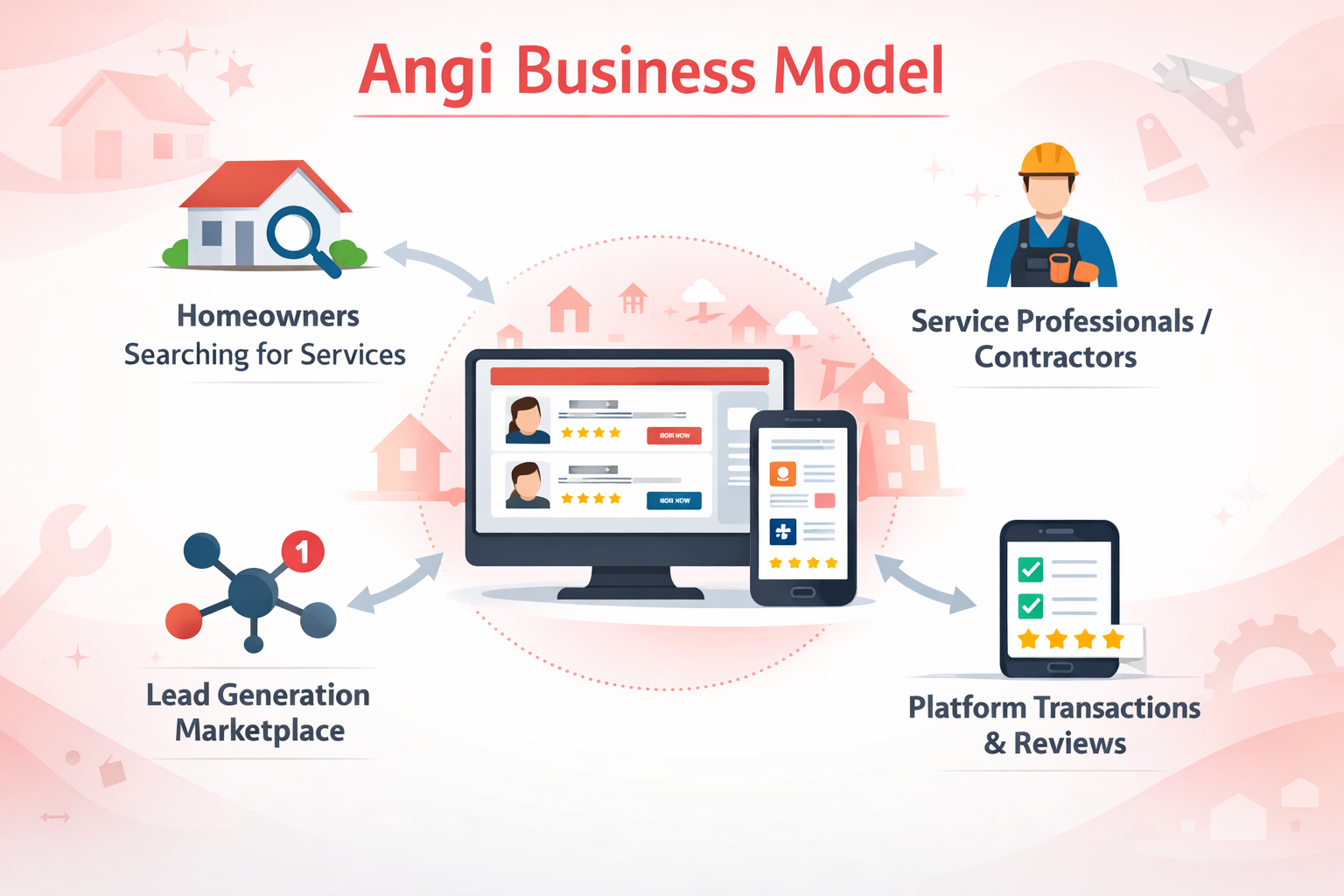
Angi is a two-sided marketplace platform. On one side, homeowners come looking for trusted professionals. On the other side, local service providers pay to access those homeowners as customers.
The platform handles the connection between both sides. Homeowners search for a service. Angi surfaces verified professionals. The homeowner requests quotes or books directly. The contractor receives the lead or the booking. The job gets done. The homeowner leaves a review.
That loop repeats millions of times a year across the United States.
Angi operates primarily in the US market and sits under the parent company IAC. The platform has millions of homeowners using it and hundreds of thousands of registered service professionals across dozens of service categories.
The Evolution of Angi
Understanding what Angi is today requires knowing where it came from. The company did not start as a marketplace. It started as something far simpler.
The Angie’s List Era
Angie’s List was founded in 1995 by Angie Hicks and Bill Oesterle in Columbus, Ohio. The original concept was a subscription-based review platform. Homeowners paid a monthly or annual fee to access verified reviews of local contractors and service providers.
The core insight was that word-of-mouth referrals for home services were unreliable and limited. Most people asked neighbors or relied on the Yellow Pages. Angie’s List offered something better: a curated, searchable database of reviewed professionals.
The subscription model worked for a while, but the rise of free review platforms like Yelp and Google put pressure on the business. If homeowners could get reviews for free elsewhere, paying for Angie’s List was harder to justify.
The Merger with HomeAdvisor
In 2017, Angie’s List merged with HomeAdvisor, another major home-services platform. HomeAdvisor had taken a different approach from the start. Rather than charging consumers, it charged contractors for leads. Homeowners could search and request quotes for free. Professionals paid to receive those requests.
The merger combined Angie’s List’s strong review database and brand recognition with HomeAdvisor’s lead-generation model. Together they formed Angi Homeservices, which later became simply Angi.
The Rebrand to Angi
The company officially rebranded to Angi in 2021. The new brand represented a shift in focus. Rather than being primarily a review site, Angi positioned itself as a full-service digital marketplace for home improvement. The rebrand emphasized instant booking, a broader range of services, and a more modern platform experience.
The evolution from Angie’s List to Angi reflects a broader shift in how home services are bought and sold. Homeowners no longer want to just read reviews. They want to find, compare, book, and pay for services from a single platform.
How Angi Works
The platform workflow is straightforward for both sides of the marketplace.
For Homeowners
- A homeowner visits Angi and types in the service they need, such as “roof repair” or “house cleaning”
- Angi shows a list of local professionals who offer that service
- The homeowner can read reviews, compare profiles, and check ratings
- They can request quotes from multiple professionals or book instantly depending on the service
- After the job is complete, they leave a review on the professional’s profile
The experience is designed to reduce the friction that comes with hiring someone you do not know. Reviews, verified profiles, and clear pricing help homeowners feel confident about who they are hiring.
For Service Professionals
- Contractors and service businesses create a profile on Angi
- They choose which services they offer and which geographic areas they serve
- Depending on their subscription or pay-per-lead arrangement, they receive customer inquiries
- They respond to leads, provide quotes, and win jobs
- Positive reviews build their reputation on the platform and help them win more business over time
The platform essentially replaces a significant portion of what a small contractor would otherwise spend on marketing, cold outreach, and customer acquisition. Instead of building their own website and running ads, they pay Angi and get a steady stream of potential customers.
The Two-Sided Marketplace Model
Angi’s core business structure is a two-sided marketplace. This model is common in platforms like Uber, Airbnb, and DoorDash, but the home-services version has its own dynamics.
Side One: Homeowners
Homeowners are the demand side of the marketplace. They come to Angi with a specific need and a willingness to spend money. They are not paying Angi directly in most cases. Instead, they get free access to search, browse, and request quotes.
The value Angi offers homeowners includes:
- Access to a large pool of vetted professionals
- Verified reviews from real customers
- The ability to compare multiple contractors in one place
- Convenient booking options including instant booking for some services
- Project cost guides and helpful content to understand what a job should cost
Side Two: Service Professionals
Contractors and service businesses are the supply side of the marketplace. They are also the paying customers of Angi. This is the key dynamic of the business model: homeowners use the platform for free, and professionals pay for access to those homeowners.
The value Angi offers professionals includes:
- A consistent source of customer leads
- A platform to showcase reviews and build credibility
- Marketing exposure to homeowners who are actively searching
- Tools to manage their profile and business presence online
The two-sided structure creates a network effect. As more homeowners use Angi, the platform becomes more attractive to contractors. As more contractors join, the platform becomes more useful for homeowners. Each side strengthens the other.
How Angi Makes Money
Angi has built several revenue streams around its marketplace. No single revenue model dominates. Instead, Angi layers multiple monetization mechanisms on top of the core platform.
Lead Generation Fees
The most foundational revenue stream for Angi is charging contractors for customer leads.
Here is how it works. A homeowner submits a request for a service, such as asking for quotes on bathroom tile installation. Angi sends that request to multiple contractors in the area who match the job requirements. Each contractor who receives that lead pays a fee.
The fee varies based on several factors:
- The type of service requested
- The location and local market demand
- The size or estimated value of the project
- The level of competition for that service category
A straightforward cleaning job might generate a lead fee of $10 to $20. A complex renovation or roofing project could generate a lead fee of $50 to $100 or more. Contractors accept this cost because the potential value of winning the job far outweighs the cost of the lead.
This model aligns Angi’s incentives with generating high-intent customer requests. The more homeowners come to Angi with real projects, the more valuable those leads become and the more contractors will pay for them.
Advertising Services for Professionals
Beyond lead generation, Angi sells advertising placements to service professionals who want more visibility on the platform.
Advertising options available to contractors include:
- Sponsored listings that appear at the top of search results
- Featured placements on category pages
- Local service ads that increase visibility in specific geographic areas
- Promoted profiles that appear more prominently when homeowners are browsing
This creates a pay-for-visibility layer on top of the basic lead model. A contractor who simply pays for leads might get a certain amount of exposure. A contractor who also buys advertising will appear more often, rank higher in results, and reach more homeowners.
This structure is similar to how Google and Amazon generate ad revenue. The base platform is functional without advertising, but businesses pay extra to stand out from the competition.
Membership Programs for Service Professionals
Angi offers subscription plans for service providers that bundle multiple features into a recurring monthly or annual fee.
A professional membership typically includes:
- A verified profile listing on the platform
- Access to a set number of leads per month
- Review management tools
- Customer communication features
- Marketing resources and visibility tools
The membership model provides Angi with predictable recurring revenue. Instead of relying entirely on variable lead fees and ad spend, subscriptions create a stable revenue base from contractors who are committed to the platform.
For contractors, a membership can also be more cost-effective than paying for individual leads, especially if they operate in a high-demand category where leads are expensive.
Transaction Commissions on Instant Booking
For certain service categories, Angi supports instant booking. Homeowners can browse available professionals, select one, and book a service directly through the platform without going through a quote request process.
When a transaction happens through instant booking, Angi takes a commission on the total job value. This model is similar to how TaskRabbit and Thumbtack handle transactions on their platforms.
The commission model benefits Angi when it can facilitate the entire transaction rather than just making the introduction. It also benefits homeowners who want the convenience of booking immediately without waiting for multiple quotes.
As Angi pushes more services toward instant booking, this revenue stream has the potential to grow significantly. The shift from lead generation to transaction commission represents a move toward higher revenue per job and deeper involvement in the service delivery process.
Angi Services and the Managed Marketplace
Angi has also developed a managed marketplace model, sometimes called Angi Services. In this model, Angi does more than just connect a homeowner with a contractor. Angi actively manages the relationship.
Here is how the managed marketplace works:
- A homeowner books a service directly through Angi
- Angi assigns a vetted professional from its network to complete the job
- The homeowner pays Angi directly rather than the contractor
- Angi takes a larger commission and handles customer service, quality control, and follow-up
This model gives Angi more control over the customer experience and allows it to compete more directly with platforms like Amazon Home Services. It also generates higher margins per transaction compared to simply selling leads.
The tradeoff is that it requires more operational involvement. Angi has to maintain a reliable network of professionals who can fulfill bookings, and it has to handle issues when jobs do not go well.
Why the Business Model Works
The Angi model has survived for decades in various forms because it is built around a genuine and recurring problem. Home repair and improvement is not a one-time need. Homeowners consistently need help across many different service categories throughout the year.
The Demand Is Constant and Predictable
Home services are not discretionary in the way that luxury goods or entertainment might be. When a furnace breaks down in January, the homeowner cannot wait. When a roof starts leaking, the project cannot be delayed indefinitely. When someone buys a new home, renovation decisions begin almost immediately.
This constant, recurring demand gives Angi a stable base of potential customers. Unlike industries where demand spikes and falls, home services maintain relatively steady activity throughout the year.
High Customer Intent
Users who search Angi are not casually browsing. They have a specific job in mind and they are actively looking to hire someone. This high intent makes leads valuable to contractors and makes the platform more efficient.
Compare this to social media advertising, where a contractor might pay to reach thousands of people who have no current interest in their services. On Angi, every person who submits a request is a potential paying customer right now.
Network Effects Build Over Time
As Angi accumulates more reviews and more contractor profiles, the platform becomes more useful and more trusted. A homeowner researching a plumber in their city will find years of verified reviews on Angi, which gives the platform an advantage over newer or smaller competitors.
More reviews mean better decisions for homeowners. Better decisions mean more completed jobs. More completed jobs mean more reviews. The cycle compounds over time.
Multiple Revenue Streams Reduce Risk
Because Angi monetizes through leads, advertising, subscriptions, commissions, and managed services, it is not entirely dependent on any single model. If lead volumes drop in one category, advertising revenue might hold steady. If instant booking grows, commission revenue offsets any decline in traditional lead fees.
This diversification makes the business more resilient to shifts in platform behavior or market conditions.
Challenges in the Angi Business Model
No business model is without its problems, and Angi faces real challenges that have shaped how the company is perceived by contractors and homeowners alike.
Lead Quality Complaints from Contractors
One of the most persistent criticisms of Angi, and of lead-generation marketplaces in general, is that lead quality is inconsistent. Contractors pay per lead regardless of whether that lead results in a job. A homeowner might submit a request, receive multiple quotes, and then decide not to do the project at all. The contractors who responded still paid for those leads.
This frustration is common across the industry. Contractors who feel they are paying for low-quality leads become less loyal to the platform and may reduce their spending or look for alternative customer acquisition channels.
Angi has worked to address this by improving lead matching and offering credits for leads that clearly do not meet basic quality standards. But it remains a tension point in the business.
Competition from Multiple Directions
Angi operates in a competitive market with challengers coming from several directions:
- Thumbtack takes a similar lead-generation approach and has a strong presence in many service categories
- TaskRabbit focuses on smaller, on-demand tasks and competes for quick-turn service bookings
- Houzz targets the higher-end home renovation market with design inspiration and contractor connections
- Google Local Services Ads allow contractors to advertise directly in Google search results, sometimes bypassing platforms like Angi entirely
- Nextdoor and neighborhood apps let homeowners ask trusted neighbors for direct referrals
Each of these competitors takes a slightly different approach, but they all compete for the same pool of homeowners and contractors.
Maintaining Trust and Verification
The value of Angi depends heavily on homeowners trusting that the professionals listed on the platform are legitimate and qualified. If fake reviews appear, if unqualified contractors get listed, or if jobs go badly with no recourse for homeowners, the platform’s credibility erodes.
Angi invests in background checks, license verification, and review moderation to address this. But managing quality across hundreds of thousands of contractors in hundreds of service categories across the entire United States is an enormous operational challenge.
Contractor Retention
Because contractors are paying customers, keeping them on the platform is critical to revenue. A contractor who has a bad experience with lead quality or platform support may cancel their subscription and look elsewhere. Acquiring new contractors to replace them costs money.
Reducing contractor churn requires constantly improving lead quality, providing useful tools, and demonstrating clear ROI on the platform investment.
Angi vs. Traditional Contractor Directories
Before platforms like Angi existed, homeowners found contractors through printed directories, referrals, or classified ads. The difference between those approaches and the Angi model is significant.
Traditional Directories
Traditional directories like the Yellow Pages offered static listings. A contractor paid for a listing, and homeowners could find their phone number and address. There were no reviews, no comparison tools, no lead routing, and no booking capabilities.
The listing existed, but everything after that was handled entirely by the contractor and the homeowner through direct contact.
How Angi Changes the Model
Angi transforms a static listing into a dynamic marketplace. Key differences include:
- Reviews are verified and continuously updated rather than static or absent
- Lead generation actively routes customer requests to relevant contractors rather than waiting for a homeowner to call
- Instant booking removes friction for homeowners and contractors alike
- Pricing transparency helps homeowners understand what a fair rate looks like before they even request a quote
- Platform tools help contractors manage their reputation, respond to reviews, and track their business performance
The result is a fundamentally more active and useful experience for both sides of the marketplace.
Angi’s Marketplace Strategy
Angi does not just operate a platform. It actively works to grow both sides of the marketplace simultaneously. The strategies for supply and demand are distinct.
Supply Strategy: Growing the Contractor Network
To attract and retain service professionals, Angi focuses on:
- Demonstrating clear value through measurable lead volume and job wins
- Offering marketing tools that help small contractors compete with larger ones
- Providing flexible pricing options from pay-per-lead to full subscriptions
- Supporting contractors with profile management, review tools, and customer communication features
- Expanding into new service categories to bring more types of professionals onto the platform
Demand Strategy: Growing the Homeowner Audience
To attract homeowners, Angi relies on:
- Search engine optimization to capture homeowners actively searching for services online
- Paid advertising across Google, social media, and display networks
- Content marketing including cost guides and home improvement resources that bring in organic traffic
- Word of mouth driven by positive experiences and the trust built through verified reviews
- Mobile apps and a streamlined booking experience that reduces the effort required to hire someone
Both strategies reinforce each other. A stronger contractor network attracts more homeowners. A larger homeowner audience attracts more contractors. The marketplace grows when both sides expand together.
Angi’s Future Direction
The company has been clear about where it sees its future growth. Several strategic priorities define the next phase of the Angi model.
A Bigger Push Toward Instant Booking
Angi has been investing heavily in expanding instant booking to more service categories. The shift from lead generation to direct booking represents a higher level of platform involvement and a larger share of each transaction. For homeowners, it simplifies the hiring process. For Angi, it increases revenue per transaction.
Managed Services Growth
The Angi Services model, where Angi manages the contractor relationship rather than just making the introduction, is another area of focus. This positions Angi closer to being a service provider rather than just a marketplace, which can command higher margins and stronger customer loyalty.
Technology and Matching Improvements
Angi has been incorporating better matching algorithms and AI-powered tools to improve how homeowners are connected with the right professionals. Better matching means higher job completion rates, fewer poor experiences, and stronger platform credibility on both sides.
Expanding Service Categories
Home improvement is broad. Angi continues to expand the categories it covers, from traditional repair and renovation to newer services like smart home installation, solar panel setup, and home energy assessments. Each new category brings new contractors and new homeowners onto the platform.
The Core of What Makes Angi Work
Strip away all the revenue streams and strategic language, and Angi’s model comes down to a simple value exchange.
Homeowners do not want to spend hours researching contractors. They want to find someone qualified, read real reviews from real customers, get a fair price, and get the job done. Angi gives them that.
Contractors do not want to spend money and time on marketing campaigns that may or may not reach anyone who needs their services. They want to be in front of homeowners who are actively looking for exactly what they offer. Angi gives them that too.
The business earns revenue by facilitating that exchange. Whether through a lead fee, an ad placement, a subscription, or a commission on a booked job, every revenue stream flows from that core value: connecting the right professional with the right homeowner at the right time.
Conclusion
The Angi business model works because it is built around a problem that does not go away. Homes always need maintenance. Homeowners always need help finding trustworthy professionals. Contractors always need a reliable source of new customers.
Angi has spent decades building a platform that addresses all three sides of that equation. The evolution from Angie’s List to a full digital marketplace reflects a company that has adapted to changing consumer behavior and market dynamics without abandoning the core value it provides.
Lead generation, advertising, subscriptions, transaction commissions, and managed services all feed into a business that generates revenue from both sides of the marketplace. The platform benefits from strong network effects, high customer intent, and recurring demand that other industries simply do not have.
The challenges are real. Lead quality complaints, strong competition, and the ongoing need to maintain trust across a massive contractor network are problems the company deals with constantly. But the fundamentals of the model remain solid.
FAQs
Angi is a digital platform that helps homeowners find and hire local professionals for home improvement, maintenance, and repair services. It connects users with contractors such as plumbers, electricians, cleaners, and remodelers through a marketplace where customers can compare professionals, read reviews, request quotes, and book services.
Angi primarily earns money by charging contractors for lead generation and advertising services. When homeowners request quotes, contractors can pay to receive those leads. Professionals can also pay for premium listings and marketing tools to increase their visibility on the platform.
Angi mainly operates as a two-sided marketplace. It does not perform the home services itself. Instead, it connects homeowners with independent contractors and service providers who complete the work.
Homeowners can browse professionals, read reviews, and request quotes on Angi without paying a subscription fee. The cost mainly comes from the services performed by contractors, not from using the platform itself.
Angi verifies professionals using several checks such as license verification, insurance validation, background checks in some cases, and customer review monitoring. Contractors with consistent negative feedback may be removed from the platform.
Angi focuses heavily on trusted reviews, verified professionals, and lead generation tools for contractors. While other platforms simply list service providers, Angi also provides booking features, service guarantees, and marketing tools for professionals.
Angi is owned by IAC, a large internet and media holding company that also owns several digital marketplace businesses.
Angi covers a wide range of home services including plumbing, electrical work, roofing, landscaping, house cleaning, home renovation, pest control, and appliance repair.
Angi has generated billions in marketplace revenue over the years, but like many digital marketplaces, profitability can fluctuate depending on marketing costs, platform investments, and contractor acquisition strategies.
Discover more from Business Model Hub
Subscribe to get the latest posts sent to your email.

[…] Angi (formerly Angie’s List) – One of the oldest home services platforms, with a large customer base and broad service coverage […]
[…] Angi (formerly Angie’s List) targets the home services category. For plumbers, electricians, and contractors, Angi is often the first stop. […]
[…] Angi (formerly Angie’s List) has been around longer. It focuses on reviews and lead generation for local service businesses. […]