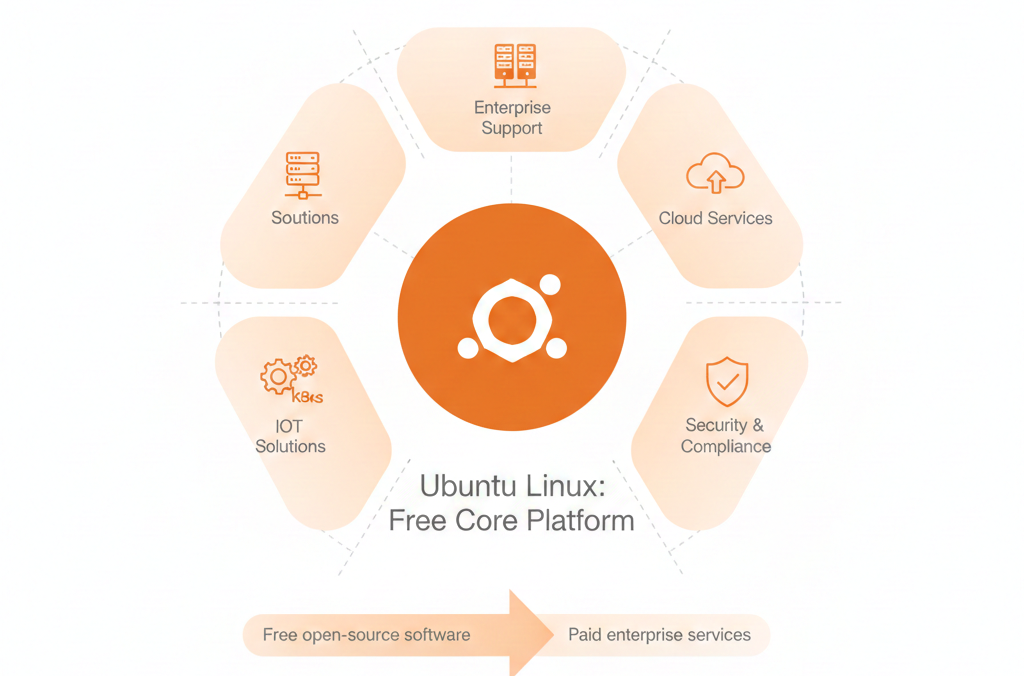

Canonical makes money by giving Ubuntu away for free and charging enterprises for support, security, cloud services, and infrastructure tools.
That sounds counter-intuitive at first.
But this “free core + paid services” model is exactly why Canonical has survived and grown for nearly two decades.
Let me break it down properly.
What Is Canonical?
Canonical Ltd. is a UK-based private company founded by Mark Shuttleworth in 2004.
It is best known for:
- Ubuntu (Linux operating system)
- Cloud and server infrastructure tools
- Open-source enterprise support
Canonical does not sell software licenses like Microsoft or Oracle.
Instead, it builds open-source products and monetizes trust, reliability, and enterprise readiness.
Canonical’s Core Philosophy (Very Important)
Before we talk about revenue, you need to understand Canonical’s mindset.
Canonical believes:
- Software should be free to use
- Innovation should be open
- Businesses will pay for stability, security, and support
So the business model is not about selling software.
It’s about selling peace of mind.
Canonical Business Model Explained
Canonical follows a commercial open-source business model.
Here’s how it works:
- Core software (Ubuntu) → Free
- Enterprises need reliability → Paid
- Canonical provides enterprise-grade services → Revenue
This model works because:
- Millions use Ubuntu for free
- A small percentage of large organizations pay a lot
That’s enough to build a profitable company.
Canonical’s Main Revenue Streams
1. Enterprise Support & Subscriptions (Biggest Revenue)
This is Canonical’s primary income source.
Companies pay for:
- 24/7 technical support
- Security updates
- Compliance guarantees
- Long-term maintenance
Products covered:
- Ubuntu Server
- Ubuntu Desktop (for enterprises)
- Ubuntu Core (IoT)
👉 Pricing is subscription-based, usually annual.
Why companies pay:
If Ubuntu breaks on a production server, they don’t want community forums—they want official support with SLAs.
2. Ubuntu Pro (Security & Compliance)
Ubuntu Pro is Canonical’s premium security offering.
It includes:
- Extended security maintenance (ESM)
- Kernel live patching
- Compliance support (HIPAA, FIPS, CIS)
This is especially valuable for:
- Banks
- Governments
- Healthcare
- Large enterprises
👉 This turns Ubuntu into an enterprise-safe operating system.
3. Cloud Partnerships (AWS, Azure, Google Cloud)
Canonical earns money through cloud marketplace partnerships.
Ubuntu is:
- The most popular Linux OS on AWS
- Widely used on Azure and Google Cloud
Revenue comes from:
- Certified Ubuntu images
- Enterprise cloud support
- Joint enterprise contracts
Canonical benefits when companies deploy Ubuntu at scale in the cloud.
4. Managed Kubernetes (Charmed Kubernetes)
Canonical offers enterprise Kubernetes services.
Includes:
- Managed Kubernetes
- Consulting
- Ongoing maintenance
This targets:
- DevOps teams
- Cloud-native startups
- Enterprises migrating to containers
👉 This is Canonical competing directly with Red Hat and cloud providers.
5. MAAS & Juju (Infrastructure Automation)
Canonical also monetizes infrastructure tools:
- MAAS – Metal as a Service (bare-metal provisioning)
- Juju – Application modeling and orchestration
Revenue comes from:
- Enterprise usage
- Support contracts
- Custom deployments
These tools lock Canonical deeper into enterprise infrastructure.
6. IoT & Embedded Systems (Ubuntu Core)
Canonical supports IoT companies using Ubuntu Core.
Use cases:
- Smart devices
- Industrial systems
- Automotive software
Revenue sources:
- Security updates
- Long-term support
- Certification
This is a slow but strategic revenue stream.
Canonical Business Model Canvas (Ubuntu)
1. Key Partners
Canonical cannot operate alone. Its ecosystem is its strength.
- Cloud providers (AWS, Microsoft Azure, Google Cloud)
- Hardware manufacturers (Dell, Lenovo, HP)
- Open-source contributors & developers
- Enterprise customers
- Government & public sector organizations
👉 These partners help Ubuntu scale globally without Canonical owning infrastructure.
2. Key Activities
What Canonical does daily to keep the business running:
- Developing and maintaining Ubuntu
- Security patching and long-term support
- Enterprise support and SLA management
- Cloud and Kubernetes tooling
- Open-source community management
- Infrastructure automation development (MAAS, Juju)
3. Key Resources
Canonical’s real assets are not physical.
- Ubuntu operating system (brand + ecosystem)
- Open-source codebase
- Engineering talent
- Global community of developers
- Enterprise trust and credibility
- Cloud marketplace presence
4. Value Propositions
Why customers choose Canonical:
For developers (free users)
- Free, stable, open-source OS
- Strong community support
- Cloud-ready by default
For enterprises (paying customers)
- Enterprise-grade security & compliance
- Long-term support (LTS)
- Guaranteed updates and SLAs
- Cloud-native infrastructure tools
- Lower total cost than proprietary OS
5. Customer Relationships
Canonical maintains two very different relationships.
- Community-driven support for free users
- Dedicated account managers for enterprises
- Subscription-based long-term relationships
- Technical support and consulting
- Documentation-first self-service model
6. Channels
How Canonical reaches its users and customers:
- Ubuntu official website
- Cloud marketplaces (AWS, Azure, GCP)
- Hardware OEM pre-installs
- Open-source communities & forums
- Enterprise sales teams
- Developer conferences & tech events
7. Customer Segments
Canonical doesn’t target everyone equally.
Free users
- Developers
- Students
- Startups
- Individual Linux users
Paying customers
- Enterprises
- Governments
- Cloud-native companies
- Telecom and infrastructure firms
- IoT and embedded system companies
8. Cost Structure
Where Canonical spends money:
- Engineering & product development
- Security research and compliance
- Enterprise support teams
- Cloud certification and partnerships
- Infrastructure and tooling
- Limited but strategic marketing
👉 Biggest cost = talent + support
9. Revenue Streams
How Canonical makes money:
- Enterprise support subscriptions
- Ubuntu Pro (security & compliance)
- Cloud support & marketplace revenue
- Managed Kubernetes services
- Infrastructure automation tools (MAAS, Juju)
- IoT and embedded system support
👉 No ads. No data selling. No license fees.
Canonical Business Model Canvas Summary
| Block | Focus |
|---|---|
| Value Proposition | Free OS + Paid enterprise trust |
| Revenue | Subscriptions & services |
| Growth | Open-source adoption |
| Moat | Community + cloud defaults |
| Customer Type | Enterprises pay, users benefit |
What Canonical Does NOT Rely On
This is equally important.
Canonical does not depend on:
- Ads
- User data
- Selling licenses
- App store commissions
This keeps:
- Trust high
- Community happy
- Brand clean
Who Are Canonical’s Customers?
Canonical’s customers are not typical users.
They are:
- Enterprises
- Cloud providers
- Governments
- Telecom companies
- Large tech firms
Regular users benefit from free Ubuntu but never pay.
This separation is intentional.
Canonical’s Cost Structure
Canonical spends heavily on:
- Engineering (open-source development)
- Security research
- Cloud partnerships
- Global support teams
They don’t spend much on marketing.
Ubuntu markets itself through:
- Community adoption
- Developers
- Cloud defaults
Canonical’s Competitive Advantage
1. Free at Scale
Ubuntu is free, fast, and widely adopted.
2. Enterprise Trust
Paid support creates credibility.
3. Strong Community
Millions of developers improve the product for free.
4. Cloud Default Status
Ubuntu is often the default OS on cloud platforms.
Canonical vs Red Hat (Quick Comparison)
| Aspect | Canonical | Red Hat |
|---|---|---|
| Core OS | Ubuntu | RHEL |
| Pricing | Free + optional support | Paid subscription |
| Community | Very open | More controlled |
| Cloud adoption | Extremely high | Strong enterprise focus |
Canonical is more open, Red Hat is more enterprise-locked.
Is Canonical Profitable?
Canonical was funded privately for years by Mark Shuttleworth.
In recent years:
- The company has moved toward sustainable profitability
- Focused heavily on subscriptions and cloud
Canonical is not chasing IPO hype.
It’s building long-term infrastructure relevance.
Why Canonical’s Business Model Works
Because it aligns perfectly with how software is used today:
- Developers want free tools
- Companies want paid assurance
- Cloud demands standardization
- Open-source drives adoption
Canonical doesn’t fight this reality it monetizes around it.
Key Lessons for Founders
If you’re building a tech or SaaS product, Canonical teaches you:
- Free can be a growth strategy
- Monetize risk reduction, not usage
- Enterprises pay for support, not features
- Community can be your strongest asset
- Infrastructure businesses win slowly, but deeply
Conclusion
Canonical is a perfect example of a quiet, infrastructure-first business model.
No flashy ads.
No aggressive sales.
Just:
Free software → Massive adoption → Paid enterprise trust
That’s why Ubuntu is everywhere and Canonical keeps earning without selling software.
Discover more from Business Model Hub
Subscribe to get the latest posts sent to your email.