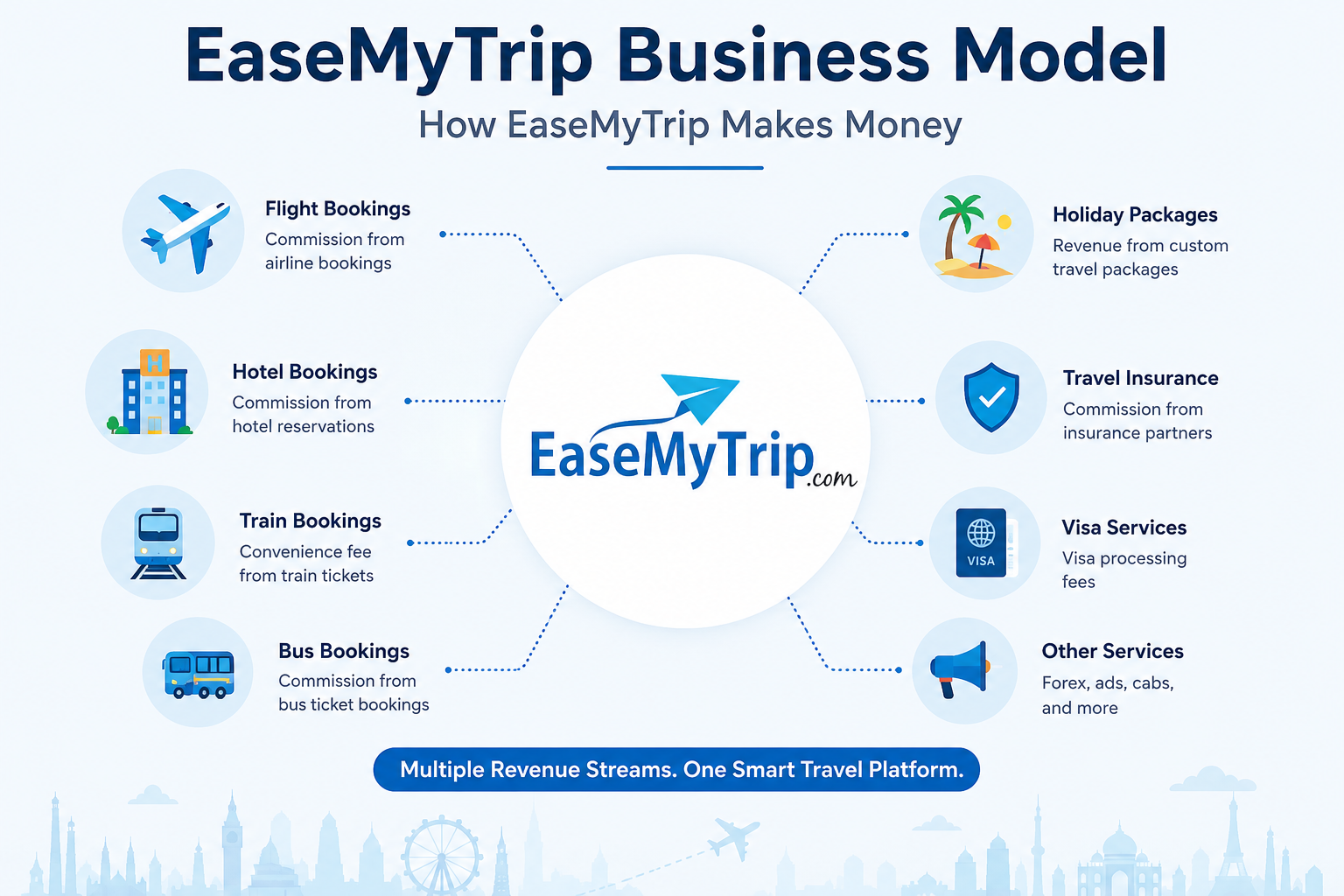

EaseMyTrip runs an asset light online travel agency model. It earns money through flight commissions, hotel bookings, holiday packages, bus and train ticketing, travel insurance, visa services, forex, and advertising. Its biggest differentiator is a zero convenience fee policy on flight bookings, which built a loyal, price sensitive customer base across India.
This post breaks down the full business model, revenue streams, cost structure, and competitive position, using the same framework practical for founders studying scalable, low asset travel platforms.
What Is EaseMyTrip?
EaseMyTrip is an Indian online travel company headquartered in New Delhi. It was founded in 2008 by brothers Nishant Pitti, Rikant Pitti, and Prashant Pitti.
The company started as a B2B travel agency before expanding into B2C and B2E (business to enterprise) channels. It now offers flight bookings, hotel bookings, holiday packages, bus and train tickets, cab bookings, travel insurance, visa assistance, and forex services.
EaseMyTrip went public in March 2021, becoming the first Indian online travel agency to list on domestic stock exchanges. It operates in India and has expanded into international markets including the UAE, UK, US, Singapore, Philippines, and Thailand.
EaseMyTrip At A Glance
| Detail | Information |
|---|---|
| Founded | 2008 |
| Founders | Nishant Pitti, Rikant Pitti, Prashant Pitti |
| Industry | Online travel and tourism |
| Business type | Asset light OTA marketplace |
| Revenue model | Commission and fee based |
| IPO | March 2021, NSE and BSE |
| Headquarters | New Delhi, India |
| Website | easemytrip.com |
| Market presence | India, UAE, UK, Singapore, Philippines, Thailand, and other international markets |
How Did EaseMyTrip Start?
EaseMyTrip started as a B2B travel agency selling airline tickets to smaller travel agents rather than directly to consumers. This kept early operating costs low while the company built airline relationships and booking volume.
The business later moved into the B2C segment, offering direct booking through its website and mobile app. It then added a B2E channel to serve corporate clients with managed travel programs.
By the time it filed for its IPO, EaseMyTrip was already profitable, which made it stand out among loss making travel startups. The IPO gave it capital to expand into hotels, holiday packages, and international markets, and to acquire smaller travel and hospitality businesses over the following years.
How Does The EaseMyTrip Business Model Work?
EaseMyTrip works as a marketplace that connects travelers with airlines, hotels, and other travel suppliers, and earns a commission or fee on each transaction it facilitates.
The basic flow looks like this.
- A customer searches for a trip on the website or app.
- EaseMyTrip compares live inventory from airlines, hotels, and other partners.
- The customer selects an option and completes payment.
- EaseMyTrip confirms the booking with the supplier.
- The supplier fulfills the actual travel service.
- EaseMyTrip collects its commission or service fee.
This model means EaseMyTrip does not own airplanes, hotels, or buses. It owns the booking technology, the customer relationships, and the supplier network, which keeps the business capital efficient.
EaseMyTrip Business Model Canvas
Who Are EaseMyTrip’s Customer Segments?
EaseMyTrip serves a broad mix of travelers rather than one narrow niche.
Its main customer groups include:
- Individual leisure travelers
- Families
- Students
- Corporate travelers
- Small and medium businesses
- Pilgrimage travelers
- International tourists visiting or departing from India
What Is EaseMyTrip’s Value Proposition?
EaseMyTrip’s core value proposition is affordability without giving up convenience.
Its main value drivers include:
- Zero convenience fees on flight bookings
- Competitive pricing across categories
- Fast and simple booking flows
- Cashback and coupon offers
- Bundled holiday packages
- Easy cancellation and refund handling
What Channels Does EaseMyTrip Use?
EaseMyTrip reaches customers through multiple channels rather than relying on one funnel, including its website, its Android and iOS apps, a network of travel agents, direct corporate sales, affiliate partners, digital marketing campaigns, and referral programs.
How Does EaseMyTrip Manage Customer Relationships?
EaseMyTrip relies mostly on self-service technology backed by human support when needed. This includes a self-service booking platform, loyalty and rewards programs, customer support teams, refund and cancellation assistance, personalized offers based on booking history, and automated notifications for price drops and itinerary updates.
What Are EaseMyTrip’s Key Resources?
The company’s core resources are digital rather than physical. Key resources include its booking technology platform, mobile apps, contracted travel inventory from airlines and hotels, brand recognition, payment infrastructure, its customer database, and its partner network.
What Are EaseMyTrip’s Key Activities?
Day to day, EaseMyTrip focuses on activities that keep the marketplace running and growing. These include platform development and maintenance, booking and inventory management, marketing and customer acquisition, customer support, partner onboarding, payment processing, and building holiday packages.
Who Are EaseMyTrip’s Key Partners?
EaseMyTrip depends on a wide supplier network to fill its marketplace with inventory, including domestic and international airlines, hotel chains and independent properties, IRCTC for rail bookings, bus operators, insurance providers, payment gateways, visa processing agencies, and tourism boards.
How Does EaseMyTrip Make Money?
EaseMyTrip generates revenue from several sources rather than depending on one product line. This diversification helps protect margins when any single category, like flight commissions, comes under pricing pressure.
Does EaseMyTrip Earn Commission On Flight Bookings?
Yes. Flight ticket commissions from airline partners are one of EaseMyTrip’s largest revenue sources. The company negotiates commission agreements with domestic and international airlines. Every flight booking made through the platform generates a small commission, and high booking volume makes this a meaningful revenue stream even at thin per ticket margins.
How Does EaseMyTrip Earn From Hotel Bookings?
EaseMyTrip earns commissions from hotels and property partners for every confirmed booking made through its platform. Hotels list availability and pricing, and EaseMyTrip takes a percentage cut or fixed fee per booking, without ever owning or operating the properties itself.
Are Holiday Packages A Major Revenue Source?
Yes. Bundled holiday packages that combine flights, hotels, and local transport generate higher margins than single service bookings. Because packages bundle multiple services together, EaseMyTrip can price them with more flexibility and capture a larger share of the total trip value compared to booking each component separately.
Does EaseMyTrip Make Money From Bus And Train Bookings?
Yes. EaseMyTrip earns ticketing commissions on bus and train bookings, including rail bookings processed through its IRCTC partnership. These categories usually carry lower commissions than flights or hotels, but they add booking volume and keep users returning to the platform for everyday travel needs.
How Does Travel Insurance Contribute To Revenue?
EaseMyTrip cross-sells travel insurance during the booking flow and earns a commission from insurance partners for every policy sold. This is a high margin, low effort revenue stream, since the insurance product is added at checkout without requiring EaseMyTrip to underwrite any risk itself.
Does EaseMyTrip Charge For Visa Assistance?
Yes. EaseMyTrip earns processing fees for helping customers with visa applications and documentation for international travel. This service adds convenience for travelers heading abroad and generates fee income without significant additional infrastructure cost.
How Does Forex Fit Into The Business Model?
EaseMyTrip earns a margin on foreign exchange services offered to travelers heading overseas. By bundling currency exchange with trip booking, the company captures another revenue point tied directly to international travel demand.
Does EaseMyTrip Earn From Advertising?
Yes. Airlines, hotels, and other travel brands pay EaseMyTrip for featured placements, promoted listings, and co-marketing campaigns. This advertising revenue is largely incremental, since it uses existing traffic and platform real estate rather than requiring new infrastructure.
What Role Does Corporate Travel Play?
Corporate travel management is a growing revenue stream, where EaseMyTrip manages end to end travel booking and reporting for business clients. Corporate accounts tend to be higher volume and more predictable than individual leisure bookings, which makes this segment attractive for long term revenue stability.
Does EaseMyTrip Earn From Convenience Fees?
Yes, but selectively. While flight bookings carry zero convenience fees, EaseMyTrip applies fees on select other services and payment methods. This selective fee structure lets the company keep its most visible product, flight booking, free of extra charges while still capturing fee revenue elsewhere.
What Are Ancillary Services?
Ancillary services are add-ons sold alongside a core booking, such as meals, extra baggage, seat selection, airport transfers, and local activities. These upsells increase the average revenue per booking without requiring EaseMyTrip to acquire a new customer for each sale.
EaseMyTrip Revenue Streams Summary
| Revenue Stream | Type | Margin Level |
|---|---|---|
| Flight commissions | Commission | Low per unit, high volume |
| Hotel commissions | Commission | Moderate |
| Holiday packages | Bundled | Higher |
| Bus and train bookings | Commission | Low |
| Travel insurance | Cross-sell | High |
| Visa assistance | Service fee | Moderate |
| Forex services | Margin based | Moderate |
| Advertising | Placement fee | High |
| Corporate travel | Managed service | Stable, recurring |
| Ancillary services | Upsell | High |
What Is EaseMyTrip’s Cost Structure?
EaseMyTrip’s biggest costs come from running and marketing a digital platform rather than maintaining physical travel assets.
Its major expense categories include:
- Employee salaries
- Marketing and customer acquisition
- Technology infrastructure and cloud hosting
- Customer support operations
- Payment gateway charges
- Regulatory compliance
- Office operations
- Ongoing product development
Because the company does not own aircraft, hotels, or buses, its fixed costs stay lower than traditional travel operators, which supports its asset light positioning.
What Is EaseMyTrip’s Pricing Strategy?
EaseMyTrip’s pricing strategy centers on removing friction points that competitors charge for, especially the convenience fee on flights.
Its approach includes zero convenience fee positioning on flight bookings, competitive pricing driven by supplier negotiations, dynamic discounts tied to demand, festival and seasonal offers, coupon based promotions, and membership deals for repeat customers.
This pricing strategy trades a small amount of per booking margin for higher volume and stronger word of mouth growth.
How Does EaseMyTrip Market Itself?
EaseMyTrip runs a multi-channel marketing strategy that mixes performance marketing with brand building.
Its marketing mix includes:
- Search engine optimization
- Google Ads campaigns
- Social media marketing
- Influencer partnerships
- IPL sponsorships
- Celebrity brand ambassadors
- Referral programs
- Affiliate marketing
- App store optimization
- Email marketing
- Push notifications
The combination of performance channels and high visibility sponsorships helps EaseMyTrip stay top of mind for price sensitive Indian travelers.
What Technology Powers EaseMyTrip?
EaseMyTrip’s platform runs on a technology stack built for real time pricing and high booking volume.
Core technology components include the booking engine, API integrations with airlines and hotels, dynamic pricing systems, AI-based recommendations, fraud detection tools, secure payment processing, mobile apps, analytics dashboards, CRM systems, and cloud infrastructure.
This technology layer is what allows EaseMyTrip to compare and confirm inventory from hundreds of suppliers in real time.
What Are EaseMyTrip’s Competitive Advantages?
EaseMyTrip has built several advantages that support its position in a crowded OTA market.
Its main strengths include:
- Asset light operating model
- Strong brand recognition in India
- The zero convenience fee strategy
- A high repeat customer rate
- Diversified travel offerings
- Consistent profitability compared to many competitors
- Disciplined cost management
- Expanding international presence
What Challenges Does EaseMyTrip Face?
Despite its strengths, EaseMyTrip operates in a difficult, low margin industry.
Key challenges include intense competition from other OTAs, pricing pressure from airlines, thin margins on core ticketing revenue, disruptions across the travel industry, regulatory changes affecting travel and payments, rising customer acquisition costs, and sensitivity to global economic slowdowns that reduce travel demand.
SWOT Analysis Of EaseMyTrip
| Category | Details |
|---|---|
| Strengths | Asset light model, zero convenience fee brand identity, diversified revenue streams, and consistent profitability |
| Weaknesses | Thin margins on ticketing, dependence on airline commission structures, and exposure to a small number of large suppliers |
| Opportunities | International expansion, AI powered trip planning, premium membership tiers, fintech integration, and growth in corporate travel |
| Threats | Intense OTA competition, airline pricing changes, economic slowdowns affecting travel demand, and regulatory shifts in the travel and payments space |
How Does EaseMyTrip Compare To Competitors?
| Company | Main Strength | Revenue Focus |
|---|---|---|
| MakeMyTrip | Market leader | Flights, hotels |
| Yatra | Corporate travel | B2B and B2C |
| Cleartrip | Simple booking experience | Flights |
| ixigo | Train and travel discovery | Rail and flights |
| Agoda | Global hotel inventory | Hotels |
| Booking.com | International accommodation | Hotels |
| Expedia | Global travel ecosystem | Multi-service |
EaseMyTrip differentiates itself mainly through pricing transparency and its zero convenience fee positioning, rather than trying to out-scale larger global players.
What Is EaseMyTrip’s Future Growth Strategy?
EaseMyTrip’s growth plans lean on both geographic expansion and product innovation.
Its stated growth directions include:
- International market expansion
- AI powered travel planning tools
- Premium membership offerings
- Fintech integration for travel payments
- Subscription based travel products
- Deeper corporate travel penetration
- Strategic acquisitions
- Experience based tourism offerings
- Sustainable travel initiatives
What Can Startups Learn From EaseMyTrip?
EaseMyTrip’s growth offers a few practical lessons for founders building marketplace or asset light businesses.
- Differentiate on pricing transparency rather than only adding features
- Stay asset light to scale faster without heavy capital requirements
- Build multiple revenue streams so no single category carries all the risk
- Focus on customer trust through simple, transparent pricing
- Diversify beyond one core product category once the core business is stable
- Invest in technology to keep the booking experience fast and reliable
- Maintain cost discipline so growth does not come at the expense of profitability
Frequently Asked Questions
What Is The EaseMyTrip Business Model?
EaseMyTrip runs an asset light online travel agency model that earns commissions and fees by connecting travelers with airlines, hotels, and other travel suppliers.
How Does EaseMyTrip Make Money?
EaseMyTrip earns revenue through flight and hotel commissions, holiday packages, bus and train bookings, travel insurance, visa services, forex, advertising, corporate travel, and ancillary upsells.
Does EaseMyTrip Charge Convenience Fees?
EaseMyTrip does not charge a convenience fee on flight bookings, which is central to its brand positioning, though it does apply fees on select other services.
Who Are EaseMyTrip’s Biggest Competitors?
Its main competitors include MakeMyTrip, Yatra, Cleartrip, ixigo, Agoda, Booking.com, and Expedia.
Is EaseMyTrip Profitable?
EaseMyTrip has historically been profitable compared to many travel startups, though like other OTAs it has faced periods of margin pressure as competition and expenses increase.
What Are EaseMyTrip’s Main Revenue Sources?
Its main revenue sources are flight commissions, hotel commissions, and holiday packages, supported by smaller streams from insurance, visa services, forex, and advertising.
Why Is EaseMyTrip Cheaper Than Competitors?
EaseMyTrip’s pricing is competitive mainly because it removes convenience fees on flights and negotiates directly with suppliers to keep margins tight but sustainable.
Is EaseMyTrip A Marketplace Or An OTA?
EaseMyTrip operates as an online travel agency that functions like a marketplace, connecting travelers with airlines, hotels, and other suppliers without owning the underlying travel assets.
What Makes EaseMyTrip Different From MakeMyTrip?
EaseMyTrip focuses heavily on pricing transparency and zero convenience fees, while MakeMyTrip operates at larger scale with a broader range of services and marketing reach.
What Is The Future Of EaseMyTrip?
EaseMyTrip’s future growth is expected to come from international expansion, AI driven travel planning, premium memberships, and deeper corporate travel offerings.
Final Thoughts
EaseMyTrip has built a scalable, asset light travel platform by combining competitive pricing, diversified revenue streams, strong supplier partnerships, and disciplined cost management.
Its focus on affordability and operational efficiency has helped it carve out a strong position in India’s competitive online travel market. Continued investment in technology and international expansion will likely shape how the company grows from here.
Discover more from Business Model Hub
Subscribe to get the latest posts sent to your email.