ElevenLabs Business Model : How the AI Voice Startup Makes Money and Scaled to a Multi-Billion-Dollar Company

ElevenLabs is a London founded AI audio company that builds text to speech, voice cloning, dubbing, and conversational voice agent technology. The ElevenLabs business model runs on a hybrid SaaS and API structure, combining consumer subscriptions, developer usage billing, and enterprise licensing. ElevenLabs makes money through tiered subscription plans, pay as you go API credits, and custom enterprise contracts with companies that need voice AI at scale. As of February 2026, ElevenLabs raised $500 million in a Series D round led by Sequoia Capital at an $11 billion valuation, making it one of the fastest growing AI companies in the world.
What is ElevenLabs?
Company introduction
ElevenLabs is an artificial intelligence company that specializes in generating natural sounding human speech. The platform converts written text into lifelike audio, clones voices from short samples, and powers conversational AI agents that can speak with customers in real time.
Founders
ElevenLabs was founded in 2022 by Piotr Dabkowski and Mati Staniszewski, with Mati Staniszewski serving as the company’s chief executive. Both founders are Polish and built the company with a mission to remove the language barrier created by robotic sounding voice technology.
Headquarters
ElevenLabs is headquartered in London, with additional offices spread across Europe, Brazil, Mexico, India, South Korea, Japan, and the United States.
Launch year
The company launched in 2022 and released its first publicly available text to speech product shortly after.
Industry
ElevenLabs operates in the AI voice and audio generation industry, a segment that sits inside the broader artificial intelligence and SaaS infrastructure market.
Why it became popular
ElevenLabs became popular because its voice models sounded dramatically more human than older text to speech engines. Creators, podcasters, and developers noticed the difference immediately and began sharing samples online, which fueled organic growth before the company spent heavily on marketing.
Company Overview
| Detail | Information |
|---|---|
| Founded | 2022 |
| Founders | Piotr Dabkowski and Mati Staniszewski |
| Headquarters | London, with global offices |
| Industry | AI voice and audio generation |
| Company Type | Private |
| Valuation | $11 billion as of February 2026 |
| Funding | Over $780 million raised across multiple rounds |
| Core Products | Text to speech, voice cloning, dubbing, conversational agents, music generation |
History of ElevenLabs
Founding story and initial idea
The founders started ElevenLabs after noticing that dubbed foreign films and AI generated voices sounded flat and unnatural. They believed neural networks could produce speech with real emotion, pacing, and tone.
Early challenges
In the early days, the team had to compete against established voice technology from large cloud providers. Building a model that sounded genuinely human required significant research investment before any revenue existed.
Product launch and viral adoption
The original text to speech tool spread quickly among YouTubers and audiobook creators who shared side by side comparisons against older tools. This word of mouth growth gave ElevenLabs an audience before it had a large marketing budget.
Major milestones and enterprise expansion
ElevenLabs expanded from text to speech into voice cloning, dubbing, conversational agents, and music generation. The platform is now used by 41 percent of Fortune 500 companies, with enterprise customers including Washington Post, TIME, Paradox Interactive, HarperCollins, Deutsche Telekom, Square, the Ukrainian Government, and Revolut.
Latest developments
In May 2026, Spotify partnered with ElevenLabs to let authors generate AI audiobooks directly through Spotify, expanding ElevenLabs from a generation tool into embedded platform infrastructure. The company also signed a memorandum with the United Kingdom’s Department for Science, Innovation and Technology in June 2026 to explore public sector voice AI use cases.
What Problem Does ElevenLabs Solve?
Robotic text to speech
Older text to speech systems sounded mechanical. ElevenLabs solves this by producing speech with natural rhythm, emotion, and inflection.
Expensive voice actors
Hiring professional voice actors for every project is costly and slow. ElevenLabs lets creators generate professional grade narration without booking studio time.
Slow localization
Translating and dubbing content for global audiences traditionally takes weeks. ElevenLabs speeds this up with AI dubbing that preserves tone and pacing across languages.
Accessibility
The technology helps people who have lost their voice due to illness or injury communicate using a synthetic version of their own voice.
Audiobook production
Publishers can generate full length audiobooks faster and at lower cost compared to traditional recording.
Video narration and gaming voice generation
Video creators and game studios use ElevenLabs to generate character voices and narration without scheduling live recording sessions.
Customer support automation
Businesses use ElevenLabs conversational agents to handle phone support, reducing wait times and operating costs.
How Does ElevenLabs Work?
The basic workflow follows a simple sequence.
A user creates an account and chooses a voice from the library or clones their own. They input text or connect an application through the API. The AI processes the language, applies the chosen voice model, and synthesizes audio. The final file is delivered as a download or returned through the API for use inside another product.
ElevenLabs Business Model Explained
AI SaaS model
ElevenLabs operates as an AI powered software as a service company. Customers pay recurring fees for access to voice generation tools rather than purchasing software outright.
Subscription model
Individual creators and small businesses pay monthly or annual subscription fees tied to usage credits.
Usage based pricing
Heavier users, including developers, pay based on the volume of audio or characters they generate through the API.
API platform
Developers can integrate ElevenLabs voice technology directly into apps, games, and customer service tools through a developer focused API platform.
Enterprise licensing
Large organizations negotiate custom contracts that include higher usage limits, dedicated support, and compliance guarantees.
Creator ecosystem
ElevenLabs also supports a creator and music marketplace, where contributors earn a share of revenue from content built on the platform.
Why this hybrid model scales efficiently
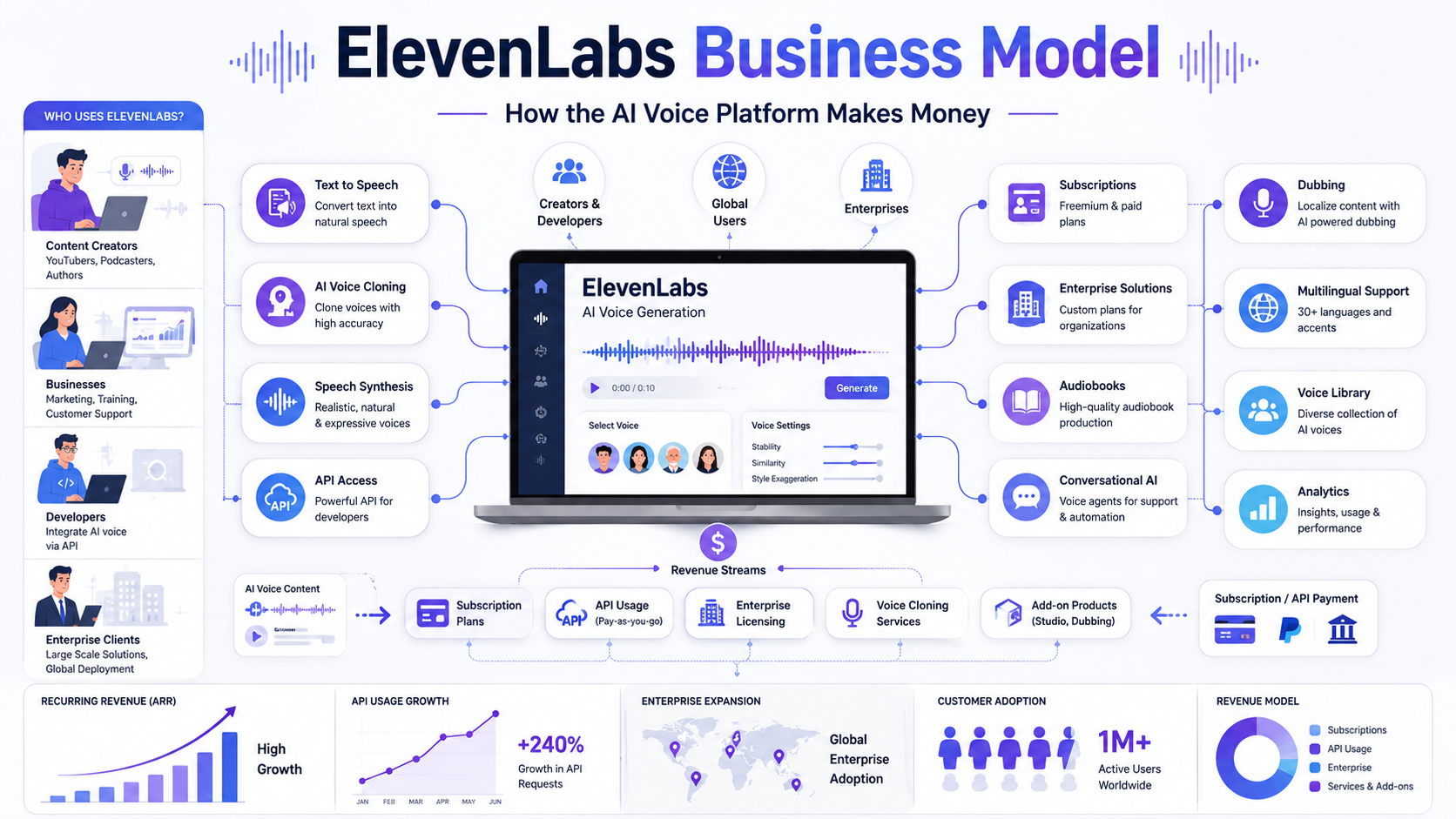
Combining consumer subscriptions, developer billing, and enterprise contracts gives ElevenLabs multiple revenue streams that grow independently. This reduces reliance on any single customer type and allows the company to capture value from hobbyists, professional creators, and large enterprises at the same time.
ElevenLabs Business Model Canvas
Customer Segments: individual creators, developers, media companies, enterprises, public sector organizations.
Value Propositions: lifelike voice generation, fast localization, scalable conversational AI agents.
Channels: website, API documentation, enterprise sales teams, partner integrations.
Customer Relationships: self service for individuals, dedicated account management for enterprise.
Revenue Streams: subscriptions, API usage billing, enterprise licensing, music and creator marketplace revenue share.
Key Resources: proprietary AI models, research talent, cloud compute infrastructure.
Key Activities: model research, product development, enterprise sales, global expansion.
Key Partners: cloud infrastructure providers, publishers, music labels, government agencies.
Cost Structure: AI research, GPU and cloud costs, engineering salaries, sales and marketing.
How Does ElevenLabs Make Money?
Subscription plans
ElevenLabs offers a Free plan, Starter at six dollars a month, Creator at twenty two dollars a month, Pro at ninety nine dollars a month, Scale at two hundred ninety nine dollars a month, and Business at nine hundred ninety dollars a month, with Enterprise pricing handled on a custom basis. Each tier includes a set amount of monthly credits, and annual billing offers roughly two months free compared to paying monthly.
The free tier does not include commercial usage rights, so any content generated must include attribution and cannot be legally monetized. Commercial use becomes available starting on the Starter plan, and professional voice cloning unlocks on the Creator plan, which is the tier most serious creators choose.
API usage revenue
Developers pay based on actual consumption, billed through a credit system. Credits are shared across every product on the platform, so the same pool can be spent on text to speech, dubbing, or conversational AI. Overage rates are tiered, with Creator plan users paying thirty cents per one thousand characters and Business plan users paying as little as twelve cents per one thousand characters beyond their included credits.
Enterprise licensing
Large organizations negotiate custom contracts that include higher volume limits, dedicated infrastructure, and compliance support. This is where ElevenLabs earns its largest individual contracts.
AI voice cloning services
Voice cloning is split between instant cloning, available on lower tiers, and professional voice cloning, which requires more audio input and is reserved for paid plans starting at Creator.
Studio products and audiobook production
ElevenLabs Studio supports long form content creation for audiobooks and publishing. The Spotify partnership announced in May 2026 specifically targets one hundred million dollars in audiobook revenue by embedding ElevenLabs as the audiobook generation layer inside Spotify.
Conversational AI
ElevenLabs Agents power automated phone and chat support for businesses. Revolut deployed these agents across the United Kingdom and Europe for more than four million customers, cutting resolution time by eight times across over thirty languages. Klarna also launched an ElevenLabs voice agent as first line phone support for thirty five million customers in the United States.
Dubbing solutions
The dubbing product translates and re-voices content while preserving tone and emotional delivery, opening revenue from media companies and streaming platforms expanding into new markets.
Commercial voice licensing and music marketplace
ElevenLabs introduced a Music Marketplace and ElevenMusic app, with nearly fourteen million songs generated since launch and over eleven million dollars already distributed to creators. This adds a creator monetization layer that also generates platform revenue through licensing.
ElevenLabs Pricing Strategy
Freemium acquisition
The free plan brings in a large volume of new users who experiment with the platform before deciding to pay.
Upgrade funnel
Because the free plan blocks commercial use, any user who wants to publish content is pushed naturally toward a paid tier, creating a clean upgrade path.
Tiered pricing and usage limits
Each plan ties price directly to a credit allowance, so spending scales with actual usage rather than a flat unlimited fee.
Enterprise customization
Large customers negotiate pricing outside the standard tiers, allowing ElevenLabs to capture significantly higher revenue per account.
High margin SaaS economics
Because the core cost driver is compute rather than manual labor, ElevenLabs can scale revenue faster than its cost base grows, which is typical of high margin AI infrastructure companies.
Customer Segments
ElevenLabs serves individual creators, YouTubers, authors, businesses, game developers, media companies, educational institutions, developers, startups, and large enterprises. This wide range allows the company to monetize everyone from a solo podcaster to a multinational bank.
Value Proposition
For creators
Fast, affordable, professional sounding narration without studio costs.
For businesses
Automated customer support that reduces wait times and operating expenses.
For developers
A flexible API that adds voice capability to any application.
For publishers
Faster audiobook production at a fraction of traditional cost.
For enterprises
Scalable voice infrastructure with compliance support and dedicated account management.
Technology Behind ElevenLabs
ElevenLabs relies on neural text to speech models, which use deep learning to predict natural sounding pronunciation, pacing, and emotion from written text. The company also uses large language model techniques to better understand context, which improves how the AI reads punctuation, tone shifts, and emphasis.
Voice cloning works by training a smaller model on a sample of a person’s voice, capturing characteristics like pitch and accent. Speech to speech technology converts one person’s spoken performance into another voice while keeping the original timing and emotion. Text normalization cleans up numbers, abbreviations, and symbols so the AI reads them correctly. All of this feeds into an audio generation pipeline that outputs a finished file or streams audio in real time.
AI Voice Generation Workflow
Text input flows into language processing, which prepares the words for the voice model. The voice model then applies tone, accent, and emotional characteristics. Speech synthesis converts this into raw audio. Audio enhancement cleans and polishes the sound. The final file is delivered through download or returned through the API.
Distribution Strategy
ElevenLabs distributes its product through its website, developer API, direct enterprise sales, and a growing list of partner integrations. Global availability now spans offices across London, New York, San Francisco, Warsaw, Dublin, Tokyo, Seoul, Singapore, Bengaluru, Sydney, São Paulo, Berlin, Paris, and Mexico City, supporting localized go to market teams for enterprise adoption. Sacra
ElevenLabs Marketing Strategy
ElevenLabs has relied heavily on freemium marketing and word of mouth, since the quality of the voice output speaks for itself. Product led growth drove early adoption among YouTubers and podcasters who shared comparisons online. The company also invests in developer community engagement, search visibility, and case studies highlighting enterprise wins like Revolut and Klarna.
Growth Strategy
ElevenLabs grows by launching new products rapidly, expanding into enterprise accounts, building out its API ecosystem, and adding global language support. The company added one hundred million dollars in net new annual recurring revenue in the first quarter of 2026 alone, showing how quickly enterprise and consumer revenue can compound together. Sacra
Competitive Advantage
ElevenLabs competes on voice realism, fast inference speed, a mature API ecosystem, broad language support, and continuous product innovation across text to speech, dubbing, music, and conversational agents.
Network Effects
ElevenLabs benefits from a moderate network effect. More creators using the platform generate more usage data that can refine voice models. More developers building on the API increase platform stickiness. More enterprise integrations create switching costs once a company has built workflows around ElevenLabs voices.
Key Partnerships
Key partners include cloud infrastructure providers, publishers, media companies, government agencies, and technology integrators. Notable partnerships include Spotify for audiobook generation and the United Kingdom government for public sector voice AI exploration. Sacra
Cost Structure
Major expenses include AI research and model training, GPU and cloud hosting infrastructure, engineering salaries, enterprise sales teams, marketing, regulatory compliance, and customer support. GPU costs in particular remain one of the largest line items for any company training and serving large voice models at scale.
Funding History
ElevenLabs raised a one hundred eighty million dollar Series C in January 2025 at a three point three billion dollar valuation. In February 2026, the company raised five hundred million dollars in a Series D round led by Sequoia Capital, bringing total funding to seven hundred eighty one million dollars across five rounds. Existing investors Andreessen Horowitz and ICONIQ increased their positions significantly, while new investors Lightspeed Venture Partners, Evantic Capital, and BOND joined the round. Cofounder Mati Staniszewski also confirmed that Nvidia invested in the company in September 2025.
Financial Performance
ElevenLabs closed 2025 at three hundred thirty million dollars in annual recurring revenue, and Sacra estimates the company crossed five hundred million dollars in annual recurring revenue by April 2026. Chief executive Mati Staniszewski has stated the company hopes to double its annual recurring revenue within the year. Bloomberg reported it took the company only five months to grow from two hundred million to three hundred million dollars in annual recurring revenue, reflecting unusually fast enterprise adoption for a company of its size.
Top Competitors
| Company | Voice Quality | Voice Cloning | API | Enterprise Focus |
|---|---|---|---|---|
| ElevenLabs | High | Yes | Yes | Strong |
| OpenAI Voice | High | Limited | Yes | Growing |
| Murf AI | Moderate | Limited | Yes | Moderate |
| Speechify | Moderate | Limited | Limited | Consumer focused |
| PlayHT | Moderate | Yes | Yes | Moderate |
| WellSaid Labs | High | Limited | Yes | Enterprise focused |
| Amazon Polly | Moderate | No | Yes | Strong |
| Google Cloud Text to Speech | Moderate | No | Yes | Strong |
| Microsoft Azure AI Speech | Moderate | No | Yes | Strong |
ElevenLabs differentiates itself primarily through voice realism and emotional expressiveness, along with a broader product suite spanning dubbing, music, and conversational agents rather than text to speech alone.
SWOT Analysis
Strengths: industry leading voice realism, diverse product suite, strong enterprise adoption, major investor backing.
Weaknesses: premium pricing compared to some competitors, heavy reliance on compute infrastructure costs, exposure to misuse concerns.
Opportunities: healthcare voice restoration, education, government deployments, expansion into video and agent based products.
Threats: increasing competition from large cloud providers, regulatory scrutiny over deepfakes, rising infrastructure costs.
Challenges Facing ElevenLabs
The company faces ongoing questions around AI regulation, copyright concerns tied to voice cloning, the risk of deepfake misuse, rising competition from both startups and large tech companies, growing infrastructure costs, and the need for strong voice consent and data privacy practices. The technology has already been used to create controversial deepfakes, drawing scrutiny from regulators, which makes responsible deployment an ongoing priority for the company. Sacra
Future Opportunities
ElevenLabs is positioned to expand into AI agents that go beyond voice, real time conversational AI, video localization, healthcare communication tools, education, gaming, enterprise automation, and continued global language expansion. The healthcare opportunity alone includes applications for patients with ALS, stroke recovery, and aging populations, tapping into the broader assistive technology market. Sacra
Key Lessons Entrepreneurs Can Learn from ElevenLabs
Solve a clear pain point instead of building a generic product. Start with exceptional product quality before focusing heavily on marketing. Use a freemium model to drive adoption while reserving commercial value for paid tiers. Build APIs alongside consumer facing products to capture developer demand. Focus on recurring revenue rather than one time sales. Expand into enterprise only after achieving real product market fit. Invest continuously in core technology rather than resting on early success. Prioritize responsible AI practices and user trust, since reputation risk can move faster than growth in this industry.
Wrapping Up
The ElevenLabs business model works because it captures value from every type of customer, from a solo creator on a six dollar plan to a global bank running conversational agents across millions of customers. The mix of subscriptions, API billing, and enterprise contracts gives the company multiple paths to revenue growth that do not depend on a single customer category.
Long term scalability comes from the company’s continued investment in core AI research, paired with rapid expansion into adjacent products like music, dubbing, and agents. Revenue diversification reduces risk, and competitive positioning remains strong due to voice quality that competitors have struggled to match.
For founders, investors, and AI enthusiasts, ElevenLabs offers a clear lesson. Solving a real quality gap, pairing a strong consumer product with a flexible developer API, and expanding deliberately into enterprise can turn a focused idea into a multi-billion-dollar company in a short period of time.
FAQs
ElevenLabs is an AI company that generates natural sounding speech, clones voices, and powers conversational voice agents.
ElevenLabs earns revenue through subscription plans, API usage billing, and enterprise licensing contracts.
ElevenLabs has not publicly confirmed profitability, but its rapid annual recurring revenue growth suggests strong unit economics.
ElevenLabs is valued at eleven billion dollars as of its February 2026 funding round.
Yes, the entire platform is built on proprietary neural network models for speech synthesis and voice cloning.
Major competitors include OpenAI Voice, Murf AI, Speechify, PlayHT, WellSaid Labs, Amazon Polly, Google Cloud Text to Speech, and Microsoft Azure AI Speech.
Yes, it operates as an AI powered software as a service company with subscription and usage based pricing.
Media, publishing, gaming, customer support, healthcare, education, and government sectors all use the platform.
Its combination of high voice realism, a broad product suite, and strong enterprise traction sets it apart from narrower competitors.
Discover more from Business Model Hub
Subscribe to get the latest posts sent to your email.