Caviar Business Model And How It Built a Premium Food Delivery Platform

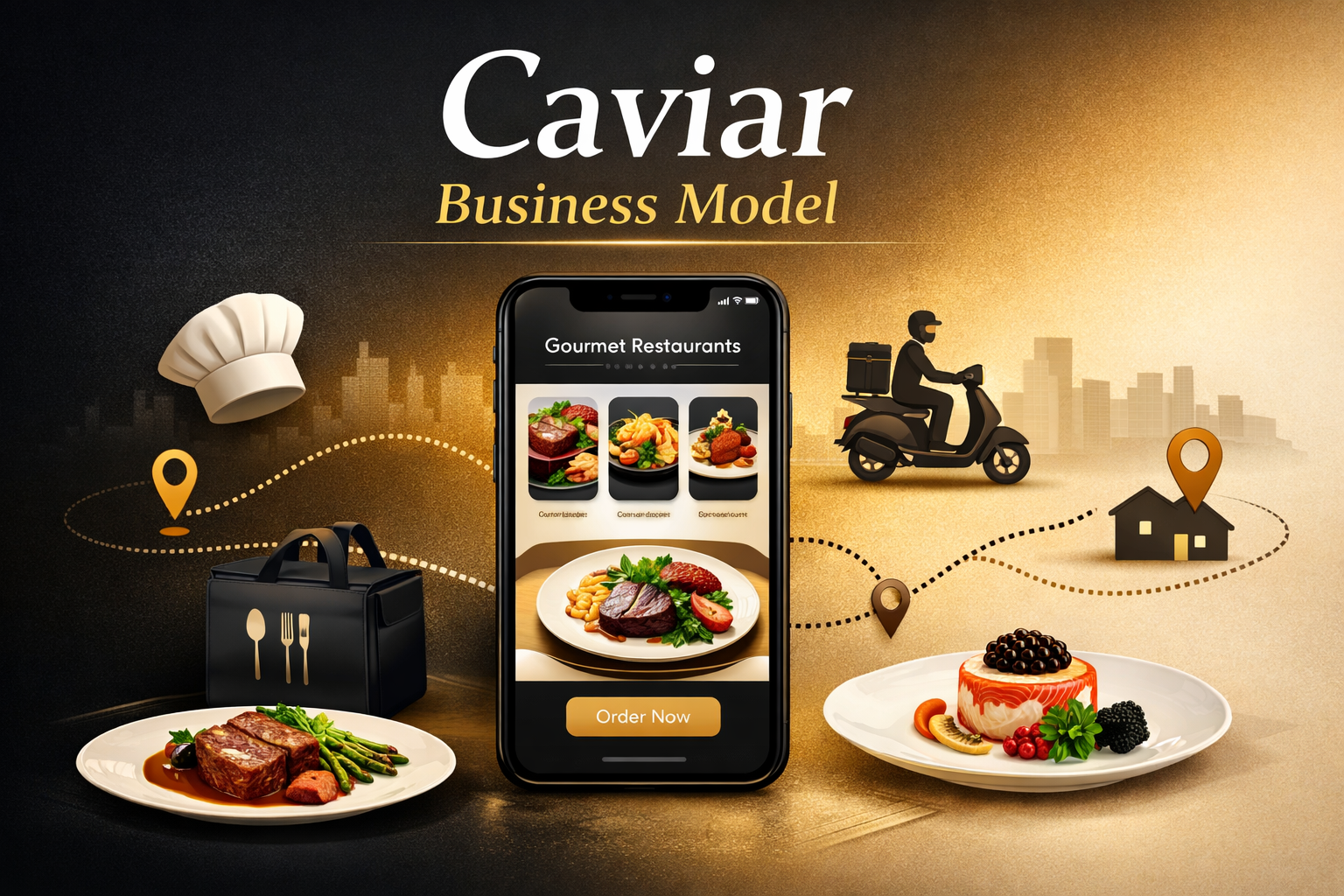
Caviar is a food delivery platform that took a different approach from the start. Instead of signing up every restaurant in a city, it handpicked high-quality dining options and delivered them to customers willing to pay a premium.
Founded under Square (now Block, Inc.), Caviar focused on urban markets where demand for quality outpaced demand for cheap and fast. The platform positioned itself as the delivery option for people who cared about what they ate, not just how fast it arrived.
In 2019, DoorDash acquired Caviar for $410 million, folding it into a broader delivery ecosystem while keeping the premium brand identity intact.
The Core Idea Behind Caviar’s Business Model
Caviar did not try to win by being everywhere. It won by being selective.
Most food delivery platforms operate on a quantity model. Sign up every restaurant. Get every customer. Compete on discounts and delivery speed. Caviar rejected that playbook entirely.
Instead, it built a curated marketplace where quality was the filter, not volume. This created a different type of customer, a different type of restaurant partner, and a fundamentally different economics profile.
Quality Over Quantity
The entire business model rests on curation. Caviar evaluated restaurants before listing them. Not every restaurant could get on the platform. This created perceived exclusivity, which attracted a customer segment willing to spend more per order.
Higher average order value (AOV) means more revenue per transaction. For a delivery platform, that matters enormously because the cost structure of each delivery (driver time, logistics, support) does not scale linearly with order size.
Premium Positioning Instead of Discount Wars
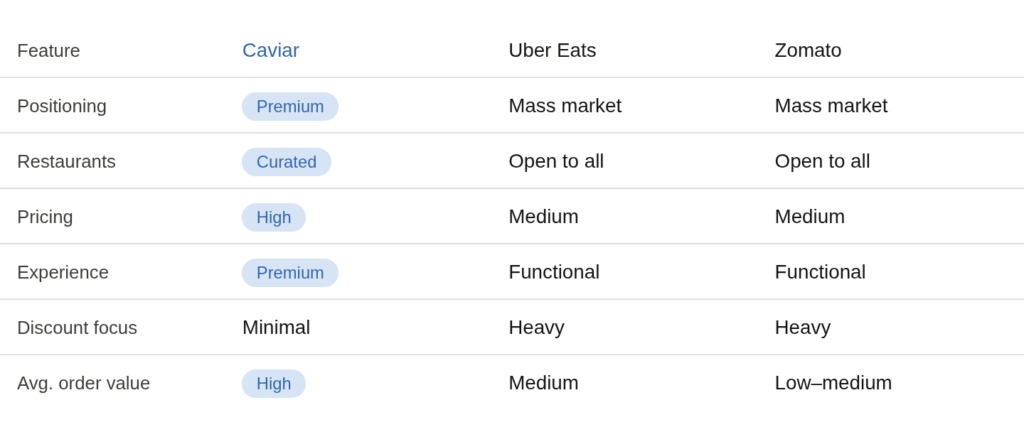
Uber Eats, DoorDash, and Grubhub regularly use discounts, promos, and loyalty rewards to acquire and retain customers. Caviar leaned into the opposite. It positioned the platform as a quality experience, not a deal-hunting destination.
This is a critical strategic choice. Discount-driven growth attracts price-sensitive customers who leave the moment a competitor offers a better deal. Premium positioning attracts customers who stay because the experience itself is the value.
How Caviar Works
For Customers
Customers open the Caviar app or website and browse a curated list of restaurants in their area. The selection is intentionally limited compared to mass platforms. Customers place an order, pay a delivery fee and service charge, and receive their food.
The experience is designed to feel clean and elevated. Minimal clutter. Strong restaurant photography. Clear quality signals at every step.
For Restaurants
Getting onto Caviar was not automatic. Restaurants went through a selective onboarding process. Once listed, they got access to a customer base that skews higher-income and more food-conscious than typical delivery platforms.
For premium restaurants, the value is not just the orders. It is brand positioning. Being on Caviar signals quality in a way that being on a mass platform does not. Restaurants do not want to be placed next to discount chains. Caviar solved that problem.
For Delivery Partners
Caviar used a standard gig-worker delivery model. Drivers picked up orders and delivered them. Because Caviar focused on premium restaurants with higher order values, drivers could often earn more per delivery even if they handled fewer total orders.
The model still relied on independent contractors, with all the typical flexibility and inconsistency that comes with gig-economy labor structures.
Caviar Business Model Canvas
Breaking the model down into its core components gives a clearer picture of how it all fits together.
Customer Segments
Caviar served two primary groups.
On the demand side: urban, high-income customers who are food-forward, willing to pay delivery fees without complaint, and care about the quality of what they order. These are not coupon-clippers. They are people who would otherwise go to a nice restaurant but want the convenience of delivery.
On the supply side: premium and upscale restaurant brands that want to reach quality-conscious customers without diluting their brand by being listed alongside fast food.
Value Propositions
For customers, the core promise is access. Access to curated, high-quality restaurants that are not available everywhere else. The secondary promise is a better experience, cleaner UI, less noise, more trust in the food quality.
For restaurants, the promise is audience quality. Not just more orders, but better orders from customers who value what they are selling. It also removes the brand degradation that comes from being lumped into a discount-heavy mass platform.
Channels
Caviar reached customers through its mobile app and website. Push notifications and email drove repeat orders. Restaurant visibility within the app itself was a discovery channel, meaning restaurants got promotion through Caviar’s own interface.
Social media and word-of-mouth also played a role. Premium positioning tends to generate organic sharing among the demographic Caviar was targeting.
Customer Relationships
Caviar invested in personalized recommendations and a premium user experience. The app was not built to overwhelm users with options. It was built to surface the right options.
Customer support was positioned as part of the premium experience, not an afterthought. When something went wrong, the resolution process was expected to match the premium promise.
Revenue Streams
Caviar generated money from multiple sources per transaction.
Restaurant commissions were the primary revenue driver. Caviar charged restaurants a percentage of each order placed through the platform. Commission rates in food delivery typically range from 15% to 30%, and premium platforms can often hold higher rates because the audience quality justifies it for restaurants.
Delivery fees were charged directly to customers. These were not hidden or discounted away. Customers on Caviar expected to pay for the convenience.
Service fees added a percentage-based charge on top of the order subtotal. This is now standard across delivery platforms.
Surge pricing during peak hours created additional revenue when demand exceeded supply.
Key Resources
Technology was the core infrastructure. The app, the order management system, the logistics routing, and the restaurant dashboard all had to work seamlessly.
The brand itself was a key resource. Caviar’s premium perception was not accidental. It was built deliberately through design, curation, and positioning, and it had real economic value.
The delivery network, while contract-based, was essential to fulfilling the service promise.
Key Activities
Restaurant curation was arguably the most important activity in the entire model. The quality filter is what differentiated Caviar. Without rigorous selection, the premium positioning collapses.
Order management and delivery logistics kept the operation running. Customer experience optimization was continuous. The product had to match the premium brand promise at every interaction.
Key Partnerships
High-end restaurant partners were the supply-side foundation. Without quality restaurants, there is no product.
Delivery partners, operating as independent contractors, formed the logistics layer. Payment processors handled transaction infrastructure. Later, integration into DoorDash’s ecosystem created operational scale.
Cost Structure
The biggest costs were delivery operations (driver payments, logistics overhead), technology development, and customer acquisition. Support and dispute resolution also carried significant cost, especially as the platform scaled. Premium service expectations mean customers escalate issues more when something goes wrong.
How Caviar Makes Money
Caviar’s revenue model stacks multiple charges on top of each transaction. Here is how each layer works.
Restaurant Commissions
This is the biggest revenue line. Caviar charged restaurants a percentage cut of every order. For restaurants, this fee is the cost of accessing Caviar’s high-quality customer base. Premium restaurants were willing to pay because the alternative was either no delivery or being listed on a mass platform that undercuts their brand.
Delivery Fees
Customers paid a delivery fee per order. This fee varied by distance and restaurant. Caviar did not compete by offering free delivery as a default. Customers understood they were paying for a premium service.
Service Fees
A percentage-based service fee was added to each order total. This is separate from the delivery fee and represents the platform’s operational margin on the transaction itself.
Surge Pricing
During peak demand periods, delivery fees increased. This is standard across delivery platforms, but for Caviar’s customer base, price sensitivity was lower. Customers who are already paying premium prices are less likely to abandon a cart because of a slightly higher surge fee.
Why Caviar Stands Out
The Curated Marketplace Advantage
Every food delivery platform claims to have “the best restaurants.” Caviar actually enforced it. The curation process was a real operational function, not a marketing talking point.
This created a fundamentally different product. When a customer opens Caviar, every restaurant on the list has been vetted. That eliminates the trust problem. On mass platforms, customers have to do their own research to find quality. On Caviar, the platform did that work.
Premium Audience Economics
High-income, food-conscious customers are valuable in ways that go beyond order volume. They tip more. They complain about price less. They churn less when competitors offer discounts. They are more likely to recommend the platform.
From a unit economics standpoint, one Caviar customer generating consistent high-AOV orders can be worth several mass-platform customers whose orders are smaller and driven by promo codes.
Brand as a Moat
Caviar’s premium brand was a real competitive advantage. Restaurants wanted to be on it because it felt exclusive. Customers wanted to use it because it felt elevated. That brand perception is hard to copy quickly. Competitors would have to spend years and significant marketing budget to replicate it, assuming they even adopted the right positioning strategy.
Growth Strategy of Caviar
Selective City Expansion
Caviar did not try to be in every city at once. It expanded to urban markets where the target demographic was concentrated. New York, San Francisco, Los Angeles, Seattle, and similar cities where the combination of disposable income and food culture made the model work.
This focus reduced operational overhead and allowed the platform to maintain quality standards in each market before moving to the next.
Restaurant Partnerships as the Core Growth Engine
For Caviar, landing the right restaurant partners was more valuable than acquiring more customers. A highly desired restaurant brought its own following. Customers who loved a particular upscale spot would download the Caviar app specifically to order from it.
This inverted the typical delivery platform growth model. Instead of spending millions on customer acquisition and hoping restaurants follow, Caviar used restaurant quality as a customer acquisition tool.
UX-Focused Product Development
The app was built to feel premium. Clean design, fast load times, strong photography, minimal friction in the checkout process. Every product decision was made through the lens of whether it matched the premium brand promise.
This is not just aesthetics. A clean, fast, intuitive app reduces cart abandonment. For a platform with high AOV orders, reducing cart abandonment by even a few percentage points has a meaningful revenue impact.
Acquisition by DoorDash
In 2019, DoorDash acquired Caviar for $410 million. This was both an exit and a strategic move that gave Caviar access to DoorDash’s infrastructure, logistics scale, and restaurant network.
For DoorDash, acquiring Caviar brought a premium segment that DoorDash struggled to capture on its own. The Caviar brand was kept intact because its value came from perception, and merging it into DoorDash’s mass-market identity would destroy that value.
Challenges in Caviar’s Business Model
Limited Scalability
The curation model is inherently harder to scale. Adding more restaurants requires human vetting. Expanding to new cities requires market research and relationship-building with the right restaurant partners. You cannot just flip a switch and scale curation the way you can scale a marketplace that accepts any restaurant.
High Operational Costs
Premium positioning costs money to maintain. Better customer support, higher quality logistics, more careful onboarding processes, and stronger technology investment all add to the cost base. Margins in food delivery are already thin. Caviar’s cost structure was more demanding than mass platforms.
Strong Competition
DoorDash, Uber Eats, and Grubhub all have far larger scale. They can absorb losses to win market share. They have more drivers, more restaurant relationships, and more customer data. Competing against that as an independent platform is genuinely difficult, which is part of why the DoorDash acquisition made strategic sense.
Price-Sensitive Market Conditions
Economic downturns hit discretionary spending first. Premium delivery is, by definition, discretionary. When consumers cut back, they cut the expensive delivery app before the cheap one. This creates cyclical vulnerability that mass platforms are better insulated against because they are already competing at the price floor.
Future of Caviar
Premium Tier Within the DoorDash Ecosystem
Post-acquisition, Caviar operates as DoorDash’s premium segment. This is a smart structure. DoorDash handles the logistics scale and infrastructure. Caviar handles the brand and customer experience for the upper end of the market.
This lets DoorDash capture a broader range of customers without compromising either brand. A customer who wants cheap, fast delivery uses DoorDash. A customer who wants quality uses Caviar.
Expansion in High-Margin Customer Segments
The long-term play is deepening the premium segment rather than expanding broadly. Corporate catering, high-end event delivery, subscription tiers for frequent premium users, and partnerships with luxury dining brands are all natural extensions.
Loyalty and Personalization
Premium customers respond well to personalization. Using order history and preference data to surface relevant restaurants before customers even have to search is a retention tool that mass platforms underinvest in. Caviar has the right customer profile to make personalization work better than it does on price-driven platforms.
Key Takeaways for Founders
You do not need to serve everyone. Caviar proved that a smaller, better-defined customer segment can build a highly valuable business. Market size is not the only variable that matters.
Premium niche equals higher margins. When you compete on quality instead of price, you attract customers who do not expect discounts. That changes the entire economics of customer acquisition, retention, and lifetime value.
Curation beats aggregation. Any marketplace can aggregate supply. Fewer can curate it. The platforms that enforce quality standards create a defensible position that aggregators cannot easily copy.
Experience can beat price wars. Competing on price is a race to the bottom. Competing on experience creates loyalty that price cuts cannot easily dislodge.
Brand is a business asset. Caviar’s brand was worth enough that DoorDash paid $410 million for it and kept the name. That kind of brand value does not come from logo design. It comes from consistent delivery on a clear promise over time.
Wrapping Up
Caviar is a case study in what focused positioning can accomplish in a crowded, competitive market.
The food delivery space is dominated by scale players competing on logistics and discounts. Caviar chose a different dimension of competition: quality and experience. That choice determined everything downstream. The customer segment, the restaurant partners, the pricing model, the product design, and ultimately the acquisition outcome.
For founders operating in competitive markets, the lesson is not to copy Caviar’s model. It is to understand the principle behind it. Find the dimension of competition your market undervalues. Build for that segment with clarity and consistency. Do not dilute the positioning to chase volume.
Positioning is strategy. Caviar executed that idea about as cleanly as a food delivery company can.
FAQs
Caviar operates as a curated food delivery marketplace. It connects high-quality, vetted restaurants with premium customers and generates revenue through restaurant commissions, customer delivery fees, and service charges per order.
DoorDash acquired Caviar from Square (Block, Inc.) in 2019 for $410 million. Caviar operates as DoorDash’s premium delivery segment.
Caviar earns through commissions charged to restaurants on each order, delivery fees paid by customers, service fees added to each transaction, and surge pricing during peak demand periods.
Caviar uses a curated restaurant selection model rather than accepting all restaurants. It targets higher-income, quality-focused customers and positions itself as a premium experience rather than competing on price or discount offers.
DoorDash acquired Caviar to access the premium food delivery market segment. Caviar’s brand, customer base, and restaurant relationships were difficult to replicate organically, making acquisition the faster and more reliable path.
No. Caviar uses a selective onboarding process. Restaurants are evaluated before being listed. This curation is the core product feature that differentiates Caviar from open marketplace competitors.
Caviar continued operating as a distinct brand under DoorDash’s ownership. DoorDash maintained the Caviar brand identity because its premium positioning was the primary asset the acquisition was intended to capture.
The main lesson is that niche focus with premium positioning can build a defensible, high-value business in a market dominated by much larger players. Competing on quality rather than price creates different economics, different customers, and different long-term outcomes than scale-at-all-costs strategies.
Discover more from Business Model Hub
Subscribe to get the latest posts sent to your email.