CookUnity Business Model And How This Chef Marketplace Is Reinventing Food Delivery

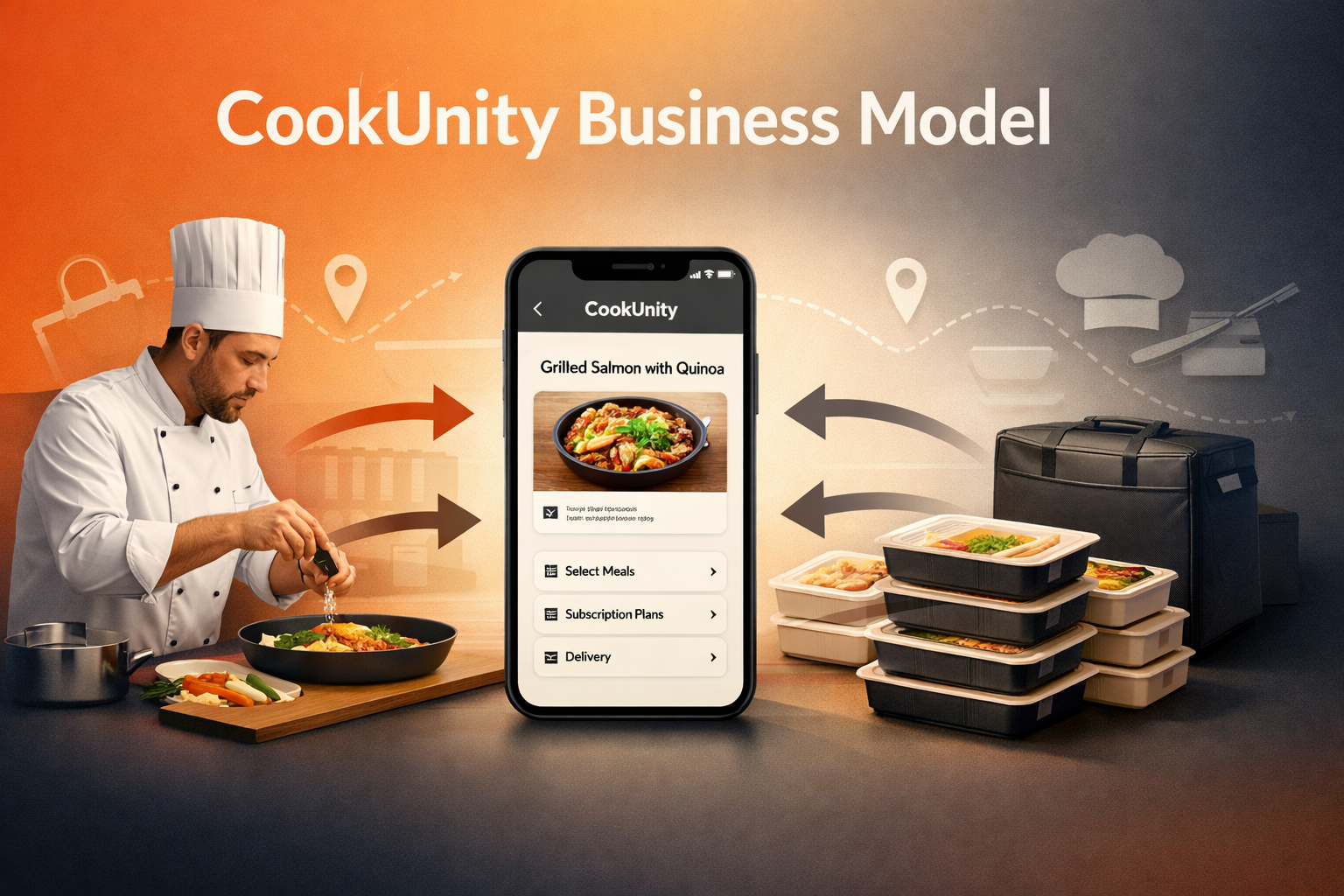
What is CookUnity? CookUnity is a chef-to-consumer food marketplace that connects independent chefs with customers through a subscription-based meal delivery platform.
How it makes money: CookUnity earns revenue through weekly subscription fees paid by customers and takes a commission from every meal sold by chefs on the platform. It also monetizes through premium meal pricing and upsells.
What is CookUnity
CookUnity was founded in 2018 by Mateo Marietti (CEO) and Lucia Cisilotto in New York City. The company started with a simple but sharp idea: most people want restaurant-quality food at home, but restaurants are either too expensive, too slow, or too inconsistent for daily meals.
The problem it solves:
Busy professionals, health-conscious eaters, and people with dietary preferences all face the same struggle. Generic meal kits require cooking. Traditional food delivery is unpredictable in quality. Restaurants are expensive for daily use.
CookUnity sits in between. It delivers fully cooked, chef-made meals directly to your door on a weekly basis. No cooking required. No apps to browse through 200 restaurant listings. Just real chef food, ready to heat and eat.
How it differs from traditional food delivery:
Apps like DoorDash or Uber Eats are logistics platforms. They move food from Point A to Point B. They do not control quality, consistency, or who makes the food.
CookUnity is the opposite. It controls the supply side (who cooks), the logistics (how it ships), and the experience (how it arrives). That vertical control is a big part of why the model works.
Target audience:
The core users are professionals aged 25 to 45 who value food quality, have limited time to cook, and are willing to pay a premium for meals that match their dietary needs. Think remote workers, fitness-focused users, parents with no time, and food enthusiasts who care about where their meals come from.
The Core Idea Behind CookUnity
Chef-driven, not restaurant-driven
Traditional food delivery depends on restaurants. Restaurants have high overhead, inconsistent kitchen staff, and profit margins that make quality hard to maintain at scale.
CookUnity removes the restaurant entirely. The chef is the brand. The chef is the product. This shift changes everything about the economics and the quality of the output.
The marketplace plus subscription hybrid
Most food marketplaces are transactional. You order, you pay, it arrives. CookUnity added a subscription layer on top of a marketplace. That combination creates predictable demand for chefs and predictable revenue for the platform.
Customers commit to a weekly plan. Chefs plan their production based on known order volumes. The platform optimizes logistics around fixed delivery windows. Everyone benefits from the structure.
Quality over convenience-only
The food delivery industry in the US spent years competing on speed. 30 minutes or less. CookUnity bet on a different axis: quality. The meals are not fast food. They are not assembly-line products. Each chef brings a distinct style, cuisine, and technique.
This positioning attracts a different customer who is less price-sensitive and more loyal.
Personalization as a retention tool
CookUnity uses taste preferences and order history to recommend meals. Over time, the platform learns what you like and surfaces chefs and dishes that match your profile. This makes the product stickier with every order.
How CookUnity Works
For customers
Signing up is straightforward. A new user selects a weekly meal plan based on how many meals they want (typically 4 to 16 meals per week). They browse available dishes from dozens of chefs and pick what they want for the upcoming week.
Meals arrive in insulated packaging every week, fresh and ready to heat. Most meals take 2 to 5 minutes in the microwave or a few minutes in a skillet. There is no prep, no dishes from cooking, and no guesswork.
Users can skip weeks, change their plan, or cancel at any time. The flexibility lowers the barrier to sign up and reduces the perceived risk of commitment.
For chefs
Chefs apply to join the platform. CookUnity has a selective onboarding process, which helps maintain quality standards and gives the chef brand some prestige by association.
Once accepted, chefs use shared commercial kitchens to prepare their dishes at scale. They upload menus each week, set quantities, and CookUnity handles the rest: order aggregation, packaging, cold chain logistics, and delivery.
Chefs earn a per-meal fee for every dish sold. They have no front-of-house responsibilities, no need to manage a dining room, and no reliance on foot traffic or Yelp reviews. The platform provides the audience and the infrastructure. The chef provides the food and the brand.
CookUnity Business Model Breakdown
Marketplace model
CookUnity functions as a two-sided marketplace. On one side are chefs looking for a scalable way to sell their food. On the other are consumers looking for quality meals without cooking. The platform creates value by connecting both sides efficiently.
Unlike a traditional restaurant aggregator, CookUnity is not listing third-party restaurants. It is recruiting individual chefs and giving them production infrastructure. This gives the platform much tighter control over supply quality.
Subscription model
The subscription layer is what separates CookUnity from a typical marketplace. Customers pay weekly, not per order. This creates recurring revenue that is highly predictable.
For the business, subscriptions are valuable because they reduce customer acquisition cost over time. Once a customer subscribes and stays, every additional week is nearly pure margin contribution after the cost of food and delivery.
Asset-light infrastructure
CookUnity does not own restaurants. It uses shared commercial kitchen spaces where chefs prepare meals. This keeps capital costs low compared to building and managing restaurant locations.
The trade-off is that CookUnity depends on available kitchen infrastructure in each city it operates in. Expansion into new markets requires finding and certifying kitchen partners before chefs can start producing.
Supply chain control
One of CookUnity’s biggest operational advantages is that it controls the full delivery chain. Meals go from chef to customer through CookUnity’s logistics network. This means the platform owns the quality signal at every step, unlike delivery apps that rely on third-party couriers with no visibility into how food is handled.
Revenue Streams of CookUnity
Subscription fees: The primary revenue source. Customers pay weekly based on their plan tier. Plans range from around 4 meals per week to larger bundles, and pricing scales accordingly.
Chef commission: CookUnity takes a percentage of every meal sold through the platform. This aligns platform incentives with chef success. The more a chef sells, the more both sides earn.
Premium meal pricing: Not all meals are priced equally. Specialty dishes, premium proteins, and meals from high-profile chefs command higher per-meal prices. The platform captures additional margin on these items.
Add-ons and upsells: Customers can add extras to their weekly order. This includes additional meals beyond their plan, drinks, snacks, or seasonal specials. These add-on purchases increase average order value without requiring a plan change.
Pricing Strategy
CookUnity meals typically run between $12 and $16 per meal depending on the plan size and what is selected. Larger plans bring the per-meal cost down, which incentivizes customers to commit to more meals per week.
Compared to Uber Eats or DoorDash, CookUnity is not cheaper in isolation. A delivery order from a decent restaurant with delivery fees, service charges, and tips often runs $20 to $35 for one person. CookUnity lands under that ceiling for a higher-quality, chef-cooked meal.
The positioning is not “cheap food fast.” It is “premium food at a reasonable per-meal cost when you subscribe.” That framing works because it targets consumers who already spend heavily on food and are looking for a smarter solution.
Subscription lock-in psychology:
Once a customer sets up a weekly plan, behavior changes. The meals become a default in their routine. Canceling requires a deliberate action. This natural inertia keeps retention rates high among satisfied users.
The weekly rhythm also makes the cost feel smaller. Paying $65 for a weekly plan feels different from paying $260 in a single monthly charge, even though the math is the same.
How CookUnity Attracts Chefs
Earnings vs. traditional restaurant work:
Restaurant chefs in the US often earn hourly wages with limited upside. At CookUnity, earnings are directly tied to how many meals a chef sells. A chef with a strong following and great food can earn significantly more per hour of work than in a traditional kitchen environment.
Creative freedom:
Working for a restaurant means cooking the restaurant’s menu. At CookUnity, chefs design their own dishes, rotate menus weekly, and experiment without a boss approving every decision. This freedom is a strong draw for talented, entrepreneurially-minded chefs.
No operational overhead:
Running a restaurant means managing front-of-house staff, handling reservations, dealing with dining room issues, and managing customer-facing problems in real time. CookUnity eliminates all of that. Chefs focus only on cooking. The platform handles everything else.
Built-in customer base:
A chef launching their own food business from scratch would need to build an audience. CookUnity provides access to its existing subscriber base from day one. A new chef on the platform can generate sales within their first week without any marketing effort.
How CookUnity Acquires Customers
Performance marketing:
CookUnity runs paid campaigns on Meta (Facebook and Instagram) and Google. The food category is highly visual, which makes Instagram a natural fit. Ads featuring real chef stories and dish photography perform well with the target demographic.
Chef branding as content:
Each chef on CookUnity has a profile with a backstory, cuisine specialty, and philosophy. This content does double duty: it helps customers choose meals and it functions as organic marketing. Chefs share their CookUnity profiles with their own audiences, driving new user acquisition at no cost to the platform.
Referral programs:
CookUnity has used referral incentives to grow its subscriber base. Existing customers who refer friends receive meal credits. This word-of-mouth loop is cost-effective and brings in users who are already pre-sold by a trusted recommendation.
Retention via personalization:
Customer acquisition is expensive. Retention is where the real profit lives. CookUnity uses order history and explicit taste preferences to personalize the weekly meal feed. Users who feel understood by the platform are far less likely to churn.
Unit Economics
Here is a simplified breakdown of how the numbers work at a per-meal level:
Meal price to customer: roughly $13 to $16 per meal.
Food and packaging cost: ingredient costs plus the chef’s production expenses typically account for a significant portion of the meal price. Estimates suggest food costs run in the 35% to 45% range of the meal price.
Delivery cost: cold chain delivery is expensive. Shipping insulated boxes via regional carriers or last-mile partners can cost $6 to $10 per delivery. Spreading that cost across more meals per box reduces the per-meal delivery cost significantly, which is why CookUnity pushes customers toward larger weekly plans.
Chef payout: chefs receive a per-meal fee that covers their ingredient cost plus a margin for their labor. CookUnity’s gross margin comes from the difference between what customers pay and what chefs are paid plus logistics costs.
Platform margin: after food costs, chef payments, delivery, and overhead, CookUnity targets a margin that improves as order density increases in a given geography. The model becomes more efficient as more customers are clustered in the same delivery zones.
The business is not yet publicly profitable on a net basis, but the unit economics at the per-meal level are designed to work at scale in dense urban markets.
Competitive Advantage
Chef-first model:
No other major food delivery platform has built its supply side around individual chefs rather than restaurants. This is a structural moat. Replicating it requires recruiting hundreds of chefs, building shared kitchen infrastructure, and creating a chef brand ecosystem, all at the same time.
Quality differentiation:
In a market full of platforms that compete on speed, CookUnity wins on quality. Chef-made, properly portioned, cuisine-diverse meals are a distinct product from aggregated restaurant delivery.
Subscription lock-in:
Subscriptions create stickiness. A customer who has set up their weekly routine, saved their preferences, and found three chefs they love is unlikely to switch platforms for marginal savings.
Brand identity:
CookUnity has built a recognizable brand in a category where most platforms are invisible utilities. The chef storytelling, the premium packaging, and the consistent product experience make the brand feel more like a food company than a tech company.
Competitors Analysis
Traditional delivery apps (DoorDash, Uber Eats):
These platforms are logistics marketplaces. They connect restaurants with customers using contract delivery drivers. They do not control food quality, chef selection, or consistency. CookUnity is not trying to compete with them directly. It serves a customer who wants a different product entirely.
Meal kit companies (HelloFresh, Blue Apron):
Meal kits require customers to cook. The value proposition is “good ingredients, easy recipes.” CookUnity’s value proposition is “chef-cooked food, no effort required.” These are adjacent but distinct products. CookUnity targets the same health-conscious audience but removes the cooking step entirely.
Cloud kitchens and ghost kitchen brands:
Cloud kitchens produce food for delivery without a dining room. But they typically operate as virtual restaurant brands, not chef-driven marketplaces. The food is often optimized for speed and consistency rather than chef artistry. CookUnity’s chefs are the brand, not a white-label kitchen.
Challenges in the CookUnity Business Model
Logistics complexity:
Cold chain delivery is hard. Getting fresh, fully cooked meals to customers in good condition requires precise packaging, temperature control, and reliable carrier partnerships. Any breakdown in the chain affects food quality and customer trust.
Food quality consistency:
Every chef has good weeks and off weeks. As CookUnity scales and adds more chefs, maintaining consistent quality across hundreds of menu items is an ongoing challenge. One bad experience can trigger a cancellation.
Scaling kitchens:
Expanding to a new city is not just a marketing exercise. It requires identifying suitable shared kitchen facilities, onboarding chefs in that market, and building local delivery density before the unit economics start working. This makes geographic expansion slow and capital-intensive.
Customer churn:
Subscription businesses always battle churn. Users who travel frequently, experience delivery issues, or simply get bored of the options may pause or cancel. Managing churn requires constant menu refresh, personalization improvements, and proactive customer retention programs.
Growth Strategy and Expansion
New city expansion:
CookUnity has been expanding from its New York roots into other major US markets. Each new city follows a playbook of kitchen partnerships, chef recruitment, and localized marketing.
Chef onboarding velocity:
More chefs mean more menu variety. More variety reduces the risk of customers running out of new things to try. Growing the chef supply is one of the fastest levers to improve retention.
Menu expansion:
CookUnity is expanding beyond traditional dinner-focused meals into breakfast, lunch, and snack categories. Capturing more meal occasions per week per customer dramatically improves customer lifetime value.
Tech-driven personalization:
The platform is investing in machine learning models that improve meal recommendations. Better recommendations drive higher customer satisfaction, more meals ordered per week, and lower churn rates.
Lessons for Founders
Build supply before demand. CookUnity needed chefs before it could sell subscriptions. In any two-sided marketplace, the supply side is harder to build and more important to get right. Acquire your supply side first, even if demand takes time to catch up.
Subscription equals predictable revenue. Transaction-based businesses are volatile. Subscription businesses allow you to plan, hire, and invest based on known future revenue. If your product can support a recurring model, build it in from the start.
Niche positioning beats general marketplace. CookUnity did not try to be everything. It went after one specific customer (quality-focused, time-constrained urban professional) and built the perfect product for them. Being specific is a competitive advantage, not a limitation.
Control logistics early. Outsourcing logistics means outsourcing your customer experience. CookUnity built its own delivery infrastructure early. This gave the platform visibility, control, and the ability to improve the last-mile experience in ways that app-based platforms cannot.
Brand matters even in food delivery. In a commodity market, brand is the moat. CookUnity invested in chef storytelling, packaging quality, and a clear brand identity. This premium positioning attracts a more loyal, less price-sensitive customer base.
The Future of CookUnity
Can it scale globally?
Global expansion is possible but not straightforward. The model depends on local chef ecosystems, shared kitchen infrastructure, and dense urban delivery networks. Markets with strong food cultures and high urban density (London, Toronto, major European cities) are logical next steps. But replicating the model outside the US requires significant localization investment.
Will it compete with Swiggy and Zomato-style models?
Not directly. Swiggy and Zomato are mass-market platforms competing on breadth, speed, and low prices. CookUnity is a premium, curated product for a specific consumer segment. They are fishing in different ponds. The interesting question is whether CookUnity’s model influences how larger platforms think about quality differentiation.
Is this the future of food delivery?
For a segment of the market, yes. The consumer trend toward health, quality, and personalization is not reversing. As urban professionals become more accustomed to subscription services managing their daily needs, chef-driven meal subscriptions fit naturally into that lifestyle.
The broader food delivery market will remain dominated by transaction-based apps. But the premium segment, the top 10% to 15% of food delivery consumers who care about quality above all else, is large enough to support a billion-dollar business. CookUnity is positioned well to own that segment.
Wrapping Up
CookUnity is not trying to replace DoorDash. It is building something genuinely different: a marketplace where chefs are the product, subscriptions create loyalty, and quality is the core value proposition.
The model works because it solves real problems on both sides. Chefs get a scalable income stream, creative freedom, and no operational headaches. Customers get consistently good food without cooking or the unpredictability of restaurant delivery.
Founders, operators, and investors should study this model closely. It demonstrates how combining a marketplace structure with a subscription layer can create a more defensible, more profitable business than either model alone.
In 2026, as consumers grow more selective about what they eat and where their food comes from, the chef-to-consumer model that CookUnity pioneered looks less like a niche experiment and more like a genuine category.
FAQs
CookUnity has not publicly disclosed profitability figures. Like most marketplace businesses at scale, it is investing heavily in expansion, technology, and chef acquisition. The unit economics at the per-meal level can work in dense markets, but overall profitability depends on how efficiently the platform scales its logistics and customer base.
Chefs earn a per-meal fee for every dish they sell through the platform. The more meals they sell, the more they earn. High-demand chefs can earn significantly more than a comparable salary in a traditional restaurant kitchen, with fewer operational responsibilities and more creative control over their menu.
No. Uber Eats is a logistics platform that delivers food from existing restaurants. CookUnity is a chef marketplace with a subscription model where individual chefs create original menus and cook in shared kitchens. The business model, customer experience, and supply chain are fundamentally different.
Discover more from Business Model Hub
Subscribe to get the latest posts sent to your email.