Practo Business Model And How It Makes Money and Scales Healthcare Digitally

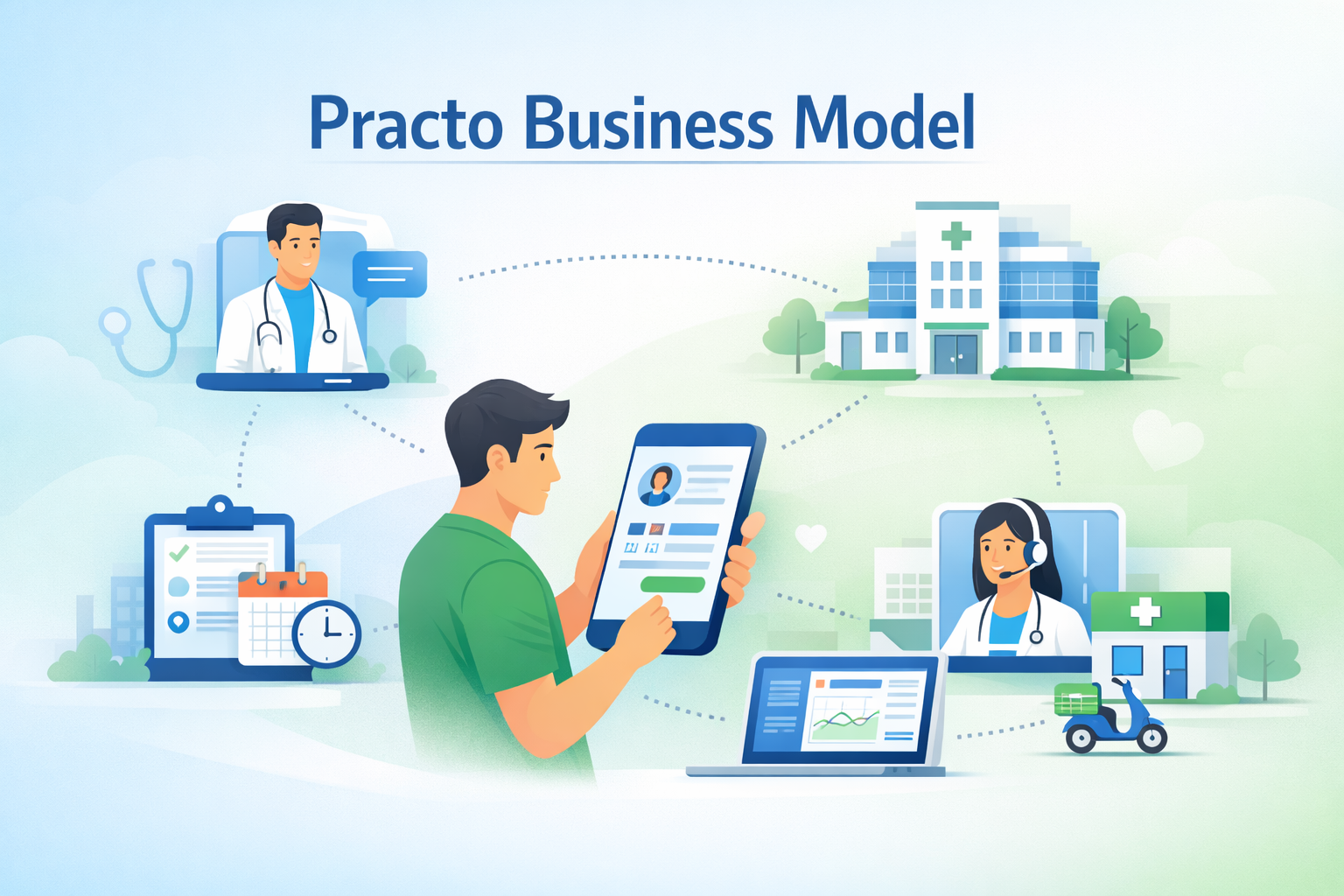
Practo is a digital healthcare platform that connects patients with doctors, clinics, and diagnostic services. It makes money through subscriptions from healthcare providers, commissions on bookings, and SaaS solutions for clinics. If you’ve ever booked a doctor’s appointment online in India, there’s a good chance Practo was involved.
Let me break down exactly how this company works, how it makes money, and what’s actually interesting about its model.
What Exactly Is Practo?
Practo was founded in 2008 by Shashank ND and Abhinav Lal in Bangalore, India. It started as a simple clinic management software. Over time, it grew into one of South Asia’s largest digital health platforms.
Today it’s more than just an app. It’s a full ecosystem connecting patients, doctors, labs, and pharmacies in one place.
Here’s a real-life example. Imagine you wake up with a bad headache. You don’t want to drive to a clinic, wait an hour, and see a random doctor. Instead, you open Practo, search for a neurologist near you, read reviews, check availability, and book an appointment, all in under five minutes.
That’s the core value Practo delivers. It saves time and removes the guesswork from finding healthcare.
The Problem Practo Actually Solves
Before platforms like Practo, finding a good doctor was genuinely painful.
You’d ask friends. You’d get random recommendations. You’d show up at a clinic and wait forever. There was no way to check reviews, compare doctors, or even know if a doctor specialized in what you needed.
The core problems were:
- Finding trusted doctors is hard, especially in new cities
- Long waiting times with zero transparency
- Patient records scattered across multiple hospitals
- No easy way to consult a doctor from home
- Healthcare information was fragmented and confusing
This created a massive market gap. Millions of people needed a better way to access healthcare. Practo stepped in to fill exactly that gap.
And honestly, this is what makes the business model work. When you solve a real, painful problem, people use your product.
Practo’s Business Model in Simple Terms
Practo runs on a platform-based model. Think of it like Airbnb or Uber, but for healthcare.
It’s a two-sided marketplace. On one side you have patients looking for doctors and health services. On the other side you have doctors, clinics, labs, and pharmacies who want more patients and better management tools.
Practo sits in the middle and earns money from both sides.
The basic structure looks like this:
- Patients use the platform mostly for free
- Healthcare providers pay to be listed and use tools
- Practo earns through subscriptions, commissions, and software fees
What makes this model smart is that it combines marketplace revenue with SaaS revenue. That’s a powerful combination because it gives Practo two steady income streams.
How Practo Works Step by Step
Understanding how the platform actually works helps you see why it’s valuable.
For patients, the flow is simple:
- Open the app or website
- Search for a doctor by specialty, location, or name
- Read reviews and check ratings
- Book an in-person or online appointment
- Consult the doctor and access health records digitally
For doctors and clinics, it’s equally straightforward:
- Create a profile on Practo
- Get visibility to thousands of potential patients
- Manage appointments, patient records, and billing
- Accept online consultation requests
- Grow their practice digitally
The beauty here is that both sides benefit. Patients get convenience. Doctors get more patients and better tools. Practo gets paid in the middle.
Practo Revenue Model: How It Actually Makes Money
Subscription Fees From Doctors
This is Practo’s primary revenue stream.
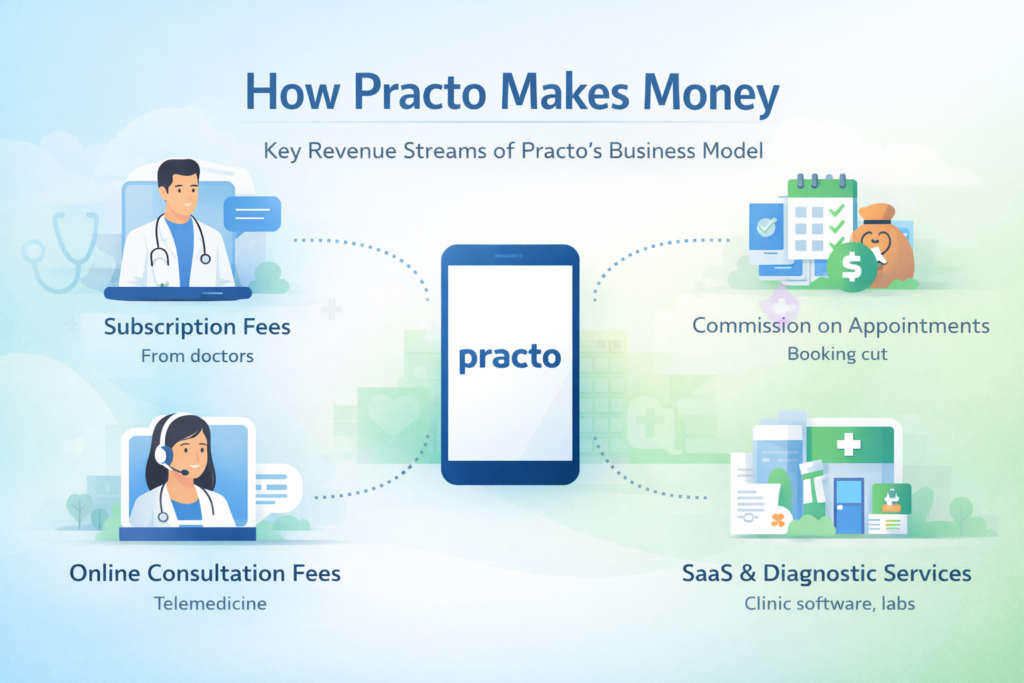
Doctors and clinics pay a monthly or yearly subscription fee to be listed on Practo. This fee gives them a verified profile, visibility in search results, appointment management tools, and patient review features.
The more premium the plan, the more visibility and tools you get.
Think of it like a premium listing on Yelp or Google Business, but specifically for healthcare. Doctors who want to grow their practice online need this visibility. Practo charges them for it.
This is the strongest revenue stream because it’s recurring, predictable, and scales well. As more doctors join, subscription revenue compounds.
Commission on Appointments
When a patient books an appointment through Practo, Practo takes a small cut from that booking.
This is a commission-based model similar to how booking platforms work. The percentage varies, but it’s a meaningful revenue layer on top of subscriptions.
The more appointments booked on the platform, the more commission revenue Practo earns. This incentivizes Practo to keep both patients and doctors active on the platform.
Online Consultation Fees
Telemedicine is a growing part of Practo’s business.
Patients can consult doctors via video or chat directly on the platform. Practo earns a fee from these online consultations. Some of that goes to the doctor, and Practo keeps a platform fee.
This became especially important after COVID. Suddenly everyone wanted online doctor consultations. Practo was already set up for this and saw massive growth in this segment.
Online consultations are valuable because there’s no geographic limit. A patient in a small town can consult a specialist in Mumbai. That opens up a much larger market.
SaaS Solutions Through Practo Ray
Practo Ray is Practo’s clinic management software.
It’s a full SaaS product that helps clinics manage appointments, patient records, billing, prescriptions, and more. Clinics pay a subscription fee to use it.
This is a smart move. Even clinics that don’t actively use Practo as a patient marketplace still need management software. So Practo captures those customers through Practo Ray.
This is a classic SaaS play with high retention. Once a clinic is using Practo Ray to manage its operations, switching costs are high. They won’t easily leave.
Diagnostic and Medicine Services
Practo also earns commissions from diagnostic labs and pharmacies.
Patients can book lab tests through Practo. Practo earns a commission from the lab for that referral. Same with medicine delivery. Pharmacies pay Practo for bringing them customers.
This layer is still growing, but it adds meaningful revenue and makes the platform stickier. When a patient can book a doctor, get tests, and order medicines all in one place, they have no reason to leave.
Practo’s Key Products and Services
Let me give you a quick breakdown of what Practo actually offers.
Practo App is the main consumer product. It handles doctor discovery, appointment booking, health records, and online consultations. This is what most patients interact with.
Practo Ray is the clinic management software. It’s a B2B product for healthcare providers. It handles scheduling, records, billing, and more.
Online Consultations let patients talk to doctors via video or chat. This is their telemedicine product, and it’s been growing fast.
Medicine Delivery lets patients order prescription and over-the-counter medicines. Practo partners with pharmacies to fulfill these orders.
Health Records is a feature that digitally stores all your medical history in one place. Every visit, every prescription, every test result is saved. This creates serious lock-in because patients don’t want to lose their health history.
Who Are Practo’s Target Customers?
Practo serves multiple segments. Understanding each one matters.
Patients are mainly urban, tech-savvy users who are comfortable booking things online. Think millennials, working professionals, and parents managing family healthcare. This is their largest user base in terms of volume.
Clinics and hospitals are their most important revenue customers. They pay subscriptions, use Practo Ray, and generate the bulk of Practo’s income.
Diagnostic labs pay commissions when patients book tests through Practo. They benefit from extra patient traffic.
Pharmacies partner with Practo for medicine delivery and earn from the patient base Practo brings them.
Who gives the most revenue? Clinics and doctors, without a doubt. The subscription model from healthcare providers is Practo’s financial backbone. Patients mostly use it for free, but they generate the demand that makes doctors pay.
This is a classic marketplace dynamic. The supply side pays. The demand side uses for free.
Practo’s Growth Strategy
Let me be honest here. Some growth strategies sound good on paper but don’t always deliver. Let me separate what actually works from what’s just marketing talk.
What actually works:
Doctor network expansion is the real growth engine. The more doctors on Practo, the more valuable it is for patients. More patients means more doctors want to join. This is a network effect flywheel.
Trust through reviews and ratings genuinely builds user confidence. In healthcare, trust is everything. Verified reviews from real patients are a competitive edge.
Mobile-first experience matters in India and emerging markets. Most users access Practo on mobile. Optimizing for mobile keeps the product accessible and fast.
What sounds good but is harder in practice:
Partnerships with large hospitals sound impressive. But large hospitals have their own booking systems and don’t always cooperate easily with third-party platforms.
Tier 2 and Tier 3 city expansion is a big opportunity but also a big challenge. Internet penetration is growing, but so is competition. And monetizing smaller markets is harder.
Telemedicine expansion is real and promising. But building trust for remote healthcare in a country used to in-person consultations takes time and effort.
Practo’s Competitive Advantage: Where It’s Strong and Where It’s Not
Practo has real advantages. But I want to give you an honest picture.
Where Practo is genuinely strong:
First mover advantage matters a lot. Practo entered the digital health space early. It built brand recognition before the market got crowded. That’s hard to replicate.
The integrated ecosystem is powerful. When you can book doctors, manage health records, order medicines, and book lab tests all in one app, patients stick around. Switching to multiple apps for the same thing is annoying.
The doctor network is massive. Years of onboarding have given Practo one of the largest verified doctor databases in Asia. Building that from scratch today would cost enormous time and money.
Where Practo is weaker:
Monetization from patients is limited. Most patients use Practo for free. Converting free users into paying ones is a constant challenge.
Doctor retention is tricky. Doctors who get their own patients through Practo might eventually stop renewing subscriptions if they feel they don’t need the platform anymore.
Brand trust in online healthcare is still fragile. Healthcare is deeply personal. Any bad experience, a wrong diagnosis or a bad doctor recommendation, can damage trust quickly.
Competitors of Practo
Practo doesn’t operate in a vacuum. Here’s a quick look at who it competes with.
Tata 1mg is probably Practo’s biggest competitor right now. It has strong medicine delivery, diagnostic services, and online consultations. Tata’s brand backing gives it serious credibility and financial muscle.
Apollo 24/7 comes from one of India’s most trusted hospital chains. It has deep brand trust, especially for older users who recognize the Apollo name. Its offline-to-online integration is strong.
Lybrate focuses more on doctor consultations and health Q&A. It’s a smaller player compared to Practo but competes in the online consultation space.
The honest take: Practo’s main edge over these competitors is its integrated ecosystem and its early network of doctors. But Tata 1mg and Apollo 24/7 have deep pockets and strong brands. The competition is real and getting tougher.
Challenges in Practo’s Business Model
I won’t sugarcoat this. Practo has real challenges.
Trust issues in online healthcare remain a problem. People are hesitant to trust a platform for something as serious as their health. Building that trust takes years and one bad headline can undo it fast.
Doctor onboarding and retention is an ongoing battle. Getting doctors to join is one thing. Getting them to stay, keep their profiles updated, and keep paying subscriptions is harder. Some doctors join, get a few patients, and then stop renewing.
High competition from well-funded players like Tata 1mg and Apollo 24/7 puts constant pressure on Practo. These companies have more resources and aggressive expansion strategies.
Monetization pressure is real. Most users are patients who use the platform for free. Growing revenue means either getting more doctors to pay more, or converting patients into paying customers. Both are challenging.
Regulatory challenges in healthcare are significant. Healthcare is heavily regulated in India. Any expansion into telemedicine, medicine delivery, or diagnostic services comes with compliance requirements that slow things down.
Future Opportunities for Practo
Despite the challenges, there are real opportunities ahead.
Telemedicine growth in India is accelerating. Post-COVID behavior shifts have normalized online doctor visits. This is a massive long-term tailwind for Practo.
AI-based health insights could be a game changer. Using the health data Practo has collected to give personalized health recommendations, predict health risks, or assist in diagnosis is a huge opportunity. The data moat is there. Execution is the challenge.
Expansion in Tier 2 and Tier 3 cities represents an untapped market of hundreds of millions of people with poor access to quality healthcare. If Practo can make this economical, it’s a massive growth lever.
Preventive healthcare focus is where consumer health is heading globally. People are shifting from reactive to proactive health management. Practo has the platform to serve this shift with health tracking, wellness content, and early intervention tools.
Key Takeaways
Let me wrap this up clearly.
- Practo is a marketplace plus SaaS hybrid, and that combination is what makes it resilient
- Revenue mainly comes from doctors and clinics, not patients
- Trust and network size are its two biggest competitive assets
- The future depends heavily on telemedicine growth and AI integration
- Competition is fierce, but Practo’s early mover advantage still counts for a lot
Wrap Up: My Honest Take on Practo’s Model
Here’s what I genuinely think about Practo.
The business model is smart. Combining a marketplace with SaaS software gives them two different revenue streams that reinforce each other. That’s a solid foundation.
But I think Practo is at a crossroads right now. It built something valuable early, but the market caught up. Tata 1mg has Tata’s brand and resources. Apollo 24/7 has Apollo’s trust. Practo needs to double down on what makes it unique, which is its integrated ecosystem and its massive doctor network.
What founders can learn from Practo: Build something that solves a genuinely painful problem. Healthcare access in India was broken, and Practo fixed a real piece of it. That’s why it grew.
Also, the SaaS layer matters more than people think. Practo Ray gives Practo a revenue stream that doesn’t depend on patient volume. That’s smart business.
What doesn’t quite work: Relying too heavily on a free patient base is risky. If patients don’t pay, everything depends on doctors continuing to subscribe. That creates fragility.
The telemedicine opportunity is Practo’s biggest bet right now. If they can scale that well, especially in smaller cities, there’s a strong future ahead.
Overall, Practo is a genuinely interesting company with a model worth studying. Whether it becomes the dominant player in Indian digital health or gets outcompeted by better-funded rivals remains to be seen. But the fundamentals of its model are sound.
FAQs
Practo has not publicly confirmed sustained profitability. Like many healthcare tech platforms, it has been in growth mode, prioritizing market expansion over near-term profits. It has raised significant venture funding over the years to support this strategy.
Practo makes money through subscription fees from doctors and clinics, commissions on booked appointments, fees from online consultations, SaaS licensing for Practo Ray, and commissions from diagnostic labs and pharmacies
Yes, for patients, Practo is largely free to use. You can search for doctors, read reviews, and book appointments without paying a platform fee. The platform earns from the healthcare providers, not the patients.
Doctors get increased visibility to thousands of potential patients, an easy appointment management system, digital health records tools, and the ability to offer online consultations. All of this helps them grow their practice and reduce administrative work.
Practo Ray is Practo’s clinic management software. It helps clinics manage appointments, patient records, billing, and prescriptions. It’s a B2B SaaS product that clinics pay a subscription fee to use.
Discover more from Business Model Hub
Subscribe to get the latest posts sent to your email.