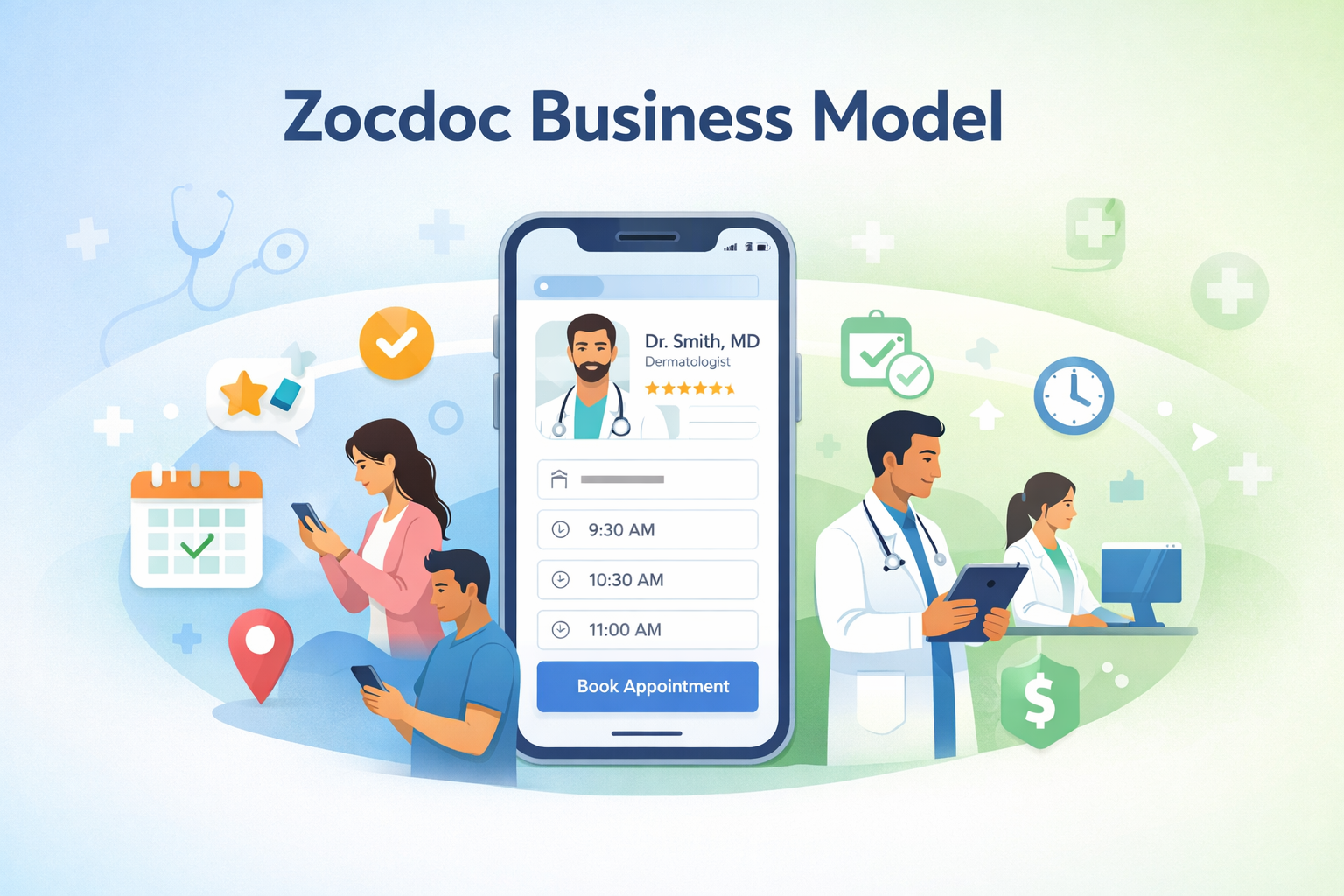
Zocdoc makes money mainly through monthly subscription fees paid by doctors and healthcare providers. It’s a two-sided marketplace that connects patients with doctors. Providers pay to be listed, get bookings, and access scheduling tools.
What Is Zocdoc, Really?
Let me be honest with you. Before I dug into this, I thought Zocdoc was just a fancy doctor search tool.
It’s not.
It’s a full healthcare marketplace. And the business model behind it is smarter than most people realize.
Zocdoc was founded in 2007 by Oliver Kharraz, Nick Ganju, and Cyrus Massoumi. They built it out of a real frustration. Massoumi had a ruptured eardrum and couldn’t find a doctor who took his insurance and had availability. That single bad experience turned into a billion-dollar idea.
Today, Zocdoc operates as a web platform and mobile app. It lets patients search for doctors, check real-time availability, verify insurance, and book appointments instantly. No phone tag. No waiting on hold.
It’s live in the US and has served millions of patients across specialties like primary care, dermatology, dentistry, and more.
The Problem Zocdoc Solves
This is where it gets interesting. Zocdoc didn’t just build a product. It solved two problems at once.
For patients, booking a doctor’s appointment used to be painful.
You’d Google a doctor, find a number, call during business hours, wait on hold, and then get told the next available slot is three weeks out. If you didn’t have the right insurance? Start over.
That’s not healthcare. That’s a scavenger hunt.
For doctors, the problem was just as real.
Solo practitioners and small practices struggled with empty appointment slots. They had no easy way to attract new patients online. Their scheduling systems were outdated. And no-shows were killing their revenue.
Zocdoc stepped in and said: what if we fix both sides at once?
That’s the core of a marketplace model. And it works.
Zocdoc Business Model Overview
Zocdoc runs what’s called a two-sided marketplace.
On one side, you have patients. They use the platform for free. They search, filter, and book. No cost to them.
On the other side, you have doctors and healthcare providers. They pay to be on the platform. They get listed, they get bookings, and they get tools to manage their schedule.
This model is similar to how Airbnb works (hosts pay, guests browse) or how OpenTable works (restaurants pay, diners book for free).
The genius is that both sides need each other. More doctors make the platform more useful for patients. More patients make it worth it for doctors to pay. That’s network effects working in real time.
I’ll break down exactly how Zocdoc makes money from each of these pieces.
How Zocdoc Works Step by Step
Before we talk money, let’s quickly walk through the user experience. It matters because the product is what drives the revenue.
Step one: A patient visits Zocdoc and searches for a doctor by specialty, location, or condition.
Step two: They apply filters. Insurance accepted, distance, availability, language, gender preference.
Step three: They browse doctor profiles. They see reviews, credentials, accepted insurance, and office photos.
Step four: They pick an open time slot and book instantly. No waiting for confirmation.
Step five: The doctor’s calendar updates in real time. The patient gets a confirmation and reminders.
It sounds simple. But that simplicity took years of engineering, provider partnerships, and insurance integrations to build. That’s the moat.
Revenue Streams of Zocdoc
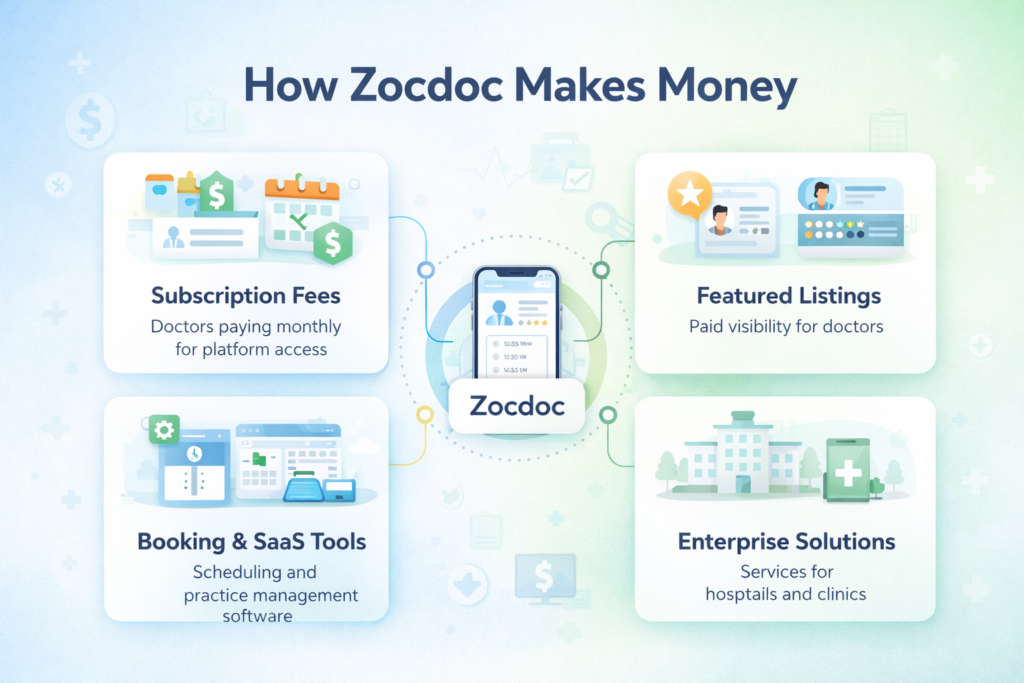
Now let’s get into the real stuff. How does Zocdoc actually make money?
Subscription Fees from Doctors
This is the main revenue stream. Doctors pay a monthly subscription fee to be listed on Zocdoc.
When Zocdoc first launched, it charged around $3,000 per year per doctor. Over time, it shifted to a more flexible subscription model. Pricing varies by specialty, location, and the size of the practice.
Why do doctors pay this? Because the ROI makes sense.
Think about it. A primary care doctor might earn $150 to $300 per patient visit. If Zocdoc brings in even 10 to 15 new patients a month, the subscription pays for itself many times over.
For doctors in competitive markets like New York or Los Angeles, patient acquisition is expensive. Zocdoc turns that into a predictable monthly cost with measurable results.
This recurring subscription model is what makes Zocdoc’s revenue stable and scalable.
Booking and SaaS Tools
Beyond just being listed, Zocdoc gives providers access to scheduling and practice management tools.
These include:
- Real-time calendar syncing
- Automated patient reminders
- Digital intake forms
- Insurance verification tools
- No-show reduction features
Doctors and clinics pay for access to these tools as part of their subscription or as add-ons. This SaaS layer makes Zocdoc sticky. Once a practice integrates Zocdoc into their workflow, switching costs go up.
It’s not just a listing platform anymore. It becomes part of how the office runs.
Featured Listings and Visibility Boosts
Not all doctors appear at the top of search results equally. Zocdoc gives providers the option to pay for better placement.
Think of it like Google Ads, but for doctor searches.
A dermatologist in Chicago who wants more visibility in competitive search results can pay to appear higher. This is a performance-based revenue layer on top of the base subscription.
It’s smart because it creates a secondary market. Doctors who want more patients have an easy way to spend more on the platform. Zocdoc benefits from that competitive dynamic.
Enterprise Solutions for Hospitals and Clinics
This is a growing revenue line that doesn’t get talked about enough.
Large health systems, hospital networks, and multi-location clinics need more than a basic listing. They need custom integrations, analytics dashboards, bulk scheduling, and patient routing across multiple departments.
Zocdoc sells enterprise contracts to these large providers. These deals are higher value and longer term.
As healthcare consolidates and more large systems look for digital patient access tools, this segment is becoming a bigger piece of the pie.
Zocdoc Pricing Strategy
Let me be clear: Zocdoc doesn’t publish its exact pricing publicly. But from what’s been reported and discussed in healthcare circles, here’s how their pricing approach works.
It’s value-based, not cost-based.
Zocdoc doesn’t just charge a flat fee and call it a day. The pricing is tied to the value a provider gets. A specialist in a high-demand area pays more than a general practitioner in a small town. That makes sense.
The ROI pitch is central to the sales conversation.
When Zocdoc sells to a doctor, the conversation isn’t “here’s what you pay.” It’s “here’s how many patients you’ll get, and here’s what that’s worth to your practice.”
That framing makes the subscription feel like an investment, not an expense.
Pricing tiers exist for different practice sizes.
A solo doctor, a small group practice, and a large hospital system are all customers. But they have very different needs and budgets. Zocdoc’s pricing reflects that segmentation.
Key Components That Make the Model Work
Platform Technology
The search and recommendation engine is the heart of Zocdoc. It matches patients to the right doctor based on:
- Location and distance
- Insurance network
- Specialty and conditions treated
- Appointment availability
- Patient reviews and ratings
The calendar integration piece is underrated. Zocdoc syncs with the practice management systems that doctors already use. That’s not easy to build. And it creates a technical barrier that’s hard for competitors to replicate quickly.
The Trust Layer
Healthcare is a trust business. Nobody wants to book a random doctor with no information.
Zocdoc built a trust layer into the platform through:
- Verified patient reviews: Only patients who actually completed appointments through Zocdoc can leave reviews. That makes them credible.
- Detailed doctor profiles: Credentials, education, specialties, languages spoken.
- Insurance transparency: Real-time insurance verification so patients know what they’ll pay before they book.
This trust layer is a big reason patients come back. And repeat patient behavior is what makes the platform valuable for doctors.
Network Effects
This is the part that makes Zocdoc hard to beat once it reaches scale in a market.
More doctors on the platform means more options for patients. More options means more patients use it. More patient volume means more value for doctors. Which brings more doctors. Which brings more patients.
That flywheel is powerful.
In cities where Zocdoc has deep penetration, it’s very hard for a competitor to break in. The network effect creates a moat.
Customer Segments Zocdoc Serves
Zocdoc serves three main customer groups, and it’s important to understand how each fits.
Patients are the demand side. They use the platform to find and book care. They don’t pay Zocdoc directly. But their presence is what creates value for the supply side.
Individual healthcare providers are the core paying customers. Solo doctors, small practices, and independent clinics subscribe to be listed and get bookings.
Hospitals and large health systems are the enterprise segment. These are higher-value, more complex relationships that Zocdoc has been growing in recent years.
Value Proposition Breakdown
What Patients Get
- Instant booking: No phone calls, no waiting. Book in under two minutes.
- Real-time availability: See actual open slots, not an outdated appointment book.
- Insurance clarity: Know before you go whether your plan is accepted.
- Transparent reviews: Read verified experiences from real patients.
- Reminders: Automated reminders reduce the chance of forgetting.
The patient value prop is all about convenience and transparency. Things that used to require three phone calls now take two minutes on your phone.
What Doctors Get
- New patient acquisition: A steady stream of patients who are actively looking for care.
- Reduced no-shows: Automated reminders and digital check-ins help reduce no-shows.
- Scheduling efficiency: The calendar tools cut down on admin work.
- Online visibility: A polished profile that shows up in search results.
- Reviews and reputation: Verified reviews help build trust with new patients.
For a doctor running a small practice, Zocdoc can replace a part-time front desk function while also acting as a marketing channel.
Zocdoc Growth Strategy
How did Zocdoc grow from a startup idea to a platform used by millions of Americans? A few key strategies stand out.
SEO is a massive patient acquisition engine.
When someone searches “dermatologist near me” or “urgent care open now,” Zocdoc wants to show up. They’ve invested heavily in search engine optimization. Their doctor profile pages, city-based landing pages, and specialty pages are all built to rank.
This organic traffic is essentially free patient acquisition. And at scale, it’s a huge competitive advantage.
Paid advertising fills the gaps.
On top of SEO, Zocdoc runs paid search and display ads. When organic traffic isn’t enough in a particular market or specialty, they can use paid ads to drive more patient volume.
Partnerships with insurance companies and employers.
Some insurers and employers partner with Zocdoc to offer it as a benefit to their members or employees. This drives volume directly and gives Zocdoc access to covered populations.
Mobile-first product development.
Most healthcare searches happen on phones now. Zocdoc built a strong mobile app early and kept improving it. The in-app booking experience is smooth and fast.
Competitors of Zocdoc
Zocdoc doesn’t operate in a vacuum. There are real competitors in this space.
Healthgrades focuses more on doctor discovery and reputation. It has a large database of provider information and patient reviews. But it doesn’t have the same real-time booking depth that Zocdoc has built.
Practo is a strong player in international markets, especially in India. In the US, it’s less of a direct threat right now.
DocASAP focuses on enterprise health systems and patient access solutions. It competes with Zocdoc’s enterprise segment more than the consumer side.
Google Search is honestly a macro competitor. As Google adds more healthcare search features, it could reduce the need for patients to visit a third-party platform.
That last point is real. It’s a risk Zocdoc has to navigate carefully.
Zocdoc vs Traditional Appointment Booking
Let me break this down simply because the contrast is stark.
| Factor | Zocdoc | Traditional |
|---|---|---|
| Booking method | Instant, online | Phone-based |
| Availability info | Real-time | Limited or unknown |
| Insurance check | Automated | Manual call |
| Reviews | Verified | Word of mouth |
| Reminders | Automated | Often none |
| After-hours access | Available | Not available |
The traditional model still exists in many practices. But patients who’ve used Zocdoc rarely want to go back to playing phone tag.
Advantages of Zocdoc’s Business Model
There are a few things I genuinely think are well-designed about how Zocdoc makes money.
It’s a recurring revenue model. Subscriptions are predictable. Doctors don’t just pay once. They pay every month. That gives Zocdoc stable, forecastable income.
Patients cost almost nothing to acquire at scale. Once the SEO engine is running and the app has reviews and brand recognition, patients come organically. That keeps the unit economics healthy.
It scales without proportional cost increases. Adding more doctors to the platform doesn’t require a huge spike in operating costs. The technology handles the load. That’s a classic SaaS advantage.
It operates in a high-demand, recession-resistant industry. People don’t stop needing doctors when the economy gets tough. Healthcare demand is durable.
Challenges and Limitations
I want to be real about the challenges too. This model isn’t perfect.
Doctor adoption is the biggest variable. If doctors don’t see the ROI clearly, they cancel. Churn in the provider base can hurt the platform’s value for patients. Zocdoc has to constantly prove its value to keep subscriptions active.
Review authenticity is an ongoing concern. Even with verified-only reviews, managing review quality and preventing gaming the system is a constant challenge.
Geographic concentration is a limitation. Zocdoc is strongest in major metro areas. In rural markets, the provider supply is thin. That limits growth outside of urban centers.
Competition from large platforms is a real threat. Google, Amazon, and large health systems all have the resources to build or buy patient access tools. Zocdoc has to stay ahead of that curve.
Pricing sensitivity among small practices. When subscription costs feel high relative to a slow month’s patient volume, small practices question the value. That creates sales and retention challenges.
The Future of Zocdoc
Here’s what I think the next chapter looks like for Zocdoc.
AI-based doctor recommendations are coming. Instead of just filtering by insurance and location, future versions of the platform could use AI to match patients with the best provider based on their specific needs, health history, and preferences. That’s a much smarter match.
Telehealth integration is already growing. The pandemic accelerated virtual care adoption. Zocdoc has been adding telehealth booking to the platform. This expands the available inventory of appointments significantly.
Expanding into new markets is on the table. The US market is large, but Zocdoc’s model could work in other countries with fragmented healthcare booking systems. International expansion is a long-term growth lever.
Deeper data and analytics for providers. As the platform matures, the data Zocdoc sits on becomes very valuable. Practice analytics, patient demand trends, and performance benchmarks could become premium features.
Wrapping Up
Here’s the lesson I take from Zocdoc’s business model.
Build for friction. Not just for features.
The founders didn’t start by asking “what can we build?” They started by asking “what is genuinely painful about this experience?” And then they built the simplest possible fix for that pain.
The marketplace model worked because both sides had a real problem. Patients couldn’t find and book care easily. Doctors couldn’t fill their calendars efficiently. Zocdoc fixed both.
The subscription model works because the value is real and measurable. Doctors can see exactly how many patients came through Zocdoc. That transparency builds trust in the product.
If you’re a founder looking at this model, the key insight is this:
Build platforms that eliminate friction with convenience and trust. The business model will follow.
Zocdoc didn’t invent doctor appointments. It just made them not terrible. And that was worth billions.
FAQs
Yes, completely free. Patients can search for doctors, check availability, and book appointments at no cost. Zocdoc makes its money from the provider side, not from patients.
Doctors pay a monthly subscription fee to be listed on the platform and access booking tools. The exact pricing isn’t public, but it’s typically structured around practice size, specialty, and location. Think of it like a marketing and scheduling software subscription combined.
Zocdoc is a private company and doesn’t disclose detailed financials. But the business model itself is structurally sound. Recurring subscription revenue, low marginal cost to add patients, and a high-demand market are all positive indicators. Reports have suggested the company has worked toward profitability as it matured from its high-growth startup phase.
Zocdoc works with a large number of major insurance plans and shows real-time insurance compatibility on provider profiles. But not every plan or provider combination is covered. Patients should always confirm coverage before their appointment.
Because it works out financially. A doctor earning $200 to $400 per visit who gets 10 to 20 new patients a month through Zocdoc is generating far more revenue than the subscription costs. For practices that rely on new patient flow, the ROI is usually clear.
Yes. Zocdoc covers a wide range of specialties including dermatology, OB-GYN, psychiatry, orthopedics, dentistry, and more. It’s not just for primary care.
Discover more from Business Model Hub
Subscribe to get the latest posts sent to your email.