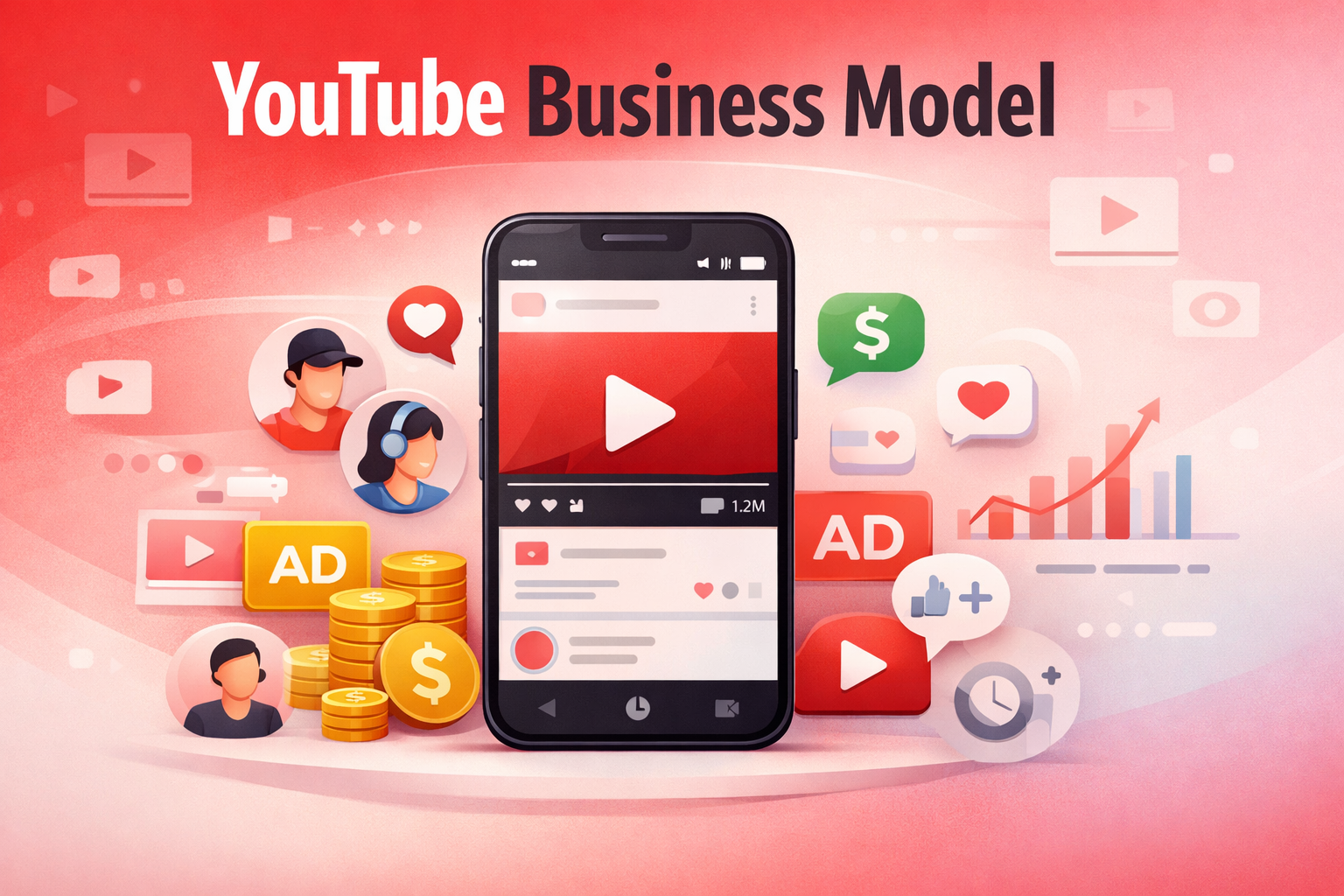
YouTube makes money by connecting creators, viewers, and advertisers on one massive platform. It earns billions through ads, subscriptions, and premium services. At the same time, it shares revenue with creators to keep the content flowing.
Have you ever wondered how YouTube gives away free content to billions of people and still makes billions of dollars every year?
I did too. And once I understood the model, it honestly blew my mind.
It’s not magic. It’s a very smart business design. One that benefits YouTube, creators, and advertisers all at the same time.
What Is YouTube?
YouTube is the world’s largest video-sharing platform. It launched in 2005, founded by three guys: Steve Chen, Chad Hurley, and Jawed Karim.
Google bought it just one year later in 2006 for $1.65 billion. At the time, people thought Google overpaid. Today, YouTube generates over $30 billion a year in ad revenue alone.
Safe to say it was a good deal.
The core idea behind YouTube is beautifully simple. Anyone can upload a video. Anyone can watch it. No gatekeepers. No TV studios. No permission needed.
That open model changed everything about media and entertainment.
The Core Business Model in One Line
“YouTube monetizes attention by connecting creators, viewers, and advertisers.”
That’s it. That’s the whole thing.
YouTube doesn’t create content. It doesn’t pay creators a salary. It just builds the stage, invites everyone in, and takes a cut of the money flowing through the system.
It’s a two-sided platform. And two-sided platforms, when done right, are some of the most powerful business models in the world.
How YouTube Works Step by Step
Before we talk money, let’s understand the basic flow. Because the business model only makes sense when you see how the pieces connect.
Here’s how the whole system works:
Step One: Creators upload videos. Anyone with a camera and internet connection can become a creator. YouTube hosts the video for free.
Step Two: YouTube recommends content. The algorithm decides what to show to which viewer. This is where YouTube’s real power lives.
Step Three: Users watch the content. Billions of people around the world open YouTube every single day. They watch, click, share, and come back again.
Step Four: Ads are displayed. Before or during videos, YouTube shows ads. These ads are served through Google’s ad network. Advertisers pay to reach viewers.
Step Five: Revenue is shared. YouTube takes its cut. Creators get their share. Everyone benefits from the attention the platform captured.
Simple cycle. Enormous scale.
YouTube Revenue Streams
This is the section I find most fascinating. YouTube doesn’t just make money one way. It has built multiple layers of revenue, and each one reinforces the others.
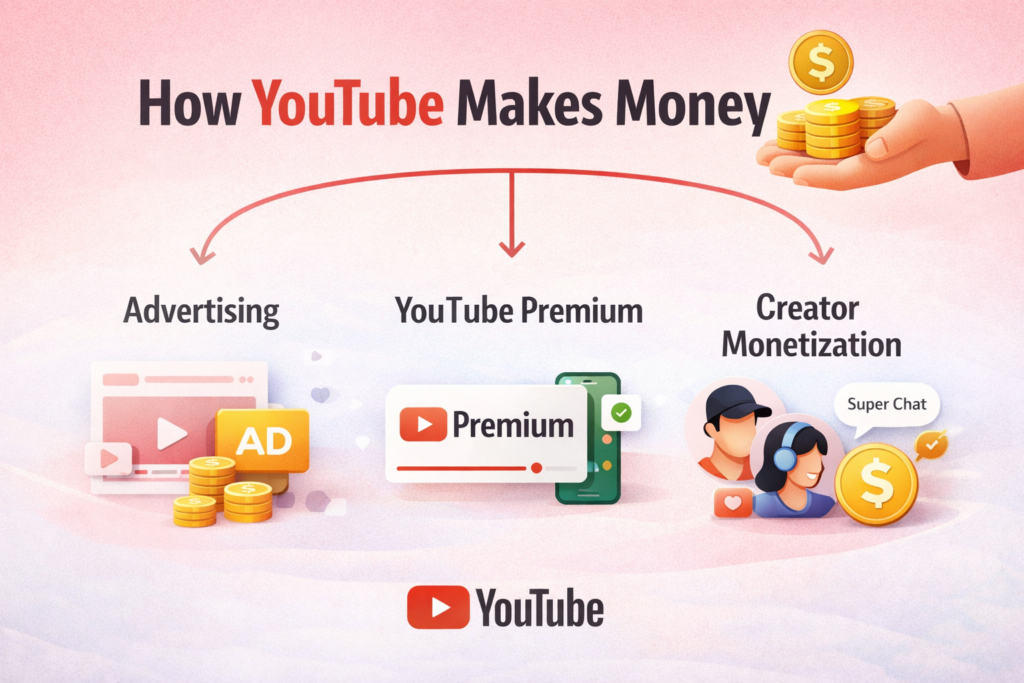
Let me walk you through each one.
Advertising Revenue
This is YouTube’s primary engine. The big one. The reason everything else exists.
YouTube runs ads through Google Ads. Since Google owns YouTube, the integration is seamless. Advertisers can target users by age, location, interests, search history, and even the type of videos they watch.
That level of targeting is incredibly valuable to advertisers.
Here are the main types of ads you see on YouTube:
- Skippable ads: You can skip after five seconds. These are the most common.
- Non-skippable ads: You have to watch the full thing. Usually 15 to 20 seconds.
- Display ads: These appear beside the video, not inside it.
- Bumper ads: Short six-second ads that play before a video.
Insight: Advertising makes up the vast majority of YouTube’s total revenue. Some estimates put it at over 80% of their earnings. Everything else is extra.
What makes this model so powerful is that YouTube doesn’t create the content the ads run on. Creators do that for free. YouTube just hosts it and sells the ad space around it.
That’s an insane margin when you think about it.
YouTube Premium
YouTube Premium is a paid subscription service. It costs around $13.99 per month in the US.
Here’s what subscribers get:
- No ads on any video
- Background play on mobile
- Offline downloads
- Access to YouTube Music
YouTube Premium is growing steadily. It gives YouTube a reliable, recurring revenue stream that doesn’t depend on ad market cycles.
If the ad market slows down, Premium revenue keeps coming in. That’s smart diversification.
Creators also earn a share of Premium revenue based on how much Premium subscribers watch their content. So it’s not just a YouTube win. Creators benefit too.
Channel Memberships
Channel memberships let fans pay their favorite creators directly through YouTube.
Fans pay a monthly fee, usually starting at $4.99, and get exclusive perks in return. Things like:
- Custom badges next to their name in comments
- Exclusive emojis
- Members-only posts or videos
- Early access to content
YouTube takes a 30% cut of membership revenue. The creator keeps 70%.
This model creates a deeper relationship between creators and their most loyal fans. It also gives creators income that doesn’t depend on ad views.
If a creator’s video gets fewer views one month, their membership income stays stable. That’s huge for creator sustainability.
Super Chat and Super Thanks
These are two features built around direct fan-to-creator payments.
Super Chat happens during live streams. Fans can pay to have their message highlighted in the live chat. The more they pay, the longer the message stays pinned at the top.
Super Thanks is similar but for regular videos. Viewers can leave a paid comment on any video to show appreciation.
Both features are simple. Both are powerful. They turn passive viewers into active supporters.
YouTube takes a cut here too, roughly 30%. The rest goes to the creator.
The insight here is brilliant: YouTube turned viewer generosity into a revenue stream without creating anything new. They just built the payment rails.
YouTube Shorts Fund and Shorts Ads
YouTube Shorts launched as a direct response to TikTok. It’s the short-form vertical video format that has exploded in popularity.
Initially, YouTube paid creators through a Shorts Fund. But they’ve since moved to a more sustainable model where Shorts earn ad revenue just like regular videos.
Creators get 45% of the ad revenue generated on their Shorts. That’s a slightly lower split than regular videos, but it reflects the smaller ad inventory in short-form content.
Shorts now get over 70 billion daily views. That’s an enormous amount of attention. And attention is exactly what YouTube monetizes.
YouTube TV and Other Services
YouTube TV is a live TV streaming service. It costs around $72.99 per month and offers over 100 live channels including sports, news, and entertainment.
This puts YouTube in direct competition with cable TV. And it’s working. YouTube TV has millions of subscribers.
Beyond TV, YouTube has experimented with:
- YouTube Movies (ad-supported free movies)
- YouTube Kids (a separate app for children)
- YouTube Learning (educational content)
These extensions keep users in the YouTube ecosystem longer. More time on platform means more ad impressions. More ad impressions mean more revenue.
YouTube Monetization Model: The Creator Side
Now let’s talk about the creator economy. Because without creators, YouTube has nothing to sell ads against.
Creators are not YouTube’s employees. They are incentivized partners. This is one of the most important distinctions in the whole business model.
YouTube doesn’t pay creators a salary. Instead, it shares ad revenue with them. Creators get approximately 55% of the ad revenue generated on their videos. YouTube keeps 45%.
To qualify for the YouTube Partner Program and start earning ad revenue, creators need to meet these requirements:
- At least 1,000 subscribers
- At least 4,000 watch hours in the past 12 months (for traditional videos)
- Or 10 million Shorts views in the past 90 days
Once approved, creators can earn through ads, memberships, Super Chat, and more.
Here’s the genius of this model: YouTube gets an enormous library of free content. Creators supply it voluntarily because they can earn real money.
Some top creators earn millions of dollars a year. MrBeast, for example, has built a media empire through YouTube revenue and brand deals. That success story attracts millions of aspiring creators. And those creators produce more content. And more content attracts more viewers. And more viewers attract more advertisers.
The flywheel never stops spinning.
Key Business Model Components
Let me break down the core building blocks that make this whole system work.
Value Proposition
YouTube offers something different to each group it serves.
For creators: A free platform to reach a global audience and earn real income. No upfront cost. No technical expertise needed.
For viewers: Free access to virtually unlimited video content. Entertainment, education, news, tutorials, anything.
For advertisers: Highly targeted access to engaged audiences. Better targeting than TV. More measurable results.
When every group gets clear value, the platform grows naturally. Nobody is forced to use YouTube. They choose it because it benefits them.
Customer Segments
YouTube serves three distinct customer groups at once:
Viewers are the largest group. Billions of people worldwide. They consume content and attract advertisers.
Creators are the content suppliers. They range from individuals with a camera to major media companies. They produce the content that keeps viewers coming back.
Advertisers are the paying customers. They fund the whole system. Without advertisers, nothing else works.
Key Resources
What does YouTube actually own that makes this work?
The algorithm is the most valuable asset YouTube has. It decides what billions of people watch next. Control the recommendation, and you control the attention.
The content library is massive and grows every minute. Over 500 hours of video are uploaded to YouTube every single minute. No competitor can match this scale.
The creator ecosystem is a self-sustaining supply chain. Millions of creators, motivated by potential earnings, continuously produce content for free.
Google’s data gives YouTube an unmatched advantage in ad targeting. YouTube knows what you search, what you watch, where you are, and what you buy. That data makes ads more valuable.
Key Activities
What does YouTube actually do every day?
- Host and store billions of videos
- Recommend content to keep users watching longer
- Serve ads efficiently and accurately
- Moderate content to maintain advertiser trust
- Support creators with tools, analytics, and monetization features
Moderation is underrated here. Advertisers won’t pay to run ads next to harmful content. Keeping the platform safe is directly tied to keeping ad revenue healthy.
The YouTube Algorithm: The Real Growth Engine
People talk about YouTube as a video platform. But I think that’s the wrong way to see it.
YouTube is a recommendation engine that happens to host videos.
The algorithm is what makes everything work. It answers one question for every user, every session: what should this person watch next?
To answer that, it looks at:
Watch time: How long did viewers watch similar videos? Longer watch time signals quality content.
Click-through rate: When YouTube shows your video thumbnail, how often do people click it? High CTR means the title and thumbnail are compelling.
User retention: Do viewers finish the video or drop off after 30 seconds? Strong retention tells the algorithm the content delivered on its promise.
Engagement: Likes, comments, shares, and saves all signal that viewers connected with the content.
The algorithm’s job is not to promote the best content. Its job is to maximize watch time. Because more watch time means more ads shown. More ads shown means more revenue.
This is why controversial or emotionally engaging videos often outperform technically superior but calmer ones. The algorithm rewards engagement, not quality.
Understanding this is key to understanding YouTube as a business. The algorithm is not neutral. It’s optimized for revenue.
Why YouTube’s Business Model Works
There are a few reasons this model is so powerful. Let me explain each one simply.
Free content creates massive scale. Because YouTube is free for viewers, the barrier to entry is zero. Anyone with internet access can use it. That brings in billions of users.
Creators supply content for free. YouTube doesn’t spend billions producing shows like Netflix does. Creators do all the work. And they do it voluntarily because of the revenue sharing model.
Ads are high margin. Once the infrastructure is built, serving one more ad costs almost nothing. Revenue scales faster than costs.
Network effects lock everyone in. More creators bring more content. More content brings more viewers. More viewers attract more advertisers. More ad money attracts more creators. The cycle feeds itself.
Here’s the simple version: More creators bring more content. More content brings more users. More users bring more advertisers. More advertisers bring more money. More money attracts more creators.
That loop is incredibly hard to break once it reaches scale. And YouTube reached scale a long time ago.
Challenges in YouTube’s Business Model
No business model is perfect. YouTube faces real challenges that could slow it down.
Creator burnout is a serious problem. The algorithm rewards consistency. Creators feel pressure to upload constantly. Many burn out. Some quit. High creator turnover is bad for the platform’s content supply.
Ad dependency is a vulnerability. If ad spending drops during a recession, YouTube’s revenue drops sharply. The business has tried to diversify with Premium and other services, but ads still dominate.
Content moderation is a never-ending battle. YouTube hosts billions of videos. Harmful content slips through. Advertisers sometimes pull spending when their ads appear next to inappropriate content. YouTube calls this brand safety and it’s a constant tension.
Competition from TikTok and Instagram is intensifying. Short-form video has shifted attention to newer platforms. Younger users especially are spending more time on TikTok. YouTube’s Shorts is a response to this threat, but the battle is real and ongoing.
Competitors of YouTube
YouTube is dominant, but it’s not alone.
TikTok is the biggest threat right now. Its algorithm is arguably better at hooking new users. It’s captured the Gen Z audience in a big way.
Instagram Reels competes directly with Shorts. Meta has enormous resources and is pushing Reels hard.
Netflix doesn’t compete directly on user-generated content. But it competes for viewing time. Time spent on Netflix is time not spent on YouTube.
Twitch owns live streaming for gaming audiences. YouTube Gaming has tried to compete but Twitch still leads in that niche.
The competition is fierce. But YouTube’s scale, creator ecosystem, and integration with Google give it durable advantages that are hard to replicate.
YouTube Business Model Canvas
Here’s a quick breakdown of the full business model in one place.
Value Proposition: Free content for viewers, income and reach for creators, targeted audiences for advertisers.
Revenue Streams: Advertising, YouTube Premium, channel memberships, Super Chat, Super Thanks, YouTube TV, Shorts ads.
Customer Segments: Viewers, creators, advertisers, YouTube TV subscribers.
Key Partners: Google (ad network, data, infrastructure), device manufacturers, internet providers, music labels.
Cost Structure: Server infrastructure, content moderation, algorithm development, creator support, legal and compliance.
The beauty of this canvas is that most of the cost structure is fixed. Hosting one more video or serving one more ad costs almost nothing at the margin. That’s what makes the business so profitable at scale.
Future of YouTube
Where does YouTube go from here? A few trends are clear.
AI recommendations will get smarter. YouTube already uses machine learning. As AI improves, recommendations will become more personalized and harder to ignore.
Creator monetization will expand. YouTube knows it needs happy creators to survive. Expect more ways for creators to earn, including e-commerce integrations, digital products, and tipping features.
Shorts will keep growing. Short-form video isn’t going away. YouTube will invest more in Shorts monetization to keep creators from migrating to TikTok.
Shopping integration is coming. YouTube has already started letting creators tag products in videos. Viewers can buy directly from YouTube. This opens up affiliate revenue and e-commerce commissions at massive scale.
Connected TV is a big opportunity. More people are watching YouTube on their TV screens, not just their phones. That shifts YouTube into direct competition with streaming services. And it commands higher ad rates.
Wrap Up
YouTube is not just a video platform. It’s one of the smartest attention businesses ever built.
It figured out how to get billions of people to produce free content, attract billions more to consume it, and charge advertisers a premium to reach all of them.
If you control distribution, you control revenue. YouTube controls how the world discovers video content. That’s the ultimate leverage.
The biggest lesson from YouTube’s business model is this: you don’t have to create the product. You just have to build the best platform for others to create it. Then capture the value that flows through your system.
That’s exactly what YouTube did. And it’s why Google’s $1.65 billion bet in 2006 turned into one of the greatest acquisitions in business history.
FAQs
YouTube makes most of its money through advertising. Advertisers pay to show ads before, during, and alongside videos. This accounts for the majority of YouTube’s annual revenue.
Creators earn roughly 55% of the ad revenue generated on their videos. Earnings vary widely based on niche, audience size, and video length. Some creators earn a few dollars a month. Others earn millions.
YouTube Premium is a paid subscription that removes ads and adds extra features. It’s growing in subscribers and provides YouTube with a stable recurring revenue stream separate from advertising.
The algorithm recommends videos based on watch time, click-through rate, viewer retention, and engagement signals. Its primary goal is to keep users watching longer, which increases the number of ads YouTube can show.
Yes, but it takes time. Creators need 1,000 subscribers and 4,000 watch hours to join the Partner Program. Once in, they earn from ads, memberships, and Super Chat. Many small creators build meaningful income over time.
Discover more from Business Model Hub
Subscribe to get the latest posts sent to your email.