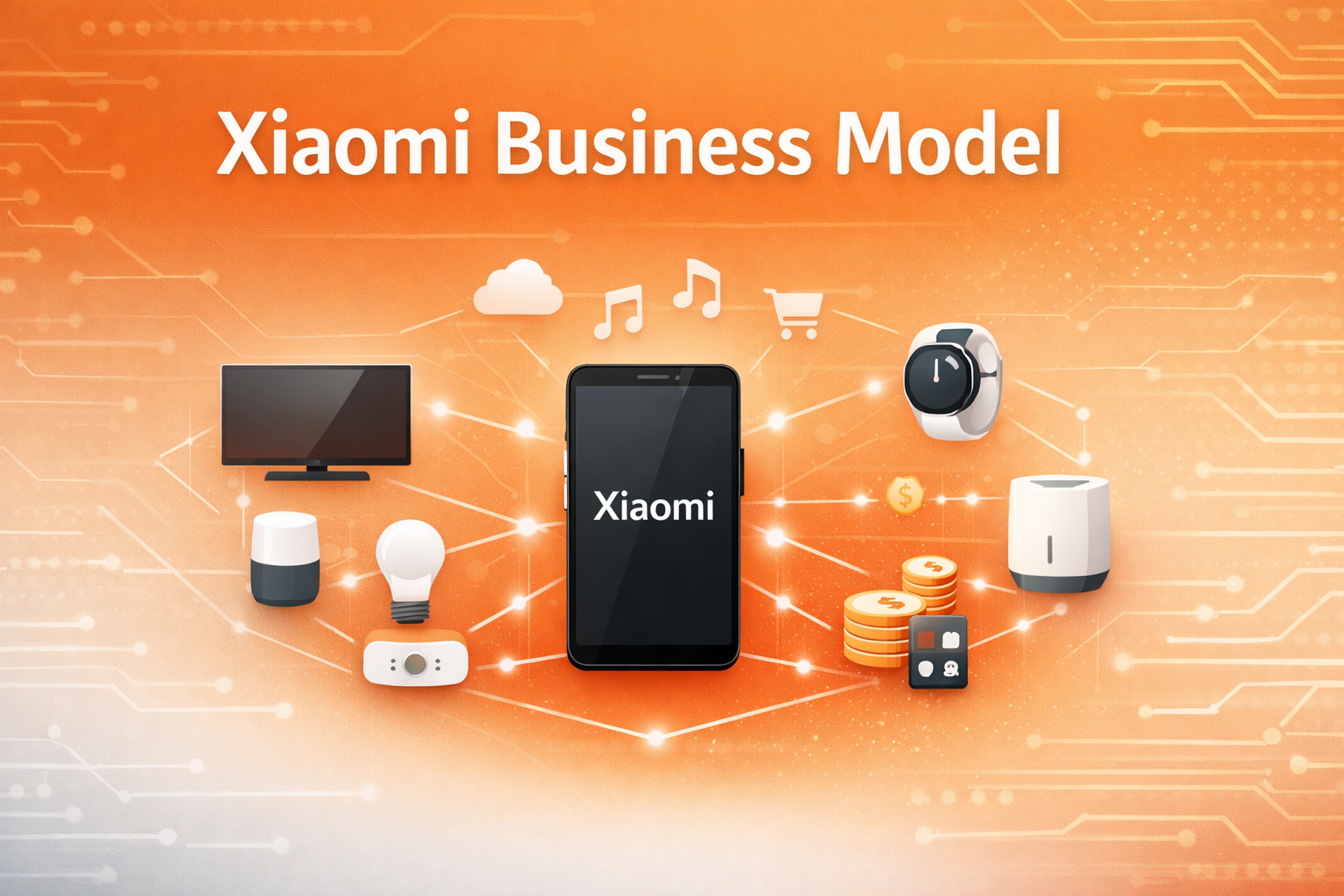
Xiaomi’s business model is based on selling high-quality smartphones and smart devices at low margins, while earning profits through ecosystem products, internet services, and its vast IoT platform.
How Does Xiaomi Sell Smartphones Cheaper Than Competitors and Still Make Money?
That is the question that puzzles most people when they first encounter the brand. A company that openly caps its own profit margins, sells phones at near-cost prices, and still manages to become one of the world’s most valuable tech companies. It sounds impossible. But once you understand the architecture behind Xiaomi’s business model, it all starts to make sense.
Xiaomi was founded in 2010 by Lei Jun, often described as China’s Steve Jobs. In just over a decade, it grew from a small startup selling one phone online to a global tech giant operating in over 100 countries. As of recent years, it has consistently ranked among the top five smartphone brands worldwide by shipment volume.
In this blog, I will break down exactly how Xiaomi makes money, what makes its model unique, and what founders and entrepreneurs can take away from studying it.
What Is Xiaomi?
Xiaomi is not just a smartphone company. That is the first thing you need to understand.
It describes itself as an “internet company with smartphones and smart hardware as its core.” That framing is intentional and tells you a lot about how it thinks about its own business.
At its core, Xiaomi is a consumer electronics and smart ecosystem company. Its product portfolio includes:
- Smartphones across multiple sub-brands including Redmi and POCO
- Smart TVs and streaming devices
- Wearables like fitness bands and smartwatches
- IoT and smart home devices including air purifiers, robot vacuums, and security cameras
- Lifestyle products like backpacks, luggage, electric scooters, and audio devices
The vision is simple but powerful: build an Apple-like ecosystem, but make it accessible to everyone. Where Apple targets the premium segment, Xiaomi targets the value-conscious consumer who still wants quality.
The Xiaomi Business Model, Broken Down Simply
At the heart of everything Xiaomi does is one core idea:
Make small profits from hardware. Make growing profits from software, services, and the ecosystem.
Or even simpler: Xiaomi does not try to make big profits from one product. It makes small profits from many products, then layers services and internet revenue on top of that base.
Think of it like a razor-and-blades model, but reimagined. The razor (the smartphone) is sold at nearly no profit. But the blades (apps, ads, subscriptions, smart devices) keep generating revenue long after the original sale.
This approach flips the traditional consumer electronics model on its head. Most hardware companies try to maximize margin on every unit sold. Xiaomi deliberately does the opposite, using low prices to acquire users at scale and then monetizing those users in multiple ways over time.
How Xiaomi Makes Money
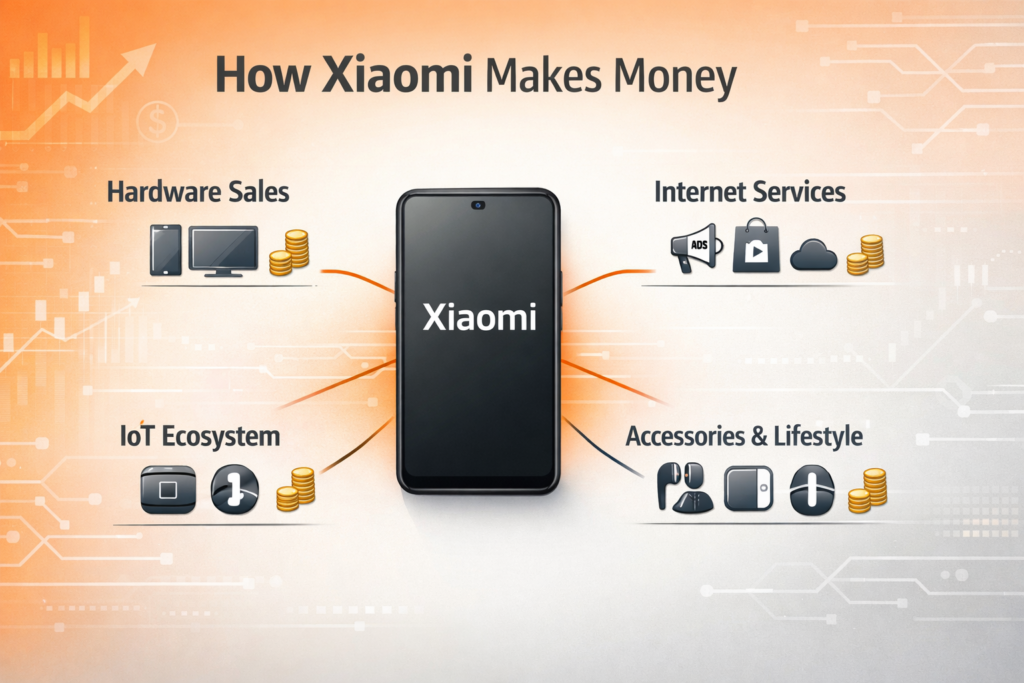
Hardware Sales
Smartphones are the entry point into the Xiaomi universe. They represent the largest share of total revenue by volume and are the primary reason most people discover the brand.
But here is the key: Xiaomi does not make much money per phone sold. It operates on notoriously thin hardware margins. The goal is not per-unit profitability. The goal is user acquisition at massive scale.
Beyond phones, Xiaomi sells:
- Smart TVs, which are among the bestsellers in markets like India and China
- Wearables including the Mi Band series, which regularly tops global fitness tracker charts
- Smart home devices through its Mi Home ecosystem
- Tablets, laptops, and audio products
All of these hardware products follow the same low-margin philosophy. The hardware is the door. The ecosystem is the room.
Internet Services
This is where the real margin lives.
Once a user is inside the Xiaomi ecosystem, the company earns money through its software and internet layer. This includes:
- Advertising on MIUI, Xiaomi’s custom Android-based operating system. With hundreds of millions of active MIUI users, even small ad revenue per user adds up to significant totals.
- App store commissions from the Xiaomi app marketplace, where developers pay a percentage of in-app purchases and downloads.
- Content subscriptions including video streaming, music, and other digital content services.
- Financial services in select markets, including lending and insurance products offered through the phone.
Internet services consistently deliver the highest margins of any segment Xiaomi operates in. While hardware might deliver margins in the low single digits, internet services can operate at margins above 60 to 70 percent.
This is the hidden engine of the business.
The IoT and Smart Home Ecosystem
Xiaomi has built what it calls the world’s largest consumer IoT platform. As of recent reports, it has connected hundreds of millions of smart devices globally, not counting smartphones and laptops.
The strategy here is built around cross-selling. A customer buys a Xiaomi phone. Then they discover the Mi Home app, which controls smart devices. Then they buy a smart light bulb. Then a robot vacuum. Then an air purifier. Each new device deepens their connection to the ecosystem and makes switching more difficult.
This is not accidental. It is engineered. Xiaomi invests in or co-develops hundreds of products through a unique model where it partners with startups, provides resources and distribution, and sells the resulting products under the Xiaomi or Mi brand.
This lets Xiaomi expand its product catalog without building everything in-house.
Accessories and Lifestyle Products
Often overlooked but highly important, Xiaomi’s accessories and lifestyle segment includes:
- Power banks (Xiaomi is one of the world’s largest sellers)
- Earphones and speakers
- Bags and backpacks
- Clothing and personal care items
- Electric scooters and bicycles
These products tend to carry higher margins than core electronics. A power bank or a pair of earbuds costs relatively little to produce but sells at prices that generate meaningful profit. By bundling these into the Xiaomi shopping experience, the company improves its overall margin profile.
The “Low Margin, High Volume” Strategy
In 2018, Lei Jun made a remarkable public commitment: Xiaomi would never let its hardware profit margins exceed five percent.
This was not a constraint. It was a strategic declaration. By capping margins, Xiaomi was signaling to consumers that they would always get a fair price. It was building trust at scale.
The math works like this:
- Sell 200 million units at a two percent margin and you generate substantial absolute profit
- Sell 20 million units at a twenty percent margin and the result might be smaller
Scale is the multiplier. When you sell at low prices, you reach more people. More people means more MIUI users. More MIUI users means more ad revenue. More users means more IoT device purchases. The flywheel accelerates with every unit sold.
This is counterintuitive for most business founders who are taught to protect margin. Xiaomi weaponized low margin as a growth tool.
The Ecosystem Strategy: Xiaomi’s Real Competitive Moat
If you want to understand why Xiaomi is hard to compete with, look at the ecosystem, not the phone.
The flow works like this:
- A customer buys a Xiaomi phone because it offers great specs at a low price
- They set it up and get used to MIUI, Xiaomi’s operating system
- They discover the Mi Home app and buy a smart bulb or a speaker
- They buy a Mi Band because it integrates perfectly with their phone
- They set up a robot vacuum because it works seamlessly with everything else
- Now they are fully inside the Xiaomi world
At every step, switching becomes more painful. Not because Xiaomi locks users in through technical barriers, but because the experience of having everything work together smoothly is genuinely better than starting over with a different brand.
This is ecosystem lock-in through value, not restriction. And it is far more durable.
Xiaomi is not a smartphone company. It is an ecosystem company that uses smartphones as the entry point.
The Asset-Light Manufacturing Model
One of the reasons Xiaomi can keep prices so low is that it does not own most of its manufacturing infrastructure.
Instead of building factories, Xiaomi outsources production to contract manufacturers. It focuses its internal resources on:
- Product design and engineering
- Software development and MIUI
- Brand building and community
- Supply chain management and negotiation
This asset-light approach has several advantages:
- Lower capital expenditure means more cash available for growth
- Greater flexibility to shift production based on demand
- Faster product launches because manufacturing partners are already set up
- Reduced risk during downturns since fixed costs are lower
For founders, this is a powerful lesson. You do not need to own everything in your supply chain to build a great product. Focus on what creates the most value and outsource the rest.
Marketing Strategy: Why Xiaomi Does Not Spend Much on Traditional Advertising
Traditional consumer electronics companies spend enormous amounts on television commercials, celebrity endorsements, and retail display fees. Xiaomi built its brand with almost none of that.
Instead, Xiaomi pioneered several unconventional marketing approaches:
Flash Sales
Early Xiaomi phones were sold exclusively through flash sales online. Limited quantities would be released at a specific time, and they would sell out in minutes. This created urgency, media coverage, and the perception that Xiaomi products were in massive demand.
Word of Mouth
By delivering genuinely great specs at low prices, Xiaomi gave customers a reason to tell their friends. Satisfied customers became the primary marketing channel.
Mi Fans Community
Xiaomi invested heavily in building an active user community called Mi Fans. These are customers who feel a genuine connection to the brand, participate in product feedback, attend launch events, and evangelize Xiaomi products in their networks.
The Mi Fans community gave Xiaomi free marketing, real product feedback, and a sense of belonging that created loyalty beyond what any ad campaign could achieve.
The result: Xiaomi spends a fraction of what its competitors spend on marketing and still achieves top-five global smartphone rankings.
Global Expansion Strategy
Xiaomi’s playbook for entering new markets follows a consistent logic: go where price-conscious consumers are underserved by existing brands.
India became Xiaomi’s largest international market and a template for global expansion. By launching aggressively on e-commerce platforms, partnering with local retailers, and pricing below every competitor, Xiaomi became the number one smartphone brand in India for multiple consecutive years.
Southeast Asia followed a similar path. Markets like Indonesia, Vietnam, and the Philippines have large populations of young, mobile-first consumers who want quality devices without premium price tags.
Europe was a more recent push, where Xiaomi competed on specs and value against Samsung and Apple in ways that resonated with budget-conscious consumers.
The common thread across all these markets is that Xiaomi does not try to sell luxury. It sells aspiration at accessible prices, which is a far larger market in most parts of the world.
Xiaomi vs Competitors
Understanding where Xiaomi sits relative to its competitors clarifies why its model works.
| Brand | Positioning | Margin Strategy |
|---|---|---|
| Apple | Premium, closed ecosystem | Very high margins on hardware and services |
| Samsung | Wide range from budget to premium | Mixed margins, heavy marketing spend |
| Xiaomi | Value-for-money, open ecosystem | Very low hardware margins, growing services |
Apple wins on brand prestige and ecosystem quality. Samsung wins on distribution and range. Xiaomi wins on price-to-performance ratio and ecosystem breadth.
The interesting comparison is with Apple. Both companies understand ecosystem value deeply. Both make money from hardware sales plus recurring software and service revenue. But Apple does it at the top of the market while Xiaomi does it at the bottom and middle. In a world where most consumers are not in the top tier of income, Xiaomi is addressing a much larger addressable market.
Why Xiaomi’s Business Model Works
Several factors combine to make this model genuinely durable:
Affordable pricing that drives volume
Low prices are not a weakness. They are the mechanism that fills the top of Xiaomi’s funnel with hundreds of millions of users.
Ecosystem lock-in that retains users
Once users are inside the Mi Home ecosystem with connected devices, the switching cost is real. Not because leaving is impossible, but because staying is clearly better.
Multiple revenue streams that reduce risk
Hardware, internet services, IoT, accessories, and financial services mean Xiaomi is never dependent on any single line of business.
Community-driven distribution that reduces cost
Mi Fans and word-of-mouth marketing dramatically reduce customer acquisition costs compared to traditional advertising.
Asset-light operations that improve scalability
Without the burden of owning factories, Xiaomi can grow faster and weather downturns more easily.
Challenges in Xiaomi’s Model
No business model is without risk, and Xiaomi faces real challenges.
Low margins leave little room for error
When you operate at two to five percent hardware margins, any disruption in supply chain costs, component prices, or currency exchange rates can turn profit into loss quickly.
Dependence on volume
The entire model requires sustained high volume. If growth slows significantly, the economics of internet services revenue do not scale up fast enough to compensate.
Intense competition in the budget segment
Xiaomi’s success in markets like India has attracted fierce competition from rivals like Realme, Vivo, and OPPO, all of which are willing to compete aggressively on price. The budget segment has no loyalty ceiling.
Brand perception challenges
In some markets, being known as the “affordable” option can make it difficult to move upmarket. Xiaomi has been working to address this with premium lines like the Xiaomi 14 series, but changing brand perception takes time.
Key Lessons for Founders
This section matters most if you are building something yourself. The Xiaomi story contains practical insights that apply well beyond consumer electronics.
Do not rely on one revenue stream
Xiaomi earns from hardware, ads, subscriptions, IoT devices, accessories, and financial services. If any one stream weakens, the others provide stability. Build your business with multiple monetization paths from early on.
Build an ecosystem, not just a product
Products can be copied. Ecosystems are much harder to replicate. Think about how your product connects with other products and services in your customer’s life. Design for that connection intentionally.
Use pricing as a growth strategy, not just a profitability tool
Most founders default to maximizing margin. Xiaomi shows that deliberately lowering price to maximize user acquisition can be a smarter long-term play if you have a plan to monetize those users over time.
Focus on retention, not just acquisition
Xiaomi does not just try to sell one phone to each customer. It tries to keep that customer inside its ecosystem for years. Retention is what makes low margins sustainable. If your customers stay and spend more over time, you can afford to acquire them cheaply.
Community is a real business asset
Mi Fans are not just a feel-good story. They reduce Xiaomi’s marketing spend, provide product feedback, and generate organic growth. Investing in community is investing in a lower-cost, higher-loyalty customer base.
Asset-light models enable faster scaling
If you are building a product company, think carefully about what you actually need to own. Design, brand, and customer relationships are often more valuable than physical infrastructure. Own what creates differentiation and outsource the rest.
The Future of Xiaomi
Xiaomi is not standing still. Several initiatives signal where it is heading next.
Electric Vehicles
Xiaomi officially entered the EV market with the launch of the SU7 sedan. This is a massive bet that the same ecosystem strategy that worked for phones and smart homes can work for cars. A Xiaomi car that integrates with your Xiaomi phone, home, and devices is a powerful extension of the existing flywheel.
Artificial Intelligence
Xiaomi is investing heavily in AI integration across its product lines. Smarter devices, better camera processing, more personalized MIUI experiences, and AI-driven services are all on the roadmap. AI could significantly increase the value of internet services and deepen ecosystem engagement.
Global Market Growth
Xiaomi continues to expand its footprint in Europe, Latin America, Africa, and other emerging regions. As smartphone penetration increases globally, Xiaomi’s value proposition becomes relevant to more consumers every year.
Premium Segment Push
With flagship lines competing directly against Samsung and Apple on camera quality and performance, Xiaomi is working to prove it can win in the premium segment without abandoning its core value positioning.
Conclusion
Xiaomi’s story is a masterclass in thinking about business model design from first principles.
Most companies ask: “How do we maximize profit per sale?” Xiaomi asked a different question: “How do we maximize the number of people inside our ecosystem and the lifetime value of each one?”
That shift in framing led to a completely different set of decisions. Low hardware prices. Community-first marketing. An IoT platform that spans hundreds of product categories. Internet services layered on top of a massive user base. Multiple revenue streams that reinforce each other.
The result is a billion-dollar empire built not on charging more, but on building a world where users keep spending over time.
For founders, the lesson is clear. The product you sell is not the business you are building. The relationship you create with your customer over years is the business. Build the ecosystem. Earn the trust. Let the revenue follow.
Xiaomi figured that out in its first decade. The companies that study and apply that thinking in their own industries will be the ones worth watching in the next decade.
Frequently Asked Questions
Xiaomi makes money through a combination of thin hardware margins, internet services revenue (ads, app commissions, subscriptions), IoT device cross-selling, and high-margin accessories. No single product needs to be highly profitable because the ecosystem as a whole generates returns.
No. Apple is significantly more profitable in absolute terms and in margin percentage. Apple’s hardware margins are far higher and its services business generates enormous profits. However, Xiaomi addresses a much larger market by volume and is more profitable than many assume given its low pricing.
By volume, smartphone sales are the largest revenue driver. However, internet services deliver the highest profit margins and are increasingly important to overall profitability.
Several reasons work together: Xiaomi outsources manufacturing, spends less on traditional advertising, operates a direct-to-consumer model that cuts distribution costs, and deliberately caps hardware margins at around five percent. The low price is a strategic choice, not a reflection of inferior quality.
MIUI is Xiaomi’s custom operating system built on top of Android. It is installed on hundreds of millions of devices and serves as the platform through which Xiaomi delivers ads, sells apps, and connects users to its services ecosystem. MIUI is one of the most important assets in Xiaomi’s business model.
Xiaomi is actively testing this with premium product lines. The challenge is that its brand identity is closely tied to value pricing. Moving upmarket requires changing consumer perception, which is a long process. Early results with flagship phones have been encouraging.
Discover more from Business Model Hub
Subscribe to get the latest posts sent to your email.