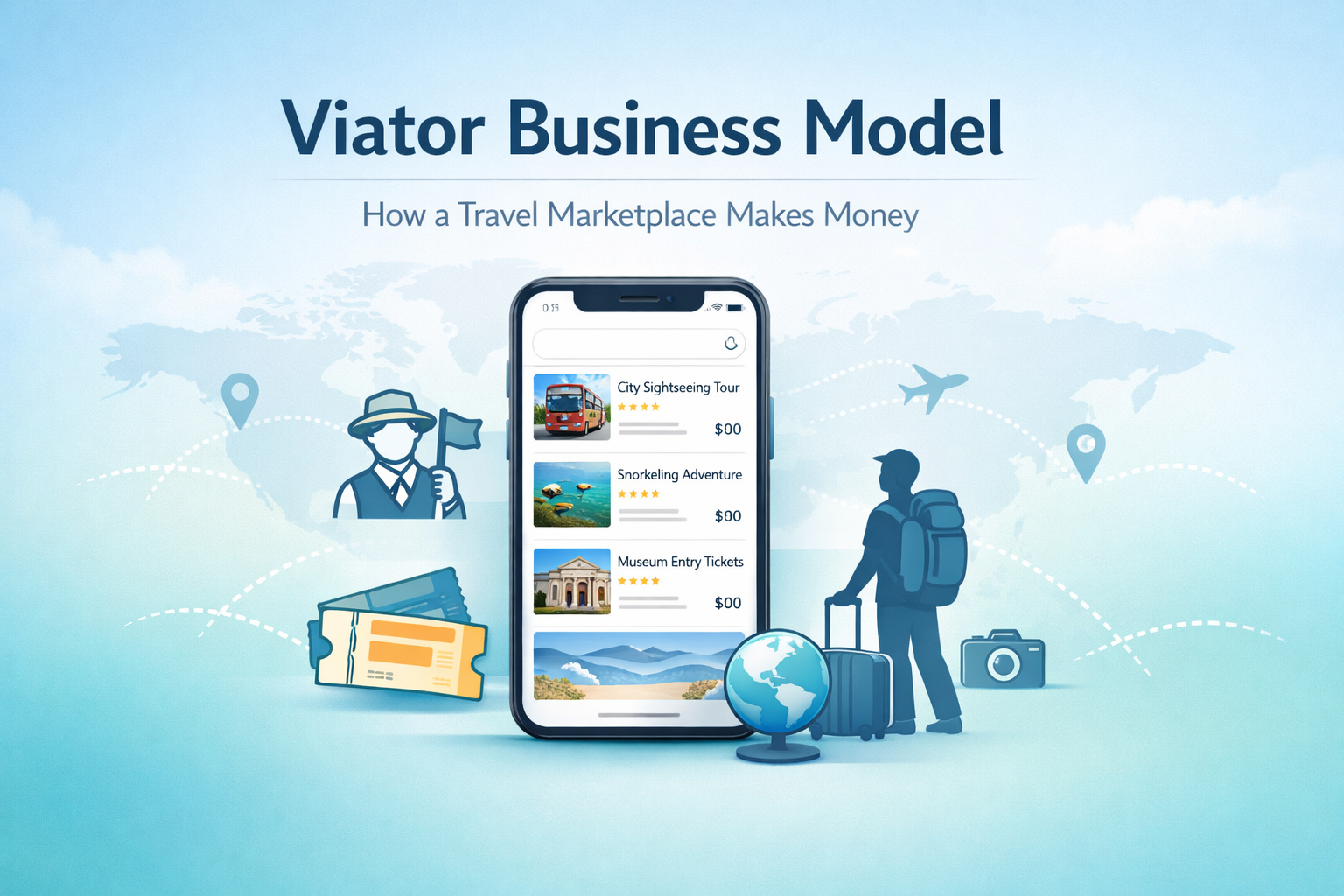
Viator makes money through a commission-based marketplace model. Every time a traveler books a tour or experience, Viator takes a cut. Simple, scalable, and incredibly effective.
If you’ve ever booked a city tour or a cooking class while traveling, there’s a good chance Viator was involved. But how does this platform actually make money? Let’s break it down.
In Short
Viator’s business model is straightforward. It connects travelers with tour operators and charges a commission on every booking made through its platform.
It doesn’t own any tours. It doesn’t hire guides. It just sits in the middle and takes a percentage every time someone books an experience.
That’s the magic of a marketplace model.
What Is Viator?
Viator is an online marketplace for tours, activities, and travel experiences.
Think of it like Amazon, but instead of buying products, you’re booking a gondola ride in Venice or a food tour in Tokyo.
It was founded in 1999 and acquired by Tripadvisor in 2014. That acquisition was a big deal. It gave Viator access to one of the most trusted travel review platforms in the world.
Today, Viator lists over 300,000 experiences across 190 countries. It covers everything from museum tickets and city walking tours to extreme adventure activities and private wine tastings.
It’s not a hotel booking site. It’s not a flight platform. Viator’s entire focus is on what you do when you get somewhere, not how you get there.
That niche focus is actually one of its biggest strengths.
How Viator Works
Understanding the business model is easier when you see how the platform actually operates. There are two sides to this marketplace: travelers and suppliers.
How It Works for Travelers
Here’s what the experience looks like from a traveler’s side:
- Search a destination. You type in “things to do in Barcelona” and Viator shows you hundreds of options.
- Browse and compare. You can filter by price, duration, category, and reviews.
- Read real reviews. This is where Tripadvisor’s ecosystem comes in. The reviews feel credible.
- Book instantly. Most experiences offer instant confirmation. No back-and-forth emails.
- Show up and enjoy. You get a voucher. The operator scans it. You’re good to go.
The experience is low-friction. That matters a lot in travel because people are often planning trips weeks in advance and they want certainty.
How It Works for Tour Operators
Now let’s look at the supplier side. This is where the business model really kicks in.
- List your experience. A tour operator signs up and adds their tours, activities, or tickets.
- Set your price and availability. Operators control their own inventory and scheduling.
- Get discovered globally. Viator promotes the listings to millions of travelers worldwide.
- Receive the booking. When a traveler books, the operator gets notified.
- Deliver the experience. The operator does the actual work.
- Get paid (minus commission). Viator keeps its cut and transfers the rest.
For small local operators, this is huge. A family-run cooking school in Tuscany suddenly gets visibility in front of travelers from 50 different countries. They couldn’t afford that kind of marketing on their own.
That’s the core value Viator delivers on the supply side.
Viator Business Model Canvas (Simplified)
Let me break down the key components of Viator’s business model in simple terms.
Key Partners
- Tour operators and local guides
- Travel agencies and DMOs (destination marketing organizations)
- Tripadvisor (parent company and traffic source)
- Payment processors like Stripe and PayPal
Key Activities
- Managing the marketplace platform
- Acquiring and onboarding new suppliers
- Driving traveler traffic through SEO and ads
- Maintaining the review and trust system
Value Proposition
For travelers: Convenience, trust, and variety in one place.
For suppliers: Global visibility without needing a big marketing budget.
Customer Segments
- Tourists looking for guided experiences
- Solo travelers and families planning itineraries
- Travel planners and group organizers
- Experience seekers who want more than just sightseeing
Revenue Streams
We’ll go deep on this next. But the short version: commissions, visibility tools, and the Tripadvisor ecosystem.
How Viator Makes Money
This is the part most people want to know. Let’s get into it.
Commission Fees
This is Viator’s primary revenue driver. Every booking made on the platform results in a commission that Viator keeps.
The commission rate typically ranges from 20% to 30% depending on the experience and the operator’s agreement.
So if a traveler books a $100 cooking class, Viator might keep $25 and pay the operator $75.
Now multiply that across millions of bookings per year. You can see how this scales fast.
The beauty of this model is that Viator takes no inventory risk. If a tour doesn’t get booked, Viator loses nothing. The operator bears all the operational cost.
That’s what makes commission models so attractive at scale.
Listing Visibility and Promotional Placements
This one is more subtle but worth understanding.
Viator gives operators the option to boost their listing visibility. Think of it like sponsored results on Google or Amazon. Operators who want to appear at the top of search results can pay for that placement.
This is an indirect revenue stream. It’s not Viator’s primary income, but it adds up.
It also creates a win-win. Operators get more bookings. Viator earns more commission plus any promotional fees. The traveler sees highly-rated experiences prominently.
Cross-Selling Through the Tripadvisor Ecosystem
This is one of Viator’s biggest competitive advantages and it often goes unnoticed.
Tripadvisor gets hundreds of millions of visitors every month. These are people actively researching destinations, reading hotel reviews, and planning trips.
When someone reads a Tripadvisor review about Rome and sees a “Things to Do” section, Viator listings show up right there. The user doesn’t even have to visit Viator directly.
That’s embedded distribution. It’s incredibly powerful.
Viator essentially gets free or low-cost traffic from one of the most visited travel websites on the planet. That traffic advantage is nearly impossible for competitors to replicate.
Every Tripadvisor visitor is a potential Viator customer. That funnel is always running.
Dynamic Pricing and Conversion Optimization
Viator uses data and technology to optimize pricing and push users toward booking.
Features like “limited spots available” or “this experience sold out last week” are classic urgency triggers. They’re not just marketing tactics. They’re data-backed nudges that increase conversion rates.
Higher conversion means more bookings. More bookings means more commission revenue.
Dynamic pricing also helps. During peak travel seasons, prices naturally go up. Viator earns more per transaction during high-demand periods without doing anything extra.
This is the kind of thing that separates a smart marketplace from a basic directory site.
Why Viator’s Business Model Works
There are a few reasons why this model is so durable and scalable.
It’s Asset-Light
Viator doesn’t own boats, buses, or tour guides. It doesn’t run warehouses or manage physical inventory.
All it manages is the platform and the relationship between travelers and operators.
That means it can expand into a new country without opening an office or hiring local staff. It just needs operators in that country to list their experiences.
This is how Viator operates in 190 countries with a relatively lean team. Physical businesses could never scale that fast.
Global Supply Without Physical Expansion
Think about what it would cost a traditional travel agency to offer tours in 300,000 locations worldwide. The logistics would be insane.
Viator does it by crowdsourcing the supply. Operators list their own experiences. They manage their own availability. They handle their own operations.
Viator just provides the platform and the customers.
That’s a fundamentally different and far more efficient model than building a traditional travel business.
Trust as a Conversion Engine
Here’s something most people underestimate: trust is the most valuable thing Viator has.
Travelers are spending real money on experiences in places they’ve never been. They’re trusting that the tour will actually happen, that it’s safe, and that it’ll be worth it.
Reviews solve that problem. And Viator’s connection to Tripadvisor gives it one of the most credible review ecosystems in travel.
When someone sees 4.8 stars across 2,000 reviews, they book. That’s the conversion engine.
Competitors can copy features. They can’t easily copy years of review data and user trust.
Tourism Demand is Structural
People want experiences. This isn’t a trend. It’s a fundamental shift in how people spend money.
Research consistently shows that younger travelers spend more on experiences than on physical goods. That tailwind benefits Viator directly.
As global travel grows, Viator’s addressable market grows with it. The platform doesn’t need to create demand. The demand already exists.
Challenges in Viator’s Business Model
No business model is perfect. Viator has real challenges too.
Heavy Competition
GetYourGuide, Klook, and Airbnb Experiences are all competing for the same market.
GetYourGuide has strong brand recognition in Europe. Klook dominates across Southeast Asia. Airbnb Experiences taps into the trust of its own massive community.
Viator is not the only option. Operators often list on multiple platforms. Travelers comparison shop. That creates pricing pressure on all sides.
Dependence on Tourism Trends
COVID-19 showed exactly how vulnerable travel platforms are to external shocks.
When travel stops, bookings stop. And when bookings stop, commission revenue drops to near zero.
Viator has no subscription revenue or recurring income to cushion those shocks. It’s entirely dependent on transaction volume.
That’s a real risk in an industry affected by pandemics, geopolitical events, and economic downturns.
Supplier Quality Control
Viator lists hundreds of thousands of experiences. Maintaining consistent quality across all of them is really hard.
Not every operator delivers what they promise. And when a traveler has a bad experience, they blame Viator, not just the local operator.
One bad tour can lead to a scathing review that hurts the entire listing. At scale, this becomes a constant management challenge.
Commission Pressure
Tour operators are not passive partners. They negotiate. They push back. And increasingly, they’re building their own direct booking capabilities.
If operators can get travelers to book directly on their own website, they avoid Viator’s commission entirely.
This is a real threat. And Viator has to keep delivering enough value (traffic, trust, instant booking) to justify its cut.
Competitors and Market Position
Let’s be honest about where Viator sits in this market.
GetYourGuide is probably its most direct competitor. It has a clean interface, strong brand partnerships, and solid market share in Europe. It’s well-funded and aggressive.
Klook has built a dominant position in Asia. It’s especially strong in markets like South Korea, Hong Kong, and Southeast Asia. For travelers headed to that region, Klook often wins.
Airbnb Experiences is different but worth mentioning. It focuses on unique, host-led experiences. It’s less about museum tickets and more about having dinner in a local’s home or learning a traditional craft.
So where does Viator win?
Volume, credibility, and Tripadvisor integration.
When someone is in the research phase of planning a trip, they’re probably on Tripadvisor. And that’s where Viator shows up. That organic integration is a moat that competitors can’t easily dig under.
Also, Viator’s sheer volume of inventory (300,000+ experiences) means travelers can almost always find something. That breadth matters.
Growth Strategy of Viator
Viator isn’t just maintaining its position. It’s actively growing. Here’s how.
SEO and Content Through Tripadvisor
Viator benefits from Tripadvisor’s massive domain authority. When people search “things to do in Paris,” Tripadvisor and Viator pages rank near the top.
That’s organic, free traffic. And in travel, organic traffic is gold.
Content marketing tied to destination guides and activity categories keeps Viator visible without massive ad spend.
Mobile-First Booking
More and more bookings happen on mobile. Travelers are booking tours the day before or even the morning of.
Viator has invested heavily in its mobile app and mobile web experience. The goal is to make it frictionless to discover and book an experience on your phone in under 60 seconds.
That last-minute mobile booking category is growing fast. Being the easiest option to use wins those bookings.
Global Supplier Expansion
Viator is constantly adding new operators in emerging travel destinations.
Places like Central Asia, West Africa, and lesser-known parts of Southeast Asia are being developed on the platform. As travelers get more adventurous, Viator wants to already have supply waiting.
Getting suppliers listed early creates a first-mover advantage in new destinations.
Personalization Using Data
Viator collects a lot of data. What travelers search for, what they click on, what they book, what they review.
That data can be used to power personalized recommendations. “You loved that food tour in Spain. Here are similar experiences in Italy.”
Personalization drives repeat usage. And repeat usage is the cheapest kind of growth.
Future Opportunities
The travel experience market is still early. There’s a lot of room to grow.
Artificial Intelligence-Based Recommendations
Imagine a travel planning assistant that knows your interests, budget, and travel style and builds a custom itinerary with Viator bookings embedded.
That’s not science fiction. It’s already being built.
AI-powered trip planning could become a major growth driver for Viator, especially as large language models get better at personalized recommendations.
Experience Bundling
Right now, Viator mostly sells individual experiences. But what if you could buy a “Florence in Three Days” package that includes a museum tour, a cooking class, and a wine tasting?
Bundling increases average order value. It also simplifies planning for travelers who don’t want to research everything individually.
This is a natural evolution of the marketplace model.
Localized and Hyper-Niche Experiences
There’s growing demand for ultra-local, off-the-beaten-path experiences. Not just a generic city tour but a neighborhood walk with a local historian or a foraging trip with a chef.
Viator can attract these niche operators and capture a segment of travelers who are bored with mainstream tourism.
Depth of experience is the new competitive frontier in travel.
Creator-Led Tourism
Travel content creators have massive, loyal audiences. Some have millions of followers who trust their recommendations completely.
Viator could build a creator partnership program where influencers curate and sell experiences through the platform. Their followers book through Viator. The creator earns a cut. Viator earns commission.
That’s a distribution model that could bring significant new customer acquisition without traditional ad spend.
Key Takeaways
Let me give you the founder-level summary of what makes Viator’s model worth studying.
Marketplace models win with trust. You can build a marketplace in any industry. But the ones that scale are the ones where buyers trust the quality of what they’re buying. Viator built that trust through reviews.
Distribution beats supply. Viator doesn’t create experiences. It distributes them. And in a world where attention is scarce, distribution is the real power.
Reviews are a conversion engine. Every review on Viator is user-generated content that drives future bookings. The more bookings, the more reviews. The more reviews, the more bookings. It’s a flywheel.
Commission models scale globally. Once the platform is built, adding a new country costs almost nothing. The margin on each incremental booking is high. That’s why commission-based marketplaces create such valuable companies.
Asset-light businesses are resilient long-term. Yes, Viator got hurt during COVID. But it also recovered fast because it had no physical assets to manage or write off.
Wrapping Up
Viator isn’t just a travel booking platform.
It’s a distribution engine for experiences. And that’s what makes its business model genuinely scalable.
The platform doesn’t need to own a single bus, boat, or museum ticket. It just needs to be the most trusted, easiest place to discover and book what to do when you travel.
That positioning is powerful. And as the global experience economy grows, Viator’s model becomes more valuable, not less.
If you’re building a marketplace business, Viator is one of the best case studies you can study. The combination of trust, distribution, and asset-light operations is a blueprint that works across industries.
The lesson? Build the layer between supply and demand. Own the trust. Let the commissions scale.
Frequently Asked Questions
Viator makes money primarily through commissions on bookings. When a traveler books a tour or experience, Viator keeps a percentage of the transaction, typically between 20% and 30%.
Yes. Tripadvisor acquired Viator in 2014. This gives Viator access to Tripadvisor’s massive traffic and review ecosystem, which is one of its biggest competitive advantages.
Listing on Viator is generally free for operators. Viator earns money when a booking is made, not when a listing goes live. Operators may pay for additional visibility or promotional placement.
Both platforms are tour and activity marketplaces. Viator’s main differentiator is its integration with Tripadvisor, which provides significant organic traffic and review credibility. GetYourGuide has strong brand recognition in Europe and is a close competitor.
For small and mid-sized operators, Viator offers global visibility they couldn’t afford on their own. The trade-off is a commission of 20% to 30% on every booking. Operators need to decide if the volume of bookings justifies that cost.
That’s a fair concern. Since Viator earns only when bookings happen, a major travel disruption directly hits revenue. However, its asset-light model means lower fixed costs, which helps it recover faster than asset-heavy travel businesses.
Discover more from Business Model Hub
Subscribe to get the latest posts sent to your email.