Uber Eats is one of the most studied business models in the world of tech startups. And for good reason. It took a simple human need (hunger) and built an entire logistics empire around it. But understanding how Uber Eats actually works, where the money comes from, and why it keeps growing requires going deeper than “they deliver food.”
This blog breaks it all down. Whether you are a founder studying marketplace dynamics, a student analyzing platform businesses, or just someone curious about what happens behind the scenes when you tap “Place Order,” this is the complete picture.
What Exactly Is Uber Eats?
Uber Eats is a food delivery platform launched by Uber in 2014. It started as a side experiment by a ride-hailing company that had one key asset: a massive network of drivers already on the road.
The idea was simple. Drivers are already driving. Restaurants have food ready to go. Customers want convenience. Why not connect all three?
What began as a test in a few cities has become one of the largest food delivery platforms globally, operating in over 6,000 cities across 45+ countries.
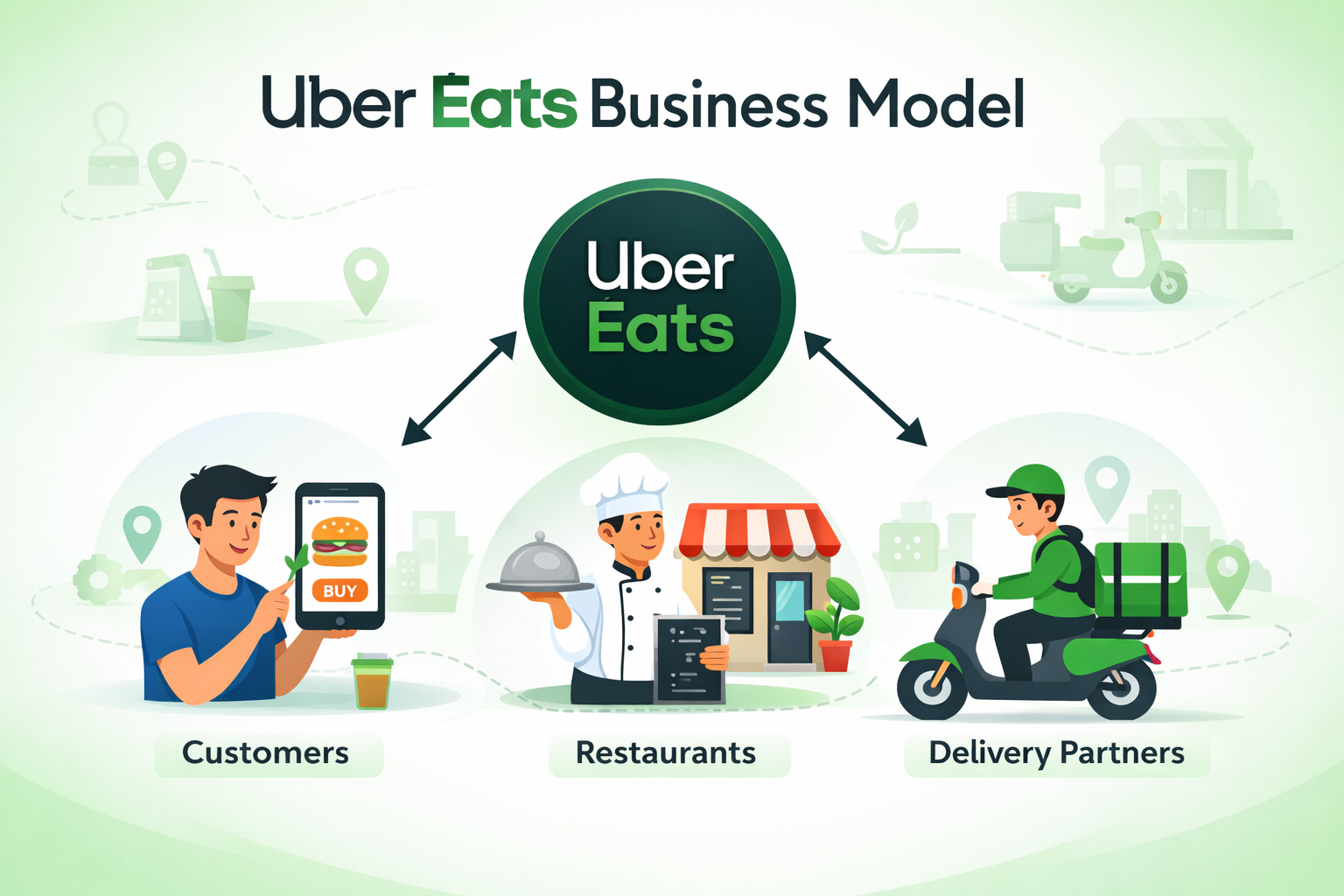
But Uber Eats is not just an app that connects hungry people with nearby restaurants. It has evolved into a three-sided marketplace that runs on data, logistics infrastructure, and powerful network effects.
How Uber Eats Actually Works
Before talking money, it helps to understand the mechanics. Uber Eats operates a three-sided platform involving customers, restaurants, and delivery partners. Each side has its own experience, and the platform sits in the middle connecting all three.
The Customer Side
- Customer opens the app and sees nearby restaurants
- Browses menus, adds items to cart, and places an order
- Pays through the app (card, wallet, or UPI)
- Tracks the order in real time from preparation to doorstep
- Rates the experience after delivery
The entire experience is designed around speed and zero friction. The less a customer has to think, the more likely they are to order again.
The Restaurant Side
- Restaurant partners with Uber Eats and lists its menu
- Gets access to a large, existing customer base instantly
- Receives order notifications through a dedicated tablet or app
- Prepares the food and marks it ready for pickup
- Hands it over to the delivery partner
- Gets paid (minus commission) on a regular settlement cycle
For restaurants, especially smaller ones, the value is clear: instant reach without building their own delivery infrastructure.
The Delivery Partner Side
- Driver logs into the app and marks themselves available
- Receives a delivery request with pickup and drop-off details
- Accepts the request, goes to the restaurant, picks up the order
- Delivers to the customer
- Earns a base pay plus tips
Delivery partners are independent contractors, not employees. This is central to the business model’s cost structure.
The UberEats Business Model Canvas
To understand Uber Eats as a business, the simplest framework is the Business Model Canvas. Here is how it looks:
Key Partners
- Restaurant chains and independent eateries
- Gig economy delivery workers
- Payment gateways (Stripe, PayPal, local providers)
- Cloud infrastructure providers
- Grocery and retail partners (newer expansion)
Key Activities
- Real-time order matching between customers and drivers
- Route and logistics optimization
- Platform development and maintenance
- Marketing and demand generation
- Driver onboarding and incentive management
Value Propositions
- For customers: convenience, speed, variety, and real-time tracking
- For restaurants: incremental revenue, marketing exposure, and zero delivery infrastructure cost
- For delivery partners: flexible income with low entry barriers
Customer Segments
- Urban and suburban consumers aged 18 to 45
- Restaurants looking to expand delivery without logistics overhead
- Gig workers seeking flexible part-time or full-time income
Key Resources
- The app and technology platform
- Driver network
- Restaurant partnerships
- Brand recognition and trust
- Data and AI capabilities
Revenue Streams: Where the Money Actually Comes From
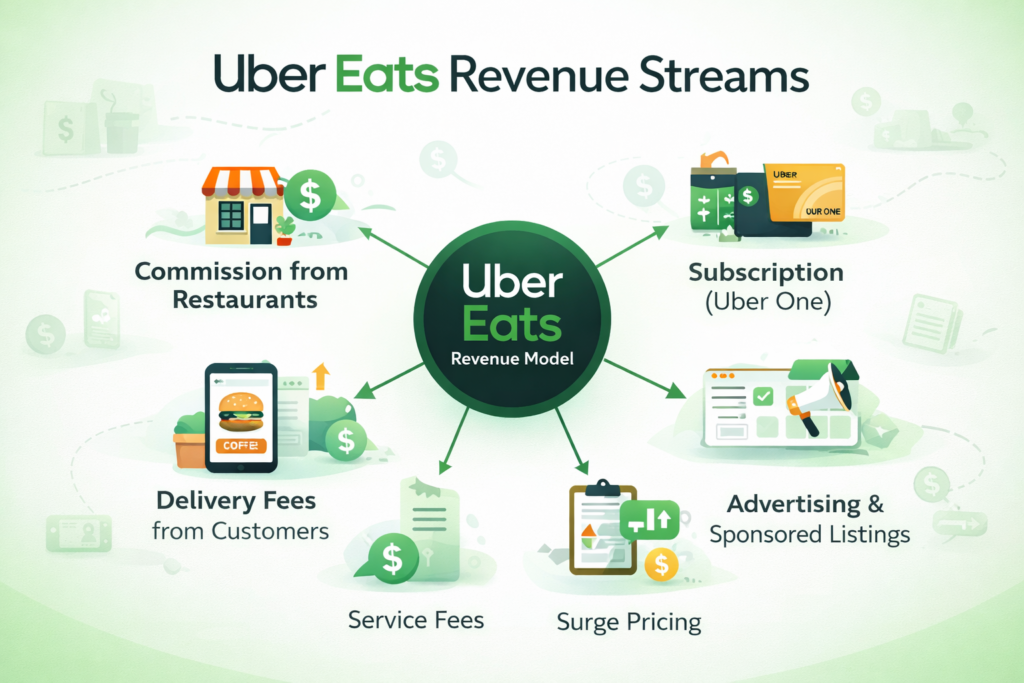
This is the core of it. Uber Eats has built a layered revenue model that monetizes every side of its marketplace.
Commissions from Restaurants
The biggest revenue driver. When a restaurant receives an order through Uber Eats, it pays a commission of roughly 15% to 30% of the order value.
- A restaurant selling a Rs. 500 meal might pay Rs. 75 to Rs. 150 per order just in commission
- Higher visibility features (like “Featured” placements) may push this further
- Commission rates vary based on the restaurant’s size, contract, and market
This is recurring, automatic, and scales directly with order volume. Every new order placed on the platform generates commission revenue without Uber Eats doing anything extra.
Delivery Fees from Customers
Customers pay a delivery fee on most orders. This fee is not flat. It changes dynamically based on:
- Distance between the restaurant and the customer
- Current demand in the area
- Time of day
- Weather conditions
A short order nearby might cost Rs. 20 to Rs. 30 in delivery fees. A farther order during peak dinner hours could cost Rs. 60 to Rs. 100 or more. This is surge pricing applied to food delivery.
Service Fees
Beyond delivery fees, Uber Eats charges a service fee. This is essentially a platform usage charge, separate from delivery logistics. It usually ranges from 5% to 15% of the order subtotal.
This fee goes directly to Uber Eats and is framed as a cost of using the platform. Customers often do not notice it separately because it is bundled into the checkout total.
Surge Pricing During Peak Hours
When demand spikes (Friday nights, rainy evenings, cricket match days), Uber Eats raises delivery fees automatically. This serves two purposes:
- Generates more revenue per order during high-demand windows
- Incentivizes more delivery partners to come online (higher earnings attract more drivers)
Surge pricing is both a revenue mechanism and a supply-demand management tool.
Advertising and Sponsored Listings
Restaurants can pay to appear at the top of search results or category feeds within the app. This is essentially a performance marketing product for restaurants.
- A new restaurant can pay for visibility and get discovered faster
- Established chains use it to stay top-of-mind in competitive categories
- Uber Eats earns advertising revenue regardless of whether the customer orders
This mirrors how Amazon charges sellers for sponsored product placements. As the platform scales, this becomes an increasingly lucrative revenue stream.
Uber One Subscription
Uber One (previously Uber Eats Pass) is Uber’s subscription product. For a monthly or annual fee, subscribers get:
- Free delivery on eligible orders
- Discounts on orders above a minimum cart value
- Priority support
- Benefits across both Uber rides and Uber Eats
Subscriptions do two powerful things for the business:
- Lock in customers (subscribers order significantly more frequently than non-subscribers)
- Create predictable recurring revenue independent of order volume fluctuations
The subscription model turns occasional users into habitual ones.
Cost Structure: Where the Money Goes
Uber Eats spends heavily to stay competitive. Understanding the cost structure explains why profitability has been difficult despite massive revenues.
Driver Incentives and Payouts
The single largest cost. Uber Eats pays delivery partners per trip, and also runs incentive programs (bonuses for completing X deliveries in Y hours) to maintain supply during peak hours.
In competitive markets, Uber Eats sometimes pays drivers more than it earns from customers just to ensure delivery coverage.
Discounts and Promotions
New user offers, referral bonuses, restaurant discount subsidies. These are customer acquisition tools that cost real money. The platform often absorbs the discount cost rather than passing it to the restaurant.
Technology and Infrastructure
- App development and maintenance
- Real-time GPS and routing systems
- Data storage and cloud computing
- Machine learning infrastructure for demand forecasting and route optimization
Customer Acquisition Costs
Paid ads, influencer campaigns, social media marketing. Getting a new customer on the platform is expensive. The bet is that the lifetime value of a retained customer justifies the upfront cost.
Operations and Support
Customer service, driver support, restaurant onboarding teams, legal and compliance across markets.
Growth Strategy
Uber Eats has grown this fast for specific, structural reasons. These are not accidents.
Network Effects
The most important growth driver. Network effects mean the platform becomes more valuable as more people use it.
- More customers attract more restaurants (higher order volumes justify listing fees)
- More restaurants attract more customers (wider variety means fewer reasons to go elsewhere)
- More orders keep more drivers online, improving delivery speed
- Faster delivery attracts more customers
This is a self-reinforcing loop. Once it kicks in at scale in a city, it becomes very hard for competitors to dislodge the market leader.
Rapid City Expansion
Uber Eats enters new cities aggressively. The strategy:
- Launch in a new market with heavy subsidies and promotions
- Acquire customers cheaply during the launch phase
- Sign up as many restaurants as possible to build variety
- Use the ride-hailing driver network to instantly create delivery supply
- Reduce subsidies once network effects kick in
This “blitzscaling” approach prioritizes market share over short-term profitability.
Data and AI Optimization
Uber Eats has an enormous data advantage. Every order generates data points:
- What people order and when
- Which restaurants convert best at which times
- Which routes take the longest
- Where demand is building before it peaks
This data powers:
- Smarter route optimization (reducing delivery times, which improves ratings)
- Demand prediction (telling restaurants when to prep in advance)
- Personalized recommendations (showing each user what they are most likely to order)
- Dynamic pricing models
Better data leads to better efficiency, which leads to better margins over time.
Cross-Leverage from Uber Rides
This is the competitive moat that DoorDash and Grubhub simply do not have. Uber Eats benefits directly from the existing Uber rides business.
- Shared driver network: any Uber driver can toggle to food delivery
- Shared user base: hundreds of millions of people already have the Uber app
- Shared payment infrastructure
- Shared brand trust
Acquiring a food delivery customer costs Uber Eats much less than it costs a standalone competitor because the distribution channel already exists.
Competitive Advantages
What makes Uber Eats hard to beat?
Logistics Infrastructure
Years of building real-time routing, GPS tracking, and delivery optimization across ride-hailing have given Uber Eats a logistics edge. This is not easy to replicate quickly.
Driver Supply Depth
The shared driver network means Uber Eats can scale delivery supply in a city without starting from zero. It also means drivers can switch between ride-hailing and food delivery based on demand, creating a more efficient labor pool.
Brand Trust
Uber is a globally recognized brand. Trust in the parent brand transfers to Uber Eats. This matters especially in new markets where food delivery is unfamiliar.
Super App Integration
In some markets, Uber Eats is being integrated into a broader Uber super app alongside rides, freight, and grocery delivery. This increases stickiness and reduces churn.
Quick Comparison with Competitors
| Feature | Uber Eats | DoorDash | Grubhub |
|---|---|---|---|
| Driver network source | Shared with rides | Standalone | Standalone |
| Geographic reach | Global | Mostly US | Mostly US |
| Subscription product | Uber One | DashPass | Grubhub+ |
| Advertising product | Yes | Yes | Yes |
| Super app potential | High | Low | Low |
DoorDash dominates in the US by market share. But Uber Eats has a global footprint and infrastructure advantage that no US-first competitor can easily match.
Challenges in the Model
No business model is without its cracks. Uber Eats has real structural challenges.
Thin Margins
Food delivery is operationally expensive. After paying drivers, subsidizing discounts, running the platform, and acquiring customers, margins are often razor thin or negative on a per-order basis. Profitability requires either massive scale or significant fee increases.
High Competition
In every major market, Uber Eats faces at least one well-funded competitor willing to burn cash to win market share. This keeps promotional spending high and margins under pressure.
Dependence on Gig Workers
The entire delivery supply chain depends on independent contractors. Any regulatory shift that reclassifies gig workers as employees (as has happened or is being considered in parts of the EU, UK, and California) would dramatically increase labor costs.
Regulatory Risks
Food delivery platforms face scrutiny around:
- Commission caps (some cities have passed laws limiting how much platforms can charge restaurants)
- Worker classification laws
- Data privacy regulations
- Anti-competitive behavior concerns
Customer Retention Costs
Customers are promiscuous. They will switch to whichever app offers the best discount today. Building genuine loyalty is expensive and requires constant investment in promotions, features, and subscription value.
The Future of Uber Eats
The platform is not standing still. Several strategic bets are shaping where Uber Eats goes next.
Grocery and Quick Commerce
Uber Eats has moved aggressively into grocery and convenience delivery. Partnerships with major grocery chains and the launch of Uber Eats Grocery signal a push beyond restaurant food into everyday essentials. Quick commerce (30-minute grocery delivery) is now a serious battlefield.
Dark Kitchens and Cloud Kitchens
Uber Eats has invested in and partnered with “dark kitchen” operators. These are commercial kitchens with no dine-in space, built purely to fulfill delivery orders. They allow popular restaurant brands to expand into new geographies without opening a physical location.
For Uber Eats, dark kitchens mean:
- More restaurant partners with lower overhead requirements
- Higher order density in strategic locations
- Potential to launch its own virtual restaurant brands
Drone and Robot Delivery Experiments
Uber Eats has run pilot programs for drone delivery in select markets. Robot delivery on sidewalks has also been tested in certain US campuses and neighborhoods.
These are long-term bets. They will not replace human delivery workers at scale anytime soon, but they point toward a future where delivery costs could drop significantly.
AI-Driven Personalization
The next frontier is hyper-personalized ordering experiences. Imagine an app that knows you order biryani on Friday evenings, automatically surfaces your usual restaurant at 6:45 PM, and pre-fills your cart.
This level of personalization increases conversion rates, order frequency, and average order value simultaneously.
Key Takeaways for Founders
If you are building a marketplace or platform business, Uber Eats is one of the richest case studies available. Here is what the model teaches:
Liquidity Before Profitability
Marketplace businesses need to reach liquidity (enough supply and demand on both sides) before they can be profitable. Subsidies and discounts in the early stage are not wasteful spending. They are the cost of building the network that eventually generates returns.
Logistics Is the Moat
In any physical-world marketplace, logistics is where competitors get separated. Building reliable, fast, optimized delivery is harder than building the app. Whoever cracks logistics at scale wins.
Discounts Are a Tool, Not a Strategy
Permanent discounting trains customers to expect them and destroys margins. Smart platforms use discounts to acquire, then convert users to habits and subscriptions that do not depend on price.
Retention Beats Acquisition
The most expensive customer is the one who orders once and never comes back. Building retention through subscriptions, personalization, and service quality is worth far more than running endless acquisition campaigns.
Multi-Sided Leverage Is Compounding
The reason Uber Eats is hard to beat is not the food delivery product in isolation. It is the compounding leverage of shared drivers, shared users, shared brand, and shared infrastructure from the rides business. When you build one platform, think about how it creates leverage for adjacent verticals.
Wrap Up
Uber Eats looks simple from the outside. You open an app, tap a few times, and food arrives at your door. But underneath that simplicity is one of the most complex business models in modern tech.
It is simultaneously a:
- Logistics company routing thousands of deliveries across cities in real time
- Marketplace balancing supply and demand across three different user groups
- Data business using billions of data points to optimize pricing, routing, and recommendations
- Media platform selling advertising to restaurants competing for visibility
- Subscription business locking in high-frequency users through Uber One
The reason Uber Eats continues to grow despite thin margins and fierce competition is that it is building compounding advantages across all of these dimensions at once. Every delivery makes the routing smarter. Every new user makes the restaurant selection better. Every restaurant that joins makes the platform more attractive to the next customer.
This is what a real platform business looks like at scale. It is not a product. It is a system.
And for founders, the most important lesson from Uber Eats is this: the business you are building today is probably not the full picture of what it can become. Uber thought it was building a ride-hailing app. What it actually built was a real-time logistics network. That network became the foundation for a food delivery empire. What is the network you are building, and what else can it power?
FAQs
Uber Eats makes money primarily through restaurant commissions, delivery fees, and service charges. It also earns from advertising, surge pricing, and subscriptions like Uber One, creating multiple revenue streams beyond just delivery.
Uber Eats typically takes 15% to 30% commission per order from restaurants, depending on the plan, location, and services like delivery and promotion.
Uber Eats has historically operated on thin margins, but profitability improves with scale, higher order volumes, and reduced incentives. Its long-term strategy focuses on efficiency and ecosystem growth.
Uber Eats operates a three-sided marketplace model connecting customers, restaurants, and delivery partners. It acts as a platform that facilitates ordering, logistics, and payments.
Both pay:
Customers pay delivery and service fees
Restaurants pay commission on each order
This dual-revenue model is key to its scalability.
Uber One is a subscription plan offering free delivery, discounts, and exclusive deals, helping Uber Eats generate recurring revenue and improve customer retention.
Delivery partners earn based on:
Distance traveled
Time taken
Demand (surge pricing)
They may also receive tips and incentives.
Major costs include:
Driver payouts and incentives
Discounts and promotions
Technology infrastructure
Customer acquisition
Compared to platforms like DoorDash, Uber Eats leverages:
Its parent ecosystem Uber
A large global driver network
Strong logistics and data optimization
No, Uber Eats does not own restaurants. It acts as a platform connecting independent restaurants with customers, though it may support cloud kitchens or partnerships.
Discover more from Business Model Hub
Subscribe to get the latest posts sent to your email.