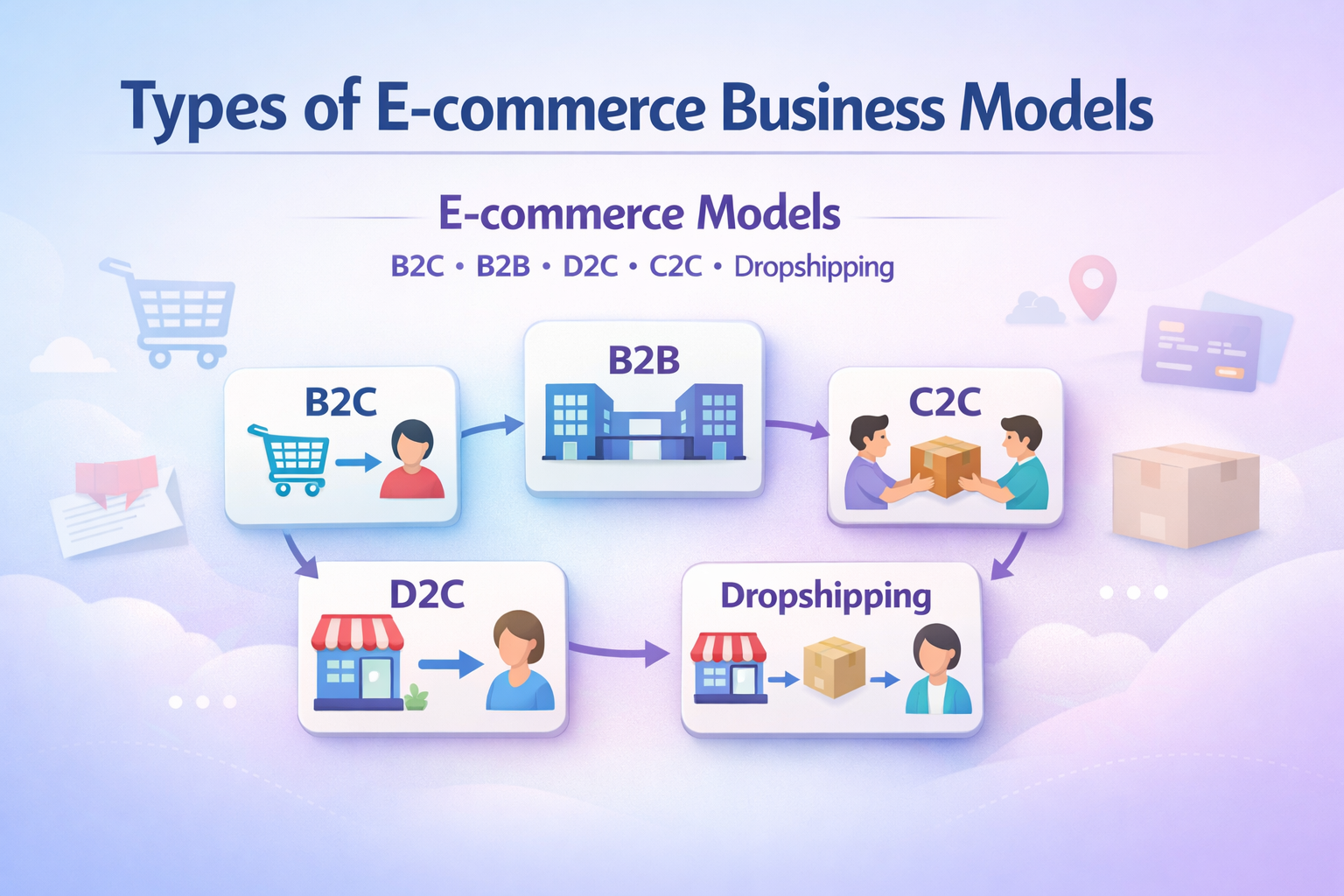
E-commerce business models define how an online business sells products or services and makes money. The most common types include B2C, B2B, C2C, C2B, and D2C models. Each one serves different customer segments and works in a completely different way.
Why You Need to Read This First
So you want to start an online business. Great idea.
But here’s where most beginners get stuck. They spend weeks picking a product, setting up a website, and then realize they never figured out how their business actually works.
That’s the business model. And skipping it is one of the biggest mistakes new founders make.
I’ve seen people jump into e-commerce just because they heard dropshipping is easy. Or because their friend made money on Amazon. But copying someone else’s model without understanding it is a recipe for wasted time and money.
In this guide, I’m going to break down every major e-commerce business model in plain English. No jargon. No fluff. Just clear explanations, real examples, and honest insights to help you pick what works for you.
Let’s get into it.
What is an E-commerce Business Model?
Simply put, it’s how your online business works and makes money.
Think of it like this. Two people can both sell shoes online. One sells directly to customers through Instagram. The other sells in bulk to retailers through a website. Same product. Totally different business models.
Your business model decides who you sell to, how you reach them, and how money flows into your business.
It also shapes everything else. Your pricing. Your marketing. Your operations. Even how much money you need to start.
Getting this right from day one saves you a lot of headaches later.
Why Understanding E-commerce Models Actually Matters
Here’s the honest truth. Most beginners skip this part.
They focus on products, logos, and Instagram reels. But they never stop to think about the foundation of their business.
Understanding your model helps you in three big ways.
It helps you make smarter decisions. When you know your model, you know your audience. And when you know your audience, your marketing gets sharper and your spending gets smarter.
It affects your margins and pricing. A B2B business prices very differently than a D2C brand. If you price wrong from the start, you’ll either lose money or lose customers.
It protects you from copying the wrong people. A lot of beginners look at successful brands and try to copy them. But if their model doesn’t match yours, that advice won’t work for you.
Now let’s go through each model one by one.
Types of E-commerce Business Models
B2C (Business to Consumer)
This is the one most people think of when they hear “e-commerce.”
B2C means a business sells directly to individual customers. You list your product. A customer buys it. Simple.
Examples: Amazon, Flipkart, Myntra, Nykaa
How it works: You source or create a product, list it on your website or marketplace, and sell to regular people like you and me. Orders come in, you pack and ship, and the customer gets their product.
Pros:
- Huge potential customer base
- Faster sales cycles
- Easier to market with social media and ads
Cons:
- High competition, especially on marketplaces
- Customer acquisition can get expensive
- Returns and complaints are common
Best for: Beginners who want to start selling physical or digital products online.
This is honestly where I’d tell most first-timers to start. The path is clear and the tools available today make it easier than ever.
B2B (Business to Business)
B2B means you’re selling to other businesses, not individual customers.
Instead of selling one product to one person, you’re selling in bulk. Your buyers are store owners, retailers, or companies that need your product to run their business.
Examples: Alibaba, IndiaMART, TradeIndia
How it works: A manufacturer or wholesaler lists products in bulk quantities. A retailer or business buyer places a large order. The transaction is usually bigger in value but happens less frequently.
Pros:
- Higher order value per transaction
- More stable, long-term relationships
- Less dependency on constant marketing
Cons:
- Longer sales cycles (decisions take time)
- Harder to get started without existing relationships
- Requires trust-building before big deals close
Best for: Manufacturers, wholesalers, and suppliers who want to sell in bulk.
B2B isn’t flashy. But if you can crack it, the revenue per deal is significantly higher than B2C.
C2C (Consumer to Consumer)
This one’s interesting. Here, individuals sell directly to other individuals.
You’re not a business. You’re just someone with stuff to sell. And the platform connects you with buyers.
Examples: OLX, eBay, Quikr, Facebook Marketplace
How it works: You list a used item or handmade product on a platform. Another person browses, finds it, and buys it. The platform just facilitates the transaction and sometimes takes a small cut.
Pros:
- Very low barrier to entry
- No need to manufacture or source products
- Great for side income
Cons:
- Hard to scale into a full business
- Trust issues between strangers
- Platform controls the rules and fees
Best for: Resellers, people decluttering, or side hustlers testing the waters.
This model is great for getting started. I know people who started reselling on OLX and eventually built full reselling businesses.
C2B (Consumer to Business)
This one flips the traditional model on its head.
In C2B, an individual offers something valuable to a business. The individual is the seller. The business is the buyer.
Examples: Freelancers on Upwork, influencers getting paid for brand deals, photographers selling stock images
How it works: A content creator builds an audience. A brand pays them to promote their product. Or a freelance designer creates a logo for a startup. The individual provides value, and the business pays for it.
Pros:
- Low startup cost (your skills are the product)
- High demand for good creators and freelancers
- You control your rates
Cons:
- Income can be inconsistent
- Hard to scale without building a team
- Highly dependent on personal reputation
Best for: Creators, freelancers, consultants, and service providers.
If you have a skill or an audience, this is one of the fastest ways to start making money online.
D2C (Direct to Consumer)
D2C has become one of the hottest e-commerce models in India over the last five years.
It means a brand manufactures or sources a product and sells it directly to the end customer. No middlemen. No distributors. Just the brand and the buyer.
Examples: boAt, Mamaearth, Sugar Cosmetics, Boat, Licious
How it works: The brand builds its own website and marketing channels. They control everything from product to packaging to customer experience. No retailers involved.
Pros:
- Full control over brand story and pricing
- Better margins (no middlemen taking a cut)
- Direct relationship with customers
- Rich data on customer behavior
Cons:
- Requires significant investment in marketing
- You handle logistics and returns yourself
- Takes time to build brand trust
Best for: Founders who want to build a brand, not just sell a product.
D2C is not the easiest path. But if you pull it off, you build something that actually lasts.
Additional E-commerce Models Worth Knowing
Once you understand the basics, there are a few more models that are growing fast right now.
Subscription-Based Model
Instead of selling once, you sell on repeat.
Customers pay a fixed amount every month or year in exchange for a product or service they keep getting.
Examples: Netflix, Spotify, Dollar Shave Club, some Indian meal kit services
Why it works: Predictable revenue. You know how much money is coming in every month. That makes planning and growth a lot easier.
The catch: You need to keep delivering value. The moment customers feel it’s not worth it, they cancel. Retention is everything in this model.
Dropshipping Model
This is the one beginners love because it sounds risk-free.
In dropshipping, you sell products without holding any inventory. When a customer places an order, you buy from a supplier and they ship directly to the customer.
How it works: You list products on your store. Customer buys. You forward the order to your supplier. Supplier ships. You pocket the margin.
The reality: Margins are thin. Competition is brutal. And customer experience depends on your supplier, not you. It’s not as easy as the YouTube ads make it look. But it’s still a valid starting point if you’re testing product ideas.
Marketplace Model
A marketplace doesn’t sell products. It connects buyers and sellers.
Examples: Amazon, Flipkart, Etsy, Airbnb, Meesho
The platform makes money by taking a commission or listing fee from sellers. The more sellers and buyers it brings in, the more it earns.
Building a marketplace is complex and capital-heavy. But if you’re thinking about it at a smaller, niche level, it can work really well. Think a local farmers market app or a freelancer marketplace for a specific industry.
White Label and Private Label Model
White label means you take someone else’s product and sell it under your brand name.
Private label takes it a step further. You work with a manufacturer to create a product specifically for your brand.
Examples: Many D2C brands in India use this. A brand like Mamaearth works with manufacturers but sells under their own label.
This is how most D2C brands operate behind the scenes. You don’t need to build a factory. You just need a strong brand and a reliable manufacturer.
Comparison Table
| Model | Who Sells | Who Buys | Example | Best For |
|---|---|---|---|---|
| B2C | Business | Consumers | Amazon, Flipkart | Beginners, product sellers |
| B2B | Business | Business | Alibaba, IndiaMART | Bulk selling, manufacturers |
| C2C | Consumers | Consumers | OLX, eBay | Resellers, side hustlers |
| C2B | Individuals | Businesses | Upwork, influencers | Creators, freelancers |
| D2C | Brand | Consumers | boAt, Mamaearth | Brand builders |
| Subscription | Business | Consumers | Netflix, Spotify | Recurring revenue |
| Dropshipping | Seller (no stock) | Consumers | Shopify stores | Low-budget starters |
| Marketplace | Platform | Buyers and Sellers | Amazon, Etsy | Platform builders |
How to Choose the Right E-commerce Model for You
Here’s the practical part. No theory. Just real questions to ask yourself.
How much money can you start with?
Low budget? Dropshipping or C2B (freelancing) lets you start with almost nothing. Medium budget? B2C on a marketplace like Amazon or Meesho is a great entry point. Larger budget and a clear vision? D2C is worth exploring.
What skills do you have?
If you’re a designer, writer, or video editor, C2B is your fastest path. If you’re good at marketing and storytelling, D2C might be your thing. If you have supplier contacts and love logistics, B2B or B2C wholesale could work.
How much risk can you handle?
Dropshipping feels low risk but it has hidden risks like quality issues and thin margins. D2C has real risk because you’re investing in brand building. Know your risk appetite before you pick.
What are your long-term goals?
Want a side income? Start with C2C or dropshipping. Want to build a company? Think B2C, B2B, or D2C from the start.
A simple cheat sheet:
- Low budget and just starting out? Go dropshipping or C2B
- Want to sell on Amazon or Flipkart? Go B2C marketplace
- Have a product idea and supplier? Go D2C or private label
- Selling bulk to stores? Go B2B
- Have stuff to resell? Go C2C
There’s no one-size-fits-all answer here. The best model is the one that fits your situation right now.
Real-World Examples (Mini Case Studies)
Amazon
Amazon started as a B2C bookstore. Now it’s a marketplace model where thousands of sellers list products and Amazon facilitates the transaction. They also have their own private label products. Amazon is a great example of how models can evolve and combine.
Meesho
Meesho is a fascinating Indian success story. It started by enabling C2C reselling through WhatsApp. Regular people would buy products from Meesho and resell them to their friends and family. It gave millions of homemakers and small entrepreneurs a way to earn online. Now it’s evolved into a full marketplace.
boAt
boAt is a textbook D2C success story. They didn’t build their own factory. They worked with manufacturers to create products under their own brand. Then they invested heavily in marketing, influencer partnerships, and brand building. Today boAt is one of India’s most recognized consumer electronics brands. And they did it by cutting out middlemen and selling directly to customers.
These stories aren’t just inspiring. They show you how different models work in real life and what it actually takes to make them succeed.
Common Mistakes Beginners Make
Let me be straight with you here. These are the mistakes I see over and over again.
Choosing a model based on hype. Everyone on YouTube is selling a course on dropshipping or Amazon FBA. That doesn’t mean it’s the right model for you. Pick based on your situation, not on what’s trending.
Ignoring logistics from day one. Shipping, returns, packaging, and delivery timelines matter enormously in e-commerce. A lot of beginners think about this too late. By then, their customers are already leaving bad reviews.
Not understanding your margins. This is a big one. You can be selling a lot and still be losing money. Know your cost of goods, shipping cost, platform fees, and marketing spend before you set a selling price.
Copying competitors without context. Your competitor might look successful. But you don’t know their supplier relationships, their cost structure, or their team. Copying their strategy without understanding their foundation usually leads to frustration.
Trying to do everything at once. Pick one model. Master it. Then expand. Beginners who try to run a D2C brand, do dropshipping, and build a marketplace all at once end up going nowhere.
Future Trends in E-commerce Models
The e-commerce space is shifting fast. Here’s what’s happening right now that you should know about.
Social commerce is exploding. Selling directly through Instagram, WhatsApp, and YouTube is becoming a massive trend in India. Brands are closing sales without a website. Creators are launching products to their audiences directly. This blends C2B and D2C in a new way.
AI-powered personalization is changing the game. Big platforms are already using AI to show customers exactly what they want. Smaller brands are now using AI tools for customer service, product recommendations, and even ad targeting. This levels the playing field a bit.
Quick commerce is reshaping expectations. Platforms like Blinkit and Zepto have trained Indian customers to expect delivery in 10 minutes. This is creating pressure on every e-commerce business to rethink their logistics and delivery promises.
Sustainability is becoming a selling point. More customers, especially younger ones, care about how products are made and packaged. D2C brands that build sustainability into their model are building stronger loyalty.
The core models won’t disappear. But how they operate and compete is changing every year.
Conclusion
There’s no single best e-commerce business model.
There’s only the model that fits where you are right now, what resources you have, and where you want to go.
If you’re a beginner, don’t overthink it. Start small. Pick one model. Test it with real products and real customers. Learn from what works and what doesn’t.
The biggest mistake is waiting for the perfect plan. Start with a good enough plan and refine it as you go.
E-commerce in India is still growing fast. The opportunity is very real. But it rewards people who take action and stay consistent, not people who just consume content about it.
Pick your model. Take the first step. Then figure out the rest along the way.
FAQs
D2C and B2B tend to have the best margins when done right. D2C gives you full control over pricing and no middlemen. B2B deals in bulk, which means higher value per transaction. But profitability depends heavily on execution, not just the model.
B2C on an existing marketplace like Amazon or Meesho is usually the easiest entry point. You don’t need to build your own website or figure out traffic. Dropshipping is another low-barrier option, but it comes with its own challenges around margins and supplier reliability.
Yes, but it’s harder than it used to be. The market is more competitive and customers expect fast shipping and great customer service. If you find a niche with low competition and a reliable supplier, dropshipping can still work. But it’s not the passive income goldmine some people make it out to be.
In B2C, the business can sell through multiple channels including third-party marketplaces. In D2C, the brand sells exclusively through its own channels, directly to the customer with no middlemen. D2C gives more control and better margins but requires more effort in building your own audience and infrastructure.
Absolutely. Many successful businesses do. Amazon is both a marketplace and a B2C seller. Mamaearth is D2C but also sells through offline retail. Start with one model, get good at it, and then expand when it makes sense.
Not necessarily. Dropshipping and C2B (freelancing or content creation) can be started with very little capital. Even B2C on a marketplace can start small. D2C and B2B usually require more upfront investment in inventory, branding, and marketing.
Discover more from Business Model Hub
Subscribe to get the latest posts sent to your email.