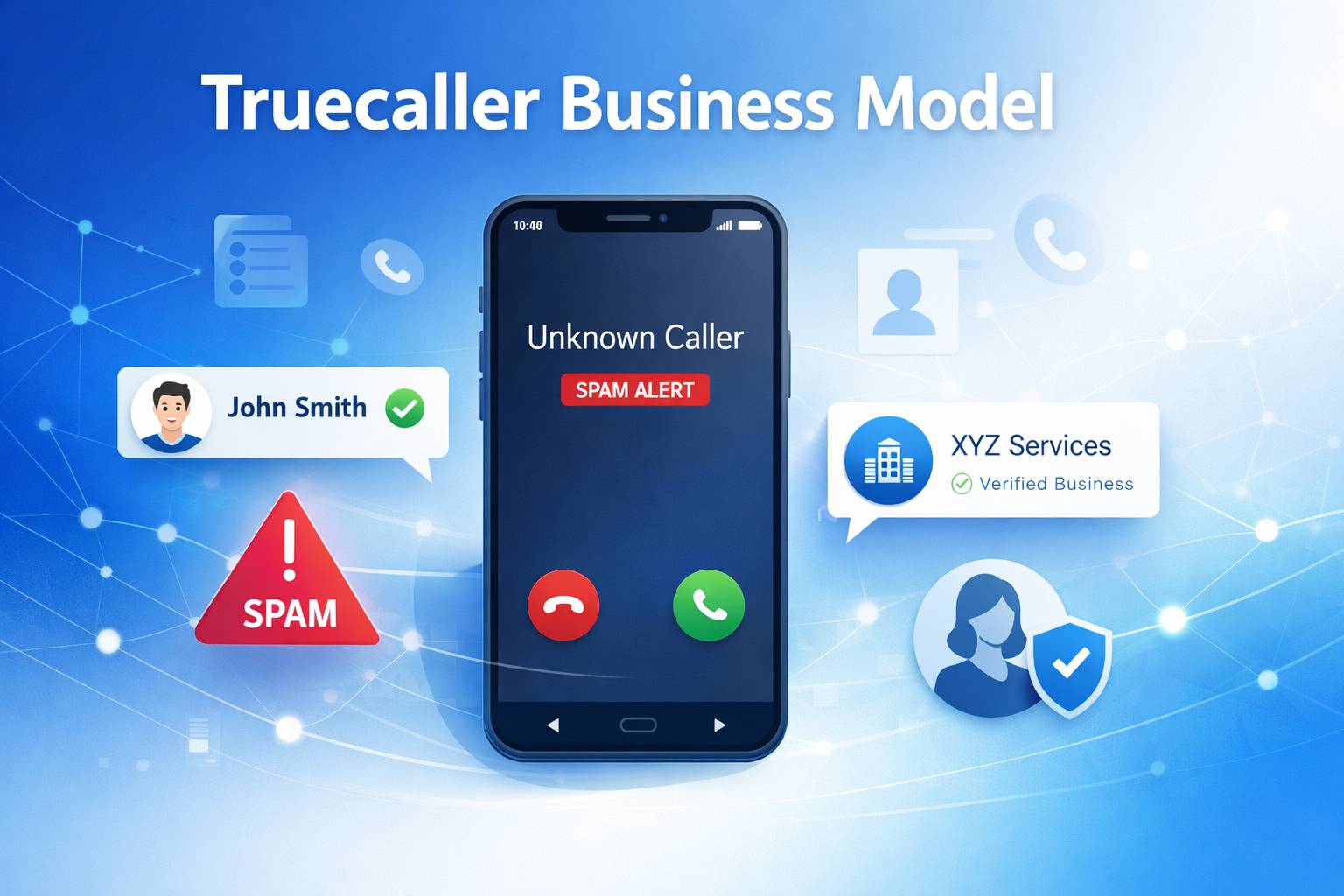
Truecaller makes money through premium subscriptions, advertising, and business solutions. But its real competitive advantage is something harder to replicate: a massive, user-generated database of phone number identities built over more than a decade.
This article breaks down exactly how Truecaller works, how it generates revenue, and why it has become the default caller ID solution across emerging markets.
What Is Truecaller?
Truecaller is a caller identification and spam detection platform founded in 2009 by Alan Mamedi and Nami Zarringhalam in Stockholm, Sweden.
It started with a simple premise: help people figure out who is calling them before they pick up the phone. That problem sounds basic, but it turned out to be a significant pain point for hundreds of millions of people, especially in markets like India where spam calls and telecom fraud are pervasive.
Today, Truecaller is more than a caller ID app. It has evolved into a full communication and trust platform that includes spam blocking, messaging, payments, and business identity tools. As of recent reports, Truecaller has crossed 350 million active users, with the majority concentrated in South Asia, Africa, and the Middle East.
The key insight the founders had was simple but powerful: telecom networks were built to connect calls, not to verify identities. Truecaller built that identity layer on top of the existing telecom infrastructure.
The Core Problem Truecaller Solves
To understand why Truecaller grew so fast, you need to understand the problems it was designed to solve.
Unknown callers create anxiety. When an unrecognized number calls, most people either ignore it or answer with suspicion. Neither outcome is ideal for the caller or the recipient.
Spam and fraud calls are rampant. In India alone, telecom fraud costs consumers billions of dollars annually. Robocalls, scam numbers, and unsolicited marketing calls have become a major quality-of-life issue. Truecaller directly addresses this by flagging spam numbers before the user even picks up.
Telecom companies never focused on caller identity. Phone carriers are infrastructure businesses. They route calls from point A to point B. They never built systems to attach verified identity information to a phone number at the consumer level. That gap left a wide open opportunity for a third party to step in.
Truecaller filled that gap by building a global phone directory where identity is crowd-sourced and continuously updated by users themselves.
How Truecaller Works
The mechanism behind Truecaller is straightforward, but the implications of how it collects and uses data are significant.
Step one: User installs the app. When a new user downloads Truecaller, they are prompted to grant access to their phone contacts and, depending on the device, call logs.
Step two: Contacts are uploaded. The names and numbers from a user’s contact book are anonymized and uploaded to Truecaller’s servers. This is the core data collection mechanism. Every new user contributes to the directory.
Step three: The database grows. As more users install and use the app, the phone number database becomes larger and more accurate. A number that appears with the same name across thousands of contact books is likely correctly identified.
Step four: Identity matching happens in real time. When a call comes in, Truecaller checks the incoming number against its database and displays a name or label before the user answers.
Step five: Spam flags are added. Users can report numbers as spam directly from the app. Once a number crosses a threshold of spam reports, it gets flagged system-wide.
This creates a self-reinforcing flywheel. More users contribute more data, which makes the identification more accurate, which attracts even more users. That loop is the structural foundation of Truecaller’s business.
Truecaller Business Model Overview
Truecaller operates across three distinct layers, each serving a different type of user and generating revenue differently.
The user layer consists of free users who download the app and use it for basic caller ID and spam detection. These users do not pay anything directly, but they generate value in two ways: they contribute data to the database, and they generate ad impressions that Truecaller monetizes.
The premium layer consists of users who pay for a subscription to unlock additional features. This is direct consumer revenue.
The business layer consists of companies that pay Truecaller to establish and manage their identity within the platform. This is B2B revenue.
What makes Truecaller’s model interesting is that it monetizes both sides of the marketplace. Free users generate data and ad revenue. Businesses pay to be identified accurately and positively within that same ecosystem.
How Truecaller Makes Money
Subscription Revenue
Truecaller offers paid tiers called Truecaller Premium and Truecaller Gold. These subscriptions remove ads and unlock features that free users cannot access.
Key premium features include seeing who viewed your profile, advanced spam filtering and call blocking, early access to new features, and a premium badge that signals credibility to other users.
This is a classic freemium monetization structure. The free product creates a large user base. A subset of those users finds enough value in the extended features to pay for a subscription. Even a small conversion rate across hundreds of millions of users produces substantial recurring revenue.
Recurring subscription revenue is highly valuable from a financial modeling perspective because it is predictable. Investors and analysts assign premium valuations to businesses with high-quality subscription revenue.
Advertising Revenue
Free users see ads served natively within the Truecaller interface. These ads appear in call logs, within the search functionality, and in other parts of the app experience.
Truecaller’s advertising inventory is valuable for a specific reason: users open the app at high-intent moments, either when they receive a call or when they are actively looking up a number. That behavioral context makes the ad placement more relevant than typical banner advertising in lower-intent environments.
Given that Truecaller has hundreds of millions of daily active users across markets with strong mobile ad demand, advertising represents a significant share of overall revenue.
Truecaller for Business
This is the B2B product line that allows companies to claim and verify their identity within Truecaller’s database.
When a business calls a customer, Truecaller can display the company’s name, logo, and reason for calling rather than showing the number as unknown. This is called verified business calling or brand calling.
For businesses, this feature solves a real problem. When company numbers appear as unknown or get flagged as spam, call pickup rates drop significantly. By establishing a verified presence in Truecaller, businesses can increase the likelihood that their calls are answered.
Truecaller charges businesses for this service, creating a direct B2B revenue stream separate from its consumer advertising model.
Caller ID API and Enterprise Solutions
Beyond the consumer-facing business product, Truecaller also licenses its data and technology through enterprise APIs. Companies can integrate Truecaller’s identification capabilities directly into their own systems and applications.
This opens up a fourth revenue stream that is less visible to end users but strategically important. It turns Truecaller’s database from a consumer product into an infrastructure layer that other businesses can build on top of.
Truecaller’s Growth Strategy
Network Effects Are the Core Engine
Truecaller’s growth is fundamentally driven by network effects. Each additional user who joins makes the product better for every other user already on the platform.
This is not a soft or indirect effect. When someone installs Truecaller and their contact book is uploaded, they directly contribute new phone number and identity data. That data improves accuracy for every existing user who might receive a call from one of those numbers.
Network effects create a compounding advantage. As the network grows, it becomes increasingly difficult for a new entrant to compete because they would need to replicate years of data accumulation before their product reaches the same accuracy level.
Freemium Maximizes Adoption
The freemium model is the right structure for a network-effects business. Charging upfront would have slowed adoption, which would have stunted the network effect, which would have made the product worse.
By keeping the core experience free, Truecaller removed the friction from user acquisition. The free product grows the network. The premium product captures revenue from a subset of engaged users who want more features. This sequence matters. You build the network first. You monetize second.
Emerging Market Focus Creates Defensibility
Truecaller made an early strategic bet on India and other high-growth emerging markets where spam call problems are severe and smartphone adoption was accelerating.
This focus paid off. India became Truecaller’s largest market by a wide margin, with the app effectively becoming the default caller ID solution on Android devices across the country. Once a product reaches that level of habit formation in a market, it becomes very difficult to displace.
The spam problem in India is objectively worse than in most developed markets, which means the value proposition of Truecaller is also higher. Users have a stronger motivation to install and keep using the app.
Truecaller’s Competitive Advantages
The Database Is the Moat
Truecaller’s most defensible asset is not the app itself. It is the database. Years of user contributions have created a phone directory that no competitor can replicate quickly or cheaply.
The accuracy of the database improves with scale. A number that appears across millions of contact books with consistent name data is highly reliable. A new entrant starting from zero cannot match that reliability, regardless of how well-designed their app is.
First-Mover Advantage Locked In Early Users
Truecaller entered the caller ID space before it became a crowded category. By reaching critical mass in key markets early, it established itself as the default choice. Users who installed Truecaller in 2012 or 2013 are still using it today because it works and there is no compelling reason to switch.
Daily Usage Creates Strong Retention
Truecaller is not an app people use occasionally. It is an app that is active every time a call comes in. That daily touchpoint creates a strong habit loop that makes churn rates low.
Users who rely on Truecaller to identify calls become dependent on it. Switching to a competing product would mean accepting an immediate reduction in caller identification accuracy. The cost of switching is real and felt immediately.
Brand Association With Safety
In its core markets, Truecaller has successfully positioned itself as a safety and trust tool rather than just a utility. Being on Truecaller feels like having a filter against fraud and harassment.
That brand positioning is valuable because it creates an emotional reason to stay with the product beyond just functional performance. Users who feel that Truecaller is protecting them are more loyal than users who simply find it convenient.
Challenges in Truecaller’s Business Model
Privacy Concerns Are a Persistent Risk
Truecaller’s data collection model has attracted criticism from privacy advocates. The mechanism of uploading users’ contact books without the explicit consent of every person in those contact books raises legitimate questions about data rights.
When someone installs Truecaller, they give the app access to their contacts. But those contacts have not consented to their phone numbers and names being uploaded to Truecaller’s servers. This creates an ethical tension that has generated controversy in India and other markets.
Truecaller has implemented features that allow users to request removal from the database, but the fundamental tension between data collection at scale and individual privacy rights remains.
Regulatory Exposure Is Growing
Governments around the world are tightening data privacy regulations. India’s data protection framework, similar regulatory developments in the European Union and other regions, creates compliance risk for a business model that depends on large-scale personal data collection.
If regulators require stricter consent mechanisms for contact book data, Truecaller’s ability to grow its database could be constrained. That would slow the network effect and potentially reduce the accuracy advantage that makes the product valuable.
Platform Dependency Is a Structural Vulnerability
Truecaller operates primarily on Android and iOS. The company has no control over the rules and policies that govern those platforms. Apple and Google can change what permissions apps are allowed to request, how data can be accessed, and what notifications can be shown.
Apple has already made significant changes to privacy and app tracking policies that affected advertising-dependent businesses. Any similar changes affecting caller ID functionality or contact book access on Android could have meaningful impact on Truecaller’s core product.
Truecaller vs. Telecom Companies
One of the most interesting strategic observations about Truecaller is how it relates to the telecom industry.
Telecom companies provide connectivity. They route calls across networks and ensure the signal gets from one phone to another. That is their job, and they are good at it.
What telecom companies never built is a reliable identity layer. When a call comes in, the carrier knows the originating number. They do not know who that number belongs to, whether it is a legitimate business, a fraudster, or a spam operation.
Truecaller built that identity layer entirely outside the telecom infrastructure. It is a software layer that sits on top of the carrier network and adds the one thing carriers never provided: context.
This positioning is why Truecaller became powerful despite having no spectrum licenses, no physical infrastructure, and no regulatory mandates. It solved a problem that the infrastructure providers never prioritized.
Future Opportunities for Truecaller
Artificial Intelligence for Smarter Spam Detection
Machine learning models can identify spam patterns that simple flagging systems miss. Truecaller is well-positioned to deploy AI-driven spam detection that goes beyond crowd-sourced reports and uses behavioral signals to identify fraudulent callers proactively.
As voice scams become more sophisticated, particularly with the rise of AI-generated voices and deepfake audio, the demand for intelligent spam detection will increase. Truecaller’s scale gives it the training data needed to build effective models.
Financial Services Expansion
Truecaller has already launched payment features in India through a UPI-based integration. The company has a verified identity for hundreds of millions of users and a trusted brand in markets where fintech is growing rapidly.
That combination positions Truecaller to expand into financial services including personal loans, credit scoring, and insurance products. Several other companies have followed a similar trajectory from communication utility to financial services platform.
Verified Communication Ecosystem
As concern over fraudulent communications grows globally, there is an opportunity for Truecaller to become the standard for verified calling. Businesses that want their calls answered have a growing incentive to participate in a verified ecosystem. Truecaller is in a position to build and own that ecosystem.
Messaging and Beyond
Truecaller has expanded into messaging in key markets, competing with WhatsApp and SMS in some usage contexts. If it can capture a meaningful share of messaging volume, it opens additional advertising and monetization surfaces beyond the call context.
Truecaller Business Model Canvas
Key partners include telecom operators who carry the calls that Truecaller identifies, Android device manufacturers who have pre-installed the app in certain markets, and advertising networks that fill Truecaller’s ad inventory.
Key activities include database maintenance and accuracy improvements, spam detection algorithm development, consumer app development and support, and sales and account management for business clients.
Value propositions differ by segment. For free consumers, Truecaller offers caller identification and spam protection at no cost. For premium subscribers, it offers an enhanced, ad-free experience with additional visibility features. For businesses, it offers verified identity and higher call pickup rates.
Revenue streams include subscription fees from premium users, advertising revenue from free users, fees from businesses for verified profiles and brand calling, and licensing fees from enterprise API access.
Lessons for Founders from Truecaller’s Model
Solve a Real Daily Problem
Truecaller did not invent a new behavior. People were already ignoring unknown numbers and worrying about spam calls. The founders identified an existing daily frustration and built a specific solution for it.
Products that solve real, frequent problems have an easier path to adoption than products that try to create new habits from scratch.
Build Network-Driven Products When Possible
A product that gets better as it grows is a product with built-in defensibility. Truecaller’s network effect means that every dollar spent on user acquisition also makes the product better for existing users.
If you are building in a category where network effects are possible, design for them from the beginning. Structure the product so that growth is self-reinforcing rather than linear.
Start Free, Monetize Later
This is not a new insight, but Truecaller is a clean illustration of why it works in network-effect businesses. The free product built the network. The network created the value. The value justified the premium tier and the business products.
Charging too early would have slowed the network growth, which would have reduced the product’s accuracy, which would have made the premium offering less valuable. Sequence matters.
Focus Creates Defensibility
Truecaller’s decision to focus on emerging markets, particularly India, when those markets were underserved gave the company time to build a dominant position before global players paid serious attention. Geographic focus allowed them to build deep penetration in specific markets rather than thin presence everywhere.
Key Takeaways
Truecaller is a data-driven platform that built its business by solving a problem that telecom companies were not incentivized to solve.
Its core value comes from a database that grows more accurate with every new user, creating a network effect that competitors cannot easily replicate. The freemium model maximizes adoption in large consumer markets while premium subscriptions and B2B products convert that scale into revenue.
The biggest structural risks are privacy regulation and platform dependency. But the biggest structural strengths, which are the database, the daily usage habit, and the brand trust in core markets, are genuinely difficult to displace.
For anyone studying business models, Truecaller is a clear example of how a software layer built on top of existing infrastructure can capture value that the infrastructure providers left behind.
FAQs
Truecaller makes money through three main sources: premium subscriptions, in-app advertising, and business solutions like verified caller IDs and API services.
Yes, Truecaller offers a free version with basic features like caller ID and spam blocking. However, it also provides paid plans (Premium and Gold) with advanced features and an ad-free experience.
Truecaller Premium is a subscription plan that offers features like:
No ads
Who viewed your profile
Advanced spam blocking
Priority customer support
Truecaller states that it does not sell personal data directly. However, it uses aggregated and anonymized data to improve its services and show relevant ads.
Businesses use Truecaller’s verified business feature to display their brand name, logo, and verified badge during calls, which helps build trust and improve answer rates.
Discover more from Business Model Hub
Subscribe to get the latest posts sent to your email.