Snapchat makes money primarily through advertising, augmented reality (AR) features, and premium subscriptions like Snapchat+, while focusing heavily on user engagement through visual communication. The platform, owned by Snap Inc., has built a multi-stream revenue model designed around a young, highly engaged audience that advertisers are eager to reach.
Quick Intro
When Snapchat launched in 2011, most people dismissed it as a novelty app for sending disappearing photos. Few predicted it would become one of the most influential platforms in the history of social media.
Today, Snapchat reaches over 400 million daily active users globally, with a particularly strong grip on Gen Z and younger Millennials. Snap Inc., the parent company behind the app, has evolved from a simple messaging tool into a multifaceted technology platform that touches advertising, augmented reality, hardware, and content.
What makes Snapchat stand out is its camera-first philosophy. Unlike other platforms that center around text feeds or video scrolling, Snapchat was built from the ground up around the idea that communication should feel visual, immediate, and ephemeral. That core identity has shaped every product decision the company has made and every revenue stream it has built.
This article breaks down exactly how Snapchat makes money, who it serves, what makes its business model work, and where the platform is headed next.
What Is Snapchat?
Snapchat is a visual communication platform where messages, photos, and videos disappear after being viewed. The disappearing format, called a “Snap,” was the original hook that made the app feel different from anything else available at the time.
The core idea is simple: communication should feel more like real life, where moments pass and conversations do not leave permanent records. This philosophy has resonated deeply with younger audiences who value authenticity and privacy over permanence.
Beyond disappearing messages, Snapchat has grown into a platform with a rich ecosystem of features:
Stories allow users to share photos and videos that remain visible for 24 hours before disappearing. This format was later copied by Instagram, Facebook, WhatsApp, and YouTube, which says a lot about the idea’s influence.
Snap Map lets users share their real-time location with friends or explore what is happening around the world through public Snaps attached to a map.
Spotlight is Snapchat’s answer to TikTok, a short-form video feed where creators can submit content for a chance to earn money through Snap’s creator fund.
Discover is a curated content hub where publishers, media companies, and creators share stories, news, and entertainment specifically formatted for the Snapchat experience.
Together, these features make Snapchat far more than a messaging app. It is an entertainment platform, a content discovery tool, a live map, and a creative studio all rolled into one.
Snapchat Business Model Overview
At its core, Snapchat operates what is called a platform-based business model. The platform itself does not charge most users anything. Instead, Snap Inc. monetizes the attention users spend on the platform by selling access to that attention to advertisers and brands.
This model has three key pillars:
User attention is the foundational asset. The more time users spend on Snapchat, the more ad inventory Snap can sell and the more valuable the platform becomes to brands.
The creator ecosystem feeds the attention engine. When creators produce compelling content on Spotlight or Discover, more users come to the platform and stay longer, increasing the value of every advertising slot.
Brand advertising is where the revenue actually flows. Brands pay Snap to reach specific audiences, particularly young consumers aged 13 to 34, who are notoriously difficult to reach through traditional channels like television.
Snap has also made deliberate moves to diversify this model by building a subscription product and investing in augmented reality as both a product feature and a separate revenue stream.
How Snapchat Makes Money
Advertising Revenue
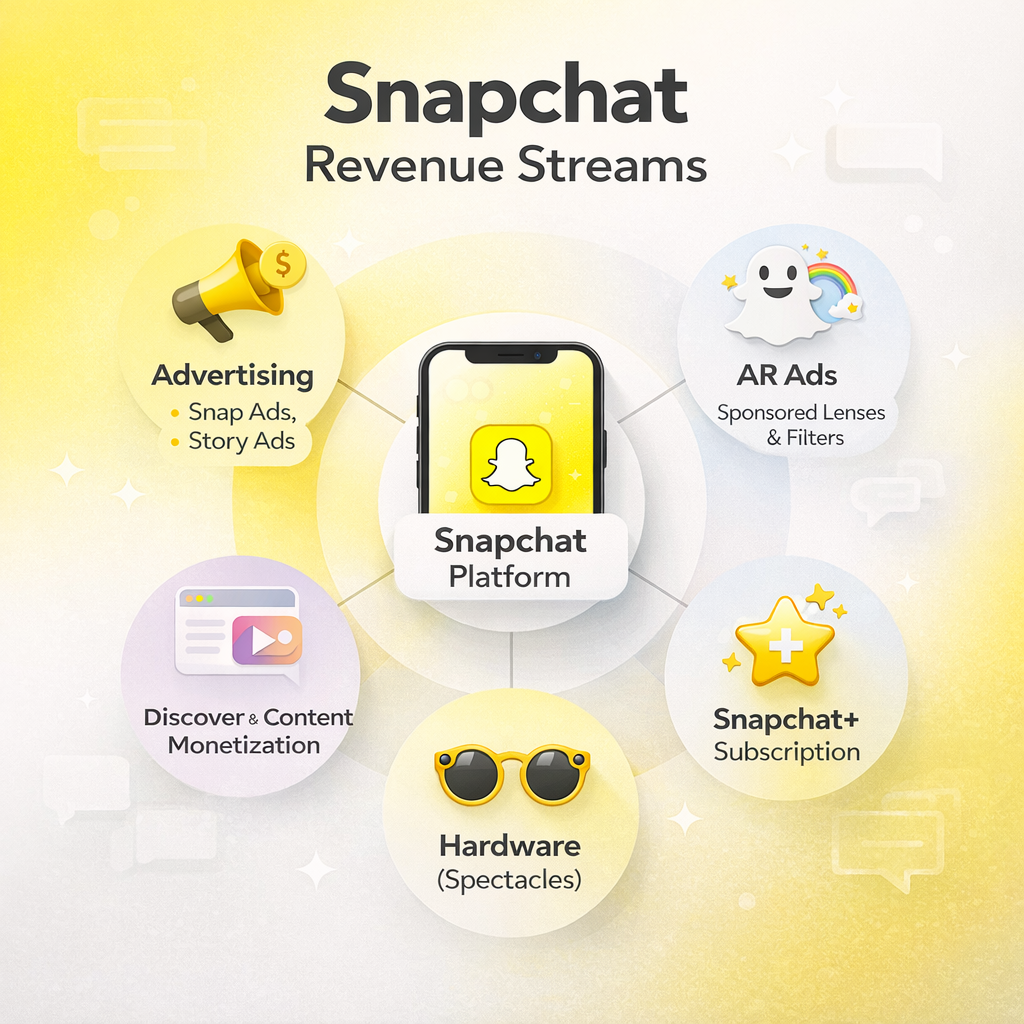
Advertising is by far Snapchat’s largest and most important revenue stream, accounting for the overwhelming majority of the company’s income. Snap offers several distinct advertising formats, each designed to fit naturally into the way users experience the app.
Snap Ads are full-screen vertical video ads that appear between Stories and Discover content. These ads are designed to feel native to the platform since the format mirrors how users already consume content on Snapchat. Advertisers can include swipe-up calls to action that lead users to websites, app downloads, or longer video content.
Story Ads appear in the Discover section as branded tiles. When a user taps on one, they are taken through a series of Snaps, similar to a Story, but fully produced by the advertiser.
Collection Ads are designed for e-commerce. They display a product image at the top with a series of smaller product thumbnails below, letting users browse and tap through to purchase without ever leaving the Snapchat experience.
The reason advertisers are drawn to Snapchat comes down to demographics. The platform reaches a large share of the 13 to 34 age bracket, a group that is highly desirable for brands across fashion, entertainment, food, gaming, technology, and consumer products. This demographic is also one of the hardest to reach through traditional advertising, which makes Snapchat’s access particularly valuable.
Augmented Reality Ads
Augmented reality is one of the most distinctive and innovative parts of Snapchat’s business model. Snap has invested heavily in AR since the early days of the platform, and today it operates one of the most advanced AR ecosystems in the consumer technology space.
Sponsored Lenses let brands create interactive AR experiences that users can apply to their own faces or environments using Snapchat’s camera. A brand might create a lens that puts their product in a user’s hands virtually, transforms a user’s appearance in a branded way, or overlays an animated scene onto a real-world background.
Branded Filters are location-based or event-based overlays that users can add to their Snaps. A company might sponsor a filter for a major sporting event, a product launch, or a holiday campaign.
What makes AR advertising so compelling for brands is the engagement it drives. Unlike a static banner ad or even a video that a user might scroll past, an AR lens invites users to actively interact with the brand. Users often share their Snaps created with branded lenses, effectively turning every user who engages into an organic advertiser.
Snap has also developed tools that allow businesses to build their own AR experiences through a platform called Lens Studio, which has a large community of creators producing AR content. This has lowered the barrier to entry for brands of all sizes.
Snapchat Plus Subscription
Snapchat+ is Snap’s premium subscription tier, launched in 2022. It represents the company’s move toward revenue diversification beyond advertising, a strategic priority that has become increasingly important given how volatile ad markets can be.
For a monthly fee, Snapchat+ gives subscribers access to a set of exclusive features that are not available on the free version of the app. These include:
- Custom app icons that let users personalize the look of the app on their device
- Early or exclusive access to new features before they roll out to all users
- The ability to see who rewatched their Stories
- A special badge on their profile that signals their subscriber status
- Custom themes and additional customization options
While Snapchat+ is not yet a major revenue contributor compared to advertising, its growth has been notable. The subscription model gives Snap a more predictable, recurring revenue stream that is not dependent on advertiser spending cycles, which tend to fluctuate with economic conditions.
Discover and Content Monetization
Snapchat’s Discover section functions as a media platform within the app, hosting content from professional publishers, media brands, and creators. Snap has built revenue-sharing arrangements with many of these content partners, meaning that when ads appear alongside their content, both Snap and the publisher earn a portion of that ad revenue.
Major publishers and media companies have built dedicated presences on Discover, creating content specifically formatted for the Snapchat audience. This content tends to be highly visual, fast-paced, and optimized for short attention spans, which fits the Snapchat user’s behavior perfectly.
The Discover ecosystem benefits Snap in two ways. First, it creates more ad inventory since more content means more spaces where ads can be placed. Second, it keeps users engaged with high-quality professional content, which increases the total time they spend on the platform and makes the overall advertising product more valuable.
Hardware: Spectacles
Spectacles are Snap’s smart glasses initiative. The product has gone through several iterations since its first launch in 2016, with each version adding more capability, including 3D AR displays in recent models.
It is worth being clear about what Spectacles represents in the current business model: it is an experimental revenue stream, not a core business driver. The glasses are primarily a research and development investment that positions Snap as a leader in wearable AR technology.
The hypothesis behind Spectacles is that as AR technology matures and form factors improve, smart glasses could become the next major computing platform. If that happens, Snap wants to be positioned as the software and content ecosystem that runs on those devices, much the way apps run on smartphones today.
Snapchat’s Value Proposition
Understanding why Snapchat’s business model works requires understanding the value it delivers to two very different groups.
For users, Snapchat offers a space for communication that feels more private, spontaneous, and fun than other platforms. The ephemeral nature of Snaps reduces the pressure of creating polished, permanent content. The creative tools, particularly the lenses and filters, make the camera experience genuinely entertaining. And the platform’s privacy focus has always been part of its appeal, especially for younger users who are acutely aware of how permanent digital records can be.
For advertisers, Snapchat offers access to a demographic that is nearly impossible to reach through any other channel at scale. Gen Z users in particular have grown up filtering out most forms of traditional advertising, but Snapchat’s native ad formats, especially AR lenses, cut through in ways that banner ads and television commercials simply cannot. The platform also offers robust targeting tools that let advertisers reach specific audiences based on interests, behaviors, and location.
Snapchat’s User Segments
Snap’s platform serves several distinct user groups, each valuable in different ways:
Gen Z (13 to 24 years old) represents Snapchat’s core and most loyal user base. This group grew up with the app and has integrated it into their daily communication habits in a way that makes it genuinely difficult to replace.
Millennials (25 to 34 years old) form a significant secondary audience. Many of them were early adopters of Snapchat and have continued using it alongside other platforms.
Content creators use Spotlight and Discover as channels to build audiences and earn income through Snap’s monetization programs. A healthy creator ecosystem is essential for keeping the content feed engaging.
Brands and advertisers are the paying customers. They are not users in the traditional sense but they are the segment that actually generates Snap’s revenue.
Key Features Driving Growth
Several specific product decisions have been central to Snapchat’s growth trajectory:
The camera-first design means that every time a user opens the app, they land on the camera rather than a feed. This framing reinforces Snapchat’s identity and makes content creation feel immediate and natural.
AR innovation has kept Snapchat technically ahead of competitors in a specific way. The depth and quality of Snap’s AR tools, both for consumers and for developers building through Lens Studio, is genuinely differentiated.
Spotlight has given Snapchat a credible answer to the short-form video trend that TikTok accelerated. By creating a discovery feed with a creator monetization program attached, Snap has given creators a reason to post original content on the platform.
Private messaging remains the heartbeat of the app. While every other major platform has moved aggressively toward public broadcasting, Snapchat has held onto the core of what made it special, which is intimate, ephemeral communication between friends.
Snapchat’s Growth Strategy
Snap’s growth playbook has several clear themes.
The company has leaned hard into understanding Gen Z behavior. This means building features that fit how young people actually want to communicate rather than retrofitting older social media formats for a new audience. Ephemeral content, visual communication, and low-pressure sharing all reflect a genuine understanding of this demographic.
Continuous feature innovation is a survival necessity in a competitive landscape where Meta, TikTok, and others have enormous resources. Snap cannot afford to stand still, and it has consistently released new features to maintain relevance.
Creator monetization has become a strategic priority. Platforms that pay creators attract more creators, which attracts more users, which attracts more advertisers. Snap has invested in creator funds and revenue-sharing programs to strengthen this flywheel.
Global expansion represents a significant growth opportunity. Snapchat has historically been stronger in English-speaking markets and Western Europe, but the company has been investing in markets across Asia, the Middle East, and Latin America.
Snapchat’s Competitive Advantage
Snap competes in one of the most brutally competitive spaces in technology, but it has several genuine advantages.
AR leadership is arguably Snap’s most defensible position. The company has been building AR technology since 2015, and the depth of the Lens Studio ecosystem, the quality of the AR effects, and the brand identity built around creative camera tools give Snap a lead that is not easy to replicate quickly.
Privacy-focused communication is increasingly valued, particularly among younger users. Snapchat’s foundational promise of ephemeral content aligns naturally with growing concerns about digital privacy and the permanence of online behavior.
Unique user experience is another moat. Snapchat’s navigation, interface, and overall feel are genuinely different from Instagram, TikTok, or any other platform. Users who have grown up with Snapchat have muscle memory for how the app works, which creates switching costs that are easy to underestimate.
When comparing Snapchat to Instagram, the key distinction is that Instagram has moved heavily toward public broadcasting and influencer culture, while Snapchat has retained more of its private, friends-and-family communication identity. When comparing it to TikTok, Snapchat’s core strength is not in viral content discovery but in personal communication and AR, where it remains stronger.
Challenges in Snapchat’s Business Model
No honest analysis of Snapchat can ignore the significant challenges the platform faces.
Competition from larger platforms is the most persistent pressure. Meta has repeatedly copied Snapchat’s innovations, most notably with Instagram Stories, and has the scale to execute those copies across a much larger user base. TikTok has reshaped the content consumption habits of exactly the demographic Snapchat depends on.
Balancing monetization with user experience is an ongoing tension. Advertising, by definition, introduces friction into what is meant to be a personal, ephemeral communication experience. Snap has to thread this needle carefully to avoid alienating the users who are the foundation of everything else.
Ad revenue dependency creates real financial vulnerability. When ad markets contract, as they did significantly in 2022, Snap’s revenue contracts with them. The push toward Snapchat+ and diversified revenue is a direct response to this risk.
User growth saturation in core markets is a genuine constraint. Snapchat has very high penetration among its target demographic in the United States, United Kingdom, France, and other key markets. Sustaining growth requires either expanding internationally or increasing the revenue generated per existing user.
Snapchat Business Model Canvas
A structured look at how Snap’s business fits together:
Key Partners include advertising agencies and brands, media publishers and content partners, AR developers building on Lens Studio, and device manufacturers like Apple and Google whose platforms Snapchat runs on.
Key Activities span platform development and maintenance, AR research and innovation, advertising product development, content curation, and creator program management.
Key Resources include the Snapchat user base, proprietary AR technology, brand relationships, the Discover publisher network, and a strong engineering and design team.
Value Proposition differs by audience. For users, it is private, creative, visual communication. For advertisers, it is access to hard-to-reach young consumers through engaging native formats.
Customer Relationships are built through constant product innovation for users and through managed account relationships and self-serve tools for advertisers.
Channels are primarily the Snapchat app itself on iOS and Android, supplemented by the web interface and Snap’s advertising sales platform.
Customer Segments include daily active users (primarily Gen Z and Millennials), brands and advertisers, content creators, and publishers.
Cost Structure is dominated by infrastructure and hosting costs, research and development, sales and marketing, and content acquisition.
Revenue Streams flow primarily from advertising, with growing contributions from Snapchat+ subscriptions and smaller contributions from hardware and content partnerships.
Real-World Example
One of the most frequently cited examples of Snapchat’s advertising effectiveness is how fashion and beauty brands have used AR lenses to drive measurable sales outcomes.
A major cosmetics brand might create a Sponsored Lens that lets users virtually try on different lipstick shades using their front camera. The lens requires active participation, which means users spend significantly more time engaging with the brand than they would watching a traditional ad. The lens gets shared by users who send Snaps to friends, creating organic reach beyond the paid placement. And the try-on mechanic directly reduces purchase hesitation by letting users see a product on themselves before buying.
This kind of campaign consistently outperforms traditional digital advertising benchmarks on engagement metrics, and the shareability of AR lenses means brands effectively get user-generated distribution on top of their paid reach.
The Future of Snapchat
The next chapter of Snapchat’s business model is being shaped by three overlapping trends.
AR and AI convergence is the most significant force. As AI becomes more capable, AR experiences become more sophisticated and more personalized. Snap is investing in tools that let users create custom AI-powered lenses, which could unlock a new wave of creative content and advertising possibilities.
Snapchat+ expansion is a clear strategic priority. As the subscription base grows, Snap gains more financial stability and more flexibility to invest in user-facing features that do not need to be directly tied to advertiser demands.
New monetization models are on the horizon. Snap has experimented with in-app commerce, augmented reality shopping experiences, and tighter integrations between AR and e-commerce. As these tools mature, there is a plausible path to Snapchat becoming a significant commerce platform, not just an advertising one.
Key Takeaways
A few things stand out when you step back and look at Snapchat’s business model as a whole:
Snapchat is an engagement platform, not simply a messaging app. The revenue depends on keeping users inside the app for as long as possible, and every product feature is ultimately designed with that goal in mind.
Revenue is heavily ad-driven but actively diversifying. Advertising will remain the dominant revenue source for the foreseeable future, but Snapchat+ and AR commerce represent credible paths to a more balanced model over time.
AR is both a product advantage and a strategic bet. Snap’s investment in augmented reality is not just about selling lenses to brands today. It is a long-term positioning play for a future where AR interfaces become a primary way people interact with the digital world.
The Gen Z relationship is the moat. Everything Snap has built, its ephemeral format, its creative tools, its privacy focus, its camera-first design, reflects a genuine understanding of how its core audience wants to experience technology. That deep alignment with a specific demographic is genuinely difficult for competitors to replicate, and it is the foundation everything else rests on.
Discover more from Business Model Hub
Subscribe to get the latest posts sent to your email.