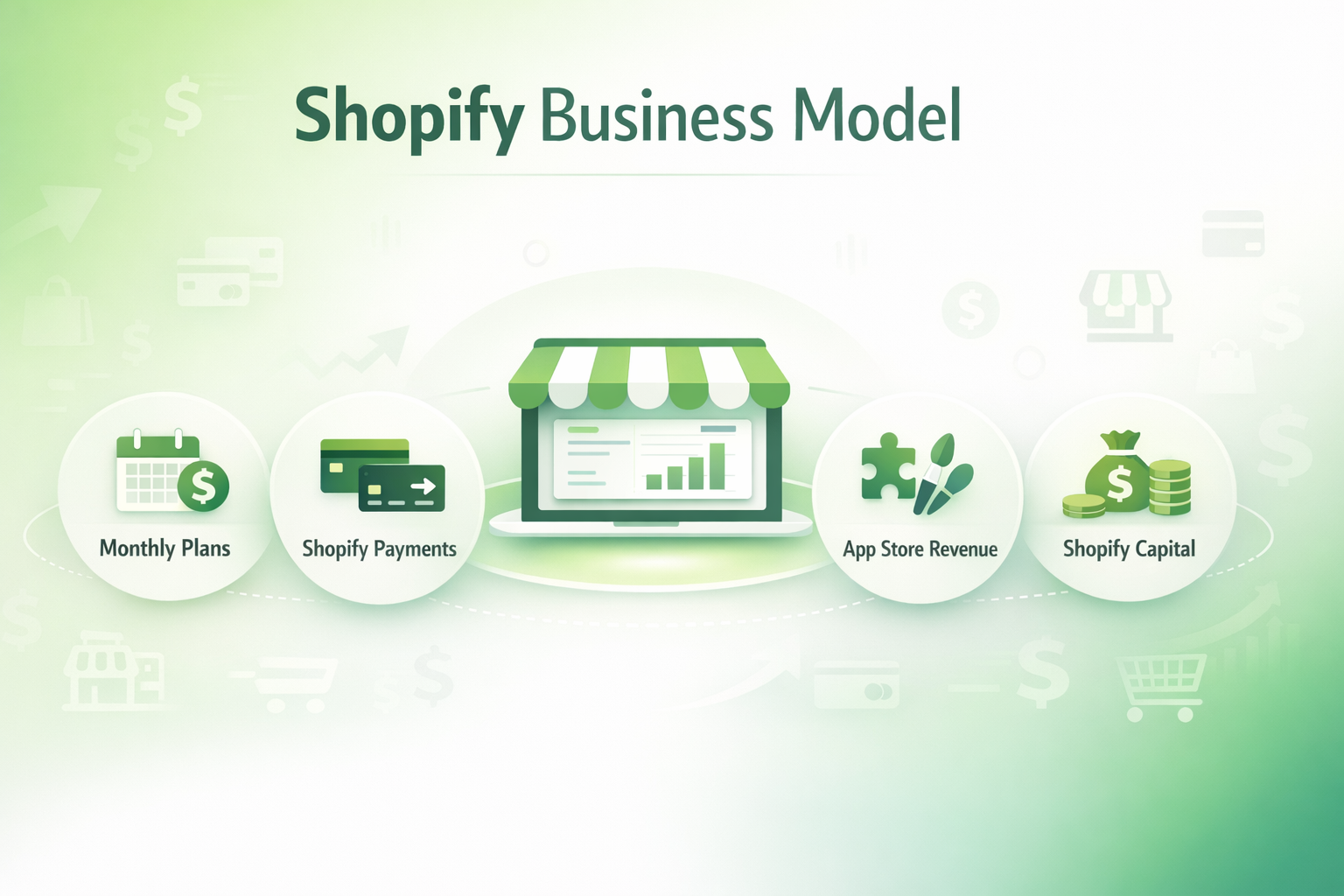
Shopify makes money through a combination of subscription plans, transaction fees, payment processing, app and theme store revenue, point-of-sale systems, and financial services like Shopify Capital. It operates as a SaaS platform layered on top of a massive merchant and developer ecosystem.
What Is Shopify?
Shopify is a cloud-based commerce platform that lets anyone build and run an online store, without needing to write a single line of code.
Founded in 2006, Shopify started as a simple storefront builder. Today, it powers over two million businesses across more than 175 countries.
Who it’s for:
- First-time entrepreneurs launching their first product
- Small businesses moving from physical to digital
- Direct-to-consumer (D2C) brands scaling fast
- Large enterprises needing custom, high-volume solutions
Why it’s popular:
- No coding required to build a fully functional store
- All-in-one platform covering everything from product listings to payments
- Thousands of third-party apps to extend functionality
- Strong community, educational resources, and partner network
Shopify removed the technical complexity of building an ecommerce store. That single insight is what made it one of the most valuable companies in the world.
Shopify Business Model Overview
Shopify is not just a website builder. It is a commerce infrastructure platform.
Its business model blends:
- SaaS (Software as a Service) through monthly subscriptions
- Platform economics through its app and theme ecosystem
- Financial services through payments, loans, and banking tools
The Two-Sided Ecosystem
Shopify operates a two-sided marketplace connecting two distinct groups:
Merchants (buyers of Shopify’s services)
- Pay subscription fees
- Use Shopify’s tools to sell products
- Rely on apps and partners to grow
Developers and Partners (builders on Shopify’s platform)
- Build apps, themes, and integrations
- Generate revenue through Shopify’s marketplace
- Expand Shopify’s functionality without Shopify bearing the R&D cost
The more merchants succeed, the more developers build. The more developers build, the more merchants choose Shopify. This is a classic network effect that creates a self-reinforcing flywheel.
Core insight: Shopify does not sell products. It sells the infrastructure for other people to sell products. Every dollar a merchant makes is a potential dollar Shopify can capture a small percentage of.
How Shopify Works
Here is how a typical merchant journey looks:
Step one: Sign up Merchants start a free trial, no credit card required in many cases.
Step two: Create a store Using drag-and-drop tools or pre-built themes, a store goes live within hours.
Step three: Add products Merchants upload product images, set prices, and configure variants like size or color.
Step four: Set up payments Shopify Payments is built in. Third-party gateways like PayPal or Stripe are also supported.
Step five: Launch the store The store is live and ready to receive orders from day one.
Step six: Scale using apps As the business grows, merchants install apps for email marketing, reviews, subscriptions, upsells, and more.
Each step creates a revenue touchpoint for Shopify. From the moment a merchant signs up to the moment they process their millionth order, Shopify is earning.
Shopify Revenue Streams
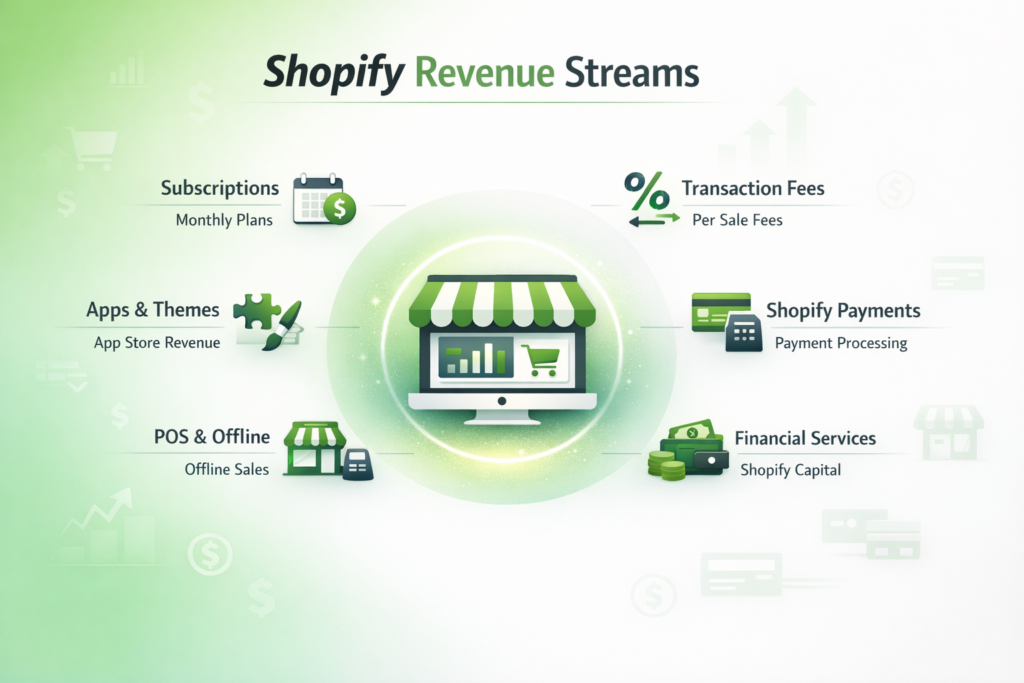
This is the core of the Shopify business model. Here is a complete breakdown of every major way Shopify generates revenue.
Subscription Plans
Shopify charges a monthly recurring fee for access to its platform.
Current plans include:
- Basic for solo entrepreneurs
- Shopify for small teams
- Advanced for scaling businesses
- Shopify Plus for enterprise brands
Subscription revenue is predictable and stable. Even when ecommerce slows down, merchants continue paying their monthly fees. This makes subscriptions the foundation of Shopify’s financial model.
Why it matters: Monthly recurring revenue (MRR) is the gold standard for SaaS companies. It allows Shopify to forecast growth, invest in R&D, and plan long-term without depending on volatile one-time sales.
Transaction Fees
Every time a merchant makes a sale using a third-party payment gateway (not Shopify Payments), Shopify charges a transaction fee.
Fee structure:
- Basic plan: higher percentage per transaction
- Advanced plan: lower percentage per transaction
This structure creates a strong incentive for merchants to either upgrade their plan or switch to Shopify Payments. Both outcomes benefit Shopify.
Strategic purpose: Transaction fees act as both a revenue stream and a funnel toward higher-margin products.
Shopify Payments
Shopify Payments is Shopify’s built-in payment processor, powered by Stripe on the backend.
When merchants use Shopify Payments, they avoid external transaction fees but still pay credit card processing fees, which flow directly to Shopify.
Why this is the most important revenue stream:
- Shopify earns on every single transaction processed
- Merchants who use it are stickier and less likely to leave
- Shopify Payments is available in over 20 countries
Shopify Payments falls under the Merchant Solutions segment in Shopify’s financial reports, which consistently generates more revenue than subscriptions. This is Shopify’s real cash engine.
App Store Revenue
Shopify has one of the most developed app ecosystems in ecommerce.
The Shopify App Store hosts thousands of apps across categories like:
- Email and SMS marketing
- Upselling and cross-selling
- Loyalty programs
- Inventory management
- Analytics and reporting
How Shopify earns: Shopify takes a revenue share from paid app subscriptions and one-time purchases. Developers keep the majority, but Shopify earns a consistent cut from every transaction across thousands of apps.
Why it scales well: Shopify does not build these apps. Developers do. Yet Shopify earns passive revenue from the entire ecosystem simply by owning the marketplace.
Theme Store
Merchants who want a professional-looking store without hiring a designer can purchase premium themes from the Shopify Theme Store.
How it works:
- Free themes are available for all merchants
- Premium themes are sold as one-time purchases (typically $100 to $400)
- Theme developers earn the majority, Shopify takes a cut
Themes are a low-effort revenue stream that also improves the quality and visual appeal of stores on the platform, which in turn attracts more merchants.
Shopify POS
Shopify’s Point-of-Sale (POS) system allows merchants to sell in physical locations, pop-up shops, or markets while keeping everything connected to their online store.
What merchants get:
- POS software (free with subscription, advanced version is a paid add-on)
- Hardware like card readers, barcode scanners, and cash drawers
- Unified inventory and reporting across online and offline sales
Revenue for Shopify:
- Monthly POS Pro subscription fees
- Hardware sales
- Payment processing fees on every in-person transaction
This positions Shopify as an omnichannel commerce solution, not just an online store builder.
Shopify Capital
Shopify Capital provides merchant cash advances and business loans to Shopify merchants.
How it works:
- Shopify analyzes a merchant’s sales history and performance
- It offers funding ranging from a few thousand to millions of dollars
- Repayments are automatically deducted as a percentage of daily sales
Why this is genius:
- Shopify has perfect data on every merchant’s revenue
- There is no lengthy application process
- Repayment is frictionless and tied directly to cash flow
Shopify Capital helps merchants grow faster. Faster growth means more sales volume. More sales volume means more payment processing fees for Shopify. It is a self-reinforcing loop.
Shopify Plus
Shopify Plus is the enterprise tier designed for high-volume brands and complex operations.
What it includes:
- Custom checkout and automation tools
- Dedicated account management
- Advanced API access and integrations
- Multi-store and multi-currency management
Pricing: Shopify Plus starts at around $2,000 per month, often scaling based on revenue for very large merchants.
Why it matters: A single Shopify Plus account can generate more revenue than hundreds of Basic accounts. Winning enterprise clients is a high-value growth lever for Shopify without requiring a proportional increase in support costs.
Shopify Ecosystem Advantage
Shopify’s biggest competitive moat is not its software. It is the ecosystem built around its software.
App Developers
Over 10,000 apps in the Shopify App Store mean Shopify can offer solutions for almost any merchant need, without building every feature itself.
High Switching Costs
Once a merchant has:
- Customized their store
- Installed and configured multiple apps
- Trained their team on the Shopify dashboard
- Integrated Shopify with their logistics and marketing tools
…leaving Shopify becomes genuinely painful. This is called switching cost moat, and it keeps merchants on the platform for years.
Network Effects
Every new merchant on Shopify attracts more developers to build for Shopify. Every new app makes Shopify more attractive to merchants. The platform becomes more valuable as it grows, creating a cycle that competitors struggle to break into.
Shopify Pricing Strategy
Shopify’s pricing is designed around a simple principle: lower the barrier to entry, then grow with the merchant.
How the strategy works:
- Affordable basic plans make Shopify accessible to anyone
- As merchant sales grow, they upgrade to higher-tier plans
- Higher tiers unlock lower transaction fees, which incentivize upgrades
- Shopify earns more as merchants earn more
This is the classic land and expand SaaS model. Get merchants in the door cheaply, then capture increasing value as they scale.
The alignment is powerful: Shopify’s revenue grows when merchant revenue grows. This creates a genuine partnership dynamic that earns trust.
Why Shopify Wins
Beginner-Friendly
No technical knowledge is required. A new merchant can launch a real store in a single afternoon. This wide accessibility gives Shopify a massive top-of-funnel advantage.
Huge Ecosystem
Thousands of apps, hundreds of themes, and a large partner network mean Shopify can solve almost any merchant problem through its platform.
Global Reach
Shopify supports:
- Multiple currencies and languages
- Local payment methods across regions
- Compliance tools for different markets
Brand Trust
Shopify has been around since 2006 and is publicly traded on the NYSE. Merchants trust it with their entire business, including payments and financing.
Challenges in the Shopify Business Model
No business model is without its weaknesses. Here are the key challenges Shopify faces.
Merchant Dependency
If merchants fail, Shopify’s revenue shrinks. During economic downturns, small businesses are particularly vulnerable. Shopify’s fate is tied closely to the health of the entrepreneurs on its platform.
Rising App Costs for Merchants
As merchants rely more on third-party apps to compete, their total monthly cost can balloon significantly above the base subscription price. This can make the platform feel expensive for growing businesses.
Competition
Amazon: Offers its own marketplace and fulfillment infrastructure. Many merchants sell on both platforms but Amazon controls the customer relationship.
WooCommerce: An open-source plugin for WordPress. It is free to install and highly customizable, though it requires technical knowledge and separate hosting.
BigCommerce, Wix, Squarespace: Compete at the SMB level with increasingly capable ecommerce features.
Shopify vs Competitors
| Platform | Model | Key Difference |
|---|---|---|
| Shopify | SaaS | All-in-one commerce platform |
| Amazon | Marketplace | Controls the customer relationship |
| WooCommerce | Open-source | Flexible but technically demanding |
| BigCommerce | SaaS | Similar to Shopify, fewer apps |
| Wix | Website builder | Ecommerce as a secondary feature |
Shopify’s key advantage over Amazon: Merchants own their customer data and brand identity on Shopify. On Amazon, Amazon owns the customer.
Shopify’s key advantage over WooCommerce: No server management, faster setup, and a more cohesive experience.
Real-World Use Cases
D2C Brands Companies like Allbirds, Gymshark, and Kylie Cosmetics built their brands on Shopify. Full control over branding, customer experience, and data.
Dropshipping Businesses Entrepreneurs use Shopify alongside apps like DSers or Zendrop to sell products without holding inventory. Shopify makes this model accessible with minimal upfront investment.
Small Businesses Scaling Globally A local candle brand in Toronto can sell to customers in Germany, Japan, and Brazil using Shopify’s multi-currency and international shipping tools, all from one dashboard.
Shopify Business Model Canvas
A breakdown of how Shopify operates across all dimensions of its business:
Key Partners
- App developers
- Payment providers
- Theme designers
- Logistics and fulfillment partners
- Marketing agencies and consultants
Key Activities
- Platform development and maintenance
- Merchant onboarding and retention
- Ecosystem management and developer relations
- Financial product underwriting (Shopify Capital)
Key Resources
- Platform technology and infrastructure
- Developer ecosystem and App Store
- Brand reputation and trust
- Merchant data and transaction history
Value Proposition
- Launch a store without technical skills
- All-in-one solution from storefront to payments to financing
- Scalable infrastructure that grows with the business
Customer Segments
- Solo entrepreneurs and side hustlers
- Small and medium businesses
- D2C and digitally native brands
- Enterprise and high-growth companies (via Shopify Plus)
Customer Relationships
- Self-service for most merchants
- Community forums and educational resources (Shopify Academy)
- Dedicated account managers for Shopify Plus clients
- Partner-led services through agencies and experts
Channels
- Shopify.com (direct)
- App Store
- Partner and affiliate network
- Content marketing and SEO
- Word of mouth from merchant success stories
Revenue Streams
- Monthly subscriptions
- Payment processing fees
- App and theme store revenue share
- Shopify Capital interest and fees
- POS hardware and software
Cost Structure
- Cloud infrastructure and hosting
- R&D and engineering
- Sales and marketing
- Merchant support and operations
- Regulatory and compliance costs
Core insight: Shopify’s power comes from combining software, ecosystem, and finance into a single merchant growth platform.
Shopify Growth Strategy
How did Shopify grow from a small snowboard shop software to a global commerce giant? Here is the full picture.
Start Small, Then Expand
Shopify began with one job: help people build online stores. Once it mastered that, it expanded into payments, then logistics, then financing. Each expansion deepened merchant dependency and opened new revenue streams.
Ecosystem-Led Growth
Rather than building every feature in-house, Shopify opened its platform to developers early. The App Store became a strategic growth engine, letting Shopify offer thousands of features without hiring thousands of engineers.
Merchant Success Alignment
Shopify’s business model is structurally aligned with merchant success. When a merchant grows, Shopify earns more. This alignment creates a powerful incentive to invest in merchant education, tools, and support.
Low Barrier Entry
A free trial and affordable starter plans mean almost anyone can try Shopify. This generates massive top-of-funnel volume, and even if conversion rates are modest, the absolute number of paying merchants scales rapidly.
Land and Expand (Upsell Strategy)
Most merchants start on a basic plan. Over time, Shopify nudges them toward higher tiers through:
- Lower transaction fees at higher plans
- Advanced analytics and automation features
- Dedicated support options
- Shopify Plus for enterprise needs
Global Expansion
Shopify aggressively localized its platform with:
- Multi-currency checkout
- Local payment methods (like UPI in India, iDEAL in the Netherlands)
- Regional compliance tools and tax calculation
This made Shopify viable globally, not just in the US and UK.
Shopify Plus for Enterprise
Going upmarket was a deliberate move. Shopify Plus brought in large, stable accounts with high revenue per customer. It also gave Shopify credibility that attracted mid-market merchants looking to grow into enterprise-grade tools.
Financial Layer Expansion
Shopify Payments, Shopify Capital, and Shopify Balance (a business banking product) transformed Shopify into a fintech company as much as a software company. Financial services carry higher margins and deeper lock-in than software alone.
Content and SEO
Shopify invested heavily in content marketing early. Its blog, free tools (like business name generators and logo makers), and Shopify Academy drove organic traffic and turned brand awareness into merchant sign-ups.
Continuous Innovation
Recent investments include:
- AI-powered product descriptions and ad copy
- Checkout optimization (Shopify Checkout converts at industry-leading rates)
- Shopify Markets for international selling
- Built-in B2B tools for wholesale businesses
Core insight: Shopify scales by monetizing every stage of a merchant’s journey, from the first store launch to enterprise-level global operations.
Key Takeaways for Founders
If you are building a business, Shopify’s model offers several powerful lessons:
Recurring revenue builds stability Monthly subscriptions create predictable cash flow that lets you plan, invest, and hire without depending on volatile one-time sales.
Ecosystem creates long-term moat Platforms that let others build on top of them become exponentially more valuable than closed tools. An ecosystem is one of the hardest competitive advantages to replicate.
Help users grow, and you grow When your revenue is tied to your customers’ success, you are naturally incentivized to serve them well. This alignment is both ethical and commercially powerful.
Expand revenue streams over time Shopify did not launch with payments, capital, and POS. It layered them in over years. Build one thing well, then expand into adjacent revenue streams that serve the same customer.
Lower the barrier, then scale up Getting customers in the door cheaply, then growing with them, is a far more durable strategy than competing solely on price or features from day one.
Conclusion
Shopify is one of the clearest examples of what a modern platform business looks like.
It is not simply a website builder. It is the commerce infrastructure layer that millions of businesses rely on to find customers, process payments, manage inventory, and grow. Every feature Shopify adds, every app a developer builds, and every merchant that succeeds strengthens the entire platform.
The Shopify business model succeeds because it aligned incentives correctly from the start. Merchants win. Developers win. Shopify wins.
That is what separates infrastructure businesses from tools. Tools get replaced. Infrastructure gets depended on.
Whether you are an entrepreneur, an investor, or a business strategist, the Shopify playbook offers a masterclass in how to build a scalable, moat-protected, multi-revenue-stream business from the ground up.
FAQs
Shopify makes money through subscription plans, transaction fees, payment processing (Shopify Payments), app and theme sales, POS systems, and financial services like Shopify Capital.
The main revenue streams of Shopify include subscriptions, transaction fees, payment processing, app marketplace revenue, theme sales, and merchant services like POS and loans.
Yes, Shopify charges transaction fees on each sale if you don’t use Shopify Payments. The percentage varies depending on the plan you choose.
Yes, Shopify primarily follows a SaaS (Software-as-a-Service) model but also operates as a platform ecosystem with additional revenue streams.
Shopify offers multiple pricing plans starting from a basic monthly subscription and scaling up to advanced and enterprise-level plans like Shopify Plus.
It depends on the business model. Shopify gives you full control over your brand and customer data, while Amazon provides built-in traffic but less control.
Shopify grows by expanding its ecosystem, offering more services like payments and apps, and helping merchants scale their businesses globally.
Discover more from Business Model Hub
Subscribe to get the latest posts sent to your email.