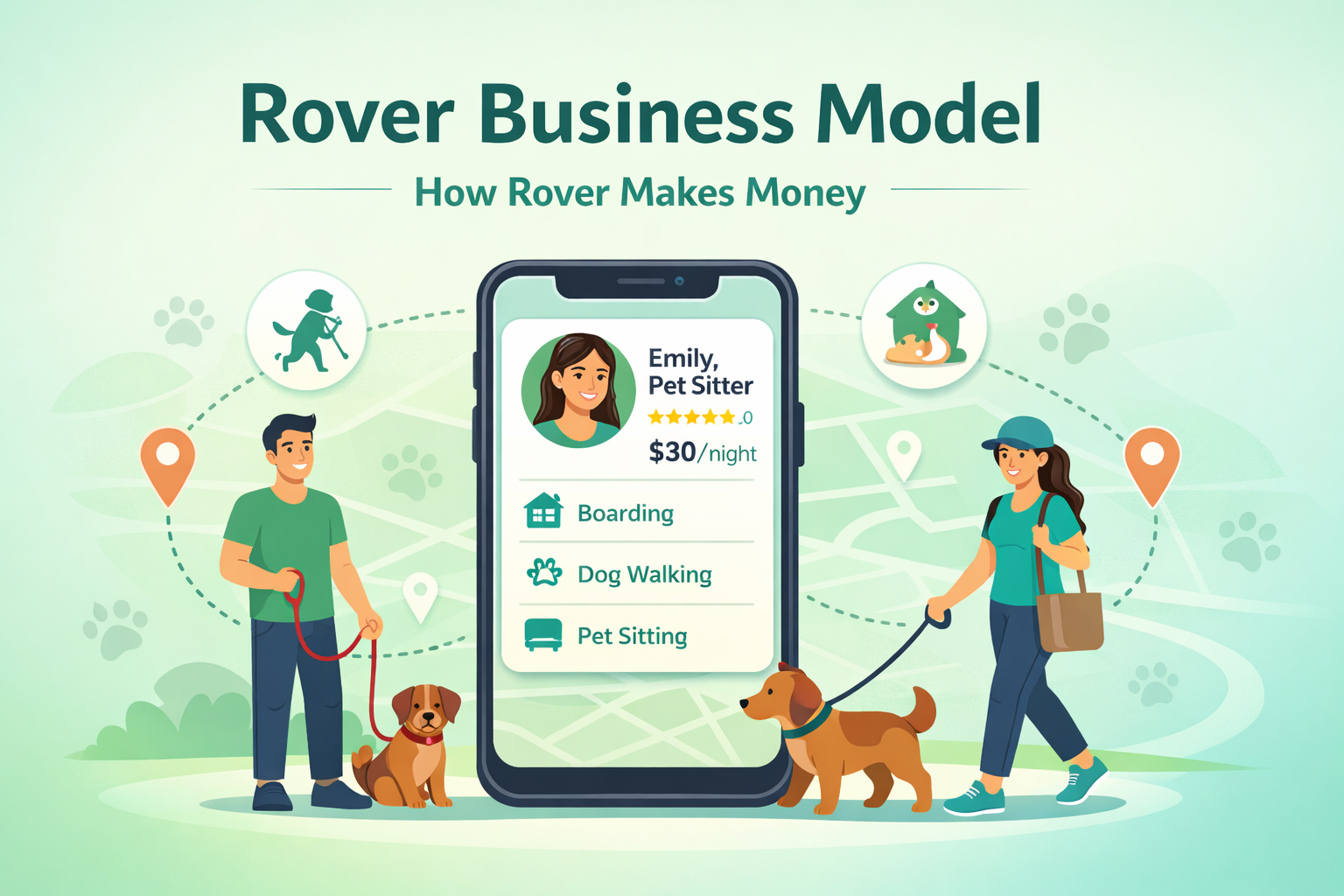
If you’ve ever left your dog with a stranger and hoped for the best, Rover was built for you. It’s a platform that turns pet care into a trusted, bookable service. And it makes money every single time that happens.
In Short
Rover is a two-sided marketplace connecting pet owners with local sitters and dog walkers. It makes money by charging service fees to pet owners and taking a commission from every booking a sitter completes. Think of it like Airbnb, but for pets.
What Rover Actually Is
Rover launched in 2011. Aaron Easterly co-founded it in Seattle with a simple idea: pet owners need reliable care, and animal lovers want to earn money doing what they love.
Before Rover, finding a trustworthy pet sitter was a nightmare. You either called a kennel, asked a neighbor, or crossed your fingers posting on Facebook. None of those felt safe or easy.
Rover fixed that.
It gave pet owners a place to find vetted, reviewed sitters nearby. And it gave dog lovers a way to turn their passion into real income.
Today, Rover operates in the US, Canada, and several European countries. It has millions of pet owners and hundreds of thousands of sitters on the platform.
Core Services Rover Offers
Rover isn’t just for boarding. It covers a full range of pet care needs:
- Dog boarding (sitter keeps your dog overnight at their home)
- Pet sitting (sitter comes to your home)
- Dog walking (30 or 60-minute walks)
- Drop-in visits (quick check-ins at your place)
- Doggy daycare (daytime care at the sitter’s home)
Each service has its own pricing. Each booking goes through the platform. That’s the key part.
How Rover Works (Step by Step)
Understanding the model starts with understanding the flow. It’s simple once you see it.
For Pet Owners
You open the app and search for sitters near you. You filter by service type, price, availability, and reviews.
You find someone you like. You check their profile, read reviews from other pet owners, and look at photos of their space.
Then you book directly through the app. Payment happens on the platform. You never hand cash to anyone.
After the service, you leave a review. That review helps the next pet owner decide.
For Pet Sitters
Sitters sign up and create a profile. They add photos, write a bio, list their experience, and set their own prices.
Rover runs a background check on them. That alone builds trust with owners.
When a booking request comes in, the sitter can accept or decline. They control their schedule. They control how many dogs they take at once.
After completing the service, the money lands in their account. Minus Rover’s cut, which I’ll break down shortly.
What Rover Does in the Middle
This is where it gets interesting. Rover isn’t just a directory.
It handles all the money. It manages communication. It provides customer support if something goes wrong. And it offers coverage through its Rover Guarantee program.
Rover is the trust layer. Without it, a pet owner booking a stranger off Craigslist feels risky. With Rover in the middle, it feels safe.
The Rover Business Model Breakdown
Let me explain the model clearly, because it’s actually elegant.
It’s a Marketplace Model
Rover is a two-sided marketplace. On one side, you have pet owners who need care. On the other side, you have sitters who want to earn.
Rover connects both sides. It doesn’t own any dogs. It doesn’t employ any sitters. It just facilitates the transaction.
This is the same model Airbnb, Uber, and Etsy use. Build a platform, bring both sides together, take a cut.
The beauty of this model is scale. You don’t need more offices or employees to grow. You just need more sitters and more owners on the platform.
It’s Asset-Light
Rover doesn’t run any kennels. It doesn’t own any pet care facilities. There’s no fleet of dog walkers on salary.
Every sitter is an independent service provider. They use their own home, their own time, their own supplies.
That means Rover’s costs stay low even as the platform grows. More bookings don’t require more physical infrastructure.
It’s Built on Trust
This is the part most people underestimate. Rover’s whole business depends on trust.
If owners don’t trust sitters, they won’t book. If sitters don’t trust the platform, they won’t join. Everything collapses.
So Rover invests heavily in:
- Background checks for sitters
- Verified reviews from real owners
- A support team that responds to problems
- Insurance and coverage programs
Trust is the product. The platform just delivers it.
How Rover Makes Money
Now the good stuff. Here’s exactly how Rover earns revenue from every booking.
Service Fees From Pet Owners
When a pet owner books through Rover, a service fee is added on top of the sitter’s price.
This fee typically ranges from around 5% to 7% of the booking total. So if your sitter charges $50 for a night of boarding, you might pay $53 or $54 total.
It’s not a huge fee. It’s small enough that most owners don’t think twice about it. But multiply that across millions of bookings per year and it adds up fast.
This is friction-free revenue. The owner is already paying. The fee just gets baked in.
Commission From Sitters
Rover also takes a cut from the sitter’s side. This is the bigger piece.
Sitters pay around 20% of their earnings to Rover as a commission. So if a sitter earns $100 for a weekend booking, they keep $80 and Rover keeps $20.
That 20% covers access to the platform, payment processing, customer support, and the Rover Guarantee.
Most sitters accept this because Rover brings them clients they wouldn’t find on their own. The platform does the marketing. The sitters do the work.
Premium Features for Sitters
Rover also offers sitters ways to pay for more visibility.
Sitters who want to appear higher in search results or get a “preferred sitter” badge can pay for it. This is a small but growing revenue stream.
It’s the same logic as Google Ads or promoted listings on Etsy. The platform has valuable real estate. Sitters pay to be seen first.
The Rover Guarantee and Safety Fees
Rover includes what they call the Rover Guarantee. It provides coverage for vet bills and other issues that happen during a booking.
Part of the service fee and commission covers this. It’s not a standalone product you buy separately. But it’s part of how Rover justifies its fees and builds trust.
The guarantee makes owners feel safe. The safety feeling drives more bookings. More bookings mean more revenue. It’s a smart loop.
Pricing Strategy: How It Actually Works
Sitters set their own base price. Rover doesn’t dictate rates.
A sitter in rural Ohio might charge $20 a night for boarding. A sitter in San Francisco might charge $80. Both are on the same platform. Prices reflect local markets.
Rover then adds its service fee on top. The final price the owner sees includes both.
This flexible pricing model helps Rover work across many cities and income levels. It’s not a one-size-fits-all pricing system.
What’s smart here is that Rover’s revenue scales with the sitter’s price. A 20% commission on $80 is $16. A 20% commission on $20 is $4. Rover earns more in expensive markets automatically.
Key Business Model Components
Let me break down the building blocks in a simple way.
Customer Segments
Rover serves two very different groups at the same time.
Pet owners want safe, affordable, convenient care. They’re busy. They travel. They need someone they can actually trust with their dog.
Pet sitters and dog walkers want flexible income. They love animals. They don’t want a traditional job. Rover gives them a way to earn on their own terms.
Both groups need each other. That’s what makes this a marketplace.
Value Proposition
For owners: You get trusted, reviewed pet care. You book in minutes. You pay securely. You can message your sitter anytime.
For sitters: You get a steady stream of clients. You set your own hours and rates. You get paid without chasing invoices.
Rover doesn’t just offer a service. It offers peace of mind. That’s what people are really paying for.
Channels
Rover reaches its users through:
- Its mobile app (most bookings happen here)
- Its website
- Word of mouth (happy pet owners tell their friends)
- SEO and content marketing (like the article you’re reading right now)
The app experience is central. It’s easy to search, book, message, and pay all in one place.
Growth Strategy of Rover
How did Rover grow from a Seattle startup to a global platform? A few smart moves.
Building Trust First
Rover didn’t compete on price. It competed on trust.
Background checks. Verified profiles. Real reviews. These aren’t cheap or easy to build. But they made owners feel safe enough to book.
Once trust is established, growth follows. You can’t reverse-engineer this. You have to build it from day one.
Network Effects
This is the most powerful part of the model.
More sitters on the platform means pet owners have more options. More options means more bookings. More bookings means sitters earn more. More earnings attract more sitters.
It’s a flywheel. Each side of the marketplace makes the other side better. This is why Rover’s model gets stronger over time, not weaker.
Once a marketplace reaches a certain size, it’s very hard for competitors to catch up.
Geographic Expansion
Rover started in the US and then expanded to Canada and parts of Europe.
Each new city follows the same playbook. Recruit local sitters. Build awareness among local pet owners. Trust the network effects to take over.
The asset-light model makes this easier. You don’t need to open offices or hire local staff at scale. You just need enough supply and demand in each market.
Mobile-First Experience
Most Rover bookings happen on the phone. The app makes it fast.
Search, compare, message, book, pay. All in a few taps. That ease of use drives repeat usage. And repeat usage is what makes a marketplace sticky.
Competitors Rover Faces
Rover isn’t alone in this space. Here’s who they compete with.
Wag is the closest competitor. It also connects dog owners with walkers and sitters. Wag focuses more on on-demand dog walking. It’s raised a lot of money and competes directly with Rover in major US cities.
Care.com is broader. It covers all types of caregiving, including babysitters, senior care, and pet sitters. It’s a bigger platform but less specialized than Rover.
Local and offline providers are the hidden competition. Dog kennels, pet hotels, and neighborhood dog walkers don’t use an app. But they’re often cheaper and trusted through personal relationships.
Rover wins by being more convenient and more trusted than offline options. Against Wag, it competes on depth of reviews and range of services.
Strengths of the Rover Business Model
Let me tell you what makes this model genuinely strong.
It’s highly scalable. Adding more users doesn’t require adding more physical assets. A hundred new bookings tomorrow costs Rover almost nothing extra in infrastructure.
It’s asset-light. No kennels. No employees walking dogs. No vans. The sitters own all of that. Rover owns the platform.
Recurring usage is baked in. Pet owners don’t just use Rover once. They use it every vacation, every work trip, every busy week. That creates loyal, repeat customers.
The trust ecosystem is hard to replicate. Years of reviews and ratings are not something a new competitor can copy overnight. That’s a real moat.
Weaknesses and Challenges Rover Deals With
No business model is perfect. Here’s where Rover has real challenges.
Trust and safety risks are real. When something bad happens to a pet on a Rover booking, it can go viral. One bad story can hurt the brand badly. Managing quality across thousands of independent sitters is genuinely hard.
Rover depends on sitter quality. It doesn’t employ sitters. It can’t fully control the experience. A great platform with bad sitters still fails.
Local competition is underestimated. A neighbor who walks dogs for $15 cash is always going to exist. And some pet owners prefer that relationship over an app.
Price sensitivity exists in many markets. Rover’s service fees and commissions make it more expensive than off-platform alternatives. In budget-conscious markets, this matters.
Real-World Example: One Booking, Three Earnings
Let me show you exactly how Rover earns from a single transaction.
Sarah has a Labrador named Max. She’s traveling for a long weekend and needs someone to board Max from Friday to Sunday. That’s two nights.
She finds a sitter named Tom. Tom charges $45 per night.
Total sitter price: $90
Rover adds a service fee of roughly 6%: about $5.40
Sarah pays $95.40 total.
Tom earns $90, but Rover takes a 20% commission.
Tom receives $72. Rover keeps $18.
Plus Rover already collected $5.40 from Sarah.
Total Rover revenue from this one booking: $23.40.
Now multiply that by millions of bookings per year. You can see why this model works.
Future Opportunities for Rover
Rover has room to grow in some exciting directions.
Pet healthcare integration makes a lot of sense. Rover already knows which pets are getting care. Partnering with vets or pet insurance companies is a natural next step.
Subscription-based services could be huge. A monthly membership for pet owners that includes discounted bookings, priority matching, and other perks could create more predictable revenue.
Expansion in emerging markets is a long-term play. Pet ownership is growing in Asia, Latin America, and parts of Africa. These are early-stage markets but massive opportunities.
Partnerships with pet brands like food companies, grooming brands, or toy companies could create sponsorship or affiliate revenue. Rover has an audience of deeply engaged pet owners. That audience is valuable.
Wrapping Up
Rover works because it solves a real problem in a smart way.
Pet owners need trusted care. Pet lovers want flexible income. Rover puts them together and takes a small cut every time they connect.
The model is scalable, asset-light, and built on trust. Those three things together make it very hard to compete with once the network is large enough.
If you’re a founder looking at this model, the lesson is simple. You don’t have to own anything to build a valuable business. You just have to connect the right people at the right time and make them both feel safe doing it.
That’s what Rover does. And that’s why it works.
FAQs
Rover has faced profitability challenges like most marketplaces at scale. It was acquired by A Place for Pets in 2023 as part of a broader consolidation in the pet care space. The marketplace model is profitable in mature markets, but building to scale requires heavy investment first.
Rover takes roughly 20% from sitters on each booking. It also charges pet owners a service fee of around 5% to 7% on top of the sitter’s rate. Both fees together are how Rover earns from every transaction.
Rover runs background checks on all sitters. It has a review system, customer support, and the Rover Guarantee that covers vet bills in certain situations. It’s safer than booking a random sitter offline, but no platform can guarantee a perfect experience every time.
Sitters get paid through Rover’s platform directly. Once a booking is complete, Rover releases the payment to the sitter’s account. They can transfer it to their bank account from there. Payment is automatic, so sitters don’t need to chase clients for money.
Yes. Sitters control their own pricing. They decide what to charge per night, per walk, or per visit. Rover then adds its service fee on top when the owner books. This gives sitters flexibility while Rover still earns its cut from every transaction.
Discover more from Business Model Hub
Subscribe to get the latest posts sent to your email.