Rakuten makes money by building an ecosystem where e-commerce, fintech, telecom, and digital services all feed into each other through one powerful loyalty system.
Now let’s break this down properly to understand what actually works, why Rakuten is different, and what you can copy (and what you should avoid).
What is Rakuten?
Rakuten is a Japanese internet conglomerate that started as an online marketplace and slowly turned itself into a full-stack digital ecosystem.
Today, Rakuten operates across:
- E-commerce
- Payments & fintech
- Banking & credit cards
- Mobile telecom
- Travel
- Media & content
- Advertising
- Loyalty programs
Think of Rakuten as Amazon + Paytm + Airtel + a loyalty engine, all tightly connected.
Rakuten’s Core Idea
Most companies focus on one product.
Rakuten focuses on one relationship.
That relationship is built through Rakuten Points.
Everything Rakuten does shopping, payments, banking, mobile, travel is designed to:
- Bring users into the ecosystem
- Keep them inside
- Increase lifetime value, not one-time revenue
This is why Rakuten’s business model is often called an ecosystem-driven model.
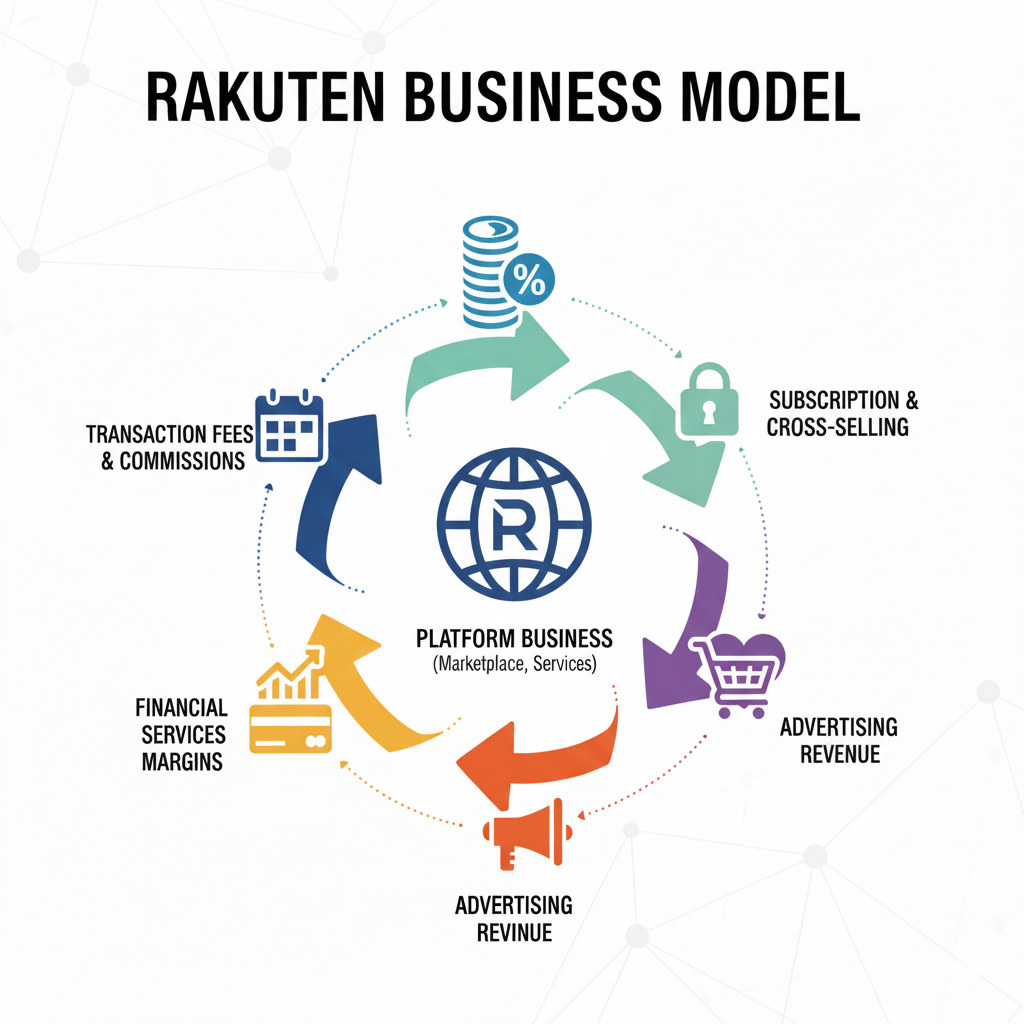
Rakuten’s Business Model at a High Level
Here’s the simple structure:
- Platform business (marketplace, services)
- Transaction fees & commissions
- Subscription & service revenue
- Financial services margins
- Advertising revenue
- Loyalty-led cross-selling
Instead of maximizing profit from one product, Rakuten optimizes the whole system.
1. E-Commerce Marketplace (Rakuten Ichiba)
This is where Rakuten started.
How it works
- Rakuten does not sell products directly
- Merchants create their own stores on Rakuten Ichiba
- Rakuten provides traffic, payment, logistics tools, and loyalty benefits
How Rakuten makes money
- Merchant commissions
- Monthly store fees
- Promotional fees
- Advertising placements inside the marketplace
Why this matters
Rakuten chose a merchant-first model, unlike Amazon’s private-label dominance.
This:
- Attracts more sellers
- Reduces inventory risk
- Scales faster without owning stock
Founder lesson:
If you don’t want inventory headaches, build infrastructure, not products.
2. Rakuten Points (The Glue of the Ecosystem)
Rakuten Points are the most important asset in the entire company.
Users earn points when they:
- Shop on Rakuten
- Pay via Rakuten Pay
- Use Rakuten Card
- Book travel
- Use mobile services
And they can spend those points anywhere inside the ecosystem.
Why this is powerful
- Increases repeat usage
- Reduces customer acquisition cost
- Makes switching away painful
- Turns multiple products into one experience
This is not just loyalty. This is behavioral lock-in.
3. Fintech: Rakuten Card, Bank & Pay
Rakuten didn’t stop at shopping. It followed the user’s money.
Key products
- Rakuten Card (credit cards)
- Rakuten Bank
- Rakuten Pay
- Rakuten Securities
How Rakuten makes money here
- Interest margins
- Transaction fees
- Interchange fees
- Investment & brokerage fees
Strategic advantage
Fintech allows Rakuten to:
- Understand spending behavior deeply
- Push personalized offers
- Reward usage with points
- Increase trust and stickiness
Founder insight:
If you control payments, you control data.
If you control data, you control growth.
4. Rakuten Mobile (High-Risk, Long-Term Bet)
Rakuten entered telecom very late and very aggressively.
Why telecom?
- Daily usage product
- Massive data generation
- Direct billing relationship
- Strong ecosystem anchor
The reality (honest take)
- Rakuten Mobile is capital-intensive
- Profitability is still a challenge
- But strategically, it reduces dependency on partners
Rakuten is playing a 10-year game, not a quarterly one.
Founder lesson:
Some moves are not about profit today they’re about control tomorrow.
5. Travel, Media & Digital Content
Rakuten also runs:
- Rakuten Travel
- Rakuten TV
- Rakuten Kobo (ebooks)
- Rakuten Advertising
These services:
- Increase user touchpoints
- Generate ad revenue
- Strengthen the ecosystem loop
Even if each service isn’t massively profitable alone, together they increase lifetime value.
6. Advertising & Data Monetization
Because Rakuten owns:
- Marketplace data
- Payment data
- Banking data
- Mobile usage data
It can offer highly targeted advertising.
Revenue sources
- Sponsored listings
- Display ads
- Merchant promotions
- Data-driven ad solutions
This is similar to how Amazon Ads works but with even richer cross-platform data.
Rakuten’s Flywheel (Very Important)
Here’s the Rakuten growth loop:
- Users shop → earn points
- Points push repeat usage
- Repeat usage increases data
- Data improves targeting & offers
- Better offers attract more merchants
- More merchants improve selection
- Better selection attracts more users
This flywheel is hard to break once it starts spinning.
What Rakuten Does Better Than Most Companies
1. Ecosystem thinking
Rakuten never asks:
“How do we monetize this product?”
It asks:
“How does this strengthen the ecosystem?”
2. Loyalty before margins
Rakuten is willing to sacrifice short-term profit to:
- Increase engagement
- Lock in users
- Build long-term value
3. Founder-led vision
Rakuten’s founder, Hiroshi Mikitani, has maintained a clear long-term vision, even when Wall Street disagreed.
Where Rakuten Struggles
Let’s be honest.
- Complex business structure
- High operational costs
- International expansion challenges
- Telecom losses
- Harder to explain to investors
Ecosystems are powerful but they are slow and expensive to build.
What Founders Can Learn from Rakuten
What to copy
- Loyalty as a growth engine
- Cross-product incentives
- Long-term thinking
- Owning user relationships
What to avoid
- Expanding too fast without strong cash flow
- Entering capital-heavy industries too early
- Over-complexity before product-market fit
Rakuten Business Model in One Line
Rakuten doesn’t sell products.
It sells convenience, loyalty, and continuity across digital life.
Final Take
If you’re building a startup, don’t try to “be Rakuten”.
Instead:
- Start with one strong core product
- Build trust
- Add adjacent services slowly
- Use incentives intelligently
- Think in terms of lifetime value, not transactions
Rakuten is proof that ecosystems beat isolated products but only if you’re patient enough to build them.
Discover more from Business Model Hub
Subscribe to get the latest posts sent to your email.