PayPal started as a simple tool for sending money online. Today, it is one of the most trusted digital payment platforms in the world, powering transactions for millions of businesses, freelancers, and consumers across more than 200 countries.
Its journey from a PayPal startup to a global fintech powerhouse is a story of smart timing, relentless innovation, and building something people genuinely trust with their money.
This guide breaks down the PayPal business model in full, including how the company makes money, how its platform works, and why it has stayed relevant in an increasingly competitive payments market.
What Is PayPal?
PayPal is a digital payments platform that allows individuals and businesses to send and receive money online. It acts as a secure digital wallet, letting users store payment methods and complete transactions without directly exposing their bank or card details.
Here are the basics:
- Founded in 1998 in Palo Alto, California
- Headquartered in San Jose, California
- Serves consumers, freelancers, small businesses, and large enterprises
- Supports over 25 currencies across 200+ markets
- Processes billions of transactions every year
Originally built to serve eBay buyers and sellers, PayPal grew into a standalone payments ecosystem used by eCommerce platforms, app developers, and brick-and-mortar businesses worldwide.
PayPal Company Overview
Before diving into the business model, here is a quick look at the company structure:
- Founders: Peter Thiel, Max Levchin, Luke Nosek, and others from the original Confinity and X.com teams
- Current CEO: Alex Chriss (as of 2023)
- Parent company: Independent, publicly traded on NASDAQ under the ticker PYPL
- Separation from eBay: PayPal was spun off as an independent public company in July 2015
PayPal also owns several major financial technology brands, including Venmo, Braintree, Xoom, and Honey. This portfolio of products gives the company reach across consumer payments, peer-to-peer transfers, merchant processing, and international money transfers.
PayPal Business Model Explained
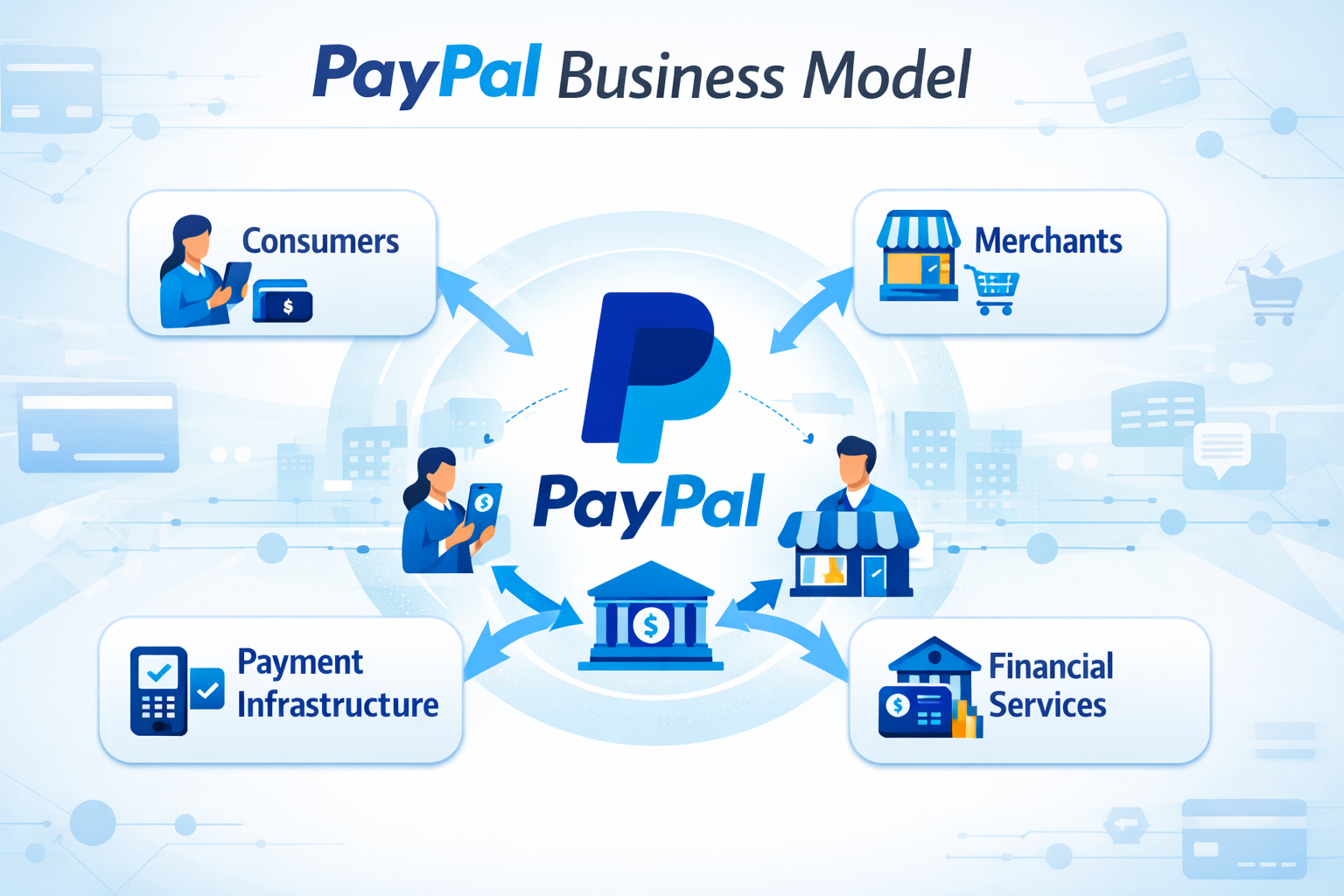
At its core, PayPal operates as a two-sided digital payments network.
On one side are consumers who use PayPal to shop, send money, and manage their finances. On the other side are merchants and businesses who use PayPal to accept payments, issue invoices, and manage transactions.
PayPal connects these two groups and earns a fee every time a transaction flows through its network. The more transactions it facilitates, the more revenue it generates.
The model works because both sides benefit from network effects. The more consumers who trust and use PayPal, the more attractive it becomes for merchants. The more merchants accept PayPal, the more useful it is for consumers. This reinforcing cycle is what makes the platform so sticky and scalable.
PayPal’s key stakeholders include:
- Consumers who want a secure, convenient checkout option
- Merchants who need a reliable way to accept online payments
- Financial institutions including banks and card networks that connect to the platform
- Developers and eCommerce platforms who integrate PayPal into their products
How PayPal Works
Understanding the payment flow helps explain why PayPal commands such a strong position in the market.
Here is how a typical transaction works:
- A user creates a PayPal account and links a bank account, debit card, or credit card
- The user shops online and selects PayPal at checkout
- PayPal authenticates the user and authorizes the transaction
- The merchant’s payment request is processed through PayPal’s infrastructure
- Funds are transferred from the buyer’s linked payment method or PayPal balance
- The merchant receives the funds in their PayPal account
What makes this flow valuable is the trust layer PayPal has built into the experience. Buyers do not expose their card details to the merchant. PayPal handles fraud screening, encryption, and dispute resolution in the background. For first-time online shoppers especially, that layer of security has historically been a powerful reason to choose PayPal over entering card details directly.
PayPal Revenue Model: How PayPal Makes Money
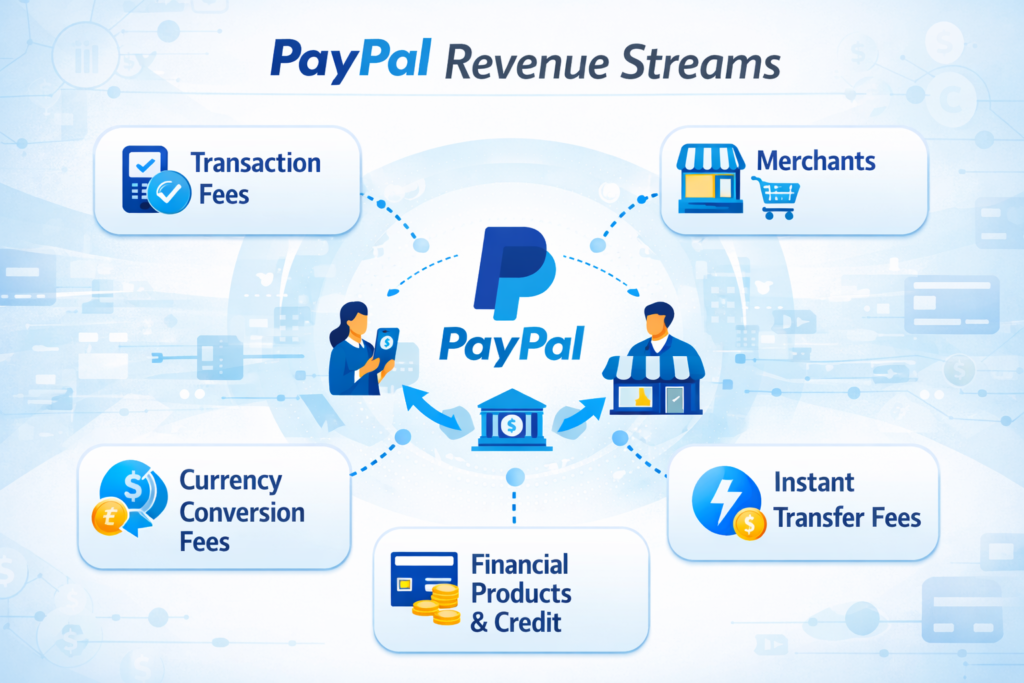
PayPal generates revenue through multiple streams. Transaction fees are the largest driver, but the company has built a diverse income base across financial services, merchant tools, and lending products.
Transaction Fees
The most direct way PayPal makes money is by charging a fee on transactions.
When a consumer pays a merchant using PayPal, the merchant pays a percentage of the transaction value plus a small flat fee. In the US, this is typically around 3.49% plus $0.49 for standard checkout transactions, though rates vary by product, transaction type, and region.
Key points about transaction fees:
- Merchants bear the cost, not consumers
- International transactions carry higher fees due to added complexity
- Micropayments and charity transactions have different fee structures
- Volume discounts are available for large merchants
This fee model scales directly with the value of payments processed through the network. As PayPal’s total payment volume grows, so does its fee revenue.
Currency Conversion Fees
PayPal processes payments in more than 25 currencies. Whenever a transaction involves a currency exchange, PayPal charges a conversion fee on top of the exchange rate.
This revenue stream is particularly significant for:
- International freelancers receiving payments from foreign clients
- Cross-border eCommerce transactions
- Consumers sending money abroad through Xoom
Currency conversion margins are relatively small per transaction but add up to a meaningful revenue stream at PayPal’s global scale.
Merchant Services
PayPal offers a comprehensive suite of tools that businesses pay for beyond basic payment acceptance. These services generate both transactional fees and subscription-style revenue.
Merchant services include:
- Payment gateways for integrating PayPal into websites and apps
- Invoicing tools for freelancers and service businesses
- Subscription billing for recurring payment management
- Point-of-sale tools for in-person transactions
- Checkout optimization through PayPal’s branded and unbranded (Braintree) checkout products
These tools deepen PayPal’s relationship with merchants and make it harder for them to switch to a competitor once embedded in their operations.
PayPal Credit and Buy Now, Pay Later
PayPal has a significant presence in consumer lending. Through its Pay Later products, it allows consumers to split purchases into installments at checkout.
This serves two purposes. It increases conversion rates for merchants, since more buyers complete purchases when they have flexible payment options. It also generates interest income and fees for PayPal when consumers use financing products.
Buy Now Pay Later has become a fast-growing segment for the company, particularly through its “Pay in 4” product that splits purchases into four interest-free installments.
Instant Transfer Fees
By default, transferring money from a PayPal account to a bank account takes one to three business days and is free. PayPal charges a fee for instant transfers that arrive within minutes.
This is a small but consistent revenue stream. Consumers and businesses who need fast access to funds pay for the convenience, and PayPal collects that fee every time.
Value-Added Financial Services
Beyond core payments, PayPal offers premium services that businesses pay for to operate more efficiently:
- Fraud protection tools that screen transactions and reduce chargebacks
- Dispute management to handle buyer and seller conflicts
- Business analytics dashboards that give merchants insights into sales and customer behavior
- Working capital loans through PayPal Business Loan, which advances cash to merchants based on their sales history
These services add recurring revenue and increase the overall value PayPal delivers to business customers.
PayPal Business Model Canvas
Here is how PayPal’s business model breaks down across the key elements of the canvas:
Key Partners
PayPal works closely with banks and financial institutions to move money across borders. It relies on card networks like Visa and Mastercard to process card-funded transactions. eCommerce platforms, app developers, and payment gateway partners extend PayPal’s reach into new markets and shopping environments.
Key Activities
The core activities that keep PayPal running include payment processing at massive scale, fraud detection and risk management, regulatory compliance across hundreds of jurisdictions, and continued development of its financial technology infrastructure.
Key Resources
PayPal’s most valuable resources are its payment processing infrastructure, the trust of hundreds of millions of users, its portfolio of financial licenses worldwide, and its data assets that power fraud detection and personalization.
Value Proposition
For consumers, PayPal offers secure, convenient checkout without sharing financial details with every merchant. For businesses, it offers a trusted payment brand that increases conversion, reduces fraud risk, and provides access to global customers.
Customer Segments
PayPal serves online shoppers, freelancers, small and medium businesses, large enterprises, and peer-to-peer money senders. Venmo extends that reach into social and casual payments among younger users.
The PayPal Ecosystem
PayPal has built a broad ecosystem of products that extend its reach well beyond the core PayPal wallet.
Venmo is the peer-to-peer payment app built for social transactions. Users send money to friends for split bills, rent, and casual purchases. Venmo generates revenue through instant transfer fees, merchant payments, and its Venmo debit card.
Braintree is PayPal’s developer-focused payment processing platform used by companies like Uber and Airbnb. It handles high-volume, complex payment flows and competes directly with Stripe.
PayPal Checkout is the familiar yellow button that appears on millions of websites worldwide. It reduces friction at checkout and leverages PayPal’s stored credentials to speed up the buying process.
PayPal Credit and Pay Later products give consumers flexible payment options that drive higher average order values for merchants.
PayPal Business Accounts give merchants a full-featured platform for managing payments, invoices, customer data, and cash flow.
Xoom is PayPal’s international money transfer service, competing with Western Union and Wise in the remittance market.
Each product in the ecosystem drives usage, generates fees, and deepens the data and trust advantages that PayPal holds across its network.
Why PayPal Became So Successful
PayPal did not just get lucky. It built a durable business through several strategic advantages that are hard to replicate.
Early mover advantage. PayPal arrived at the moment online commerce was taking off. eBay’s massive user base gave it scale before most competitors even existed. That early adoption created habits and trust that stuck.
Buyer protection. PayPal’s purchase protection policy gave consumers confidence to buy from unknown sellers online. This was a major differentiator in the early days of eCommerce when fraud was a genuine concern.
Network effects. Every new user who joined PayPal made it more useful for existing users. Every new merchant who accepted PayPal gave consumers more reasons to use it.
Easy integration. PayPal made it straightforward for small businesses and developers to accept payments without building complex infrastructure. That ease of integration drove widespread adoption among merchants.
Global reach. By expanding to more than 200 markets and supporting 25+ currencies, PayPal became the default cross-border payment option for many international transactions.
Brand trust. PayPal built one of the most trusted names in financial technology. That trust translates directly into consumer willingness to store payment credentials and use the service repeatedly.
PayPal Competitors
PayPal operates in a fiercely competitive market. Its main competitors include:
Stripe targets developers and technology-forward businesses with a flexible API-first approach. It has become the preferred payment infrastructure for startups and scale-ups globally.
Square (now Block) focuses on small businesses with integrated point-of-sale hardware and software. It competes with PayPal’s merchant tools and business banking products.
Apple Pay and Google Pay compete at the consumer level by embedding payments directly into device ecosystems. They reduce the need for a separate PayPal account at checkout.
Adyen targets enterprise-level merchants with omnichannel payment processing across online, in-store, and mobile channels.
Wise and Remitly compete with PayPal’s international money transfer capabilities, often offering better exchange rates.
The common thread across these competitors is that each one targets a specific pain point in the payments experience. PayPal’s advantage is breadth: it tries to serve all of these use cases under one brand.
PayPal’s Growth Strategy
PayPal is not standing still in the face of competition. Its growth strategy focuses on several key areas:
Expanding mobile and in-store payments. PayPal has been building out its presence in physical retail through QR codes, contactless payments, and the Venmo card.
Buy Now Pay Later expansion. Pay Later products are being pushed to more merchants and geographies as consumer appetite for flexible payment options grows.
International markets. PayPal continues to invest in markets in Asia, Latin America, and Africa where digital payments are growing rapidly and traditional banking is underpenetrated.
Merchant value-added services. By offering working capital, analytics, and business management tools, PayPal deepens its relationship with merchants beyond just processing payments.
Partnerships with banks and fintechs. Rather than only competing with financial institutions, PayPal has been building co-branded products and data-sharing agreements that integrate it deeper into existing financial infrastructure.
Venmo monetization. Venmo has more than 90 million users but historically generated less revenue than PayPal’s core platform. PayPal is working to close that gap through merchant payments, debit cards, and Pay Later integration.
Challenges in PayPal’s Business Model
Despite its advantages, PayPal faces real challenges:
High transaction fees for merchants. PayPal’s fee structure is more expensive than some competitors, particularly Stripe for technology-focused businesses. This creates pressure to win on brand and features rather than price alone.
Intense fintech competition. The payments landscape has fragmented dramatically. Every major tech company, bank, and startup is competing for a slice of the transaction fee pool that PayPal has historically owned.
Regulatory complexity. Operating as a financial institution across 200+ countries means navigating an enormous web of financial regulations, compliance requirements, and licensing obligations. This adds cost and operational complexity.
Fraud and chargeback risk. As a high-value target for fraud, PayPal must invest heavily in security and absorbs meaningful losses from disputed transactions.
Consumer habit changes. Younger consumers are gravitating toward native device payment solutions like Apple Pay and Google Pay, which do not require a separate account or app.
The Future of PayPal
PayPal is adapting to a changing payments landscape. Several themes are likely to shape its future:
AI-driven fraud detection and personalization. PayPal has enormous transaction data that can power machine learning models for fraud screening, offer personalization, and risk assessment. Investing in AI here creates a data moat that is hard to replicate.
Cryptocurrency integration. PayPal already supports buying, selling, and holding cryptocurrency for US users and has been expanding crypto-related features. It is positioned to serve as a bridge between traditional payments and digital assets.
Deeper eCommerce integration. As shopping becomes more embedded in social media, messaging apps, and video platforms, PayPal will need to integrate into those surfaces or risk being left out of the checkout flow.
Fintech ecosystem expansion. PayPal has the scale to become a full financial services provider for small businesses, offering not just payments but banking, lending, payroll, and insurance under one platform.
Conclusion
PayPal’s business model is built on a two-sided payments network that earns every time a transaction flows through its platform. Transaction fees are the backbone, supported by currency conversion fees, merchant services, consumer lending, instant transfer charges, and premium business tools.
What makes PayPal durable is not just the fees it collects today, but the trust it has built with consumers and merchants over more than two decades. That trust is genuinely hard to replicate and gives PayPal a foundation to expand into adjacent financial services.
Competition is intense and growing. But PayPal’s combination of global scale, brand recognition, a broad product ecosystem, and network effects gives it a strong base to navigate a rapidly changing fintech market.
For anyone trying to understand how digital payments work and how money flows through the internet economy, PayPal remains one of the clearest and most instructive models to study.
FAQs
PayPal primarily makes money by charging transaction fees to merchants when customers pay using the platform. The company also earns from currency conversion fees, instant transfer fees, merchant services, and financial products such as PayPal Credit.
PayPal operates a two-sided platform business model that connects consumers and merchants. It provides digital payment infrastructure that allows users to send money, receive payments, and complete online transactions securely.
Yes, PayPal is one of the largest fintech companies in the world. It provides digital payment solutions, financial services, and payment processing technology for individuals and businesses.
PayPal is a publicly traded company listed on the NASDAQ stock exchange under the ticker symbol PYPL. The company was previously owned by eBay before becoming independent in 2015.
Yes, PayPal charges transaction fees mainly to merchants for processing payments. Fees may vary depending on the country, payment method, and whether the transaction is domestic or international.
Businesses can integrate PayPal into their websites or apps to accept payments. Customers pay through PayPal using their balance, bank account, or card, and the payment is processed through PayPal’s secure payment infrastructure.
PayPal offers several financial and payment services including:
Online payment processing
Peer-to-peer payments
Merchant checkout solutions
Payment gateways
Business invoicing tools
Digital wallets
Some major competitors of PayPal include:
Stripe
Square
Apple Pay
Google Pay
Adyen
These companies also provide digital payment and fintech solutions.
Yes, PayPal is considered a secure payment platform because it uses encryption, fraud detection systems, and buyer protection policies to safeguard transactions.
PayPal has hundreds of millions of active accounts worldwide, including consumers, businesses, and merchants who use the platform for digital payments.
Discover more from Business Model Hub
Subscribe to get the latest posts sent to your email.