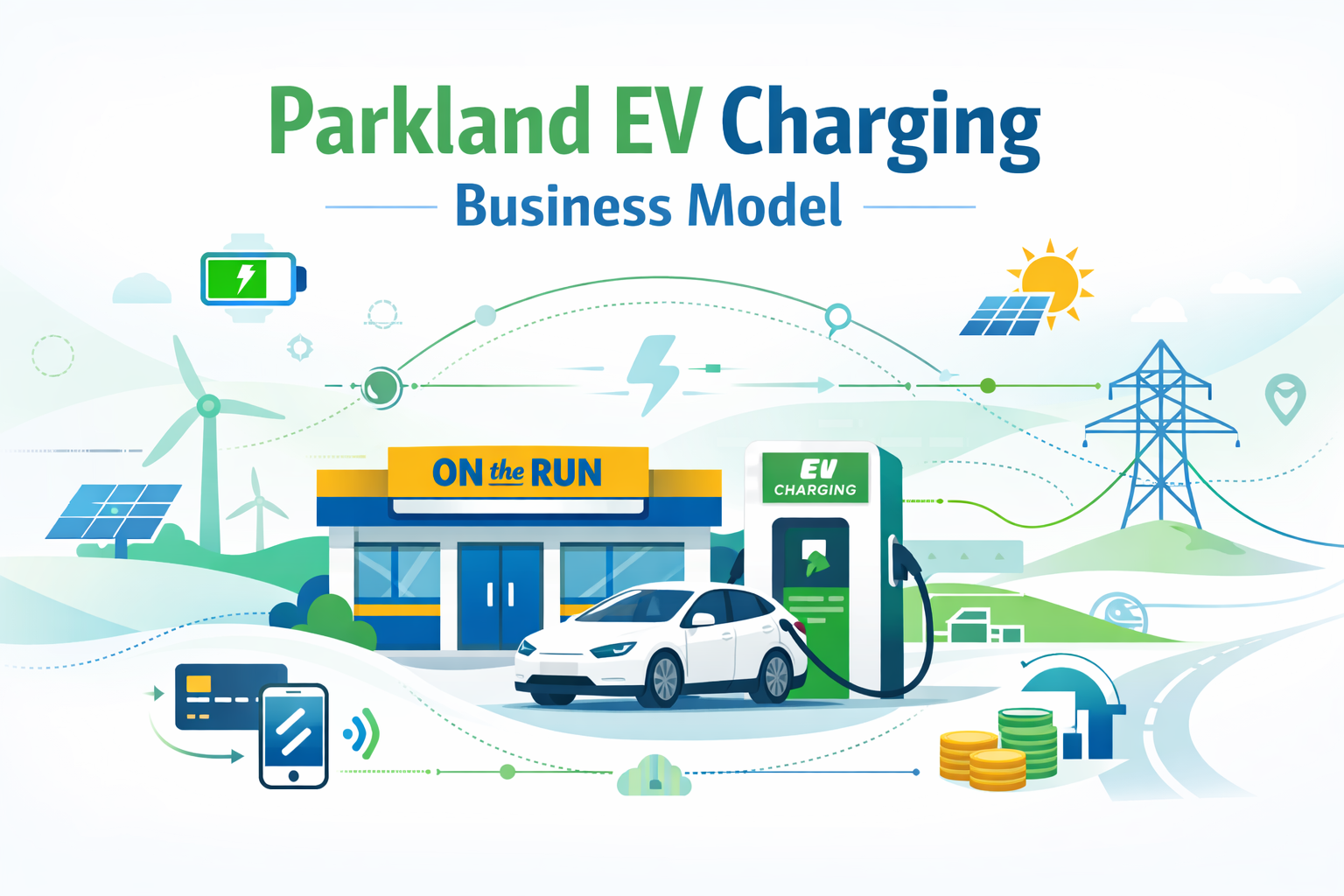
The energy market is shifting fast. Electric vehicles are no longer a niche product reserved for early adopters. They are becoming mainstream, and the infrastructure needed to support them is one of the biggest business opportunities of the decade. Traditional fuel companies are facing a choice: adapt or become obsolete.
Parkland Corporation, one of Canada’s largest fuel distributors and convenience retailers, has chosen to adapt. Rather than watching the EV revolution from the sidelines, Parkland is actively building the charging infrastructure that electric vehicle drivers will depend on. And it is doing so in a uniquely smart way, by using the network it already has.
This blog breaks down Parkland’s EV charging business model, how it works, where the money comes from, and why it could serve as a blueprint for fuel retailers transitioning into the clean energy era.
What Is Parkland Corporation?
Before diving into the EV strategy, it helps to understand who Parkland actually is.
Parkland Corporation is a Canadian fuel distributor and convenience retailer headquartered in Calgary, Alberta. The company operates thousands of locations across Canada, the United States, and the Caribbean. Its retail footprint includes some of the most recognizable fuel and convenience brands in the country.
Brands under Parkland’s umbrella include:
- Chevron
- Ultramar
- Pioneer
- Fas Gas Plus
- ON the RUN convenience stores
Parkland’s core business has traditionally revolved around fuel distribution and retail. It supplies gasoline, diesel, and other petroleum products to consumers, businesses, and commercial fleets. Its convenience store network brings in significant foot traffic and retail revenue alongside fuel sales.
But the company has been quietly repositioning itself. Over the past few years, Parkland has made strategic moves toward renewable fuels, low-carbon energy products, and EV charging infrastructure. The goal is clear: evolve from a fuel retailer into a full-service energy and mobility provider.
The energy transition strategy rests on a few core ideas:
- Fuel demand will decline over time as EV adoption grows.
- The physical locations Parkland already owns are strategically valuable for the next era of energy delivery.
- Charging infrastructure is a long-term growth business with strong revenue potential.
- Convenience retail and charging are a natural pairing.
This thinking is what gave birth to Parkland’s EV charging network, branded under the ON the RUN name.
Why does EV charging matter for fuel retailers specifically?
The answer is simple. Fuel retailers have something EV charging networks desperately need: locations. Charging infrastructure is only useful if it is placed where people actually travel. Highway corridors, urban fuel stops, travel centers, and convenience hubs are exactly the kinds of locations where EV drivers need to charge. Parkland has been building and maintaining these locations for decades. That physical presence is a serious competitive advantage that pure-play EV charging companies cannot easily replicate.
The ON the RUN EV Charging Network
Parkland’s EV charging initiative is built around its ON the RUN brand, which most Canadians recognize as a convenience store chain. Parkland has extended that brand into EV charging, creating what it calls the ON the RUN ultra-fast EV charging network.
The network is being rolled out at existing Parkland retail locations, which means no need to acquire new land or build standalone charging plazas from scratch. The infrastructure is being layered on top of sites that already serve thousands of drivers every day.
Key technical specs of the ON the RUN charging network:
- Chargers deliver between 150 and 200 kW of power.
- Most vehicles can reach a meaningful charge within 20 to 30 minutes.
- DC fast charging technology is used, which is currently the fastest widely available standard for public charging.
The 20 to 30 minute charging window is important from a business perspective. It is long enough for drivers to step inside, grab a coffee, buy snacks, use the restroom, and browse the store. But it is short enough that the experience does not feel like an inconvenient ordeal. That window is where Parkland’s retail ecosystem kicks in.
Installation locations include:
- Highway fuel stations along major travel corridors
- Standalone convenience store locations
- Travel centers with attached food service
- Urban and suburban retail fuel stops
The strategy here is deliberate. Parkland is not just installing chargers in parking lots. It is transforming its existing stations into what the company calls mobility hubs. These are destinations where drivers can refuel their bodies and their vehicles at the same time, whether they are running on gasoline or electrons.
How Parkland’s EV Charging Business Model Works
The business model behind Parkland’s EV charging network is multi-layered. It is not simply a case of installing chargers and collecting fees. There are several interlocking components that work together to generate value.
The Infrastructure Layer
At the foundation, Parkland installs and operates ultra-fast DC charging stations at its retail locations. This involves significant capital investment in hardware, electrical upgrades, grid connections, and installation.
The company is not outsourcing this to a third-party network and taking a cut. Parkland is building and owning the infrastructure directly. That means higher upfront costs but also higher long-term control over the customer experience, the pricing, and the revenue.
Owning the infrastructure also means Parkland can integrate charging directly into its loyalty and payment ecosystem, which is a key part of how the model generates repeat business.
The Platform Layer
Once the chargers are installed, customers need a way to access and pay for charging sessions. Parkland handles this through two main channels.
Access methods include:
- Direct credit or debit card payment at the charger
- The Journie Rewards app, which is Parkland’s existing loyalty and payment platform
The Journie app is already used by millions of Canadian drivers for fuel discounts, rewards points, and promotions. Integrating EV charging into that same app creates a seamless experience for existing Parkland customers who are transitioning to electric vehicles. It also gives Parkland valuable data on charging behavior, which can be used to optimize pricing, promotions, and station placement.
The Retail Ecosystem
This is where Parkland’s model gets genuinely interesting. While a standalone charging company collects a fee and sends the driver on their way, Parkland captures additional value through everything that happens while the car is plugged in.
What charging site visitors have access to:
- ON the RUN convenience stores stocked with snacks, drinks, and travel essentials
- Attached restaurant and food service options at many locations
- Clean restrooms and rest areas for road trip travelers
- In some cases, car wash services and other amenities
A driver who spends 25 minutes charging is likely to spend money inside the store. That spending adds a revenue layer on top of the charging fee itself. It also increases the overall profitability of each location, which is important because the margins on EV charging alone can be thin in the early stages of adoption.
Revenue Streams in Parkland’s EV Charging Model
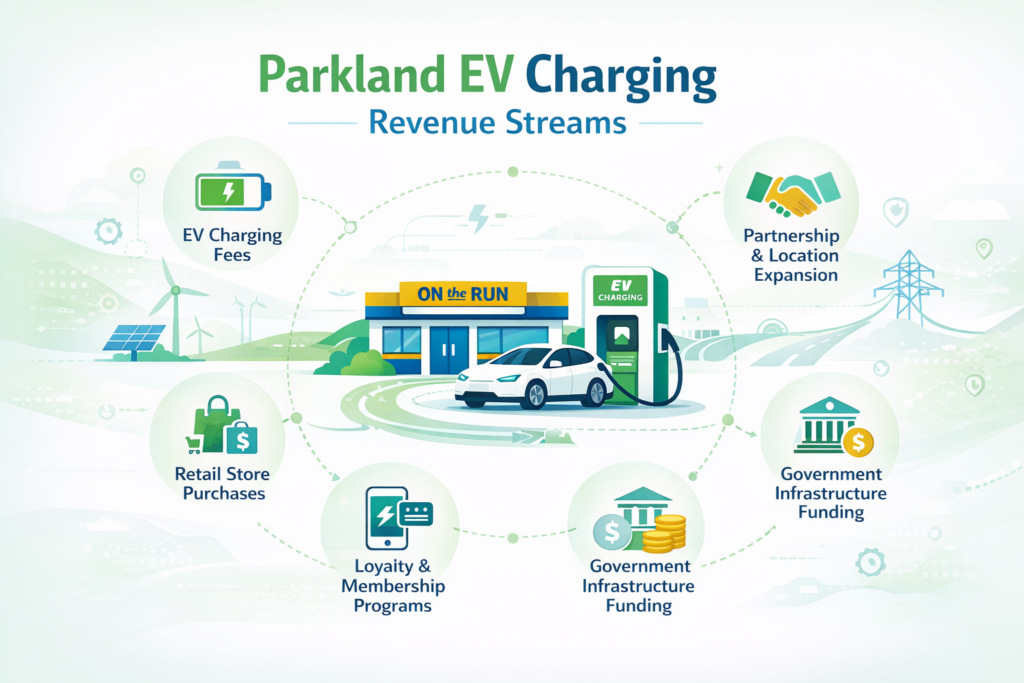
One of the strongest aspects of Parkland’s approach is that it is not dependent on a single revenue stream. The model stacks multiple income sources on top of each other, which makes the business more resilient during the early growth phase of EV adoption.
EV Charging Fees
The most direct revenue source is the fee charged to EV drivers for using the chargers.
Pricing structures can include:
- Per kWh pricing, where drivers pay for the exact amount of electricity they consume
- Per session flat fees for a set charging period
- Time-based pricing, especially relevant if a vehicle is occupying a charger after it has finished charging
Per kWh pricing tends to be the most transparent and consumer-friendly approach. It allows drivers to compare costs directly against home charging and other public networks. As EV adoption scales up and more drivers use Parkland chargers regularly, this revenue stream becomes increasingly significant.
Retail Sales During Charging
This is arguably the most powerful revenue driver in the model, and it is one that pure-play EV charging networks simply cannot replicate.
When a driver plugs in and walks into the ON the RUN store, they are a captive retail customer for the next 20 to 30 minutes. Research on consumer behavior at fuel stations consistently shows that the longer a customer is on-site, the more they spend.
Typical in-store purchases during a charging session might include:
- Hot and cold beverages
- Packaged snacks and fresh food
- Travel essentials like phone chargers, sunscreen, and over-the-counter medication
- Lottery tickets and tobacco products
- Prepared food items from attached food service partners
Multiplied across thousands of charging sessions per day across hundreds of locations, this retail uplift becomes a substantial revenue contributor. It also makes the economics of each charging station location look significantly better when retail and charging revenue are considered together.
Loyalty Program Revenue and Retention
The Journie Rewards program plays a dual role in the business model. It generates direct engagement and repeat visits while also enabling more sophisticated promotional strategies.
How the Journie app contributes to the EV charging model:
- Drivers earn points on charging sessions that can be redeemed for fuel discounts, free products, or other rewards
- Push notifications can drive visits to specific locations during low-utilization periods
- Bundled promotions can encourage EV drivers to shop in-store
- Data from charging sessions helps Parkland understand customer patterns and optimize the network
Loyalty programs are proven tools for increasing customer lifetime value. By integrating EV charging into an existing loyalty ecosystem rather than building a new one from scratch, Parkland gets a head start on building habitual charging behavior among its customers.
Government Grants and Infrastructure Financing
Building EV charging infrastructure at scale is expensive. Parkland has been smart about using available public funding to offset those costs.
Key funding sources include:
- Financing through the Canada Infrastructure Bank, which supports large-scale clean energy and transportation infrastructure projects
- Federal and provincial government grants aimed at accelerating EV charging deployment across the country
- Program funding tied to Canada’s broader clean fuel and electrification policy goals
The availability of government support reduces the effective capital cost of the charging network and improves the return on investment timeline. It also reflects a broader policy alignment. Canadian governments at multiple levels are actively trying to expand public charging infrastructure, and Parkland’s existing network of high-traffic locations makes it an ideal partner for that goal.
Partnerships and Infrastructure Leasing
While Parkland primarily owns and operates its own charging infrastructure, there is also potential revenue from third-party arrangements.
Possible partnership models include:
- Leasing space at Parkland-owned locations to third-party charging operators
- Co-branding arrangements with automakers or charging networks
- Infrastructure agreements with commercial property owners who want to offer EV charging without building it themselves
- Fleet charging contracts with companies that operate electric delivery vehicles or service fleets
These partnership revenue streams are still developing but represent a meaningful opportunity as the market matures and the demand for managed charging infrastructure grows.
Why EV Charging Fits Parkland’s Existing Business
The strategic logic behind Parkland’s EV push is not complicated, but it is compelling.
Parkland already operates high-traffic locations at exactly the kinds of places where EV drivers need to charge. Highway off-ramps, busy urban intersections, travel centers along major corridors. These locations took years and significant capital to develop. They come with existing utilities, parking infrastructure, staff, and customer traffic.
Adding EV charging to these locations is far more efficient than building standalone charging plazas from scratch. The land is already there. The permits are already held. The customers are already coming.
Key strategic advantages Parkland holds over pure-play EV charging competitors:
- An existing network of thousands of high-traffic locations across Canada
- Established relationships with regular customers through the Journie app and fuel loyalty programs
- The ability to cross-subsidize charging with retail revenue during the early adoption phase
- Experience operating complex multi-site fuel and retail networks at scale
- Strong brand recognition in the markets where it operates
There is also a customer behavior argument. Drivers have been stopping at Parkland locations for decades. When those same drivers switch to electric vehicles, Parkland wants to ensure they have a reason to keep stopping. If a Parkland station has fast chargers and a well-stocked store, an EV driver has every incentive to continue the habit they already have.
This is the core insight behind the mobility hub concept. Parkland is not trying to sell electricity the same way it sold gasoline. It is selling a stop, a destination, a place where travel-related needs get met. The energy delivery method changes from a pump to a charger, but the fundamental value proposition stays the same.
Parkland’s EV Charging Expansion Strategy
Parkland is not treating EV charging as a small pilot project. The company has announced substantial expansion targets that reflect a long-term commitment to building out the network.
Key expansion targets include:
- Approximately 1,800 EV charging ports planned by 2028
- Over $200 million in financing committed to support the rollout
- Hundreds of charging locations across the country
Priority expansion markets include:
- British Columbia, which has one of the highest EV adoption rates in Canada
- Ontario, Canada’s most populous province with dense highway networks
- Quebec, where provincial EV incentives have driven strong adoption
- Major highway travel corridors connecting urban centers
The geographic focus makes sense. Parkland is targeting the markets where EV adoption is already highest, which means higher charger utilization from day one. As adoption spreads to other provinces and regions, the network can expand accordingly.
The $200 million financing commitment signals that this is not a token gesture toward sustainability. It is a real capital allocation toward a business that Parkland believes will be a core revenue driver in the years ahead.
Competitive Advantages of Parkland’s EV Model
Not every company can replicate what Parkland is building. The combination of physical infrastructure, existing customer relationships, retail integration, and government support creates a set of advantages that is genuinely difficult to duplicate.
Existing retail network at scale
Most EV charging companies are building networks from scratch. They need to secure land, negotiate leases, obtain permits, run electrical connections, and then attract customers to new locations. Parkland skips most of that process. Its locations are already built, already permitted, and already busy.
The convenience experience
When a driver charges at a Tesla Supercharger in a parking lot, there is often little to do while waiting. Parkland stations offer a fundamentally different experience. The presence of food, coffee, restrooms, and retail transforms the charging stop from a chore into a convenient travel break.
Fast charging technology
With chargers delivering up to 200 kW, Parkland’s network sits at the faster end of what is currently available on public networks. Faster charging means less waiting and a better customer experience, which drives repeat visits.
Positioning in the energy transition
Parkland’s EV investment is also a narrative shift. The company is communicating to investors, regulators, and customers that it is not a company in decline fighting a losing battle against electrification. It is a company actively shaping the new energy landscape. That positioning has value beyond the direct revenue from chargers.
Challenges in the EV Charging Business
A fair analysis of Parkland’s EV strategy has to acknowledge the real challenges involved. The EV charging business is not without its difficulties, and Parkland will face meaningful headwinds along the way.
High infrastructure costs
Installing ultra-fast DC chargers is expensive. Each charger unit, combined with the electrical upgrades needed to support it, can cost tens of thousands of dollars. Multiply that across hundreds of locations and the capital requirements are substantial. Even with government support, the investment is significant.
Low utilization in early adoption phases
EV charging networks are most profitable when chargers are being used frequently. In the early stages of EV adoption, many public chargers sit idle for long stretches of the day. Low utilization means slow payback on the capital investment and limited revenue from charging fees.
Grid capacity constraints
Installing 150 to 200 kW chargers at multiple sites puts real demands on local electrical grids. In some locations, grid upgrades are necessary before fast chargers can even be installed. Coordinating with utilities on those upgrades adds cost and time to the rollout.
Competition from established EV charging networks
Parkland is not entering an empty market. It faces competition from networks that already have significant infrastructure and brand recognition.
Key competitors include:
- Tesla Supercharger network, which is the largest fast charging network in North America and increasingly open to non-Tesla vehicles
- ChargePoint, one of the largest third-party charging networks with tens of thousands of locations
- Electrify America, which has focused specifically on highway corridor charging with high-power stations
- Petro-Canada’s own charging network, which competes directly in the Canadian market
Differentiating in this competitive landscape requires Parkland to lean into what makes its stations unique, which comes back to the retail and convenience experience.
The Future of Parkland’s EV Charging Strategy
Looking further ahead, there are several directions in which Parkland’s EV charging strategy could evolve.
Integration with renewable energy
As Parkland expands its charging network, there is an opportunity to pair charging stations with on-site renewable energy generation. Solar canopies over parking areas, combined with battery storage systems, could allow some locations to generate their own clean power for charging. This would reduce grid dependency, lower electricity costs, and strengthen the sustainability narrative.
Smart charging and AI-driven optimization
Future charging networks will not just deliver electricity passively. They will use real-time data to manage energy demand, optimize pricing based on grid conditions, and predict when and where charging demand will spike. AI-driven energy management could help Parkland maximize revenue from each charger while reducing operating costs.
Expansion across North America
Parkland already has operations in the United States and the Caribbean. As its Canadian charging network matures, there is a clear pathway to expanding into US markets, particularly in regions with strong EV adoption like California, the Pacific Northwest, and the Northeast.
Fleet charging contracts
Commercial fleets are electrifying rapidly. Delivery companies, municipal transit systems, and corporate vehicle fleets are all moving toward electric. Parkland could develop dedicated fleet charging solutions, offering managed charging contracts to large vehicle operators who need reliable, high-volume charging at fixed locations.
Becoming a multi-energy mobility platform
The ultimate vision Parkland seems to be working toward is a company that serves drivers regardless of what powers their vehicle. Gasoline, diesel, hydrogen, electricity. The fuel type changes but the customer relationship stays intact. That kind of multi-energy positioning is rare and potentially very valuable as the market continues its transition over the next two decades.
Conclusion
Parkland Corporation’s EV charging strategy is a textbook example of a legacy energy company using its existing assets intelligently rather than fighting the future.
The company is not trying to stop EV adoption. It is not pretending the shift is not happening. Instead, it is asking a more productive question: how do we make sure that when drivers go electric, they still stop at our locations?
The answer it has built involves fast charging infrastructure layered on top of a trusted retail network, integrated into a loyalty ecosystem that millions of Canadians already use, and supported by government financing that reduces the capital burden.
The model works because it stacks multiple value drivers on top of each other:
- Charging fees provide direct revenue from the electricity itself
- Retail spending during the charging window adds a second revenue layer that pure-play competitors cannot match
- Loyalty programs drive repeat behavior and customer data
- Government support reduces the effective cost of infrastructure buildout
- The existing location network eliminates the need to acquire and develop new sites from scratch
The challenges are real. Utilization rates need to grow, grid infrastructure needs investment, and competition from established charging networks is fierce. But Parkland enters this market with advantages that most competitors lack. The land, the brand, the customer relationships, and the retail ecosystem are all already in place.
What Parkland is ultimately building is not just a charging network. It is a new version of the roadside stop, reimagined for an electric future. The vehicles outside are changing. The store inside stays the same.
That continuity, combined with smart infrastructure investment, is what makes Parkland’s EV strategy worth watching closely as Canada and the world continue moving toward electric mobility.
FAQs
Parkland Corporation operates an EV charging business model by installing ultra-fast EV charging stations at its retail fuel and convenience store locations. Drivers pay for electricity to charge their vehicles, while Parkland also generates revenue through in-store purchases, loyalty programs, and infrastructure partnerships.
Parkland operates the ON the RUN EV Charging Network, which provides fast and ultra-fast charging stations at selected convenience store and fuel station locations across Canada.
Parkland earns revenue from multiple sources including:
EV charging session fees
Convenience store purchases during charging stops
Loyalty and rewards programs
Government infrastructure funding
Partnerships and location expansion deals
This combination creates a multi-revenue mobility ecosystem around EV charging stations.
Parkland is investing in EV charging to adapt to the global shift toward electric mobility. By installing chargers at its existing retail locations, the company can transform traditional fuel stations into multi-energy mobility hubs that serve both gasoline and electric vehicle drivers.
Most chargers in the ON the RUN EV Charging Network are ultra-fast DC chargers capable of delivering 150 kW or more, allowing many electric vehicles to recharge in about 20–30 minutes depending on the vehicle model.
Parkland installs EV charging stations primarily at:
Convenience store locations
Highway travel centers
Retail fuel stations
These locations are designed to give EV drivers access to food, rest, and shopping while their vehicles charge.
Parkland Corporation plans to expand its EV charging infrastructure significantly, targeting hundreds of locations and thousands of charging ports across Canada over the coming years.
Parkland’s strategy focuses on combining charging infrastructure with retail experiences. Instead of standalone charging stations, the company integrates EV chargers with convenience stores, travel stops, and loyalty programs to create a more profitable ecosystem.
Discover more from Business Model Hub
Subscribe to get the latest posts sent to your email.