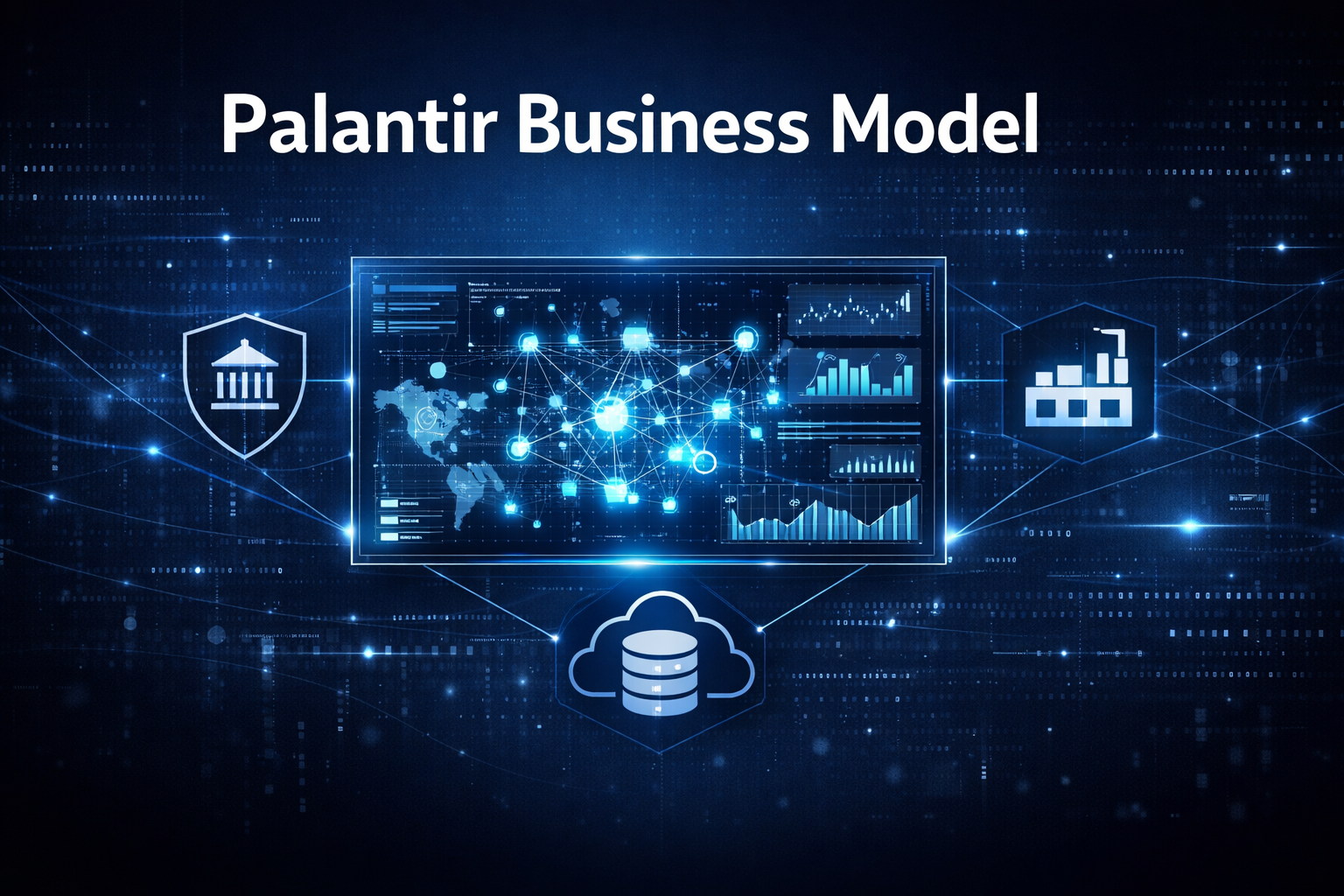
Palantir Technologies operates on a high-value enterprise SaaS and services hybrid model, where it provides advanced data analytics platforms to governments and large enterprises through long-term contracts, deep customization, and mission-critical integration. Unlike conventional software companies, Palantir does not sell a product you can simply download and use. It sells operational intelligence, and that distinction changes everything about how the company works, grows, and earns.
Most Software Companies Sell Subscriptions. Palantir Sells Intelligence.
There is a certain kind of software company that everyone understands. You sign up, pay a monthly fee, get a dashboard, maybe use it for a while, and eventually cancel if it stops feeling worth it. That is the SaaS model in its most familiar form, and it has produced some of the most valuable companies in the world.
Palantir is not that kind of company.
Founded in 2003 by Peter Thiel, Alex Karp, and a small group of PayPal alumni, Palantir was built around a very specific and very difficult problem: how do you make sense of enormous, messy, contradictory datasets in environments where getting the answer wrong has serious consequences? The early clients were not startups looking for productivity tools. They were intelligence agencies trying to prevent terrorism. The stakes were as high as stakes can be, and that origin shaped everything about how Palantir thinks about its business.
Peter Thiel brought the founding capital and the ideological framework. Alex Karp, who holds a doctorate in neoclassical social theory from Frankfurt, became the face of the company and its long-term CEO. Together, they built something that defies easy categorization. Palantir is part software company, part consultancy, part defense contractor, and part data infrastructure provider. Understanding how it actually makes money requires understanding all of those layers at once.
In this article, we will break down exactly how Palantir earns revenue, who its customers are, why its model is extraordinarily difficult to replicate, and what founders and business thinkers can take away from studying it.
What Does Palantir Actually Do?
Before getting into the business model mechanics, it helps to understand what Palantir’s products actually are and what problems they solve.
At its core, Palantir builds software that takes data from many different sources, standardizes it, connects it, and turns it into something that humans can use to make better decisions. That sounds simple, but the execution is enormously complex. Most large organizations, whether a government agency or a multinational corporation, sit on top of data that lives in dozens of incompatible systems. Different departments use different formats. Legacy infrastructure does not talk to modern tools. Information that should be connected is siloed behind bureaucratic and technical walls.
Palantir’s platforms cut through that complexity.
Palantir Gotham
Gotham is the platform built for defense and intelligence use cases. It was the product that put Palantir on the map, developed in close collaboration with agencies like the CIA and later adopted by military and law enforcement organizations around the world. Gotham allows analysts to bring together massive amounts of structured and unstructured data, find patterns, build timelines, map relationships between entities, and surface actionable intelligence.
The platform is designed for environments where the cost of a missed connection is potentially catastrophic. It does not just show you data. It helps you understand what the data means in relation to everything else you know.
Palantir Foundry
Foundry is Palantir’s commercial offering, aimed at large enterprises across industries including manufacturing, financial services, healthcare, energy, and logistics. Where Gotham was built for intelligence analysis, Foundry was built for operational decision-making.
A company using Foundry might integrate data from its supply chain systems, its financial reporting tools, its manufacturing floor sensors, and its customer relationship management software into a single unified environment. From there, teams can build models, run analyses, track performance, and make decisions with a level of data coherence they simply could not achieve with off-the-shelf tools.
Palantir Apollo
Apollo is the layer that sits beneath both Gotham and Foundry. It is Palantir’s continuous delivery and infrastructure management system, responsible for keeping deployments running reliably across cloud environments, on-premise installations, and even classified government networks. Apollo is less visible to end users but critically important to Palantir’s ability to operate in secure and complex environments where standard cloud infrastructure cannot go.
Together, these three platforms create a full-stack offering that covers intelligence, commercial operations, and deployment infrastructure. That combination is rare and difficult to build, which is a significant part of why Palantir holds the market position it does.
Who Actually Pays Palantir?
Palantir is deliberate and selective about its customers. This is not a company chasing volume. It does not want millions of small business owners signing up for a free trial. Its entire model is oriented around a small number of very large, very complex clients who have problems that cannot be solved by anything cheaper or simpler.
Government Clients
Government work is where Palantir started and it remains a defining part of the business. Palantir works with defense departments, intelligence agencies, law enforcement organizations, and public health institutions across the United States and its allies.
The U.S. Army, the Department of Defense, the CIA, the FBI, the Department of Health and Human Services, and Immigration and Customs Enforcement have all been reported clients at various points. International governments across Europe and beyond have also engaged Palantir for defense and public sector analytics.
Government contracts tend to be large, long-term, and extremely sticky. Once a government agency has integrated Palantir into its core analytical workflows, ripping it out is a major operational undertaking. These are not subscriptions that get cancelled because someone found a cheaper option. They are infrastructure relationships that persist for years or decades.
Commercial Clients
Palantir has invested heavily in growing its commercial segment over the past several years, and that effort has paid off. Its commercial client list includes some of the largest companies in the world across a wide range of industries. Organizations in aerospace, automotive, pharmaceuticals, financial services, and energy have all deployed Foundry to solve complex data integration and operational analytics challenges.
The common thread across all Palantir clients, both government and commercial, is complexity. These are organizations dealing with data problems that are genuinely hard. They have the budget to pay for a real solution, and they have enough at stake that a superficial or generic tool will not do.
Why Palantir Ignores Small and Medium Businesses
Palantir does not sell to startups or small businesses, and this is a deliberate strategic choice rather than an oversight. The onboarding process is intensive. Deploying Palantir inside an organization requires significant time, engineering resources, and change management. The return on that investment only makes sense at a certain scale of complexity and budget.
Chasing smaller clients would dilute Palantir’s focus, strain its forward-deployed engineering teams, and produce worse outcomes for everyone involved. By staying focused on large, complex organizations, Palantir can charge premium prices, maintain deep relationships, and build a reputation that itself becomes a competitive advantage.
The Palantir Business Model Broken Down
This is where things get interesting. Palantir’s revenue model has several distinct layers that work together to create a business that is genuinely different from conventional enterprise software.
Enterprise SaaS That Is Not Really SaaS
Palantir is sometimes described as a SaaS company, and in some technical senses that description fits. It sells software, and some of that software is delivered as a service through cloud infrastructure. But calling Palantir a SaaS company in the conventional sense is like calling a hospital a hotel because both provide rooms and meals.
A typical SaaS product is designed to be self-serve or nearly so. You sign up, configure your account, connect your tools, and you are off. The software company never needs to deploy engineers on-site. It does not need to understand your specific workflows, your organizational politics, or the technical debt buried in your legacy systems. It just needs to build something good enough that most customers can use it productively without hand-holding.
Palantir’s model is nothing like that. Deploying Palantir inside a client organization is a substantial engineering and consulting engagement. It involves understanding the client’s data infrastructure in detail, building custom integrations, training users, and often co-developing analytical workflows alongside the client’s own teams. This is closer to the model of a management consultancy or a systems integrator than a pure software company.
The software is real and it is central to the value Palantir provides. But the software cannot do what it does without the human layer that surrounds it. That combination is what clients are really buying.
The Custom Implementation Layer
One of the most distinctive features of Palantir’s model is the forward-deployed engineer. These are Palantir employees who embed themselves inside client organizations, sometimes for months at a time, working directly alongside the client’s teams to build out their deployment.
This is expensive for Palantir, and it is a significant reason why the company took a long time to become profitable. But it creates something extremely valuable: a solution that is deeply tailored to each client’s specific context and needs.
When a pharmaceutical company deploys Foundry, Palantir engineers do not just hand over access credentials and wish them luck. They work inside the client’s environment, understanding how clinical trial data flows, how regulatory reporting works, how different teams use different systems, and how all of that can be integrated into a coherent analytical platform. The result is not a generic dashboard. It is a purpose-built decision-making system that reflects the specific reality of that organization.
This level of customization creates something that is almost impossible to replicate quickly with a competing product. A rival company could theoretically build a platform with similar features. It could not instantly replicate months of co-development and organizational learning. That knowledge lives inside the deployment, and it makes switching away from Palantir genuinely painful.
Usage-Based and Contract Revenue
Palantir’s pricing is not a simple per-seat subscription. Revenue is tied to the scale and scope of deployment, which typically includes the amount of data being processed, the number of use cases being supported, the number of users accessing the platform, and the specific contractual terms negotiated with each client.
Multi-year contracts are standard, which provides Palantir with a degree of revenue predictability that most software companies can only dream about. When a government agency signs a three-year or five-year agreement, that revenue is largely locked in. Palantir can plan its engineering capacity, its sales investments, and its product development roadmap with real visibility into future cash flows.
Contract renewals and expansions are where a significant portion of Palantir’s growth comes from. An organization that starts with one use case frequently expands to more as they see what the platform can do. This upsell dynamic is built into the model at the structural level: the more deeply Palantir is embedded, the more obvious it becomes that it could be solving additional problems.
Deep Integration as a Strategic Moat
Perhaps the most important element of Palantir’s model is what happens after deployment. Once Palantir is running inside an organization, it does not sit alongside other systems as a reporting layer. It becomes embedded in core workflows. Analysts build processes around it. Decision-makers rely on outputs generated through it. Institutional knowledge accumulates inside it.
At that point, Palantir is not a software vendor. It is infrastructure. And you do not replace infrastructure casually.
This depth of integration is the core of Palantir’s competitive moat. It is not primarily about the features of the software, although those are genuinely impressive. It is about the switching cost that builds up over time as the platform becomes woven into how an organization operates. A competitor might build a technically superior product, but they cannot erase the years of institutional embedding that Palantir has already achieved inside its client base.
Revenue Streams in Detail
Palantir’s revenue comes from several distinct sources that together create a diversified and resilient financial model.
Government contracts remain the bedrock of Palantir’s business. These are typically large, multi-year agreements with defense and intelligence agencies. They provide stable, predictable revenue and come with the reputational credibility that opens doors to other government clients around the world.
Commercial SaaS subscriptions represent the growth frontier. As Palantir has invested in making Foundry more accessible to enterprise clients outside the government sector, this segment has expanded significantly. Commercial revenue is growing faster than government revenue, which is an important signal about where the company’s long-term trajectory is headed.
Professional services encompass the implementation work, training, and ongoing support that Palantir provides to clients. This includes the forward-deployed engineering model discussed earlier. Professional services revenue is sometimes viewed skeptically by investors who prefer pure software margins, but for Palantir it serves a strategic purpose beyond just generating fees. It is what makes the software actually work inside complex organizations.
Expansion revenue is the growth that comes from existing clients adding more use cases, more users, or more data to their existing deployments. Because of how deeply embedded Palantir becomes, this expansion is often the path of least resistance for both the client and Palantir. The infrastructure is already there. The relationships are established. Adding new applications on top of an existing deployment is far easier than a new sale.
Why the Model Works
Palantir’s business model succeeds for reasons that are genuinely structural, not just the product of clever marketing or a temporarily favorable market.
High Switching Costs
Switching costs in software are common, but Palantir’s are unusually high. The combination of deep technical integration, years of customized development, and institutional embedding means that the true cost of replacing Palantir is enormous. It is not just the cost of a new software license. It is the cost of rebuilding analytical workflows, retraining users, migrating years of data and institutional knowledge, and accepting a period of degraded operational capability during the transition. Very few organizations are willing to absorb that cost unless there is a compelling reason, and Palantir works hard to ensure there is never a compelling reason.
Niche Focus on Hard Problems
Palantir does not try to solve generic problems. It does not compete with Salesforce for CRM or with Slack for communication. It goes after problems that are genuinely complex, data-intensive, and high-stakes. That focus means Palantir is rarely the obvious choice for a casual buyer, but it is often the only viable choice for a serious one.
By defining its market narrowly around organizations with real complexity and real budgets, Palantir avoids the brutal commoditization that affects companies selling to broader markets. There are not ten credible alternatives to Palantir for a defense intelligence agency with classified data requirements. That scarcity protects pricing and margins.
Trust and Security as a Barrier to Entry
Building software that can operate inside classified government networks is not just a technical challenge. It requires years of relationship-building, security certifications, cleared personnel, and a track record that new entrants simply cannot manufacture. Palantir has been doing this work for over two decades. The trust it has earned with government clients is itself a formidable barrier to entry.
On the commercial side, the same dynamic applies in a softer form. Large enterprises dealing with sensitive operational data want to work with vendors they trust. Palantir’s track record with the most security-conscious clients in the world is a powerful credential in commercial sales conversations.
Long-Term Contract Stability
The multi-year contract structure gives Palantir something that most growth-stage software companies lack: revenue visibility. Knowing that a substantial portion of next year’s revenue is already contracted allows for more disciplined resource allocation, more patient product development, and less pressure to chase short-term growth at the expense of long-term value.
The Real Challenges in Palantir’s Model
A complete analysis requires honesty about the difficulties and risks in Palantir’s approach.
Government dependence has historically been a significant concentration risk. When Palantir was generating a large majority of its revenue from government contracts, its financial performance was heavily exposed to the political and budgetary cycles that govern defense spending. Budget freezes, contract disputes, and policy shifts can all affect revenue in ways that Palantir cannot fully control.
Long sales cycles are an inherent feature of selling to large enterprises and governments. Procurement processes at these organizations can take months or years. That means Palantir must invest in sales relationships long before seeing any revenue, and it must maintain those relationships patiently through lengthy evaluation and negotiation processes. For a company that wants to grow quickly, this is a genuine constraint.
High implementation costs affect profitability. The forward-deployed engineering model is strategically valuable, but it is also expensive. Palantir has had to work hard to improve the efficiency of its implementation process and reduce the cost of getting new clients up and running, and this remains an ongoing operational challenge.
Data privacy controversy is something Palantir cannot fully escape given its history and client base. The company has been involved in programs that raise legitimate civil liberties concerns, from immigration enforcement to surveillance capabilities. These controversies create reputational risk and occasionally complicate sales to clients who are sensitive to political optics. Alex Karp has been notably unapologetic about the company’s work with defense and law enforcement clients, which has kept the company out of some markets while deepening its relationships in others.
Palantir Compared to Traditional SaaS
To understand what makes Palantir genuinely different, it helps to place it alongside a conventional SaaS company.
| Aspect | Palantir | Typical SaaS |
|---|---|---|
| Setup | Complex, months-long implementation | Simple, often self-serve |
| Customers | Governments and large enterprises | SMBs to enterprises |
| Pricing | Custom multi-year contracts | Subscription tiers |
| Sales Cycle | Very long | Short to medium |
| Retention | Extremely high | Moderate |
| Switching Cost | Very high | Low to moderate |
| Scalability | Limited by implementation capacity | Near-infinite |
| Margin Profile | Mixed (software + services) | High (software only) |
The most important insight from this comparison is the tradeoff between scalability and defensibility. A conventional SaaS company can grow very fast because its product can be deployed to new customers at almost zero marginal cost. But that same low friction makes it easy for customers to leave and easy for competitors to offer alternatives. Palantir’s model grows more slowly because each new client requires significant implementation work, but each client, once installed, is extraordinarily unlikely to leave. The model sacrifices growth velocity for durability, and in the long run durability often wins.
Real-World Use Cases
The business model becomes more concrete when you look at what Palantir actually enables for its clients.
In defense and intelligence, Palantir’s Gotham platform has been used to support battlefield decision-making, counter-terrorism operations, and military logistics. The platform connects intelligence from disparate sources and helps analysts identify patterns and threats that would be invisible in a sea of unstructured information.
In supply chain management, large manufacturers have used Foundry to build real-time visibility into their global supply networks. During the supply chain disruptions of recent years, companies with Foundry deployments were able to identify bottlenecks and reroute procurement faster than competitors working with fragmented data systems.
In healthcare and pharmaceutical development, Palantir has supported clinical trial management, regulatory data reporting, and hospital operations optimization. The ability to bring together clinical, operational, and financial data in a unified environment enables decisions that were previously impossible to make with confidence.
In financial services and fraud detection, institutions have used Palantir to monitor transaction patterns across millions of accounts in real time, identifying anomalies that indicate fraud or money laundering at a scale and speed that manual processes cannot match.
Key Takeaways for Founders and Business Thinkers
Palantir’s model offers lessons that apply well beyond the data analytics industry.
Depth beats breadth in some markets. Palantir chose to go extremely deep with a small number of clients rather than broadly with many. That choice means slower growth in the early years but creates a client base that almost never churns. For founders in complex B2B markets, this is a legitimate and often underrated strategic path.
Switching costs can be built, not just found. Palantir did not stumble into high switching costs. It engineered them deliberately through the forward-deployed model, through deep customization, and through becoming embedded in workflows rather than sitting alongside them. Founders should ask whether they are building something that becomes more essential over time or something that can be easily replaced.
Serving the hardest clients builds the deepest moat. Working with intelligence agencies and defense departments is not easy. The requirements are demanding, the security constraints are severe, and the sales process is exhausting. But the track record it produces is nearly impossible to fake, and it opens doors that no amount of marketing can open.
Profitability can follow a longer arc in defensible models. Palantir took many years to become consistently profitable, partly because of the investment required in its implementation model. But that investment built the client relationships and the switching costs that now underpin its financial stability. Not every business needs to be profitable in year two.
Enterprise clients are slow but stable. The long sales cycles and complex procurement processes that make enterprise sales painful are the same features that make enterprise clients sticky once won. Founders who can survive the patience required to close enterprise deals often find that those clients become the most reliable part of their revenue base.
Palantir Isn’t Just a Software Company
After looking at the full picture of how Palantir operates, a simple label like “software company” or even “data analytics company” feels inadequate. What Palantir has built is infrastructure for consequential decisions. It does not just surface information. It becomes the environment inside which organizations understand the world and decide how to act in it.
That is a fundamentally different thing from a SaaS product that automates invoice processing or schedules social media posts. And it justifies a fundamentally different business model, one built around deep integration, high switching costs, long-term relationships, and a willingness to do the hard, slow, expensive work of embedding itself inside the most complex organizations in the world.
While most technology companies chase scale by making their products easier to adopt, cheaper to use, and simpler to leave, Palantir went the other direction. It chose depth over breadth, complexity over accessibility, and durability over velocity.
FAQs
Palantir builds software platforms that help large organizations make sense of complex, fragmented data. Its tools connect data from many sources, make it coherent, and help teams use it to make better operational and strategic decisions.
Palantir earns revenue through multi-year government contracts, commercial SaaS subscriptions, professional services fees for implementation and support, and expansion revenue from existing clients adding more use cases.
Technically yes, but it operates very differently from conventional SaaS. Palantir’s model includes significant services and consulting components, long sales cycles, and deep customization. It is better described as a hybrid of enterprise software and professional services.
Palantir’s client list includes the U.S. Department of Defense, various intelligence agencies, large pharmaceutical companies, major financial institutions, and multinational manufacturers. Many clients are not publicly disclosed.
Palantir has faced criticism related to its work with immigration enforcement, military surveillance programs, and predictive policing initiatives. Critics argue that the power of its technology raises serious civil liberties concerns. The company’s leadership has generally defended this work as serving legitimate national security and public safety purposes.
Discover more from Business Model Hub
Subscribe to get the latest posts sent to your email.