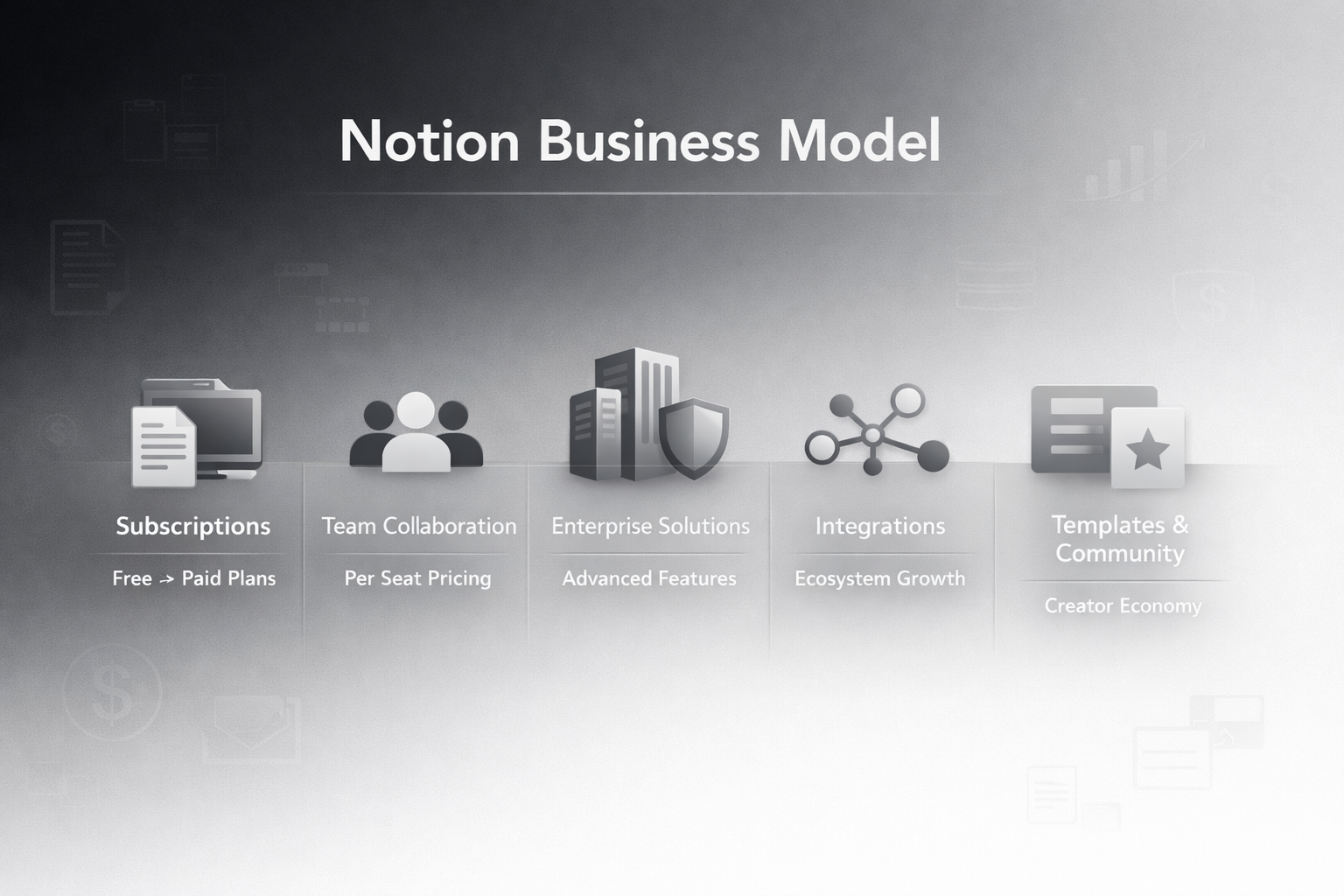
Notion makes money through a freemium SaaS model. Users can start for free and upgrade to paid plans for advanced features, team collaboration, and enterprise-level tools.
Main revenue sources:
- Subscription plans (individuals and teams)
- Enterprise solutions
- Add-ons and integrations (indirect value)
What is Notion?
Notion is an all-in-one productivity workspace that lets you write notes, manage tasks, build databases, create wikis, and collaborate with teams, all inside a single tool.
It was founded by Ivan Zhao in 2013 and relaunched publicly in 2018. Since then, it has grown into one of the most popular productivity platforms in the world, with over 30 million users.
What makes Notion different is its flexibility. Most tools do one thing. Notion does everything.
Target users include:
- Students and individual creators
- Freelancers and solopreneurs
- Startups and growing teams
- Large businesses and enterprises
Notion Business Model Overview
Before diving deep, here is Notion’s business model at a glance:
- Model Type: SaaS (Software-as-a-Service)
- Revenue Strategy: Freemium to paid conversion
- Core Strength: Product-led growth
- Distribution: Word-of-mouth, templates, and community
Notion does not rely on advertising revenue. It does not sell your data. Its entire business is built on one simple idea: give people a powerful free product, let them fall in love with it, and charge them when they need more.
That is the freemium playbook. And Notion executes it exceptionally well.
Notion’s Core Revenue Streams
Subscription Plans
This is where the majority of Notion’s revenue comes from.
Notion offers four tiers:
- Free Plan – The entry point. No cost, limited features, ideal for personal use.
- Plus Plan – For individuals and small teams who need more.
- Business Plan – For growing teams needing advanced collaboration features.
- Enterprise Plan – For large organizations needing security, admin controls, and dedicated support.
Why do users upgrade from free to paid?
- They hit storage or block limits on the free plan
- They need to collaborate with more than a handful of people
- They want advanced features like unlimited version history, guest access, or admin tools
- Their team grows and the free plan no longer fits
The pricing psychology here is smart. The free plan is genuinely useful, not crippled. This builds trust and habit. Once users are reliant on Notion, upgrading feels natural rather than forced.
Low entry barrier. High perceived value. That is how freemium should work.
Team and Collaboration Monetization
Notion uses seat-based pricing for teams. That means businesses pay per user, per month.
Here is why this matters for revenue:
- A startup with 5 users pays a small monthly fee
- A company with 200 users pays significantly more
- As the business grows, Notion’s revenue from that customer grows automatically
This is where SaaS businesses truly scale. You acquire a customer once, and your revenue from them increases over time without doing anything extra. It is called net revenue retention, and it is one of the most powerful metrics in SaaS.
Notion benefits from this model because:
- Teams naturally invite more members
- Once a team adopts Notion, switching is painful
- The product becomes more valuable as more people use it together
Enterprise Solutions
Enterprise is where the big revenue lives.
Large companies have very different needs from individual users or small teams. They need:
- Advanced security and compliance features
- SSO (Single Sign-On) integration
- Audit logs and admin controls
- Dedicated customer success support
- Custom contracts and SLAs
Notion’s Enterprise plan targets corporations, large organizations, and institutions that need more than just a productivity tool. They need a secure, manageable, scalable workspace.
Enterprise deals are typically high-ticket. A single enterprise contract can be worth tens of thousands of dollars per year. These contracts also come with longer commitment periods, which improves Notion’s revenue predictability.
This is the segment Notion has been actively investing in over the last few years, building out features specifically designed to win enterprise customers.
API and Integrations
Notion’s API and its wide range of integrations are not a direct revenue source. But they are a powerful indirect revenue engine.
Notion integrates with tools like:
- Slack (team communication)
- Google Drive (file storage)
- Zapier (workflow automation)
- GitHub (developer workflows)
- Figma, Loom, and dozens of others
Why does this matter for the business model?
- Integrations make Notion stickier. When Notion is connected to your other tools, removing it becomes disruptive.
- They expand use cases. A team using Notion with GitHub for project tracking is more likely to stay than a team using it just for notes.
- They attract power users who build complex workflows, and power users are the ones most likely to pay and stay.
The API also enables a developer ecosystem. Builders create custom tools on top of Notion, which adds value and keeps the community engaged.
The Template Ecosystem
This is Notion’s most underrated growth lever.
Notion has a massive library of free and paid templates created by both Notion’s team and the community. There are templates for:
- Personal productivity systems
- Student study planners
- Startup operating systems
- Content calendars
- CRM databases
- Investment trackers
- And thousands more
How does this drive revenue?
Templates lower the barrier to getting started. Instead of building a workspace from scratch, a new user can download a template and be productive in minutes. This shortens time-to-value dramatically.
When users get value fast, they stick around. When they stick around, they upgrade.
Additionally, some creators sell premium templates on platforms like Gumroad or directly through Notion’s gallery. This creates a whole ecosystem of creators who are essentially doing Notion’s marketing for them, for free.
The template economy drives:
- User acquisition (people find Notion through template searches)
- Community-led growth (creators promote Notion to their audiences)
- Retention (users with structured setups are less likely to leave)
Notion’s Growth Strategy
Product-Led Growth
Notion is one of the cleanest examples of product-led growth (PLG) in the SaaS world.
PLG means the product itself is the primary driver of acquisition, retention, and expansion. Instead of spending heavily on sales teams and paid ads, Notion lets the product do the work.
Here is how it plays out:
- A user discovers Notion, tries the free plan, and loves it
- They share their workspace or a template with a friend
- That friend signs up, builds their own system, and shares it further
- The loop continues without Notion spending a dollar on that acquisition
This is incredibly capital-efficient. It is why Notion grew from a niche tool to a global platform largely through organic word-of-mouth.
The Freemium Strategy
Freemium is not just a pricing decision. It is a growth strategy.
Notion’s free plan is genuinely powerful. It supports unlimited pages, basic collaboration, and access to most core features. This is intentional.
A weak free plan creates skeptical users. A strong free plan creates loyal users.
The upgrade triggers are subtle but effective:
- You hit the guest limit and need to add more collaborators
- You want unlimited version history to recover an old draft
- Your team grows past the free plan’s member limit
- You need advanced permissions for a growing organization
Each of these is a natural moment where upgrading makes sense. Notion does not push users. It waits for them to outgrow the free plan.
Community and Virality
Notion’s community is one of its greatest assets.
There are thousands of YouTube channels, Twitter accounts, newsletters, and Reddit communities dedicated entirely to Notion workflows and templates. These creators are not paid by Notion. They create content because they genuinely love the product.
This creates a self-reinforcing growth loop:
- Creators make content about Notion
- That content reaches new audiences
- New users discover Notion and sign up
- Some of those users become creators themselves
- The loop repeats
On YouTube alone, searches for “Notion tutorial” or “Notion setup” return hundreds of thousands of results with millions of combined views. This is free, evergreen marketing that compounds over time.
Notion supports this by building a robust template gallery and a Notion Ambassador program that recognizes and rewards top community contributors.
Notion’s Cost Structure
Like any SaaS company, Notion has several major cost categories:
- Infrastructure: Cloud hosting, servers, data storage. As usage grows, so do infrastructure costs. Notion runs on AWS and pays significantly to keep the platform fast and reliable.
- Product Development: Notion invests heavily in engineering. Building and maintaining a complex, cross-platform product requires a large engineering team.
- Customer Support: Enterprise customers in particular require dedicated support resources. As Notion moves upmarket, support costs increase.
- Marketing: Notably, Notion spends relatively little on paid advertising compared to most SaaS companies of its size. Most of its marketing budget goes toward community programs, creator partnerships, and content rather than performance ads.
This lean marketing spend is made possible by the community and product-led growth model. It is one of the reasons Notion has remained capital-efficient despite its scale.
Notion’s Competitive Advantage
Notion competes in a crowded market. Here is what sets it apart:
Simplicity meets flexibility. Most productivity tools either do one thing very well or try to do everything and end up complicated. Notion threads this needle by offering deep functionality through a simple, block-based interface.
One tool for many jobs. Teams use Notion as a wiki, a project manager, a CRM, a content calendar, and a knowledge base simultaneously. This replaces multiple tools, which makes Notion more valuable per dollar.
Community moat. The template ecosystem and creator community create a network effect. The more people use Notion, the more templates exist, the more tutorials get made, and the easier it is for new users to get started.
How does Notion compare to alternatives?
- Evernote is primarily a note-taking app. It lacks Notion’s database functionality and collaboration features. It has struggled with stagnant growth while Notion has accelerated.
- Microsoft OneNote is deeply integrated with Microsoft’s ecosystem, making it the natural choice for enterprises already on Microsoft 365. But it lacks Notion’s flexibility and community.
- Airtable is a powerful database tool but is more complex and less approachable than Notion. It targets a different use case and has a steeper learning curve.
Notion sits in a unique position: approachable enough for students, powerful enough for large companies.
Challenges in Notion’s Business Model
No business model is perfect. Notion faces several real challenges:
Free users who never convert. A significant portion of Notion’s user base uses the free plan indefinitely and never upgrades. This is the core tension in freemium models. Serving free users costs money, and if conversion rates are low, the economics can strain the business.
Intense competition. The productivity tool market is one of the most competitive in SaaS. Competitors include not just Evernote and Airtable but also newer entrants like Coda, Obsidian, and Linear, as well as tech giants like Google and Microsoft building their own solutions.
Performance at scale. Notion has faced persistent criticism for being slow, especially with large databases or complex workspaces. Performance issues can become a dealbreaker for enterprise customers who need reliability above all else. This is an ongoing engineering challenge.
Enterprise sales motion. Moving upmarket toward enterprise requires building an entirely different muscle. Enterprise sales cycles are long, requirements are complex, and security reviews can take months. Notion has been building out this capability but it takes time and investment.
Key Takeaways From the Founder Perspective
If you are building a SaaS product or studying business models, here is what Notion teaches you:
- Freemium works when the product is genuinely good. A weak free tier creates frustration. A strong free tier creates evangelists. Notion chose the latter.
- Community is a compounding growth asset. You cannot buy the kind of organic promotion Notion gets from creators. You have to earn it by building a product people love and want to talk about.
- Simplicity is a strategic choice, not a limitation. Notion could have built more powerful features earlier. Instead, it focused on making everything feel simple and intuitive. That decision attracted millions of users who would have bounced from a more complex tool.
- Retention beats acquisition. It is cheaper to keep a user than to acquire a new one. Notion’s entire model is designed around retention: hooks, habits, community, integrations, and templates all make it harder to leave.
- Seat-based pricing scales automatically. When you price per user, your revenue grows with your customers. You do not need to sell more, you just need your customers to grow.
Conclusion
Notion is one of the best case studies in modern SaaS growth. It took a crowded market, found a unique position, and grew to tens of millions of users with minimal paid marketing.
The business model is elegant in its simplicity. Give away a genuinely useful free product. Build a community that markets for you. Charge when users need more. Scale revenue automatically as teams grow.
If you are building a SaaS product, Notion is a perfect example of how patience with freemium, investment in community, and obsession with simplicity can compound into something extraordinary.
The lesson is not just about pricing or features. It is about building a product so good that people want to tell others about it. That is the real engine behind Notion’s growth, and it is something no amount of ad spend can replicate.
Frequently Asked Questions
Notion has not publicly disclosed profitability figures. The company was last valued at around $10 billion after its 2021 funding round. Given its lean marketing spend and growing enterprise customer base, analysts believe Notion is on a path toward profitability, but exact figures are not public.
Notion offers a free plan as part of its freemium strategy. The goal is to get as many users as possible into the product, build habit and dependency, and then convert a portion of those users into paying customers. The free plan also fuels word-of-mouth growth, which is Notion’s primary acquisition channel.
Notion charges per seat for team plans. Each user added to a workspace on a paid plan increases the monthly bill. As companies grow, they add more members, and Notion’s revenue from that account grows automatically. This seat-based model is one of the most scalable in SaaS.
Not directly. Notion does not charge creators to publish templates or take a cut from template sales on external platforms. However, the template ecosystem drives user acquisition and retention, which indirectly fuels paid conversions. The real value of templates for Notion is growth and retention, not direct monetization.
Discover more from Business Model Hub
Subscribe to get the latest posts sent to your email.