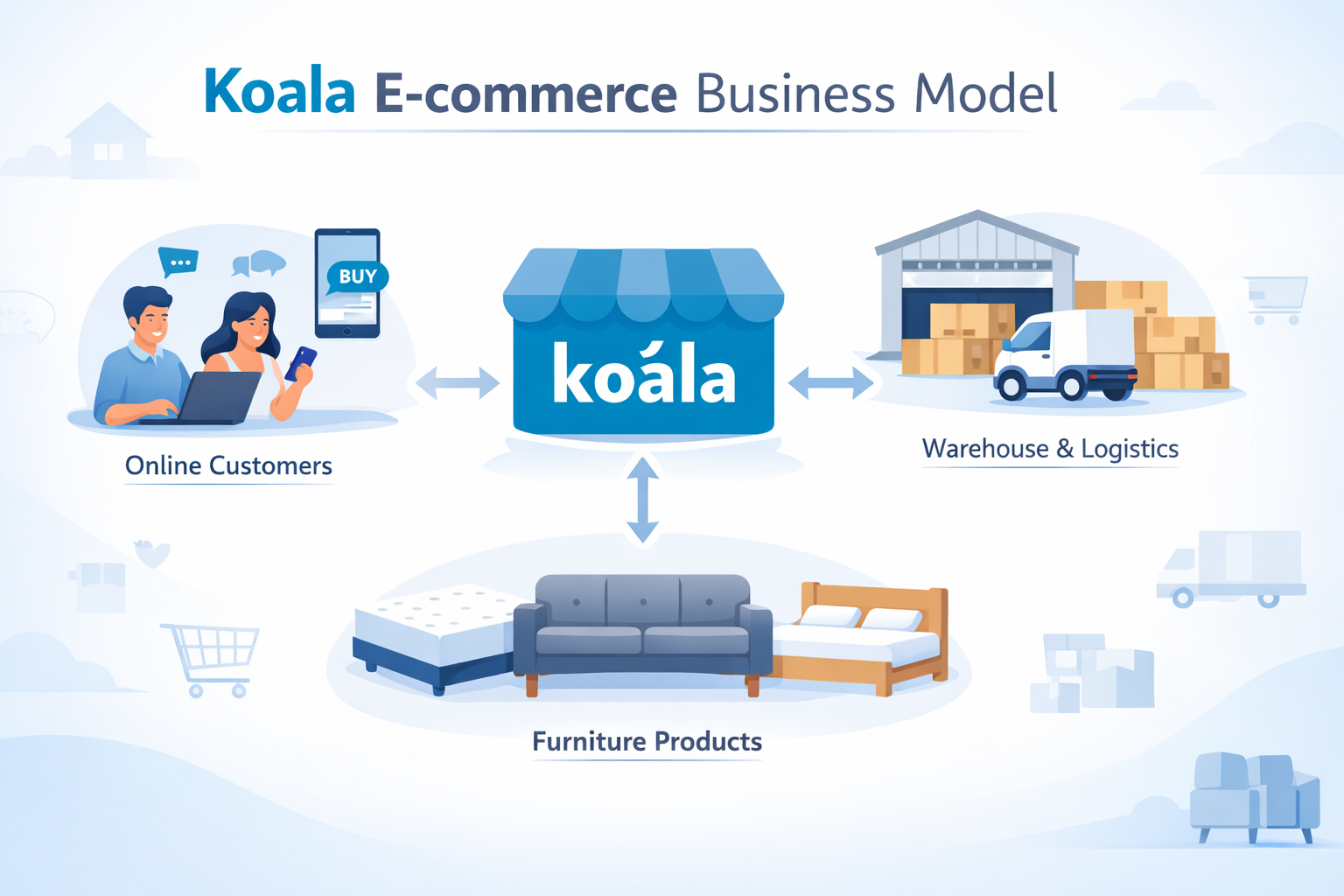
Koala operates a direct-to-consumer (D2C) e-commerce business model. It sells furniture, primarily mattresses and sofas, directly through its own website without relying on retailers or distributors.
Key pillars of the model:
- Sell direct, cut out middlemen
- Focus on a small product range done exceptionally well
- Use fast delivery and risk-free trials to remove purchase hesitation
- Build brand trust through strong identity and sustainability
Company Overview
Koala was founded in 2015 in Australia. It started as a mattress brand and expanded into sofas, bed frames, and broader home furniture.
Key facts:
- Founded: 2015, Sydney, Australia
- Primary market: Australia, with international expansion
- Sales channel: Online-first, via its own website
- Product focus: Mattresses, sofas, bed frames, furniture accessories
- Brand identity: Comfort, convenience, sustainability, Australian values
Koala’s founding premise was straightforward. Furniture retail was broken. The buying process was slow, confusing, and filled with unnecessary friction. Koala was built to fix that by moving the entire experience online.
The Core Business Model
Direct-to-Consumer (D2C) Structure
Koala sells exclusively through its own website. There are no retail partners, no wholesale distributors, and no department store agreements.
Why this works:
- Eliminates retail markup, allowing competitive pricing with strong margins
- Koala owns the full customer relationship from first click to post-purchase
- Pricing is fully controlled, no third party can discount and erode brand value
- Customer data is owned entirely by Koala, not shared with retailers
- Feedback from buyers reaches the brand directly and quickly
The trade-off:
All customer acquisition costs fall on Koala. There is no retailer driving footfall. Every visitor to the website must be earned through marketing spend or organic channels.
Limited Product Strategy
Koala deliberately offers a small number of products instead of a wide catalog.
What this achieves:
- Fewer options means faster purchase decisions from customers
- Simpler inventory management and lower operational complexity
- All marketing spend concentrates on a small number of hero products
- Brand identity becomes tightly linked to specific, well-known products
The principle at work:
More choice creates more hesitation. Fewer, better options create faster conversions. Koala applies this across its entire catalog. Even as the brand has grown, it resists the temptation to multiply SKUs without purpose.
Online-First Sales Funnel
The Koala website is the primary sales engine. The entire customer journey, from discovery to checkout to post-purchase support, happens online.
The funnel works like this:
- Paid ads and SEO bring customers to the website
- Product pages are built to inform and convert, not just display
- The 120-night trial removes purchase hesitation at the decision point
- Fast delivery confirmation closes the sale
- Post-purchase emails and support build loyalty and encourage repeat purchases
How Koala Makes Money
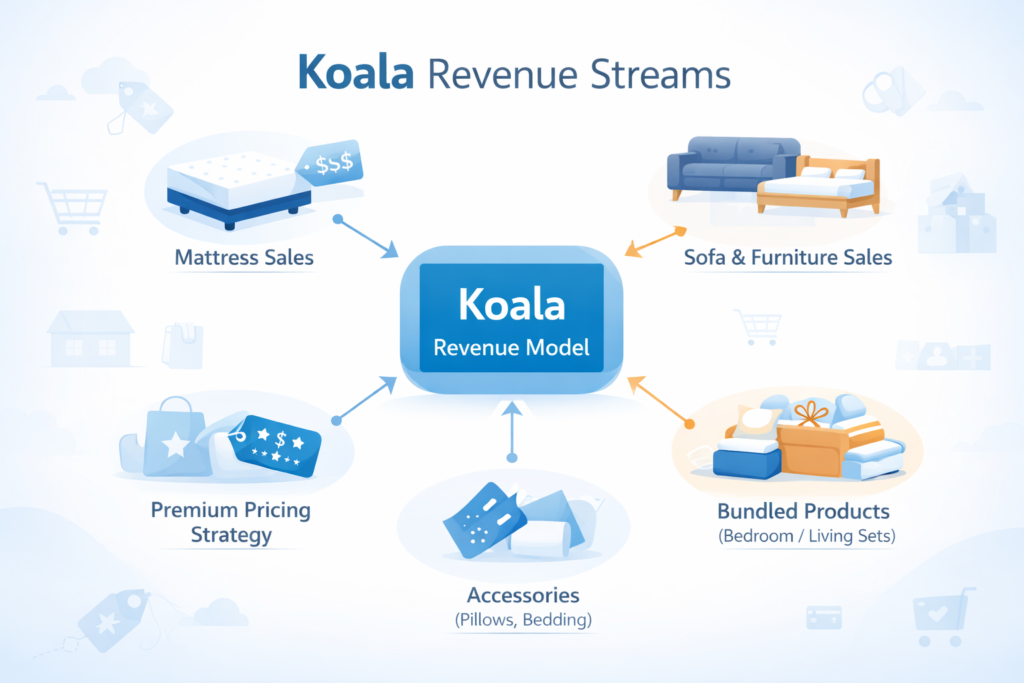
Product Sales
This is the primary revenue source. Koala sells:
- Mattresses
- Sofas
- Bed frames
- Furniture accessories and add-ons
Pricing is positioned in the mid-to-premium range. Koala is not the cheapest option, but it offers significantly better value than traditional retail at a similar price point because the D2C model removes retail margin from the equation.
Bundling Strategy
Koala actively encourages customers to purchase complementary products together in a single transaction.
Common bundles:
- Mattress plus bed frame
- Sofa plus ottoman
- Bedroom furniture sets
Why bundling matters:
It increases Average Order Value (AOV). A customer who spends $1,500 instead of $900 in one transaction generates more revenue without requiring any additional marketing spend to acquire. The margin improvement on a bundled sale is disproportionately high.
Koala surfaces bundle recommendations naturally during the browsing and checkout process rather than through aggressive upsell tactics.
Premium Pricing
Koala is not a discount brand. It charges a premium justified by:
- The convenience of the buying experience
- Fast, reliable delivery
- The 120-night risk-free trial
- Product quality and design
- Strong brand trust
Customers are not just paying for a mattress. They are paying to avoid the traditional furniture buying experience entirely. That convenience has measurable monetary value to buyers, and Koala prices accordingly.
Customer Acquisition Strategy
Performance Marketing
Koala runs paid advertising across Facebook, Instagram, and Google.
What the campaigns target:
- People actively searching for mattresses or furniture
- Homeowners and renters furnishing new spaces
- Previous website visitors who did not purchase (retargeting)
Retargeting is particularly important. The mattress buying cycle can take weeks. Staying visible during that consideration period directly improves conversion rates.
The challenge:
Heavy dependence on paid ads makes profitability sensitive to rising advertising costs and platform algorithm changes. This is a known vulnerability in the model.
Search Engine Optimisation
Koala invests in long-term organic traffic through content and SEO.
Target content areas:
- Mattress buying guides and comparisons
- Sleep quality and health content
- Furniture setup and home styling advice
- Brand and product-specific search terms
Ranking well for high-intent searches like “best mattress Australia” generates traffic with no cost per click. Over time, SEO reduces dependency on paid acquisition and improves overall unit economics.
Brand Positioning
Koala’s brand voice is warm, playful, and distinctly Australian. This is a deliberate strategic choice, not just a stylistic preference.
What strong branding delivers:
- Higher direct traffic as brand awareness grows
- Lower customer acquisition costs over time
- Premium pricing justification
- Word-of-mouth referrals from satisfied customers
Koala also integrates sustainability messaging into its brand identity. Conservation partnerships, responsible sourcing, and environmental commitments resonate with its core customer base and add a dimension of brand loyalty that purely functional competitors cannot match.
The 120-Night Sleep Trial
This is the single most important conversion tool in Koala’s model.
How it works:
Customers can sleep on the mattress for 120 nights and return it for a full refund if they are not satisfied. No questions asked.
Why it works:
- Removes the primary barrier to buying a mattress online, which is the fear of committing to the wrong product
- Signals strong product confidence from the brand
- Actual return rates are lower than the policy might suggest, because the product genuinely delivers
- Generates organic word-of-mouth as customers tell others about the policy
The business logic:
The cost of returns is outweighed by the lift in conversion rate the trial policy produces. More customers buy because the risk is removed. Most of those customers keep the product. Net result is positive.
Logistics and Operations Model
Fast Delivery
Koala offers same-day or next-day delivery in major Australian cities.
Why this is a competitive advantage:
Traditional furniture retailers require weeks or months for delivery. Koala delivers the next day. That gap is not marketing. It is an operational capability that directly influences purchase decisions. Customers who need a mattress this week will choose Koala over a retailer quoting a six-week lead time.
Mattress-in-a-Box Packaging
Koala compresses and rolls its mattresses into compact boxes for shipping.
What this enables:
- Standard courier networks can handle delivery, no specialist furniture trucks required
- Freight costs are significantly reduced
- A single person can carry and unbox the product
- The unboxing experience is shareable on social media, generating organic content
This packaging innovation is what made the entire online mattress category viable. Without it, shipping a king-size mattress economically and quickly through a standard logistics network would be impossible.
Warehousing Strategy
Koala operates warehouses positioned near major population centres to enable fast delivery.
The logic:
Last-mile delivery is the most expensive and time-consuming part of any logistics chain. Placing inventory close to customers shortens that last mile. Shorter last mile means faster delivery and lower cost per delivery. Both outcomes support the business model directly.
Key Growth Strategies
Simplification
Koala grew by removing complexity, not adding it.
- Fewer product variants
- Simpler website navigation
- Clearer messaging
- Straightforward returns process
Every element of friction removed from the customer journey translates directly into a higher conversion rate.
Convenience as a Core Product Attribute
Koala treats convenience as part of the product itself, not as an optional feature.
What convenience means in practice:
- Fast delivery is guaranteed, not approximate
- Returns are easy and free
- The website answers questions before they are asked
- Checkout is fast and frictionless
When convenience is built into the product promise, customers are willing to pay more for it. Koala captures that premium.
Emotional Brand Connection
Koala markets the outcome, not the product.
The messaging is not about foam density or spring count. It is about better sleep, more comfortable mornings, and a home that feels right. This emotional positioning builds stronger customer loyalty than functional product claims alone.
Competitive Advantages
| Advantage | How It Works |
|---|---|
| D2C margins | Higher profit per unit than retail competitors, enables competitive pricing |
| Delivery speed | Next-day versus weeks for traditional retailers |
| Trial policy | 120 nights risk-free, builds trust competitors cannot easily replicate |
| Brand strength | Lower acquisition costs over time, supports premium pricing |
| First-party data | Customer data owned entirely, improves targeting and retention |
| Packaging innovation | Mattress-in-a-box enables standard courier delivery at scale |
Challenges in the Business Model
High logistics costs. Fast delivery of heavy, bulky products is expensive. Maintaining delivery speed as geographic reach expands is a continuous cost challenge.
Returns complexity. Every returned mattress under the 120-night trial requires collection, inspection, and responsible disposal or donation. At scale, this is a meaningful operational and cost burden.
Paid acquisition dependency. Heavy reliance on Facebook and Google ads exposes Koala to rising CPMs and platform changes. This creates pressure on customer acquisition cost and overall unit economics.
Increasing competition. The D2C mattress model has attracted many competitors including Emma, Sleeping Duck, and international entrants. Maintaining differentiation requires sustained investment in brand and product quality.
Category expansion risk. Moving from mattresses into broader furniture increases product complexity and operational requirements. Managing this expansion without diluting brand focus is an ongoing challenge.
Koala vs Traditional Furniture Retail
| Factor | Koala | Traditional Retail |
|---|---|---|
| Sales channel | Online direct | Physical stores |
| Pricing model | D2C, no retail markup | Marked up for retail margin |
| Delivery time | Same or next day | Weeks to months |
| Return policy | 120-night trial, free returns | Often restricted |
| Customer data | Fully owned by brand | Minimal or shared |
| Buying experience | Fast, simple, online | Time-consuming, in-store |
| Product range | Focused, few SKUs | Wide, often overwhelming |
Lessons for Founders
Start with fewer products. One or two excellent products outperform ten average ones. Focus builds brand identity and simplifies every downstream decision from marketing to logistics.
Remove buying friction first. Free trials, easy returns, and fast delivery address the real reasons customers do not buy. Solving hesitation is often more valuable than improving the product itself.
Own your distribution channel. Selling through your own website means owning the customer relationship, the data, the pricing, and the margin. Dependence on retail partners means giving all of that away.
Speed is a product feature. Delivery speed is not just a logistics metric. It is a competitive advantage that directly influences purchase decisions. Customers will choose a faster brand over a slower one even at a higher price point.
Brand trust scales. A strong brand with high trust lowers customer acquisition costs over time. Every dollar invested in brand building compounds into lower CPMs, higher direct traffic, and stronger word-of-mouth.
What Comes Next for Koala
Koala’s likely future direction based on its current trajectory:
- Category expansion into broader home furniture beyond mattresses and sofas
- International market growth, particularly in Asia-Pacific
- Offline experience centres as hybrid showrooms that support online conversion rather than replace it
- Sustainability-led product development as consumer expectations around environmental responsibility continue to rise
- Loyalty and retention programs to reduce dependency on paid acquisition and improve lifetime customer value
Final Takeaway
Koala did not win by inventing a new product. Mattresses existed long before 2015.
Koala won by rebuilding the buying experience from scratch around what customers actually want: simplicity, speed, and confidence that they are making the right decision.
The business model is not complicated. Sell direct. Keep the product range focused. Remove every reason a customer might hesitate. Deliver fast. Stand behind the product with a risk-free trial.
Discover more from Business Model Hub
Subscribe to get the latest posts sent to your email.