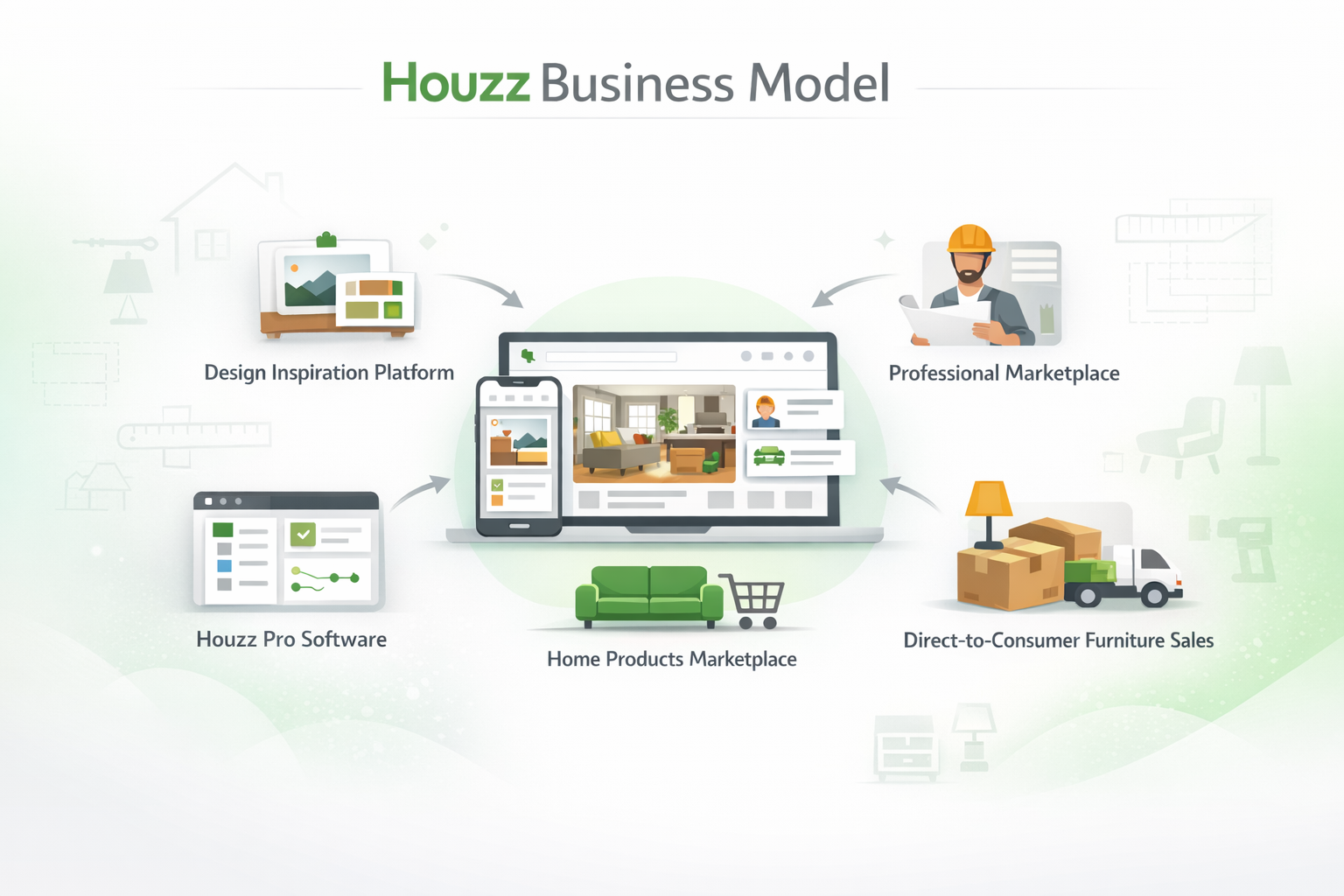
Houzz operates a two-sided marketplace that connects homeowners, home design professionals, and furniture brands on one platform.
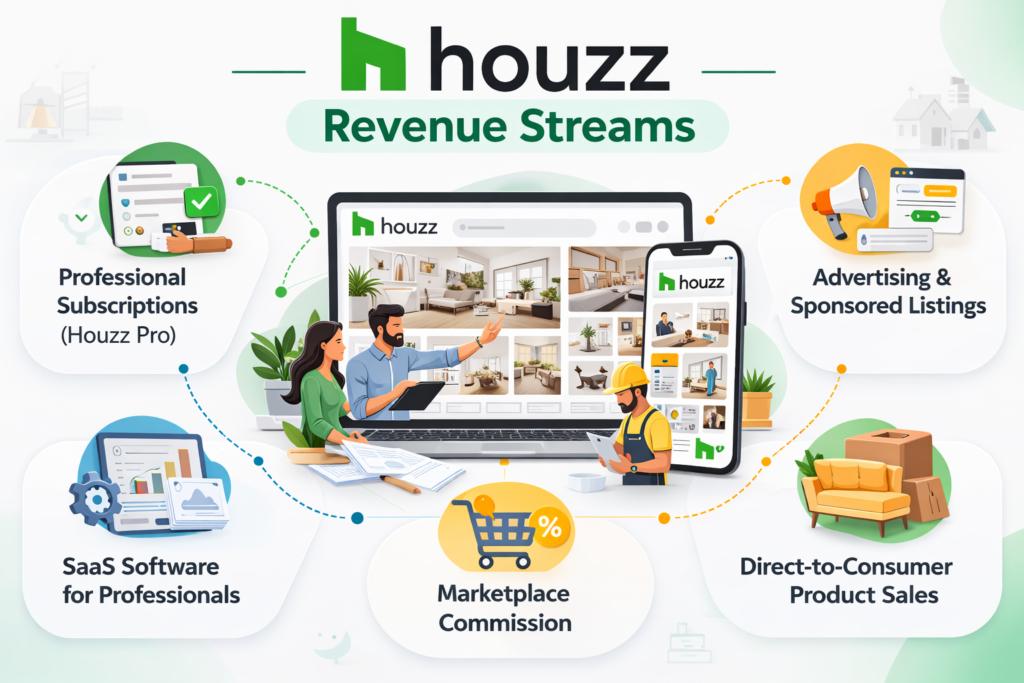
The company generates revenue through five main streams:
- Professional subscriptions
- Advertising and marketing services
- Product marketplace commissions
- Houzz Pro software (SaaS)
- Direct-to-consumer furniture and decor sales
In simple terms, Houzz is part Pinterest, part LinkedIn for home professionals, and part Wayfair. It combines visual inspiration, professional networking, and eCommerce into one platform built specifically for home renovation.
What Is Houzz?
Houzz was founded in 2009 by Adi Tatarko and Alon Cohen, a married couple who were frustrated by how difficult it was to find reliable contractors and design inspiration for their own home renovation.
Their solution was straightforward: build a single platform where homeowners could discover ideas, connect with professionals, and buy the products they needed to complete a renovation.
Today, Houzz is one of the largest online platforms for home improvement and interior design. It serves millions of homeowners and hundreds of thousands of professionals across multiple countries.
The platform sits at the intersection of several industries:
- Home renovation and remodeling
- Interior design and architecture
- Furniture and home decor retail
- Contractor and trades services
What makes Houzz different from a simple directory or marketplace is that it covers the entire renovation journey from the first spark of inspiration to the final product purchase.
The Core Idea Behind the Houzz Business Model
The Houzz business model is built around one central idea: own the entire home renovation process.
Most platforms pick a lane. Pinterest handles inspiration. Angi handles contractor discovery. Wayfair handles furniture shopping. Houzz decided to do all three inside one ecosystem.
This is what makes the business model powerful.
A homeowner who visits Houzz for kitchen inspiration can, within the same session:
- Save photos of designs they love
- Browse profiles of local contractors and designers
- Read verified reviews of professionals
- Purchase a kitchen faucet or cabinet hardware
- Use planning tools to visualize the finished space
Every step of the process keeps the user inside Houzz. That is by design.
This closed-loop model increases session time, reduces drop-off, and creates multiple opportunities to monetize the same user across their renovation journey.
How the Houzz Marketplace Works
Houzz is a two-sided marketplace. That means it serves two distinct groups of users, and the platform only works when both sides are active and engaged.
Side One: Homeowners
Homeowners come to Houzz because they want help turning a vague renovation idea into a real project.
They use the platform to:
- Browse millions of professional design photos
- Save ideas into organized folders
- Discover architects, designers, and contractors in their area
- Read reviews and view past project work
- Get quotes and communicate with professionals
- Buy furniture, lighting, fixtures, and decor
These users are high intent. They are not casually scrolling. They are actively planning a project that will likely cost thousands of dollars. That matters a lot when it comes to monetization.
Side Two: Professionals
On the other side of the marketplace are the professionals. This group includes:
- Architects
- Interior designers
- General contractors
- Kitchen and bathroom remodelers
- Landscape designers
- Builders and developers
- Home stagers
Professionals join Houzz because it gives them a place to showcase their work and attract new clients. Unlike a general business directory, Houzz lets professionals build rich portfolios with high-quality project photos, client reviews, awards, and credentials.
For a contractor or designer, a strong Houzz profile can be a consistent source of inbound leads. That makes it worth paying for.
How the Two Sides Interact
Houzz acts as the connector between these two groups.
Homeowners provide demand. They are searching for professionals and products.
Professionals provide supply. They are offering services and building credibility through content.
When both sides are large and active, the platform gets more valuable. More homeowners attract more professionals. More professionals create more content, which attracts more homeowners. This is the network effect that powers the Houzz business model.
The Houzz Direct-to-Consumer Model
One of the most important and often overlooked parts of the Houzz business model is its direct-to-consumer (DTC) product marketplace.
Houzz does not just connect homeowners with professionals. It also sells products directly to homeowners.
What Houzz Sells
Through the Houzz marketplace, homeowners can purchase:
- Sofas, chairs, and bedroom furniture
- Lighting fixtures and ceiling fans
- Kitchen faucets and sinks
- Bathroom vanities and accessories
- Rugs, curtains, and soft furnishings
- Outdoor furniture and garden decor
- Wall art and mirrors
The product catalog covers essentially every category a homeowner might need during a renovation or redecoration project.
How the DTC Model Works
When a homeowner is browsing design inspiration photos on Houzz, they will often see products tagged directly in those photos. A lamp in a living room photo, a faucet in a bathroom redesign, a dining table in a kitchen remodel.
These tags link directly to product listings where the homeowner can purchase the item immediately.
This is a smart design choice. It shortens the path from inspiration to purchase. Instead of screenshotting an idea, searching for the product elsewhere, and eventually buying from a competitor, the homeowner can complete the purchase inside Houzz.
Why This Matters for the Business Model
The DTC model matters because it gives Houzz a direct revenue stream from product sales. Rather than only earning advertising fees or subscription revenue, Houzz captures a slice of every transaction.
It also deepens engagement. When users can buy products directly, they spend more time on the platform and return more frequently.
The DTC model positions Houzz as a competitor to furniture retailers like Wayfair, while simultaneously being a platform for professional discovery. That dual identity is part of what makes the business model difficult to replicate.
How Houzz Makes Money: Revenue Streams Explained
Houzz generates revenue from several distinct sources. Each one targets a different group of users and serves a different purpose within the platform ecosystem.
Professional Subscription Plans
The largest and most consistent revenue stream for Houzz comes from professional subscriptions.
Professionals who want to grow their presence on Houzz pay for a subscription called Houzz Pro. These are not free accounts. Paying professionals get access to tools and features that free accounts do not.
Benefits of a paid professional subscription include:
- Priority placement in local search results
- Enhanced profile features
- Access to lead generation tools
- Analytics on profile views and contact requests
- Client communication tools
- Advertising credits
For professionals, this is essentially a marketing investment. A contractor in a competitive city who pays for a Houzz Pro subscription is buying visibility in front of homeowners who are actively planning projects.
The subscription model works well for Houzz because it creates recurring revenue. Professionals do not pay once and disappear. They pay monthly or annually as long as the platform continues to deliver leads.
Advertising and Sponsored Listings
Beyond subscriptions, Houzz earns advertising revenue from professionals and brands who want additional visibility on the platform.
This includes:
- Sponsored placement in search results
- Featured profiles in category and location searches
- Display advertising across the platform
- Local area advertising targeting homeowners in specific zip codes
Advertising on Houzz is attractive to professionals because the audience is highly targeted. These are not random internet users. These are homeowners who have already expressed intent to renovate. The conversion potential for a sponsored listing on Houzz is much higher than a generic digital ad.
For brands selling home products, Houzz advertising offers access to buyers who are already in shopping mode. A lighting brand that runs sponsored listings on Houzz is reaching someone who is actively redesigning a room, not someone who might theoretically buy a lamp someday.
Marketplace Commission on Product Sales
When products are sold through the Houzz marketplace, the platform earns a commission on each transaction.
This applies to:
- Third-party sellers listing products on Houzz
- Brands using Houzz as a sales channel
- Any product transaction completed through the platform
The commission model is standard for eCommerce marketplaces. Sellers pay a percentage of each sale to the platform in exchange for access to its audience and transaction infrastructure.
For Houzz, this creates a revenue stream that scales with volume. As more products are listed and more homeowners shop through the platform, commission revenue grows without requiring proportionally more investment.
Houzz Pro SaaS Software
Houzz Pro is not just a subscription profile product. It is also a full software suite designed to help contractors and designers run their businesses.
The SaaS features inside Houzz Pro include:
- Project management tools
- Client communication and messaging
- Estimate and proposal creation
- Invoicing and payment processing
- Mood boards and design visualization tools
- 3D floor planning
- Lead tracking and pipeline management
This is a significant product. It positions Houzz not just as a marketing platform for professionals but as an operational tool they use to manage their business day to day.
The SaaS element is important because it creates switching costs. Once a contractor is managing their projects, invoices, and client communications inside Houzz Pro, leaving the platform becomes disruptive. They are not just losing a marketing channel. They are losing their entire business management system.
This increases retention, reduces churn, and makes the professional subscriber base more stable.
Direct-to-Consumer Product Revenue
In addition to marketplace commissions from third-party sellers, Houzz earns direct revenue from its own DTC product sales.
Houzz sources and sells products under its own retail operation, meaning it takes on inventory or uses drop-shipping arrangements to fulfill orders directly.
Categories include furniture, decor, fixtures, and accessories across every room category.
This revenue stream blends eCommerce retail economics with the demand generation advantage of Houzz’s massive inspiration platform. Houzz generates the traffic, converts it with inspiration content, and captures the sale.
How Houzz Creates Network Effects
Network effects are the reason two-sided platforms become so difficult to compete with once they reach scale.
For Houzz, the network effect works like this:
- More homeowners on the platform attract more professionals who want to reach them
- More professionals create more portfolio content and reviews, making the platform more useful
- More useful content attracts more homeowners
- More homeowners make the product marketplace more active
- More marketplace activity attracts more brands and sellers
Each group makes the platform more valuable for every other group. This is a multi-sided network effect, and it is one of the strongest competitive moats a platform business can have.
Houzz also benefits from content network effects. Every photo a professional uploads, every review a homeowner writes, every product that gets tagged in an inspiration image adds to the platform’s content library. That content attracts organic search traffic, which brings in new users without paid acquisition.
Over time, this creates a massive archive of home design content that is genuinely hard for a new competitor to replicate. The content is not just sitting there. It is actively generating traffic and leads every day.
Houzz Growth Strategy
Houzz scaled by focusing on a few key strategic priorities that reinforced each other.
Building a Visual Content Platform First
Before Houzz became a marketplace or a SaaS company, it was a content platform. The core product was a place to browse beautiful home design photos.
This was a smart starting point. Visual content is highly shareable, highly searchable, and addictive to browse. Users who came for inspiration photos became regular visitors. Regular visitors became buyers and lead generators for professionals.
The content-first approach gave Houzz a foundation of organic traffic and engagement that it then layered monetization on top of.
Growing the Professional Side Through Credibility
Houzz made a deliberate choice to focus on quality when it came to professionals. The platform emphasizes:
- Verified reviews from past clients
- Portfolio photos of completed projects
- Professional credentials and awards
- Response rates and activity levels
This focus on credibility helped homeowners trust the professionals they found through Houzz. And trust drives conversions. A homeowner who believes a contractor is legitimate is far more likely to reach out and eventually hire them.
Integrating Shopping with Browsing
One of Houzz’s most effective growth moves was making the transition from browsing to buying as frictionless as possible.
By tagging products inside inspiration photos, Houzz turned its content library into a shopping interface. Inspiration became shoppable. Users did not need to leave the platform to act on what they saw.
This increased transaction volume and kept users inside the ecosystem longer.
Investing in SaaS to Lock In Professionals
The development of Houzz Pro as a full business management platform was a strategic move to deepen the relationship with professional subscribers.
Instead of being a platform professionals used once a month to check their leads, Houzz became a platform professionals used every single day to run their business. That daily usage increases loyalty, reduces churn, and justifies higher subscription pricing.
Houzz Competitors
Houzz operates in a competitive landscape, but its integrated model means it competes differently depending on which part of its business you are looking at.
Pinterest competes with the inspiration and visual discovery side of Houzz. Both platforms are used by homeowners browsing design ideas. The key difference is that Pinterest is a general visual discovery platform while Houzz is entirely focused on home improvement. Houzz users typically have much higher purchase intent.
Wayfair
Wayfair competes directly with Houzz’s product marketplace. Both sell furniture, decor, and home accessories online. Wayfair is a pure-play eCommerce retailer with a massive catalog. Houzz differentiates by embedding product shopping inside an inspiration and professional discovery platform.
Angi (formerly Angie’s List)
Angi is a marketplace for home service professionals. It competes with the contractor and professional discovery side of Houzz. Angi is more transactional and service-focused, while Houzz puts more emphasis on design quality and professional portfolios.
Thumbtack
Thumbtack is a local services marketplace that helps homeowners find professionals for a wide range of tasks. It competes with Houzz for contractor and designer leads but lacks the inspiration content and product marketplace that Houzz offers.
The competitive challenge for Houzz is that each of these competitors is more focused. Wayfair does eCommerce better at scale. Pinterest has more social features. Angi has a larger base of verified service professionals in some categories.
Houzz’s answer to that challenge is integration. No single competitor offers inspiration, professional discovery, and product shopping in one place.
Key Advantages of the Houzz Business Model
Integrated Ecosystem
The most important advantage Houzz has is that it covers the full renovation journey. Homeowners do not need to go to four different platforms to plan a project. They can do everything in one place.
This integration is not easy to build. It requires investment in content, marketplace technology, professional verification, logistics partnerships, and software development simultaneously. That is a high barrier to entry for any new competitor trying to replicate it.
High Intent Users
The Houzz audience is not casual. People who come to Houzz are planning renovations. They are looking to spend real money on real projects in the near term.
This matters enormously for monetization. High-intent users convert at higher rates on both the professional lead generation side and the product marketplace side. Advertisers and professional subscribers see better results, which means they are willing to pay more.
Multiple Revenue Streams
Houzz is not dependent on a single revenue model. If advertising spend drops, subscription revenue continues. If one product category slows down, another may pick up.
This diversification makes the business more resilient and gives Houzz flexibility to invest in different areas depending on where growth opportunities are strongest.
Content-Driven Growth
Houzz’s massive library of user-generated and professional-created content is a long-term competitive asset. It drives organic search traffic, keeps users engaged, and reduces dependence on paid marketing for user acquisition.
Every photo uploaded, every review written, and every product tagged strengthens this asset. It compounds over time in a way that financial investment alone cannot replicate quickly.
Challenges in the Houzz Business Model
No business model is without its difficulties. Houzz faces several real challenges.
Intense Competition
Each segment of the Houzz business faces competition from a focused, well-funded competitor. Competing on all fronts simultaneously requires significant resources and creates the risk of being outperformed in individual categories by more specialized platforms.
Logistics Complexity
Selling furniture and large home products online involves complicated logistics. Delivery, returns, damage, and customer service for large items are expensive and operationally demanding. Managing this well at scale is a persistent challenge for any home goods retailer, including Houzz.
Renovation Market Sensitivity
The home renovation market is cyclical. When housing markets slow down, interest rates rise, or consumer confidence drops, renovation spending falls. This affects professional subscription value, product sales, and advertising revenue simultaneously.
Maintaining Professional Quality
The value of the professional marketplace depends on the quality of professionals listed. If homeowners have bad experiences with contractors they found through Houzz, trust erodes. Maintaining quality standards across a large and distributed network of professionals is an ongoing operational challenge.
Conversion from Inspiration to Transaction
A significant portion of Houzz’s user base is in browsing mode rather than buying mode at any given time. Converting passive inspiration browsers into active buyers and lead generators requires consistent product and UX investment.
The Future of the Houzz Business Model
Houzz has several directions it could pursue to grow and evolve the business model in the coming years.
AI-Powered Design Tools
Artificial intelligence is transforming how people interact with visual content. Houzz could integrate AI tools that help homeowners visualize renovation outcomes, get instant design recommendations, or generate custom room layouts based on their preferences and existing space.
This would deepen engagement and make the platform more useful earlier in the planning process, increasing the likelihood that users eventually convert to buyers or professional leads.
Augmented Reality for Product Visualization
AR technology that lets homeowners see how a piece of furniture would look in their actual room before purchasing is a natural fit for the Houzz product marketplace. This technology already exists in basic forms at some retailers. Houzz could integrate it to reduce purchase hesitation and decrease return rates.
Deeper SaaS for Contractors
The Houzz Pro software suite could expand further into the operational needs of contractors and designers. Features like supplier management, subcontractor coordination, permit tracking, and financial reporting would make the platform even more embedded in professionals’ daily workflows.
Expanding DTC Furniture Brands
Houzz could develop its own private-label furniture and home decor brands, similar to what Amazon has done in various retail categories. Owning the brand and the product margin, rather than just the commission, would increase profitability on product sales.
International Expansion
While Houzz already operates in several countries, there is significant room to grow in markets where home renovation platforms are less developed. Localizing the platform, building professional networks, and adapting the product catalog for different markets represents a substantial growth opportunity.
Final Takeaway
The Houzz business model works because it does something most platforms do not: it owns the entire customer journey.
From the first moment a homeowner gets inspired by a kitchen photo to the day they purchase a faucet and hire a contractor, Houzz can be present at every step. That is rare. And it creates an unusually deep relationship between the platform and its users.
The combination of subscription revenue, advertising, marketplace commissions, SaaS tools, and direct product sales gives Houzz multiple ways to monetize a single user journey. Each revenue stream reinforces the others.
Professionals pay for subscriptions because there are enough homeowners on the platform. Homeowners come because there are enough professionals and products. Brands advertise because the audience is buying. Products sell because the content inspires purchase decisions.
That is what a well-designed platform business looks like. Not just a marketplace. Not just a content site. Not just a SaaS tool. All three, working together, serving the same user at different points in the same journey.
FAQs
The Houzz business model is a two-sided digital marketplace that connects homeowners with home design professionals and furniture brands.
The platform allows users to:
Discover home design inspiration
Find and hire professionals like architects or contractors
Buy furniture and home improvement products
Houzz generates revenue through multiple streams, including:
Professional subscriptions (Houzz Pro)
Advertising and sponsored listings
Marketplace commissions from product sales
Direct-to-consumer home product sales
SaaS tools for home professionals
This combination of content platform + marketplace + SaaS tools allows Houzz to monetize the entire home renovation journey.
Houzz is a technology company focused on home design and renovation services.
It operates as:
An online design inspiration platform
A marketplace for home professionals
An eCommerce store for home products
A software provider (Houzz Pro) for contractors and designers
The company was founded in 2009 and is headquartered in Palo Alto, California.
Houzz works by connecting homeowners, design professionals, and home product sellers on one platform.
The typical user journey works like this:
Discover inspiration
Users browse millions of home design photos and ideas.
Find professionals
Homeowners can contact architects, interior designers, contractors, or builders.
Buy products
Users can purchase furniture, decor, lighting, and renovation materials directly through the Houzz marketplace.
Manage renovation projects
Professionals use Houzz Pro software to manage clients, proposals, and project workflows.
This integrated ecosystem makes Houzz a complete home renovation platform.
The CEO of Houzz is Alon Cohen.
He co-founded Houzz with Adi Tatarko in 2009.
In 2024, Cohen became CEO while Tatarko moved to the role of executive chair.
As of now, Houzz has not announced an official IPO date.
The company is still privately held and backed by venture capital investors. However, because Houzz has achieved a multi-billion-dollar valuation, analysts have speculated that it could consider an IPO in the future if the company decides to raise capital through public markets
Discover more from Business Model Hub
Subscribe to get the latest posts sent to your email.