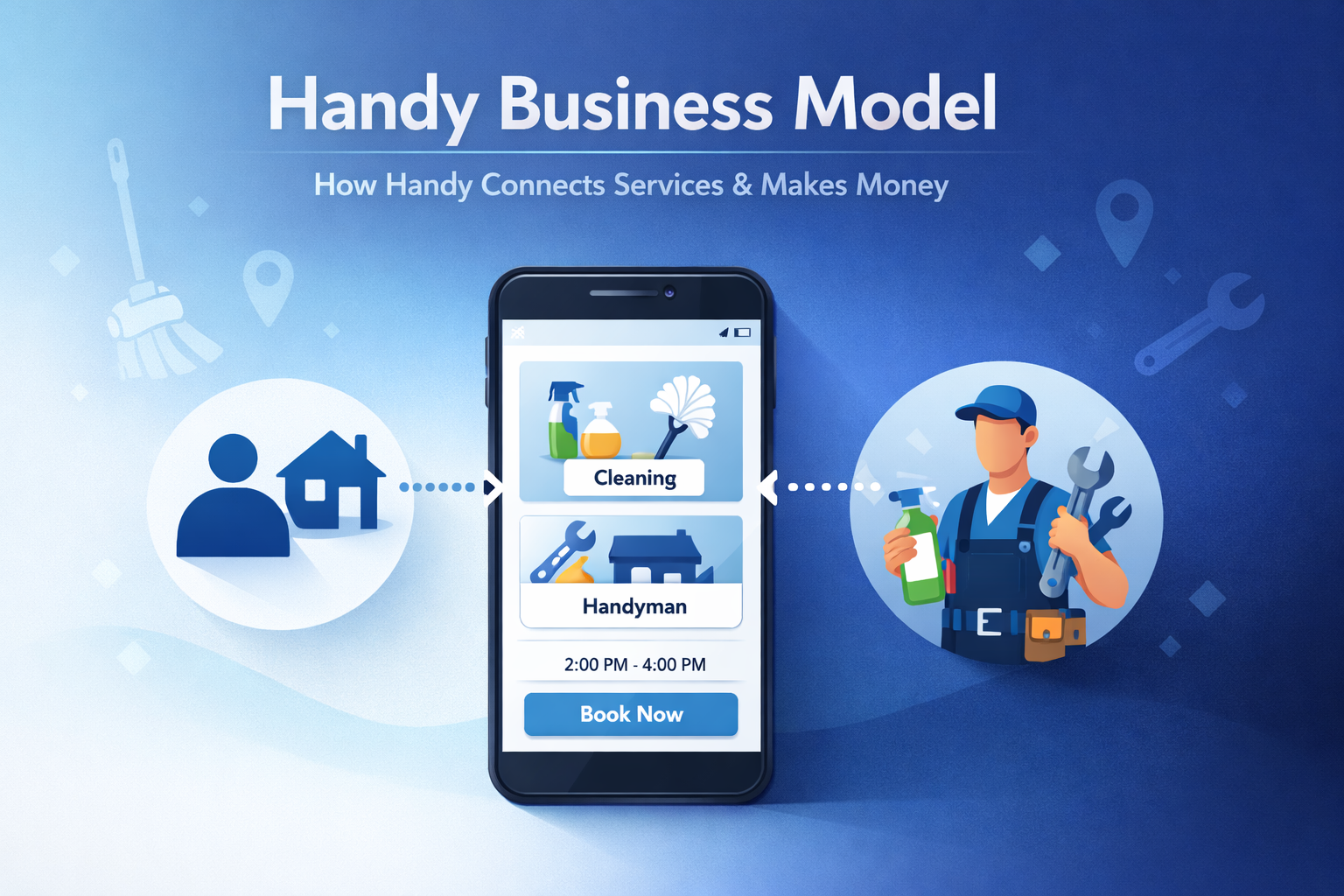
Handy runs a two-sided marketplace that connects customers with home service professionals. It earns money through commissions, platform fees, and subscriptions. It doesn’t clean your house. It just makes sure the right person shows up to do it.
What Even Is Handy?
Let me paint a quick picture.
You just moved into a new apartment. You need it cleaned. You don’t know any cleaners. You don’t want to ask around, wait for referrals, or negotiate prices with strangers.
So you open an app, pick a time, pay online, and someone shows up. Done.
That’s Handy.
Founded in 2012, Handy built a platform that makes home services feel as easy as ordering food. Their main focus is cleaning and handyman jobs. They operate mostly in the US, UK, and Canada.
Think of it like Uber, but instead of rides, you get a cleaner, a plumber, or someone to assemble your IKEA furniture.
Quick Answer: How Does Handy Make Money?
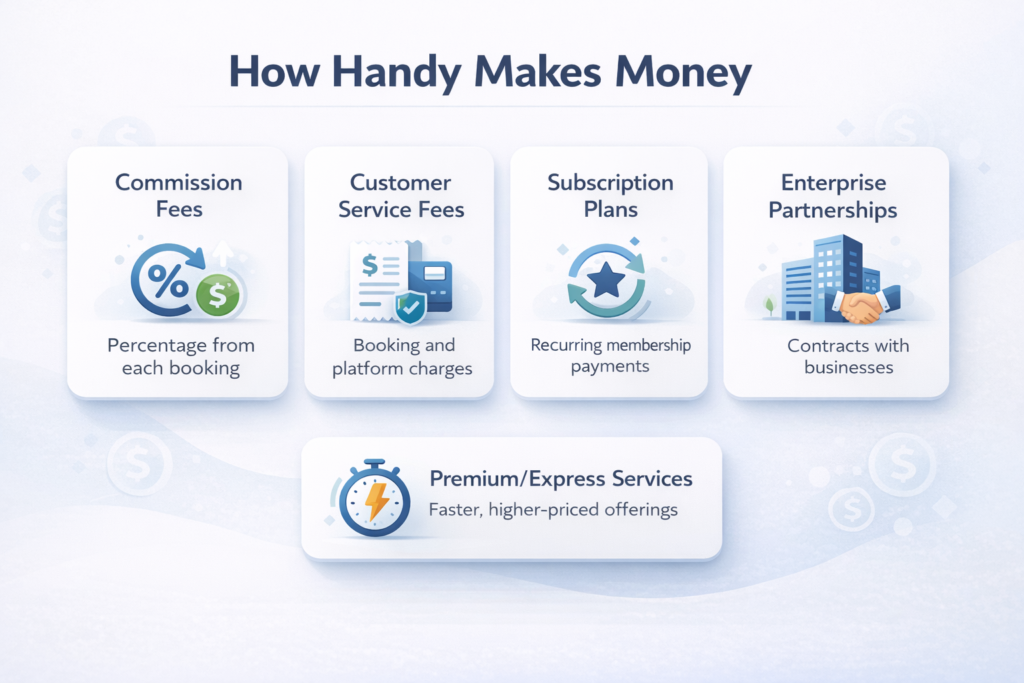
Handy makes money in four main ways:
- Commissions from service professionals on every booking
- Platform fees charged to customers
- Subscription plans for repeat customers who want discounts
- B2B partnerships with businesses and property managers
The core idea is simple. Handy owns no mops, no trucks, no tools. It just owns the platform. And the platform takes a cut every time a service happens.
That’s the magic.
The Core Idea Behind Handy’s Business Model
Here’s the thing most people miss.
Handy is not a cleaning company. It’s a technology company that sells access to cleaners.
Big difference.
This is what’s called an asset-light model. Handy doesn’t hire cleaners as employees. It doesn’t buy vans or equipment. It doesn’t manage payroll for 10,000 workers.
Instead, it builds software. The software does the heavy lifting.
On one side, you have customers who need home services. On the other side, you have professionals who offer those services. Handy sits in the middle and connects both.
Handy doesn’t provide services. It enables them.
This model is powerful because it scales fast. You can grow from 5 cities to 50 cities without hiring thousands of people. You just need more professionals to sign up on your app.
Real-world example: Airbnb doesn’t own hotels. Uber doesn’t own cars. Handy doesn’t own cleaning supplies. But all three make serious money by owning the platform.
How Handy Actually Works (Step by Step)
Let me walk you through a typical booking. It’s simpler than you think.
Step 1: Customer books online
You go to Handy’s website or app. You pick the service you need, your location, and the time that works for you. The whole thing takes about two minutes.
Step 2: Handy matches you with a pro
Their system finds an available, verified professional near you. You don’t need to interview anyone. You don’t need to post a job. The algorithm handles it.
Step 3: The service happens
The professional shows up at your door. They do the job. You don’t deal with cash or invoices. Everything was already paid online.
Step 4: Payment gets processed
Handy handles all the payments on the platform. The customer’s card gets charged. The professional gets paid after the job is done.
Step 5: Handy takes its cut
Before the money reaches the professional, Handy keeps a commission. That commission is the business.
Simple. Clean. Scalable.
How Handy Makes Money (Full Revenue Model)
Commissions from Service Providers
This is Handy’s biggest money maker.
Every time a professional completes a booking through the platform, Handy takes a percentage of the payment. The professional doesn’t get the full amount. A cut goes straight to Handy.
Think of it like a tax on every job. The more bookings that happen, the more Handy earns.
And here’s the smart part: Handy doesn’t carry the cost of doing the work. The professional does the labor. Handy just sits back and collects the fee.
This is why platform businesses are so attractive. Revenue scales without costs scaling equally.
Customer Service Fees
Handy also charges customers a small fee when they book.
It might show up as a platform fee or booking fee during checkout. It’s not huge. But when you multiply it across thousands of bookings per day, it adds up fast.
This creates a double-sided revenue stream. Handy earns from both the customer and the professional on every single transaction.
Subscription Plans
This one’s clever.
Handy offers subscription plans to customers who book regularly. If you’re someone who gets their place cleaned twice a month, you can subscribe and get a lower price per session.
You save money. Handy gets guaranteed, recurring revenue.
It’s a win-win. But Handy wins a little more because subscriptions lock in loyalty. Once someone subscribes, they’re far less likely to switch to a competitor.
Recurring revenue is the holy grail for any business. Subscriptions give Handy exactly that.
Partner and Enterprise Services
This is the B2B side of the business and it’s growing.
Handy partners with large companies like property management firms, real estate businesses, and even furniture retailers. These businesses need home services at scale.
For example, a furniture retailer might partner with Handy to offer assembly services when someone buys a couch or a shelf. The retailer looks good. The customer gets convenience. Handy gets paid.
This B2B angle gives Handy a steady, high-volume revenue stream outside of individual consumers.
Handy’s Business Model Canvas (Simple Breakdown)
Let me lay this out cleanly.
Key Partners
- Independent service professionals
- Payment processors
- Enterprise and B2B clients
- Retail brands offering bundled services
Key Activities
- Running and improving the platform
- Matching customers with the right professionals
- Handling payments and customer support
- Onboarding and verifying new professionals
Value Proposition
- Easy online booking in minutes
- Verified, reviewed professionals
- Transparent, upfront pricing
- No cash, no awkward negotiation
Customer Segments
- Busy urban professionals
- Homeowners who don’t have time
- Property managers handling multiple units
- Businesses needing recurring services
Channels
- Mobile app
- Website
- Partner integrations
Revenue Streams
- Commissions from professionals
- Platform/booking fees from customers
- Subscription plans
- B2B service contracts
Why Handy’s Business Model Actually Works
This isn’t just theory. There are real reasons why this model holds up.
Home Services Are a Recurring Need
People don’t just clean their homes once. They need it done every two weeks, every month, on and on.
This is a market with built-in repeat demand. Unlike buying a car or booking a vacation, home services are regular habits for millions of people.
When customers repeat, revenue repeats. That’s the dream.
Asset-Light Scaling Is a Superpower
Handy doesn’t need to open a physical location to enter a new city. It just needs professionals in that city to sign up on the platform.
This means expansion is cheap. Adding 10 new cities doesn’t require 10 new offices or 500 new employees. It requires marketing, a few sign-up drives for professionals, and the same app that already works.
Traditional service businesses can’t do this. A local cleaning company in Chicago can’t serve New York tomorrow. Handy can.
Convenience Wins Every Time
Think about how people used to hire cleaners. You’d ask a friend for a recommendation. You’d call someone. You’d negotiate a price. You’d hope they showed up.
Now? You book online in two minutes. The price is fixed. A verified person shows up. You rate them after.
Convenience isn’t just a feature. It’s the entire product.
People pay more for convenience. They stay loyal because of it. Handy built its whole business around removing friction.
Trust Is Built Into the System
One of the biggest barriers to hiring strangers for home services is trust.
Handy solves this with verification, background checks, reviews, and ratings. You’re not hiring a random person off the street. You’re hiring someone the platform has vetted and other customers have reviewed.
This trust layer is what keeps customers coming back. It’s also what makes professionals want to stay on the platform, because good ratings lead to more bookings.
Handy’s Growth Strategy
Handy didn’t blow up overnight. There was a strategy behind the growth.
Expanding into new cities was the first move. Start in one urban market, prove the model works, then push into the next city. Rinse and repeat.
Retail partnerships were a game changer. Partnering with furniture companies to offer assembly services as an add-on was brilliant. The customer is already spending money on furniture. Paying for assembly feels natural. Handy gets a new customer without spending much on marketing.
Focus on repeat customers is where the real growth happens. Getting someone to book once is good. Getting them to subscribe and book every month is 10 times better.
Improving reliability and service quality was critical. The hardest challenge in marketplace businesses is consistency. One bad experience can lose a customer forever. Handy had to invest in training, standards, and support to keep quality high.
Challenges Handy Faces (It’s Not All Perfect)
Let’s be honest. This model has real challenges.
Quality Control Is Hard
When you don’t employ the workers directly, you can’t control what they do. A professional might do a great job on Monday and a mediocre job on Friday.
Maintaining consistent quality across thousands of independent workers is genuinely difficult. Handy uses ratings and reviews to flag bad performers, but that’s reactive, not proactive.
Worker Retention Is a Real Problem
Gig workers have options. A cleaner working through Handy might decide to take clients directly and cut Handy out entirely. This is called “leakage” in the industry.
If a customer likes a specific professional, they might offer to pay them directly. The professional earns more. Handy loses the booking fee. Everyone wins except Handy.
Platforms have to constantly create reasons for both sides to stay. Handy does this through scheduling tools, payment protection, and insurance for professionals.
Competition Is Fierce
Handy isn’t the only player in this space.
TaskRabbit, Thumbtack, Angi, and dozens of local services compete for the same customers. In some cities, local companies have a better reputation simply because they’ve been around longer.
Standing out in a crowded market requires constant investment in brand, marketing, and service quality.
Pricing Pressure
Customers want low prices. Professionals want high earnings. Handy needs its cut in the middle.
Balancing these three competing interests is a constant tension. If Handy raises its commission, professionals are unhappy. If it raises prices for customers, they might switch to a competitor.
Finding the right pricing balance is an ongoing challenge.
Competitors of Handy
Let’s look at who Handy is up against.
TaskRabbit is probably the closest competitor. It focuses more on handyman-style tasks and allows customers to browse individual professionals and negotiate.
Thumbtack works differently. Professionals bid on jobs. Customers review bids and pick their favorite. It’s more flexible but also more effort.
Angi (formerly Angie’s List) has been around longer. It focuses on reviews and lead generation for local service businesses.
Urban Company is big in India and other markets. It’s very similar to Handy in model but operates in a different geography.
Each competitor has a slightly different angle. But they’re all fighting for the same market: people who want home services without the headache.
Handy vs Traditional Service Businesses
Here’s where it gets interesting.
| Factor | Handy | Traditional |
|---|---|---|
| Booking | Online, instant | Phone call, waiting |
| Speed | Same day, often | Days or weeks |
| Pricing | Fixed, upfront | Negotiated |
| Scalability | Very high | Very limited |
| Trust | Reviews and ratings | Word of mouth |
| Availability | 7 days a week | Business hours |
Traditional cleaning or handyman businesses are local by nature. They grow slowly. They rely on repeat customers and word of mouth. They can’t serve 50 cities at once.
Handy can. And that’s the fundamental difference.
The platform model just isn’t a fair fight against traditional businesses in terms of scale.
Lessons for Founders
If you’re building something and studying Handy’s model, here’s what actually matters.
Build platforms, not just services.
If you’re doing all the work yourself, your growth is limited by your own time and capacity. But if you build a platform that enables others to do the work, you can scale without hiring an army.
Convenience is your moat.
In a world where time is the scarcest resource, the business that saves people time wins. Don’t just be better. Be easier.
Trust is the product.
Especially in any marketplace where strangers interact, trust is everything. Reviews, verification, guarantees, insurance. These aren’t extras. They’re core features.
Recurring demand equals stable revenue.
Look for markets where the need repeats. Not just a one-time purchase. Home cleaning repeats. Haircuts repeat. Dog walking repeats. Find the recurring need, build around it, and your revenue becomes predictable.
Start niche, then expand.
Handy started with cleaning. Then handyman jobs. Then enterprise. They didn’t try to do everything on day one. Nail one category. Then grow.
The Future of Handy’s Business Model
Where does Handy go from here?
AI-based matching is the obvious next step. Smarter algorithms that match customers with the best professional for their specific need, based on past behavior, preferences, and location. This would improve completion rates and customer satisfaction.
Subscription-first model seems likely. More and more SaaS and consumer apps are moving toward subscriptions because they create predictable, loyal revenue. Handy could push harder in this direction.
Deeper B2B integrations with property managers, real estate companies, and retail brands could become a much bigger revenue stream than it is today. Enterprise contracts are more stable than individual consumer bookings.
Expansion into more service categories is also on the table. Beyond cleaning and handyman work, there’s plumbing, electrical, HVAC, pest control, and more. The platform model works for all of these.
The home services industry is massive. In the US alone, it’s worth hundreds of billions of dollars. Handy has only scratched the surface.
Wrap Up
Here’s the honest truth about Handy’s business model.
Handy didn’t invent home services. Cleaners and handymen existed long before apps did. What Handy invented was a better way to connect people who need those services with people who provide them.
That’s it. That’s the whole idea.
But that simple idea unlocked something powerful. An asset-light business that scales across cities. A revenue model that earns on every transaction. A trust layer that makes strangers feel safe inviting professionals into their homes.
Handy made home services faster, easier, and more reliable. And it built a very real business doing it.
If you’re looking at building something in a similar space, the lesson isn’t to copy Handy. It’s to find an industry where people still do things the hard way. Then make it easier.
That’s always worked. And it always will.
FAQs
Handy makes money through commissions taken from service professionals on each booking, platform fees charged to customers, subscription plans for regular users, and B2B partnerships with businesses and property managers.
No. Handy is a technology platform that connects customers with independent home service professionals. The professionals are not Handy employees. Handy is the marketplace, not the service provider.
Handy was acquired by ANGI Homeservices (now Angi Inc.) in 2018. It continues to operate as its own platform under the Angi umbrella.
Handy primarily offers home cleaning and handyman services. It also covers furniture assembly, TV mounting, plumbing help, and other general home tasks depending on the market.
Handy runs background checks on professionals before they can join the platform. It also uses a rating and review system so customers can evaluate quality after each booking.
Handy focuses more on recurring services like cleaning and offers a subscription model. TaskRabbit is more of a task-based marketplace where customers can browse individual professionals for one-off jobs. Both are solid platforms, but they serve slightly different needs.
Discover more from Business Model Hub
Subscribe to get the latest posts sent to your email.