Short answer: Glovo runs a multi-sided marketplace that connects customers, local businesses, and couriers. It makes money through delivery fees, commissions, subscriptions, and ads. It’s not just food delivery it’s a full urban logistics platform.
If you think Glovo is just another food delivery app, you’re thinking too small.
I thought the same thing at first. But once you dig into how it actually works, it’s clear Glovo is building something much bigger a “deliver anything” city-level logistics layer.
That changes everything about how the business model works.
Let’s break it all down simply.
What Is Glovo? (Quick Overview)
Glovo was founded in 2015 in Barcelona, Spain.
The core idea was bold: deliver anything, anytime, anywhere. Not just food. Groceries, medicine, electronics, flowers whatever you need, fast.
Today, Glovo operates across Europe, Africa, and parts of Asia. It’s one of the biggest delivery platforms in markets where Uber Eats and DoorDash haven’t fully taken over.
The tagline sounds simple. But the business behind it? Pretty complex.
How Glovo’s Business Model Actually Works
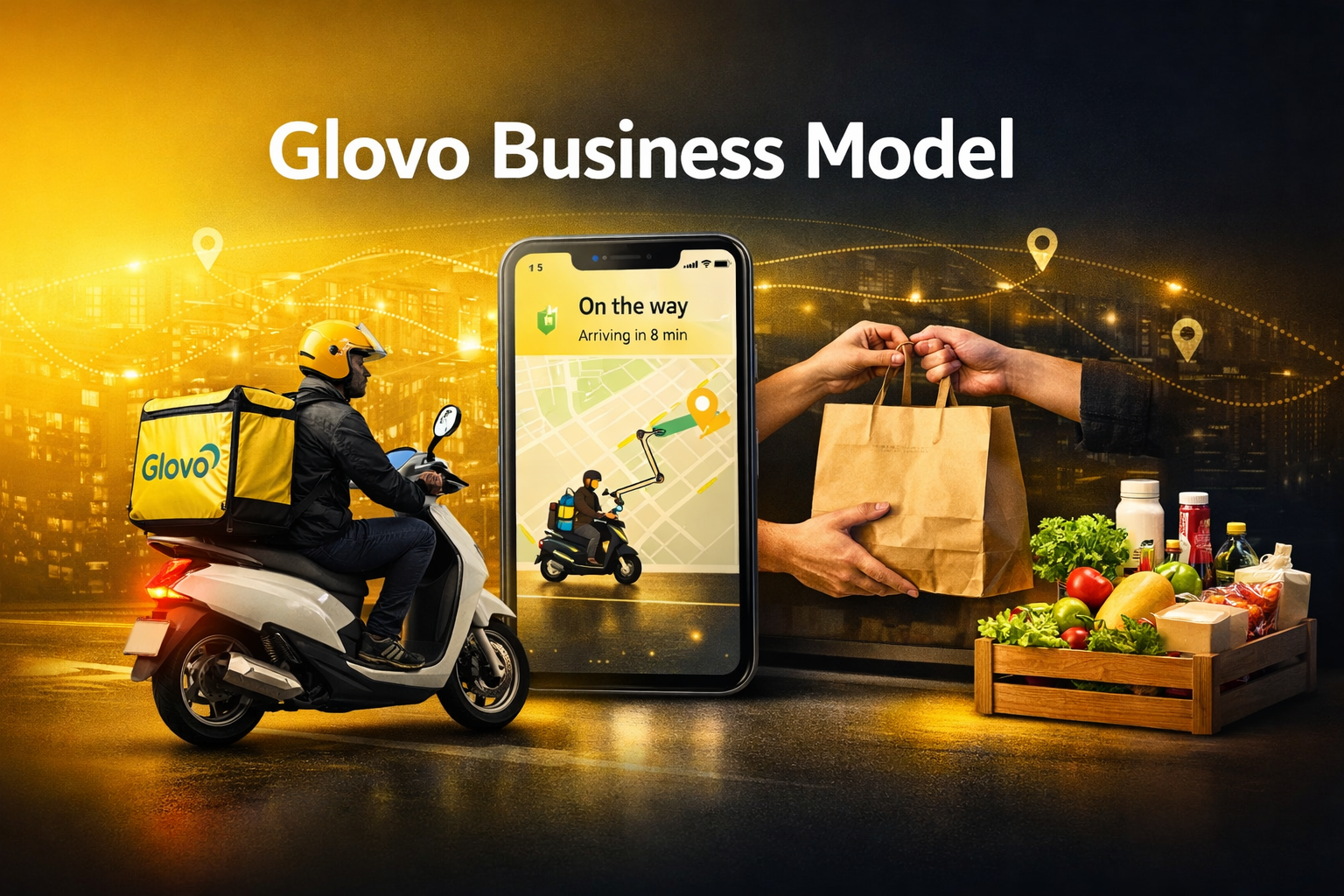
At its core, Glovo is a multi-sided marketplace.
That’s a fancy term for a platform that connects multiple groups and creates value for all of them at the same time.
Glovo connects three groups:
- Customers who want things delivered fast
- Partner businesses (restaurants, stores, pharmacies) who want more orders
- Couriers who want flexible earning opportunities
Here’s the key insight: Glovo doesn’t own the food, the stores, or the vehicles.
It owns the platform, the demand, and the logistics layer. That’s it.
Side 1 — The Customer
Customers download the app and order whatever they want.
It could be a burger, a bag of groceries, or a bottle of shampoo. The app shows options nearby, gives a delivery time estimate, and charges a delivery fee plus a small service charge.
The experience is designed around one thing: convenience.
You don’t leave the house. You don’t call anyone. Your order shows up in under 45 minutes, sometimes under 30.
For busy urban professionals, that’s not a luxury. That’s a time-saver.
Side 2 — The Partner (Restaurants & Stores)
Restaurants and local stores list their products on Glovo’s platform.
When a customer orders from them, Glovo takes a commission — typically between 15% and 35% per order.
That’s a big cut. But here’s the trade-off: these businesses get access to thousands of customers they’d never reach on their own. No marketing budget needed. No delivery infrastructure to build.
For a small restaurant, that’s a huge deal.
For Glovo, every transaction earns a cut. That’s the foundation of their revenue.
Side 3 — The Courier (Gig Workers)
Couriers are independent contractors. They use their own bikes or scooters.
They earn per delivery. The more they deliver, the more they earn. Glovo also offers bonuses and incentives based on demand, time slots, and locations.
The gig model keeps Glovo’s costs variable, not fixed. During slow periods, fewer couriers work. During peak hours, more jump on.
This flexibility is a big part of why Glovo can scale without owning a massive fleet.
Glovo’s Value Proposition (Why Each Side Stays)
This is where things get interesting.
Every marketplace lives or dies by its value proposition. If any one side of the equation stops finding value, the whole thing falls apart.
Here’s what Glovo offers each group:
For Customers
- Fast delivery (30–45 minutes average)
- One app for almost everything
- No need to travel or wait in line
- Subscription option for free delivery
The real value isn’t food. It’s time. People pay for convenience, and in dense cities, that’s worth a lot.
For Partner Businesses
- Instant access to a large customer base
- No need to build or manage delivery logistics
- Data insights on orders and customer behavior
- Visibility through promotions and advertising
A small local grocery store can’t afford its own delivery drivers. Glovo solves that overnight.
For Couriers
- Work whenever you want
- No fixed schedule or minimum hours
- Earn more during peak times
- Low barrier to entry (just need a bike and smartphone)
It’s not perfect — gig work has real downsides we’ll cover later. But for many couriers, the flexibility is a genuine benefit.
How Glovo Makes Money (All Revenue Streams Explained)
Let’s get into the numbers side.
Glovo has built a smart, layered revenue model. It doesn’t rely on just one income source. Here’s every way Glovo brings in money:
1. Delivery Fees
Every order comes with a delivery fee charged to the customer.
This varies by distance, order size, and demand. During peak hours, it can go up (surge pricing). On quiet afternoons, it might be lower.
This is the most direct revenue stream. Every single order generates it.
2. Commission from Partners
This is the biggest revenue driver.
When a restaurant or store gets an order through Glovo, they pay a commission — usually somewhere between 15% and 35% of the order value.
Higher visibility on the platform? Higher commission tier. It’s a sliding scale depending on the partnership agreement.
At scale, these commissions add up to serious money.
3. Service Fees
Beyond delivery fees, Glovo charges a small service or platform fee per order.
It sounds minor. But multiply it across millions of orders per month, and it becomes a meaningful revenue line.
Think of it like a processing fee that covers operational costs.
4. Glovo Prime (Subscription)
This one’s smart.
Glovo Prime is a monthly subscription that gives customers free or discounted delivery on all orders.
It’s a win for customers who order frequently. And it’s a win for Glovo — because it creates predictable, recurring revenue regardless of how many orders happen.
Subscriptions also increase order frequency. When delivery is “free,” people order more often.
5. Advertising and Promotions
Want your restaurant to appear at the top of the app? Pay for it.
Glovo sells sponsored listings and promotional placements to partner businesses. It’s similar to how Amazon lets sellers pay for better product visibility.
As Glovo’s user base grows, this advertising revenue becomes increasingly valuable. More eyeballs = more ad revenue potential.
6. Dark Stores and Quick Commerce
This is the most ambitious part of Glovo’s model.
Dark stores are small, local micro-warehouses. They’re not open to the public. They exist purely to fulfill delivery orders — usually for groceries and household items.
Glovo stocks these stores itself and delivers directly from them.
This means Glovo can guarantee 10–20 minute delivery for everyday items. No restaurant involved. No partner dependency.
It’s a higher-margin opportunity — but it also means Glovo is taking on inventory risk for the first time.
Quick commerce (q-commerce) is the fastest-growing part of the delivery industry right now. Glovo is betting big on it.
Key Business Model Components
Beyond the revenue streams, a few structural elements make Glovo’s model work.
Asset-Light Model
Glovo doesn’t own restaurants, stores, or delivery vehicles (except dark stores).
This keeps capital costs low. The platform scales without massive infrastructure investment.
Less ownership = more flexibility. If a market doesn’t work out, Glovo can pull back without being stuck with physical assets.
Network Effects
This is the secret weapon of every great marketplace.
More customers on the platform → more attractive for restaurants to join → more variety for customers → more orders → more work for couriers → and the cycle continues.
Each new user makes the platform more valuable for everyone else.
This is hard to replicate. Once Glovo reaches a certain density in a city, it becomes very difficult for a competitor to break in.
Hyperlocal Strategy
Glovo doesn’t try to be everywhere at once.
It focuses on dense urban areas where order volume is high and delivery distances are short. This keeps logistics costs down and delivery times fast.
A city like Barcelona or Warsaw with millions of people in a compact area is perfect for Glovo. A rural town with low density? Not viable.
This hyperlocal focus is why Glovo is strong in specific markets but not everywhere.
Logistics Optimization
Behind the scenes, Glovo runs serious technology.
AI-based dispatch systems decide which courier gets which order. Route batching lets couriers handle multiple orders in one trip, increasing efficiency.
The better these systems get, the faster deliveries become — and the lower the cost per delivery.
This is where tech actually matters in the delivery business.
Glovo’s Growth Strategy
Glovo isn’t just trying to grow orders. It’s trying to evolve the entire business.
Market Expansion
Instead of competing head-to-head with Uber Eats in Western Europe, Glovo has pushed into emerging markets — Eastern Europe, Africa, Central Asia.
Less competition. Growing middle class. Rising smartphone usage.
These markets are risky but offer strong long-term potential.
Vertical Expansion
Glovo started with food. Now it delivers groceries, pharmacy items, pet supplies, electronics, and more.
Every new vertical is a new revenue opportunity. And it deepens customer dependency on the platform — why would you use another app if Glovo already delivers everything?
Quick Commerce Push
The real growth frontier right now is 10–20 minute delivery.
Glovo is expanding its dark store network to make this possible for everyday grocery items. This puts it in direct competition with players like Getir, Gopuff, and Gorillas.
The company that wins ultra-fast delivery wins the daily habit. And daily habits are worth billions.
Competitive Landscape
Glovo doesn’t operate in a vacuum.
The main players it competes with:
- Uber Eats — global scale, huge restaurant network
- Deliveroo — strong in UK and Europe
- Just Eat / Takeaway — big in Northern Europe
- DoorDash — dominant in North America
What makes Glovo different?
Most competitors focus primarily on food. Glovo’s core pitch is “deliver anything.”
That positioning gives it more use cases, more order frequency, and more customer stickiness. When someone needs a phone charger at midnight, they’re not opening Uber Eats. But they might open Glovo.
Challenges in Glovo’s Business Model
Let’s be honest. This model has real problems.
Thin Margins
Delivery is expensive. Couriers, tech infrastructure, marketing, customer support — the costs pile up fast.
Even with commissions and delivery fees, margins are razor-thin. A small increase in fuel prices or courier wages can wipe out profitability in a market.
This is the fundamental challenge of the delivery business.
Courier Dependency and Regulation
Glovo depends on gig workers. But gig work is increasingly under legal scrutiny.
In Spain — Glovo’s home market — the Supreme Court ruled that couriers must be treated as employees, not contractors. That ruling forced Glovo to restructure its model in Spain.
If similar laws pass in more countries, Glovo’s cost structure changes dramatically. Employee benefits, social security, minimum hours — these all eat into the asset-light model.
Competition and Pricing Wars
Every major market has at least two or three delivery platforms fighting for the same customers.
That leads to heavy discounts, promotions, and subsidies. Everyone races to the bottom on price to acquire users.
User acquisition is expensive. Retention is harder. If a competitor offers a better deal, customers switch instantly — there’s almost no loyalty in this category.
Profitability Pressure
Glovo has historically operated at a loss.
Expansion costs money. New markets require subsidies. Dark stores require upfront investment.
The playbook is classic startup growth strategy — lose money now, build scale, optimize later. But investors are increasingly impatient.
Profitability matters more now than it did in the low-interest-rate era.
Is Glovo Profitable?
Honestly? It’s complicated.
Glovo was acquired by Delivery Hero in 2022, so it no longer reports standalone financials. But the picture from before the acquisition and from Delivery Hero’s reports tells a clear story.
Glovo has been loss-making in most markets due to expansion costs. However, in mature markets with high order density like Spain, Poland, and some African cities unit economics have been improving.
The key metric is contribution margin per order. In strong markets, each order generates positive contribution. The problem is covering centralized overhead tech, marketing, executive costs across the entire operation.
Simple take: Glovo can be profitable market-by-market. But at the group level, it’s still a scale game.
The better the order density in each city, the closer it gets to sustainable profitability.
The Future of Glovo’s Business Model
Here’s where I think it gets exciting.
Quick Commerce Will Define the Next Chapter
10–20 minute delivery of everyday items is the big bet.
If Glovo can own the “I need this in 15 minutes” use case in major cities, it becomes essential infrastructure — not just a convenience app.
Dark stores are the key to making this real.
Subscriptions and Ads Will Grow
Delivery fees and commissions are transactional. Subscriptions and advertising are recurring.
As the platform matures, I expect Glovo to push harder on both. More subscription tiers, better ad products for partners, data monetization.
These revenue streams have higher margins than delivery. They’re the path to real profitability.
Automation on the Horizon
Long term, AI logistics optimization, autonomous vehicles, and potentially drone delivery will reshape the cost structure.
Glovo won’t be the one building drones. But it’ll be one of the first platforms to deploy them if they become viable.
The delivery layer is software. The physical execution will get automated over time.
Urban Infrastructure Play
Here’s the big picture view.
Glovo isn’t just delivering burritos. It’s becoming part of how cities function supply chains for small businesses, last-mile logistics for retail, emergency item delivery for individuals.
That’s an infrastructure position. And infrastructure businesses have defensible moats.
If Glovo executes well, it won’t just be a delivery app. It’ll be something cities genuinely depend on.
Key Takeaways
Let me wrap this up simply:
- Glovo is a multi-sided marketplace. Customers, partners, and couriers all participate. Glovo takes a cut at every level.
- Revenue is diversified — delivery fees, commissions, subscriptions, ads, and dark stores.
- Margins are thin. The delivery business is hard. Profitability requires density and efficiency.
- The real moat is execution and network effects, not technology alone.
- Quick commerce is the future bet. Whoever wins 10-minute delivery wins the daily habit.
- Glovo is evolving from an app into urban logistics infrastructure. That’s a much bigger story.
FAQs
Glovo uses a multi-sided marketplace model with logistics integration. It connects customers, local businesses, and couriers — and earns revenue from every transaction on the platform.
Glovo makes money through delivery fees, commissions from partner businesses (15–35% per order), service fees, Glovo Prime subscriptions, advertising placements, and revenue from its dark store quick-commerce operations.
Glovo’s core focus is “deliver anything” — not just food. This includes groceries, pharmacy items, electronics, and more. It also has a stronger presence in emerging markets where other platforms are less competitive.
Not consistently at the group level. Glovo has historically invested heavily in expansion, which created losses. However, in mature, high-density markets, unit economics are improving. Profitability is achievable — but it depends on order volume and operational efficiency in each city.
Glovo was acquired by Delivery Hero, a German food delivery company, in 2022. It still operates under the Glovo brand in its active markets.
Discover more from Business Model Hub
Subscribe to get the latest posts sent to your email.