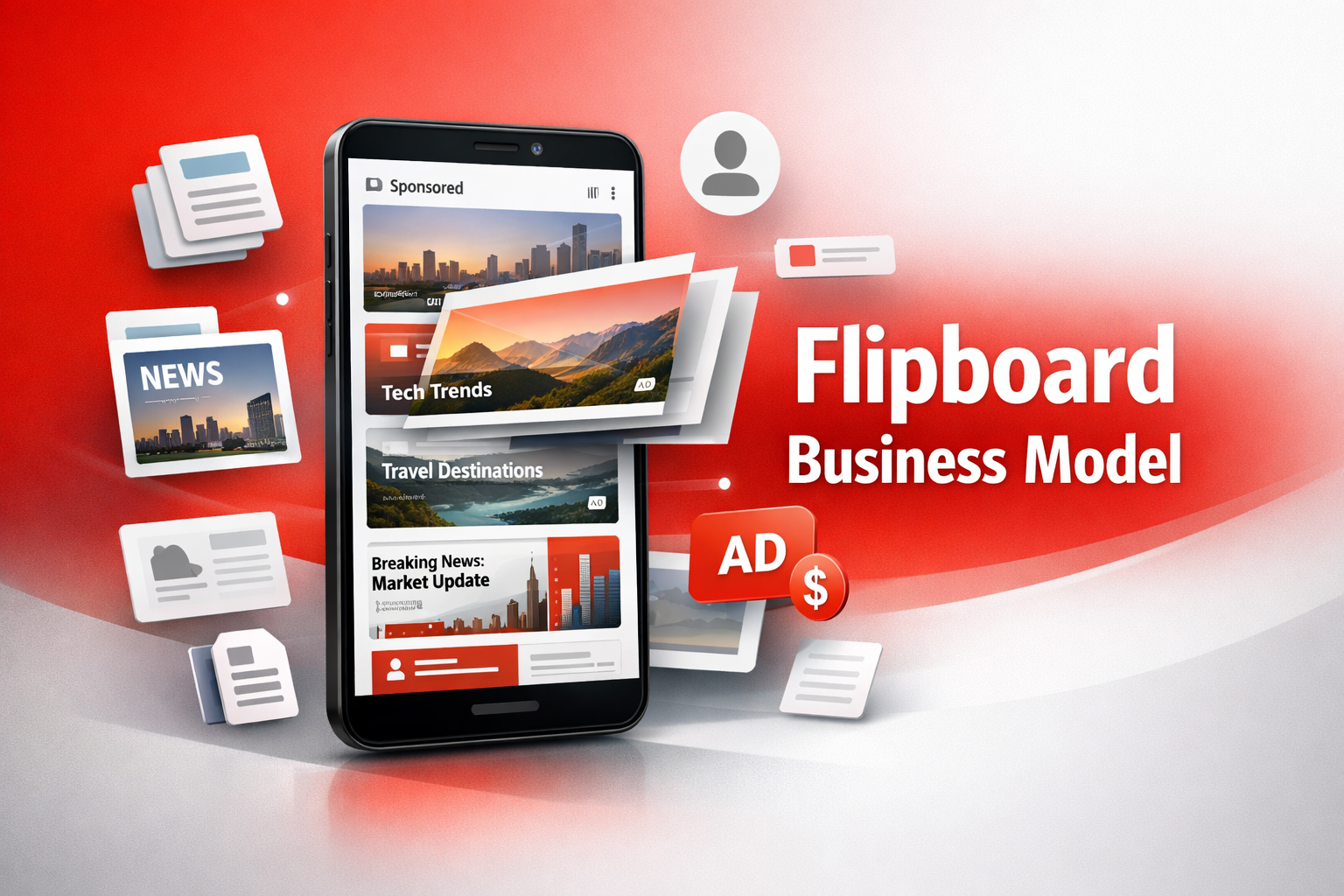
Flipboard operates on a content curation and aggregation business model. It collects articles, blogs, and social content into a personalized magazine-style feed and monetizes primarily through advertising, brand partnerships, and content distribution deals. This model positions Flipboard as a middle layer between publishers and readers, not a content creator itself.
What Is Flipboard?
Flipboard is a news aggregation and content curation platform available on mobile and web. It pulls articles, blog posts, videos, and social media content from thousands of sources and organizes them into visually rich, magazine-style feeds tailored to each user’s interests.
Founded in 2010, Flipboard built its product around a simple idea: the internet has too much content and readers need a smarter filter.
Users browse topics, follow publishers, and save stories. The interface mimics flipping through a physical magazine, which is where the name comes from. Flipboard does not write its own content. It curates, surfaces, and presents content from external sources.
It is available on iOS, Android, and the web, with the mobile app being its primary product.
Flipboard Business Model Overview
Flipboard sits between publishers and readers. It does not spend money producing original journalism. Instead, it focuses on three core activities: aggregating content, personalizing feeds, and monetizing attention.
The core logic is simple:
Curate content from publishers and social platforms. Use algorithms and AI to personalize what each user sees. Insert advertising and sponsored content into those feeds. Generate revenue based on impressions, clicks, and brand partnerships.
This model keeps content creation costs near zero while allowing Flipboard to build a large, engaged audience. Publishers supply the content for free because Flipboard sends them traffic in return. Advertisers pay Flipboard to reach that audience.
It is a classic media aggregation play, updated for the mobile era.
How Flipboard Works (Step-by-Step)
Understanding the operational flow helps clarify how Flipboard turns curation into cash.
Step one: Content sourcing. Flipboard pulls content from publishers, news outlets, blogs, and social platforms like Twitter and Instagram. Publishers can also directly submit RSS feeds or integrate via the Flipboard Publisher Program.
Step two: Personalization. Flipboard uses AI and editorial algorithms to learn what each user cares about. It tracks topics followed, time spent on articles, and interactions to build a profile. The result is a feed that gets more relevant over time.
Step three: User engagement. Users scroll through their feed, save articles to personal collections, and curate their own magazines. This engagement data is fed back into the algorithm to sharpen personalization.
Step four: Ad insertion. Native ads, sponsored stories, and brand campaigns are inserted directly into the feed. Because the ads match the editorial look and feel, they integrate naturally rather than interrupting the experience.
Step five: Revenue generation. Flipboard earns money based on ad impressions, engagement metrics, and fees from brand partnerships. Publishers also benefit through the traffic Flipboard drives back to their sites.
Flipboard Revenue Streams
Flipboard does not rely on a single income source. Its revenue comes from several interconnected streams.
Advertising Revenue
This is Flipboard’s primary revenue driver. The platform sells native advertising, which means ads that look and feel like editorial content rather than traditional banners.
These native ads appear inside user feeds and are formatted like regular article cards. Users may see a sponsored story from a brand that resembles organic content. This format typically delivers higher engagement rates than display advertising because it does not disrupt the reading experience.
Flipboard also runs sponsored stories and brand campaigns for major advertisers looking to reach content consumers across categories like technology, travel, fashion, and finance.
Revenue here depends directly on user volume, time spent in the app, and the quality of the audience data Flipboard can provide to advertisers.
Publisher Partnerships
Flipboard does not charge publishers to be on the platform. Instead, it operates a traffic-based partnership model.
Publishers contribute their content, Flipboard surfaces it to relevant users, and the traffic that flows back to publisher sites serves as the value exchange. Publishers benefit from additional distribution and audience reach without paying placement fees.
In some arrangements, Flipboard shares a portion of advertising revenue with publishers whose content is featured prominently. This creates a mutual incentive structure where both sides benefit from strong user engagement.
Content Distribution Deals
Beyond standard publisher relationships, Flipboard pursues syndication agreements and featured placement deals with premium content partners.
These arrangements may involve Flipboard paying for exclusive or early access to certain content, or content partners paying for guaranteed placement in front of specific audience segments. The specifics vary by partner, but the goal is the same: create a pipeline of high-quality content that keeps users engaged and returning daily.
Content distribution deals also allow Flipboard to offer advertisers more precise contextual targeting by ensuring certain categories of content are consistently available.
Brand Collaborations and Curated Magazines
Flipboard allows brands to create their own curated magazines on the platform. These branded magazines collect relevant content around a theme and serve as a branded content marketing channel.
A fashion brand might curate a magazine on style trends. A technology company might build one around innovation and future of work content. These branded collections keep the brand in front of readers without a hard sell.
Flipboard earns fees from brands for setting up, promoting, and managing these curated properties. It is a relatively low-cost format for the brand while generating steady revenue for Flipboard.
Flipboard Value Proposition
Flipboard succeeds because it delivers genuine value to three distinct groups.
For Users
Flipboard offers a clean, distraction-free reading experience at a time when most social media apps are optimized for maximum noise and engagement manipulation.
Users get content matched to their actual interests without being bombarded by outrage bait or algorithmic controversy. The visual layout is easy to navigate, and the ability to create personal magazines makes the experience feel curated rather than chaotic.
The platform is free to use, with no subscription required to access the core features.
For Publishers
Publishers gain additional distribution and traffic without paying for it. Getting onto Flipboard means reaching an audience that might not discover their content through Google search or social media alone.
For smaller publishers and bloggers, Flipboard can be a meaningful traffic source. For larger publishers, it provides another channel for audience development.
The relationship is mutually beneficial: publishers provide content, Flipboard provides reach.
For Advertisers
Advertisers get access to a highly engaged, content-seeking audience. People on Flipboard are actively reading, not passively scrolling. That intent-based behavior makes ad placement more valuable.
Native ad formats on Flipboard also tend to outperform traditional display ads because they match the editorial context of the feed. Advertisers can also target by topic category, which allows precise alignment between ad content and reader interest.
Target Audience
Flipboard serves three distinct customer groups, and each group plays a role in making the business model function.
Content consumers are everyday users who want a smarter way to follow news and niche interests. They are typically educated, digitally active, and interested in staying informed across multiple topic areas. These users generate the engagement that makes Flipboard valuable to advertisers.
Publishers and bloggers treat Flipboard as a distribution channel. They want traffic and audience growth, and Flipboard delivers both without requiring a paid relationship.
Brands and advertisers are the paying customers in Flipboard’s ecosystem. They buy ad placements and branded magazine experiences to reach an attentive audience of content consumers.
The business model works because all three groups are interdependent. Remove any one of them and the whole system weakens.
Flipboard vs Traditional Media Platforms
Flipboard occupies a distinct position in the media landscape.
Unlike traditional media companies, Flipboard does not produce any original content. It is purely a curation and distribution layer. This keeps operating costs low because there are no editorial teams to pay or content licensing fees to manage at scale.
Compared to news apps like Google News and Apple News, Flipboard differentiates on user experience. The magazine-style layout and personal magazine feature create a more personalized, visually engaging product than a simple news feed.
Google News and Apple News are built around breaking news and information delivery. Flipboard is built around interest-based content consumption. These are meaningfully different use cases, which is why significant audiences use both.
Flipboard also differs from social media platforms that primarily distribute user-generated content. Flipboard focuses on professional and editorial content from publishers, which tends to attract a different type of user with different behavior patterns.
The key competitive advantage Flipboard maintains is the combination of editorial content quality and personalization technology. Neither social media nor traditional news apps deliver both effectively.
Flipboard Growth Strategy
Flipboard has pursued a consistent set of strategic priorities to grow its user base and advertiser relationships.
Personalization at the core. Every product decision prioritizes helping users find content they care about. Better personalization means more time spent in the app, which directly increases advertising revenue.
Mobile-first design. Flipboard built its product around the mobile use case from the beginning. The gesture-based navigation and card-style layout were designed for touchscreens, not adapted from a desktop product. This gave it an edge in the early days of smartphone-driven media consumption.
Premium publisher partnerships. Flipboard actively recruits relationships with high-quality publishers across categories. Better content leads to better user retention, which supports advertiser pricing power.
Social sharing mechanics. Flipboard’s personal magazine feature turns users into curators and micro-publishers. When a user shares their Flipboard magazine, they market the platform to their network for free. This social distribution layer lowers user acquisition costs.
Challenges in the Flipboard Business Model
No business model is without vulnerabilities. Flipboard faces real structural challenges.
Dependency on third-party content is the most fundamental risk. If major publishers restrict their content or change their distribution terms, Flipboard’s feed quality suffers immediately. Publishers have increasing leverage as they build direct subscriber relationships.
Competition from Google News and Apple News is intense. Both competitors have virtually unlimited resources and deeper integration with operating systems and browsers. Google News is pre-installed on Android. Apple News is built into iOS. Flipboard must convince users to seek it out.
Ad revenue fluctuations create instability. Digital advertising is sensitive to economic conditions, and native ad budgets are often the first to be cut during downturns. Flipboard’s reliance on advertising without a significant subscription alternative makes it more vulnerable to these swings.
User retention is an ongoing challenge. Content consumption habits are difficult to sustain. Users who download the app during a news cycle may churn once the event passes. Keeping users engaged with a consistent daily habit requires constant product improvement.
Flipboard Business Model Canvas
| Element | Detail |
|---|---|
| Key Partners | Publishers, news outlets, social platforms, brand advertisers |
| Key Activities | Content aggregation, AI personalization, ad sales, publisher relations |
| Value Proposition | Personalized reading for users, traffic for publishers, targeted reach for advertisers |
| Customer Segments | Content consumers, publishers, brands and advertisers |
| Revenue Streams | Native advertising, brand campaigns, content distribution deals, brand magazine partnerships |
| Key Resources | Curation algorithm, publisher network, user data, mobile platform |
| Cost Structure | Engineering, ad sales, publisher partnerships, platform operations |
| Channels | iOS app, Android app, web platform |
Real-World Example: How It Works in Practice
Here is how the Flipboard model plays out for two participants.
A publisher gaining traffic. A mid-size technology publication integrates its RSS feed with Flipboard. When users who follow the technology category scroll through their Flipboard feed, they see articles from this publication. Users who click through are redirected to the publication’s website. The publisher gains traffic without paying Flipboard anything. Flipboard gains quality content to populate feeds and keeps users engaged longer.
How ads appear in a user feed. A user who follows topics related to personal finance and investing opens Flipboard. Between two editorial articles, they see a sponsored story formatted like a regular article card. It might be from a brokerage firm promoting a new investment product. The card has a headline, image, and brief description matching the editorial look of the feed. The user may or may not recognize it immediately as an ad. The brokerage pays Flipboard based on impressions or click-through performance.
These two examples show how the revenue engine operates without users or publishers writing a check.
Future Opportunities for Flipboard
Flipboard has several realistic paths to expand its business model.
AI-driven personalization improvements. Advances in natural language processing and recommendation systems could significantly improve how well Flipboard matches content to user intent. Better personalization directly increases engagement and retention, which supports ad revenue growth.
Creator monetization features. As the creator economy matures, Flipboard could build tools that allow individual writers and curators to monetize their personal magazines directly, similar to what Substack and Medium offer. This would attract a new creator audience and generate new revenue streams through revenue sharing or platform fees.
Subscription-based premium experience. A paid tier that removes advertising, unlocks advanced personalization features, or provides access to exclusive publisher content could diversify Flipboard’s revenue base. In an environment where ad revenue is volatile, subscription income provides stability. This would follow a path similar to what Spotify took in audio or what many news apps have pursued.
Expanded brand partnership formats. As brands shift more budget into content marketing, Flipboard’s branded magazine product has room to grow into a more sophisticated offering with analytics, audience targeting, and co-created content capabilities.
Key Takeaways
Flipboard is a curation-first platform, not a content creator. It operates as an aggregation layer between publishers and readers, and it monetizes the attention and engagement that result from delivering a superior reading experience.
Its revenue depends heavily on native advertising and brand partnerships. The business model works because it creates genuine value for users, publishers, and advertisers simultaneously.
The biggest competitive advantage Flipboard holds is not technology or content rights. It is user experience. The magazine-style interface, personalization quality, and editorial content focus combine to create a product that is genuinely different from what Google News and social media deliver.
The challenges ahead are real, particularly around advertiser dependency and competition from platform-embedded news products. However, the opportunity to expand into subscriptions and creator monetization gives Flipboard a credible path to a more diversified revenue model.
Want to Build an App Like Flipboard?
Content aggregation and curation platforms are among the most scalable digital products because they rely on third-party content rather than expensive original production.
If you are thinking about building something in this space, the core components you need are a content ingestion system, a personalization engine, a user engagement layer, and a monetization framework.
The MVP does not need to solve all of these at once. Most successful content platforms start by doing one thing well, usually personalization or a specific niche, and expand from there.
If you are exploring this type of product, here are useful starting points: MVP development to validate the core curation and feed experience, app strategy consultation to define your niche and monetization approach before building, or a partner agency model if you want to move faster by working with a team that has already built similar systems.
The Flipboard model proves that you do not need to create content to build a valuable media business. You need to curate it better than anyone else and build an audience worth reaching.
Conclusion
Flipboard’s business model is built on a clean and logical foundation. Aggregate the best content from across the web, personalize it for each user, and monetize the attention that results.
It does not compete with publishers. It distributes them. It does not create content. It curates it. This positioning keeps costs low and keeps Flipboard’s value proposition intact for all three groups it serves: readers, publishers, and advertisers.
The path forward depends on how successfully Flipboard can diversify beyond pure advertising revenue into subscriptions or creator tools. But the core model, turning curation into revenue by being the best reading experience on mobile, remains sound.
If you are building in the content or media space, the Flipboard model offers a clear template: own the experience, not the content.
FAQs
Yes. Flipboard is free for users across iOS, Android, and the web. There is no subscription required to access the core reading experience.
Flipboard makes money primarily through native advertising placed inside user feeds, sponsored stories, brand magazine partnerships, and content distribution deals with publishers and media companies.
Flipboard has not publicly disclosed profitability figures. The company has raised over $200 million in funding since 2010 and has gone through multiple rounds of restructuring. Like many ad-dependent media platforms, profitability depends heavily on advertising market conditions.
Google News focuses on breaking news aggregation and is deeply integrated with Google search and Android. Flipboard focuses on interest-based content discovery with a magazine-style interface. Flipboard also allows users to curate their own personal magazines, which Google News does not offer. The user experience and intent are meaningfully different.
Discover more from Business Model Hub
Subscribe to get the latest posts sent to your email.