Wholesale has always been a gamble.
You order too much, you’re stuck with dead inventory. You order too little, you miss the season. You find a great brand, but their minimum order quantity is $2,000 and returns aren’t allowed. You’re a small retailer with limited cash flow, and the system was never really built for you.
Faire looked at all of that and decided to fix it.
Today, Faire is one of the most talked-about B2B marketplaces in retail and for good reason. It’s not just connecting brands with retailers. It’s removing the fear that’s always made wholesale feel like a high-stakes bet.
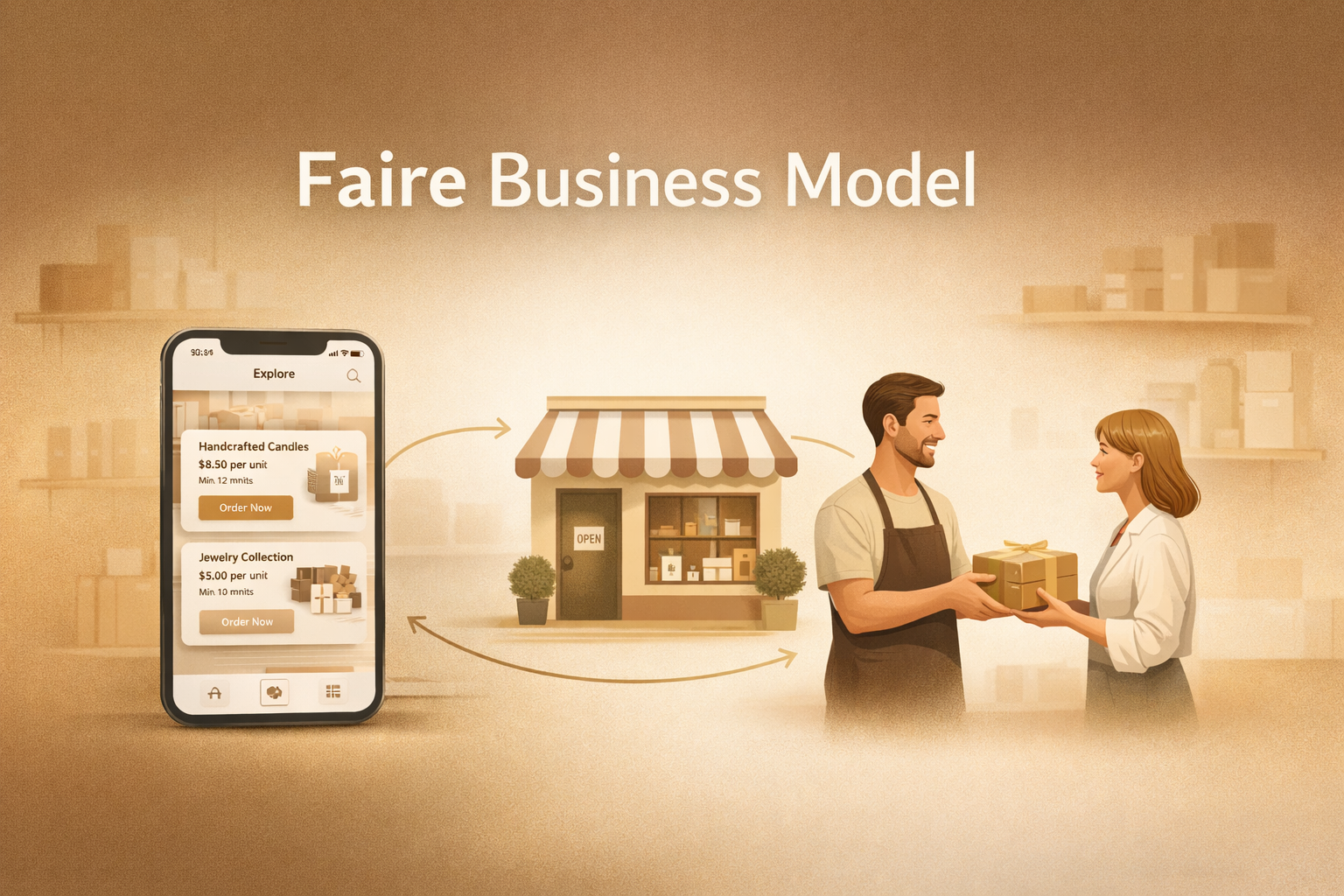
Faire is a B2B wholesale marketplace that connects independent retailers with emerging and established brands. It earns revenue through commissions on transactions, retailer financing (net 60 terms), and logistics margins. But more than a marketplace, it’s a risk-reduction platform for both sides of the wholesale equation.
What Is Faire?
Faire was founded in 2017 by Max Rhodes, Daniyar Nyssanbayev, Marcelo Cortes, and Jeff Kolovson all former Square employees who understood payments, trust, and the complexity of small business commerce.
Their thesis was simple but powerful: independent retail is massive, underserved, and broken at the infrastructure level.
There are millions of independent retailers around the world boutiques, gift shops, specialty food stores, toy shops, bookstores. They buy from hundreds of different brands. They manage dozens of supplier relationships. And they do most of it manually, through trade shows, email threads, and phone calls.
On the other side, emerging brands struggle to reach these retailers without expensive sales reps or exhausting trade show circuits.
Faire built a platform to fix both sides at once.
At its core, Faire is a two-sided B2B marketplace but calling it just a marketplace undersells what it actually does. It’s more accurate to think of it as a wholesale operating system for independent retail.
The Problem Faire Actually Solves
Before you understand how Faire makes money, you need to understand the pain it’s solving. Because the business model only makes sense in that context.
For Retailers
Independent retailers face three compounding problems in wholesale:
Inventory risk. When you place a wholesale order, you’re typically committing to a minimum quantity with no guarantee those products will sell. If they don’t move, that’s your cash sitting on a shelf.
Limited discovery. Finding new brands used to mean attending trade shows like Magie or NY NOW — expensive, time-consuming events that smaller retailers couldn’t always afford to attend. Word of mouth filled in the rest, which meant discovery was slow and geographically limited.
Cash flow pressure. Most brands require payment upfront or within 30 days. For a small retailer managing payroll, rent, and seasonal inventory swings, that’s brutal.
For Brands
Emerging brands have their own version of this nightmare:
Distribution challenges. Getting your product into independent retail stores requires either a distributor (who takes a cut), a sales rep (who’s expensive), or you doing it all yourself (which doesn’t scale).
High customer acquisition costs. Finding the right retailers — the ones whose customer base actually matches your product — is genuinely hard. Trade shows help, but they’re expensive and reach is limited.
Scaling difficulty. A brand doing $500K in revenue doesn’t have the infrastructure to manage net terms, handle returns, or chase unpaid invoices. Faire handles all of that.
The insight at the center of Faire’s model: both sides of wholesale are being held back by fear and friction. Retailers fear bad inventory bets. Brands fear retailer defaults and distribution headaches. Remove that fear, and you unlock a massive amount of latent commerce.
How Faire Actually Works
Faire’s user experience is deliberately simple, even if the backend is anything but.
For Retailers
- Create a free account and verify your retail business
- Browse a curated catalog of thousands of brands and products
- Place orders with net 60 payment terms — meaning you receive the goods before you pay for them
- On first orders from any brand, benefit from free returns on items that don’t sell
- Pay Faire 60 days later, once you know what’s actually moving
That free returns policy is one of the most strategically important things Faire offers. It completely removes the inventory risk on new brand discovery. If you order from a brand for the first time and the product flops, you can return what doesn’t sell.
This one feature probably does more for retailer adoption than anything else Faire has built.
For Brands
- Apply to list on Faire and go through a curation process
- Set up your catalog, pricing, and minimum order quantities
- Receive orders from vetted retailers across the country (and internationally)
- Faire handles payment collection and retailer financing
- Brands get paid reliably, without chasing invoices
The key thing brands give up is margin — Faire’s commission rates are meaningful. But what they get in return is distribution, discovery, and financial reliability they couldn’t build themselves.
The Faire Business Model: An Overview
Faire operates as a two-sided marketplace with an embedded fintech layer.
The marketplace connects supply (brands) with demand (retailers). The fintech layer is what makes that marketplace sticky — it finances retailer purchases, absorbs default risk, and creates a payment infrastructure that neither side has to build.
This combination is what makes Faire’s model genuinely defensible. A pure marketplace can be replicated. A marketplace with deeply embedded financial infrastructure is much harder to compete with.
Let’s break down each revenue stream in detail.
How Faire Makes Money
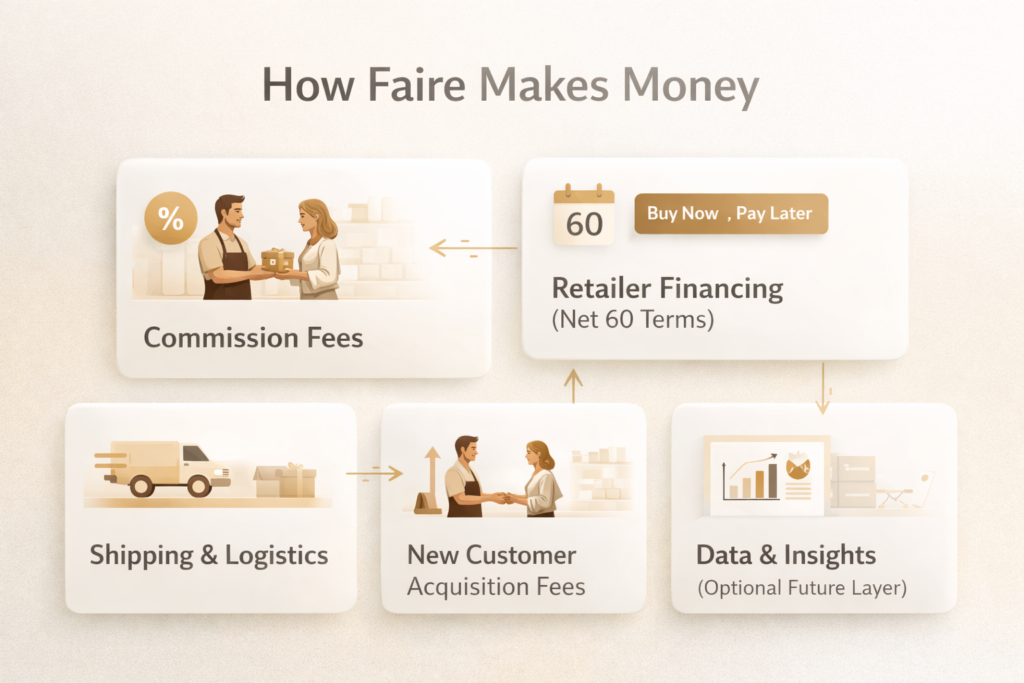
Commission on Orders
The most straightforward piece of Faire’s revenue is the commission it charges brands on each transaction.
Faire’s commission structure is tiered:
- Around 25% commission when Faire introduces a brand to a new retailer (new customer acquisition)
- Around 15% commission on repeat orders between brands and retailers who already have a relationship
This tiering is strategically brilliant. Faire charges more when it creates more value. If a brand was already selling to a retailer before Faire, they can connect those existing relationships on the platform at the lower rate. But when Faire’s algorithm surfaces your brand to a retailer who never heard of you — and that retailer places an order — Faire takes a bigger cut. That’s a new customer it delivered.
For brands, even 25% can be worth it. Compare it to the cost of a trade show booth ($5,000–$20,000+), a sales rep commission (10–15% plus a base salary), or the effort of cold outreach that mostly gets ignored.
Faire is essentially acting as a performance-based sales channel. You only pay when you get an order.
Retailer Financing and Net Terms
This is where Faire becomes genuinely interesting from a business model perspective — and where it stops being just a marketplace.
Faire offers retailers net 60 payment terms. Buy now, pay in 60 days. That’s trade credit, and it’s something most small retailers could never get from individual brands.
For Faire to offer this, it has to front the money. When a retailer places an order, Faire pays the brand (minus its commission). The retailer pays Faire back 60 days later.
This creates two revenue opportunities:
Financing margin. Faire earns the spread between what it costs them to access capital and what the effective terms are worth to retailers.
Late fees. Retailers who pay after the 60-day window incur fees. This isn’t the main revenue driver, but it’s part of the model.
More importantly, Faire takes on the credit risk. If a retailer doesn’t pay, that’s Faire’s problem — not the brand’s. Brands get paid reliably regardless.
To make this work, Faire has built sophisticated underwriting infrastructure. It uses data from retailer purchasing behavior, order history, return rates, and business signals to assess creditworthiness. Over time, as Faire accumulates more data on retailer behavior, this underwriting gets more accurate and the risk becomes more manageable.
This is what turns Faire from a marketplace into a fintech-marketplace hybrid. The financing layer is a massive value-add that creates lock-in on both sides. Retailers don’t want to lose their credit line. Brands don’t want to go back to chasing invoices.
Shipping and Logistics Margins
Faire has built shipping integrations that give brands access to discounted rates through partnerships with major carriers.
Faire earns a small margin on this — it’s not the biggest revenue line, but it matters for two reasons:
First, it improves the end-to-end experience. If Faire controls the shipping layer, it can ensure reliable tracking, consistent packaging standards, and a smoother experience for retailers.
Second, it creates another touchpoint in the transaction — another layer where Faire is providing value and earning a small return. These small margins add up at scale.
New Customer Acquisition Fees
The higher commission on new customer introductions deserves its own callout because it represents something important: Faire monetizes discovery itself, not just transactions.
When Faire’s recommendation engine surfaces a brand to a retailer and that retailer places an order, Faire has done something genuinely valuable for the brand. It found a customer they didn’t have. That’s worth paying for — and Faire charges accordingly.
This aligns Faire’s incentives with brands in a healthy way. Faire is motivated to make its recommendations actually good, because bad recommendations lead to high returns and low repeat rates — which undermines the whole model.
As Faire’s algorithm gets better (more data, better personalization), this discovery function becomes more valuable. The best brands on Faire aren’t just there for the transaction infrastructure — they’re there because Faire is genuinely one of their best customer acquisition channels.
Data as a Future Revenue Layer
Faire sits on top of extraordinary amounts of data:
- Which products sell in which types of stores in which geographies
- Seasonal demand patterns across thousands of categories
- How quickly new products gain traction
- Which brands have high return rates vs. high reorder rates
Right now, Faire uses this data internally to improve recommendations, to better underwrite credit, to optimize its own operations.
But this data has obvious monetization potential. Premium analytics for brands, trend forecasting, category benchmarks these are products that brands would pay for and that Faire is uniquely positioned to offer.
This isn’t a current revenue line, but it’s a clear path for future expansion.
Faire’s Key Business Model Components
Value Proposition
For retailers: risk-free wholesale discovery with flexible payment terms. For brands: a reliable, scalable distribution channel with built-in payment infrastructure.
Customer Segments
- Independent retailers (boutiques, specialty stores, gift shops)
- Emerging and mid-size brands looking to grow retail distribution
Channels
- Web platform and mobile app
- Email recommendations and trend alerts
- Word of mouth (significant in the indie retail community)
Revenue Streams
- Transaction commissions
- Retailer financing margins
- Logistics margins
- (Future) Data and analytics products
Cost Structure
- Capital cost for financing retailer purchases
- Credit losses on unpaid retailer invoices
- Engineering and platform development
- Customer acquisition (for both brands and retailers)
- Customer support
How Faire Grows: The Flywheel
Faire’s growth strategy follows a classic marketplace flywheel but with some unique twists.
Supply comes first. The most important thing for a marketplace is having inventory worth discovering. Faire has been deliberate about curation not just accepting any brand, but maintaining quality standards. This keeps retailer trust high.
Demand follows quality supply. As more interesting, vetted brands join the platform, more retailers show up to discover them. Retailers also bring word of mouth independent shop owners are a tight-knit community.
Data improves discovery. As more transactions happen, Faire’s recommendations get better. Better recommendations lead to more orders, higher satisfaction, and stronger retention.
Retention creates compounding revenue. Faire’s model is dramatically more valuable when retailers keep coming back. A retailer who uses Faire for three years reordering from familiar brands, discovering new ones, managing their net 60 line generates far more lifetime value than a one-time user.
Global expansion multiplies the model. Faire launched in the US, expanded to Canada, then moved into Europe. Each new geography unlocks a new pool of brands and retailers, and cross-border discovery (a US boutique discovering a European ceramics brand) is something only Faire’s platform makes easy.
What Makes Faire Competitively Defensible
A lot of marketplaces have tried to crack wholesale. What makes Faire harder to displace than it looks?
Net 60 terms are hard to replicate. Offering retailers buy-now-pay-later at scale requires capital, underwriting infrastructure, and the willingness to absorb credit risk. That’s not something a new entrant can bolt on quickly. It took Faire years to build.
Free returns lower the barrier to discovery. This single feature unlocks retailer behavior that wouldn’t happen otherwise trying new brands, taking risks on unfamiliar products. It’s expensive to offer, but it creates a discovery loop that makes the platform more valuable over time.
Curation creates trust. Faire’s brand approval process means retailers aren’t wading through low-quality suppliers. The signal-to-noise ratio is better than open marketplaces, and that matters for busy shop owners with limited time.
Focus on independent businesses. Amazon and Alibaba serve everyone. Faire serves independent retailers specifically and that focus shows in the product. The recommendations, the payment terms, the return policy are all designed for small business realities.
Who Competes With Faire?
Direct Competitors
Handshake — Shopify’s wholesale marketplace. It has distribution advantages by sitting inside the Shopify ecosystem, but it’s less focused on the financing and risk-reduction layer that makes Faire distinctive.
Tundra — A wholesale marketplace that charges zero commission to brands, making its economics very different from Faire’s. It’s a pressure point on Faire’s commission rates but lacks the financing infrastructure.
Indirect Competitors
Amazon Business – Massive reach but not designed for the indie retail experience. Doesn’t offer the curation, net terms, or free returns that make Faire specifically useful to boutique owners.
Alibaba – Strong for overseas sourcing, but lacks the brand trust and payment protection that Faire provides. Different use case for most Faire users.
The competitive reality is that Faire’s biggest moat isn’t any single feature it’s the combination of marketplace, financing, and data that would take years to replicate.
The Unit Economics That Actually Matter
A few numbers that define Faire’s business model health:
Average Order Value (AOV). Higher AOV means more commission per transaction. Faire benefits from curating brands with strong wholesale price points.
Repeat Purchase Rate. This is critical. The lower commission on repeat orders means Faire’s margin improves as relationships mature but the volume of repeat orders needs to be high enough to make up for lower per-order take rates. High repeat rates also mean more financing volume, which is its own revenue stream.
LTV vs. CAC. Acquiring a retailer onto the platform is expensive. The model only works if that retailer comes back repeatedly over many years. Faire’s free returns and net terms are both designed to drive this they make the platform sticky enough that retailers don’t want to go back to the old way of doing things.
Credit Loss Rate. If too many retailers default on their net 60 obligations, Faire’s financing business becomes a liability rather than an asset. Keeping this rate low through good underwriting is essential.
The real moat in Faire’s model is retailer retention. Once a retailer has been using Faire for 18–24 months — building a vendor list, getting comfortable with the credit line, relying on the recommendations the switching cost becomes significant.
The Honest Challenges in Faire’s Model
No business model is without its stress points. Faire has real ones.
Credit risk at scale. Financing tens of thousands of small retailers is inherently risky, especially during economic downturns when small businesses struggle. A spike in defaults could meaningfully hurt Faire’s financials.
Commission pressure. As competitors like Tundra offer zero commissions to brands, there’s ongoing pressure on Faire’s take rates. Some brands have started using Faire for discovery and then tried to move relationships off-platform to avoid commissions.
Brand dependency. If Faire’s most popular brands leave or reduce their Faire presence, retailer engagement drops. Managing brand relationships keeping the supply side happy is an ongoing challenge.
Competition from big platforms. Shopify’s entry into wholesale through Handshake is particularly notable because Shopify already owns the relationship with many of the brands Faire works with. That’s a potential pressure point.
Is Faire Profitable?
Faire has raised over $1.7 billion in venture funding and was valued at around $12.4 billion at its peak.
Like most high-growth marketplaces, it has prioritized growth and infrastructure investment over near-term profitability. The financing business requires significant capital. Customer acquisition in both brand and retailer categories is expensive. Engineering a global marketplace is not cheap.
The path to profitability runs through retailer retention and financing margin improvement — essentially, making the existing base of users more valuable over time rather than relying purely on growth.
Whether and when Faire reaches profitability will depend significantly on how credit markets evolve, how well it retains retailers through economic cycles, and whether it can expand its revenue per user through data products and embedded finance.
Where Faire Is Headed
The most interesting version of Faire’s future isn’t a bigger marketplace — it’s a deeper financial and operational layer for independent retail.
Embedded finance expansion. Faire could expand beyond net 60 terms into inventory financing, working capital loans, or even banking products for retailers. It has the data and the relationship to do this better than most lenders.
AI-driven discovery. Better personalization means higher conversion, higher AOV, and more repeat purchases. As AI gets better, Faire’s recommendation engine — already strong — becomes a more meaningful competitive advantage.
Supply chain tools. Helping brands manage inventory, forecast demand, and optimize production based on Faire’s demand signals is a natural extension.
The retail OS vision. At scale, Faire could become the infrastructure layer through which independent retailers manage their entire supply side not just ordering, but supplier relationships, payments, returns, demand forecasting, and trend intelligence.
That’s a much larger opportunity than a wholesale marketplace. And the data and relationships Faire is building today are what make that future possible.
The Takeaway
If you’re building a marketplace or studying how the best ones work here’s what Faire teaches you:
Don’t just connect buyers and sellers. Remove their biggest fear.
For retailers, the fear was inventory risk. Faire solved it with free returns and net terms. For brands, the fear was unreliable payments and distribution chaos. Faire solved it with payment guarantees and discovery infrastructure.
Every strong feature in Faire’s model traces back to a real, specific fear that was preventing commerce from happening. That’s the insight worth stealing.
The commission, the financing margin, the logistics cut those are the revenue model. But the product strategy underneath all of it is fear removal. Build that, and the business model has a reason to exist.
FAQs
Faire uses a two-sided B2B marketplace model with an embedded fintech layer. It connects independent retailers with brands and earns through commissions, retailer financing, and logistics.
Faire earns through transaction commissions (15–25% per order), financing margins on net 60 retailer terms, and small margins on shipping and logistics services.
Direct competitors include Handshake (Shopify’s wholesale marketplace) and Tundra (a zero-commission marketplace). Indirect competitors include Amazon Business and Alibaba.
Faire offers net 60 payment terms, free returns on first orders from any brand, and curated product discovery — all of which reduce the risk and friction of wholesale buying for small businesses.
No. Faire has expanded to Canada, the UK, and across Europe, and continues to grow internationally.
Faire typically charges around 25% for new customer introductions and around 15% for repeat orders between existing brand-retailer relationships.
Discover more from Business Model Hub
Subscribe to get the latest posts sent to your email.