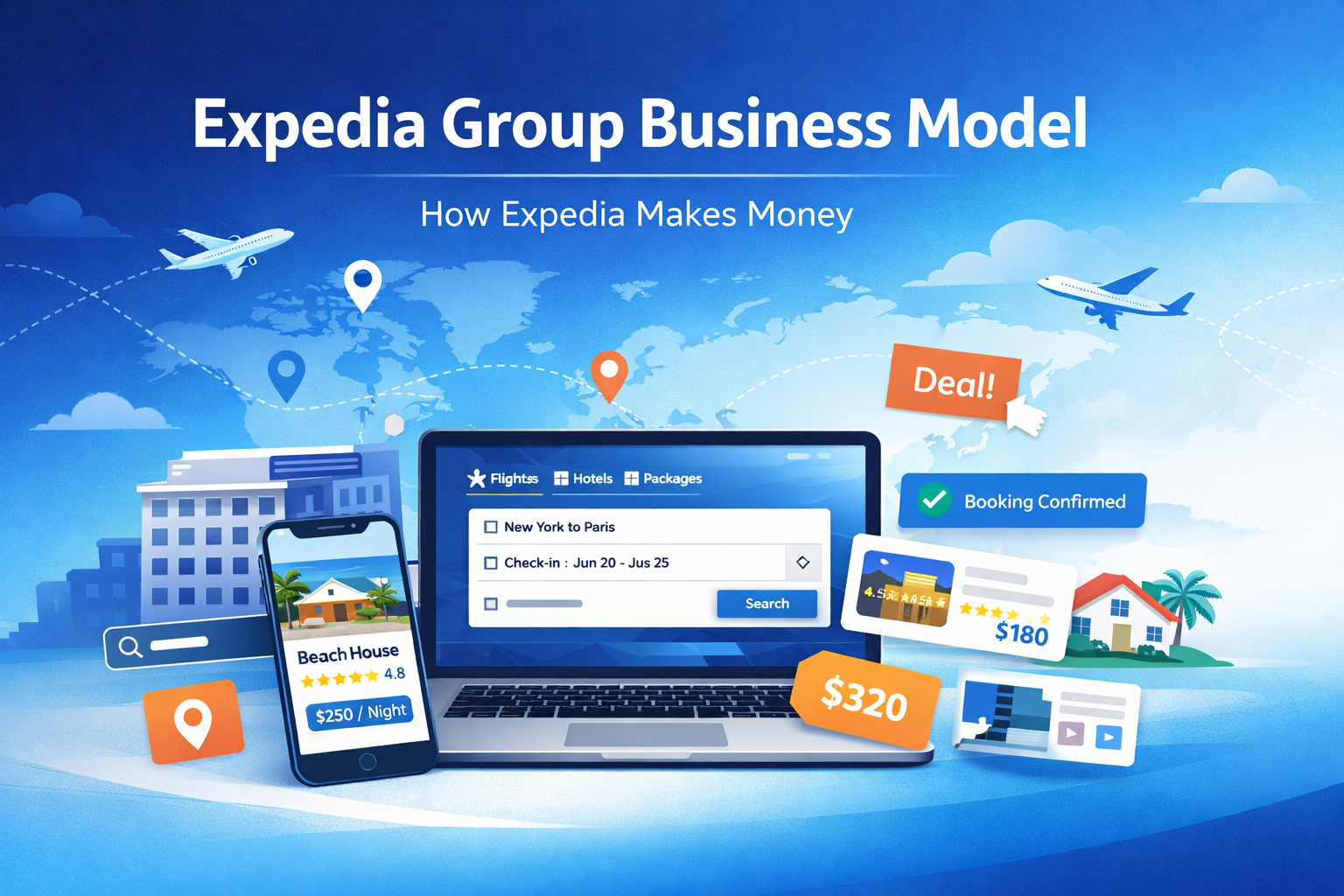
Expedia Group is one of the largest travel technology companies in the world. But most people only see the surface a website where you book flights and hotels.
The real story is different.
Expedia is a demand aggregation machine that owns distribution, not assets. It makes money by sitting between travelers and suppliers, and it does it across dozens of brands simultaneously.
This breakdown covers every layer of how Expedia actually works and makes money.
What Is Expedia Group
Expedia Group is not a single travel app. It is a portfolio of travel platforms operating under one parent company.
Think of it like this: Expedia Group is the holding company. Expedia.com, Hotels.com, Vrbo, Trivago, and Orbitz are the individual brands underneath it. Each one targets a different traveler or use case.
The company acts as a middle layer between two sides of the market:
- Travelers who need to book something
- Suppliers like hotels, airlines, and car rental companies who need customers
Expedia does not own a single hotel room or airplane seat. What it owns is access to demand — millions of travelers who come to its platforms every month looking to book travel.
That is the core insight. Expedia’s real product is distribution. Suppliers pay to be on the platform because that is where the customers are.
How Expedia Started and Why That History Matters
Expedia began as an internal project at Microsoft in 1996. It was one of the earliest attempts to put travel booking online.
Microsoft spun it off as a separate company in 1999. After going public, Expedia grew through a deliberate strategy of acquiring travel brands rather than building everything from scratch.
This acquisition-driven growth model is what turned Expedia into a travel conglomerate. Instead of competing with every new travel startup, it bought them.
The result is a network of brands that collectively cover almost every type of travel need. Each acquisition added inventory, user base, or technology that made the whole ecosystem stronger.
Understanding this history matters because it explains why Expedia’s moat is so hard to replicate. It was built over decades through capital deployment and strategic acquisition, not just product development.
The Core Business Model
The Marketplace Model
Expedia operates as a two-sided marketplace. This is the foundation of everything.
On one side you have travelers. They come to Expedia looking for the best deal on a flight, hotel, vacation rental, or full itinerary.
On the other side you have suppliers. Hotels, airlines, cruise lines, and car rental companies list their inventory on Expedia’s platforms in exchange for access to Expedia’s massive user base.
Expedia creates value for both sides simultaneously:
For travelers: One platform to compare prices, read reviews, and book everything in one place.
For suppliers: Access to millions of potential customers without having to build their own marketing infrastructure.
This two-sided dynamic is what makes the marketplace model so powerful. As more travelers join, more suppliers want to list. As more suppliers list, more travelers get better options. It is a self-reinforcing loop.
The Aggregator Model
Alongside the marketplace model, Expedia functions as a price aggregator.
It pulls inventory and pricing from thousands of suppliers and presents them in one unified interface. Travelers can compare hotel rates, flight prices, and rental car costs across multiple providers without leaving the platform.
This is similar to how Booking Holdings operates with Booking.com. The aggregator model gives users a reason to come to Expedia first before going directly to a supplier’s website.
The aggregator function is also a key reason Expedia spends heavily on SEO and paid search. If Expedia shows up first when someone searches “hotels in Miami,” the aggregation value kicks in immediately.
The Merchant vs. Agency Split
Expedia uses two distinct revenue models depending on the booking type.
Merchant Model
In the merchant model, Expedia buys hotel rooms or travel inventory at a wholesale rate and resells them at a higher price. The margin between what Expedia pays and what the traveler pays is Expedia’s profit.
This model gives Expedia more control over pricing and higher margins per transaction. But it also comes with more risk. If rooms go unsold, Expedia absorbs the loss.
Agency Model
In the agency model, Expedia acts as the middleman and earns a commission on every booking. The supplier sets the price. Expedia takes a percentage cut when a traveler books through its platform.
This model is lower risk because Expedia only earns when a transaction happens. Margins are thinner, but there is no inventory risk.
Most of Expedia’s hotel revenue today uses a hybrid of both models depending on the property and market.
The Expedia Group Brand Ecosystem
One of Expedia’s most underrated strategic moves is running multiple brands simultaneously. Each brand targets a specific traveler intent and user segment.
Expedia The flagship platform. Full-service travel booking covering flights, hotels, vacation packages, car rentals, and activities. Targets the all-in-one traveler who wants to plan an entire trip in one place.
Hotels.com Focused exclusively on hotel bookings. Known for its loyalty program where guests earn a free night after a certain number of stays. Targets travelers who prioritize accommodation over everything else.
Vrbo Vacation rental platform competing directly with Airbnb. Lists whole homes, cabins, beach houses, and apartments rented by owners. Targets families and groups who prefer private accommodations over hotel rooms.
Trivago A hotel price comparison engine. Trivago does not handle the booking itself — it redirects users to the cheapest available rate across booking platforms. Revenue comes from cost-per-click advertising from hotels and booking sites, including Expedia’s own brands.
Orbitz Deals-focused platform with roots in airline ticket booking. Popular with price-sensitive travelers and frequent flyers. Orbitz has its own loyalty currency and rewards program.
Travelocity, Wotif, ebookers Additional regional and niche brands that target specific geographies or traveler types.
The multi-brand strategy is not redundant. Each brand captures a different type of intent. Someone searching for a beach house rental and someone comparing hotel prices represent completely different user journeys. Having separate brands for each means Expedia captures both without diluting either experience.
It also reduces dependence on any single platform. If one brand underperforms, the others pick up the slack.
How Expedia Makes Money
Commissions from Bookings
This is the primary revenue driver.
Every time a traveler books a hotel, flight, rental car, or cruise through an Expedia platform, the supplier pays a commission. For hotels, this commission typically ranges from ten to thirty percent of the booking value depending on the property, market, and negotiated contract.
Airlines operate differently. Airline commission structures have compressed significantly over the past two decades. Expedia makes less per ticket on flights compared to hotels, which is why hotel bookings are disproportionately important to revenue.
Car rentals and activities also generate commissions, though at a smaller scale.
Commission revenue is volume-driven. Expedia makes more money by increasing the total number of bookings across its platforms rather than squeezing higher margins per transaction.
Service Fees
Expedia charges travelers service fees on many transactions. These are separate from the hotel or flight price and show up at checkout.
Service fees apply to bookings, changes, and cancellations. The exact structure varies by product and booking type. Non-refundable bookings generally involve different fee structures than flexible fares.
This revenue stream is relatively small compared to commissions but adds up significantly at scale given the volume of transactions Expedia processes annually.
Advertising Revenue
Hotels and other suppliers pay Expedia for increased visibility on its platforms. This is similar to how Amazon sellers pay for sponsored product placements.
Sponsored Listings Hotels can pay to appear at the top of search results on Expedia’s platforms. A hotel that pays for a sponsored listing gets more eyeballs, which typically translates to more bookings.
Trivago’s CPC Model Trivago generates almost all of its revenue through cost-per-click advertising. Hotels and booking platforms pay every time a user clicks through to their site from Trivago’s comparison results. Expedia’s own brands are among Trivago’s biggest advertisers.
Advertising revenue scales with traffic. The more users Expedia drives to its platforms, the more valuable its advertising inventory becomes.
B2B Revenue Through Expedia Partner Solutions
This is the revenue stream most people overlook. It is also one of the most strategically important.
Expedia Partner Solutions (EPS) is the B2B division that licenses Expedia’s technology and inventory to third parties. This includes:
- Banks that offer travel booking portals to credit card customers
- Airlines that want to offer hotel bookings on their own sites
- Travel management companies serving corporate clients
- Independent travel agencies that need a booking engine
- Other apps and platforms that want to add travel as a feature
These partners essentially plug into Expedia’s backend through APIs. They get access to Expedia’s hotel inventory, pricing, and booking infrastructure. Expedia gets a cut of every transaction that runs through the system.
The B2B model is highly scalable. Once the API infrastructure is built, adding a new partner has minimal marginal cost. Expedia earns revenue through every transaction without having to market directly to the end traveler.
For startup founders, this is the angle worth studying. Expedia essentially turned its core technology into a platform-as-a-service layer that other businesses pay to access. The customer acquisition cost for B2B clients is high, but the lifetime value per partner is massive.
Vacation Rental Revenue Through Vrbo
Vrbo generates revenue through two mechanisms.
Commission Per Booking Property owners and managers pay a commission each time a traveler books their property through Vrbo. The commission structure varies based on the listing type and management agreement.
Subscription Listing Fees Some property owners pay an annual subscription to list their property on Vrbo. This gives them unlimited bookings without paying per-transaction commissions. For high-volume hosts, this is often the more economical option.
Vrbo competes directly with Airbnb in the vacation rental space. While Airbnb has a larger brand presence globally, Vrbo is particularly strong in the US market for whole-home rentals, especially for family travel and beach destinations.
Customer Segments
Expedia serves four distinct customer groups across its brands.
Leisure Travelers The largest segment by volume. Individuals and families booking vacations, weekend trips, and personal travel. This group is price-sensitive and responds strongly to deals, loyalty rewards, and bundled packages.
Business Travelers Professionals booking travel for work purposes. This segment values convenience, flexibility, and loyalty rewards over price. Expedia for Business and Orbitz for Business serve this segment with tools like centralized billing and itinerary management.
Property Owners and Managers Hosts who list vacation rentals on Vrbo. They are both customers and suppliers. They pay to list and pay commissions on bookings, but they also receive a service in return — access to millions of potential guests.
Travel Agencies and B2B Clients Businesses that white-label or integrate Expedia’s technology. Banks, airlines, and agencies fall into this category. They pay for API access and technology licensing rather than individual transactions.
Why People Choose Expedia
For Travelers
One Platform for All Travel Needs Booking a flight, hotel, and rental car separately across three different websites takes time. Expedia bundles all of this in one place with package pricing that is often cheaper than booking individually.
Price Comparison Travelers can compare hotel rates across properties and see airline fare options side by side. Trivago extends this by comparing prices across booking platforms, including third-party competitors.
Bundled Discounts Expedia offers package deals where travelers save money by booking flights and hotels together. This increases average transaction value for Expedia while delivering real savings for the traveler.
Reviews and Trust Consolidated reviews across millions of properties give travelers confidence before booking. This is particularly important for vacation rentals on Vrbo where trust in the listing matters as much as price.
For Suppliers
Global Exposure A small boutique hotel in Portugal does not have the marketing budget to reach travelers in the US, Canada, and Australia. Listing on Expedia gives that hotel instant global visibility.
Incremental Bookings Many hotels view Expedia as an incremental channel. They use their own direct booking channels first and fill remaining inventory through Expedia. The commission paid to Expedia is offset by the booking revenue they otherwise would not have captured.
Data and Analytics Expedia provides suppliers with market data, booking trends, and competitive pricing insights through its partner portal. This helps suppliers optimize their own pricing and availability.
Key Business Drivers
Inventory Size The more hotels, flights, and rentals Expedia can offer, the more useful it is to travelers. Inventory breadth is a critical competitive advantage. Suppliers have to be on Expedia because that is where the customers are.
Pricing Competitiveness Expedia’s algorithms constantly adjust pricing and promotions to stay competitive. If a traveler finds the same hotel cheaper elsewhere, they leave. Pricing parity is essential to retention.
User Experience Search speed, mobile usability, checkout friction, and customer support quality all directly affect conversion rates. Expedia invests heavily in UX because a single percentage point improvement in conversion at their scale translates to hundreds of millions of dollars in additional revenue.
Trust and Reviews Travelers read reviews before booking. A strong review infrastructure builds trust that converts browsers into bookers.
Growth Strategy
Acquisitions
Expedia has grown largely through buying other travel companies. Rather than spending years building a vacation rental platform from scratch, it acquired HomeAway (now Vrbo) for $3.9 billion in 2015. Rather than competing with Trivago, it acquired a majority stake in 2012.
This strategy allows Expedia to quickly enter new segments and add inventory without the startup risk of building from zero.
SEO and Content Dominance
Expedia generates massive organic traffic through search engine optimization. Its platforms rank for millions of travel-related keywords across dozens of languages and markets.
When someone searches “hotels in Chicago” or “flights to Cancun,” Expedia wants to be the first result. Organic traffic is essentially free customer acquisition, which dramatically improves unit economics compared to paid advertising.
Expedia’s content strategy includes destination guides, travel tips, and informational pages that capture users early in the research phase before they are ready to book.
Mobile Growth
Expedia invests heavily in its mobile apps. App-only discounts and mobile-exclusive deals incentivize travelers to download and use the app rather than booking through the web.
Mobile bookings are strategically important because users who download an app are more likely to return for future bookings. App-based customers have higher retention rates and lower acquisition costs over time.
Loyalty Programs
Hotels.com’s loyalty program — where every ten nights earns one free night — is one of the most straightforward rewards structures in travel. Expedia’s own One Key loyalty program launched in 2023 attempts to unify rewards across Expedia, Hotels.com, and Vrbo into a single currency.
Loyalty programs increase retention. A traveler with accrued points on Expedia has a financial reason to keep booking on Expedia rather than switching to a competitor.
Competitive Landscape
Booking Holdings The biggest direct competitor. Booking Holdings operates Booking.com, Priceline, Kayak, and Agoda. The competitive dynamic between Expedia Group and Booking Holdings is essentially a duopoly in Western online travel.
Booking.com has a stronger international presence, particularly in Europe. Expedia has traditionally been stronger in the US market.
Airbnb Airbnb competes directly with Vrbo in the vacation rental space. Airbnb has more brand recognition globally and a larger listing base. Vrbo differentiates by focusing on whole-home rentals rather than shared spaces.
Google Google is both a traffic source and a competitor. Google Flights and Google Hotels pull travelers directly into a booking interface without leaving Google. When Google captures a booking, Expedia loses a potential customer. This is one of the most significant structural risks in Expedia’s business model.
MakeMyTrip and Regional Players In markets like India, Southeast Asia, and Latin America, regional OTAs have strong local advantages that global platforms struggle to overcome.
Challenges in the Business Model
Thin Margins and High Competition Online travel is brutally competitive. Hotel chains, airlines, and vacation rental platforms all want travelers to book directly rather than through an OTA. The constant pressure to offer the lowest price compresses margins.
Google Dependency A significant portion of Expedia’s traffic comes from Google search. If Google changes its algorithm, increases ad costs, or captures more bookings directly, Expedia’s traffic and revenue can drop sharply. This dependency is a structural vulnerability that Expedia cannot fully control.
Customer Acquisition Costs Expedia spends billions of dollars annually on performance marketing — primarily Google and Facebook ads. As these platforms increase ad prices, Expedia’s customer acquisition costs rise. The pressure to reduce CAC while maintaining growth is constant.
Supplier Dependency and Direct Booking Pressure Major hotel chains like Marriott and Hilton actively push travelers to book direct by offering better rates, points, and perks exclusively through their own channels. This undermines Expedia’s value proposition for loyalty-driven travelers and puts downward pressure on commissions.
Why Expedia Still Wins
Despite intense competition and structural challenges, Expedia has durable advantages that are hard to replicate.
Brand Portfolio Strength Running multiple travel brands means Expedia captures travelers at different stages of intent and through different user needs. A competitor would need to match not just Expedia.com but also Hotels.com, Vrbo, Trivago, and Orbitz simultaneously.
Global Supplier Network Expedia has contracts with hundreds of thousands of hotels, airlines, and suppliers worldwide. Building this network took decades and enormous capital. A new entrant cannot replicate it quickly.
Data Advantage Billions of historical transactions give Expedia pricing intelligence, demand forecasting capability, and personalization data that smaller competitors cannot match. This data advantage improves search relevance, pricing accuracy, and product recommendations over time.
High Switching Costs for Suppliers Hotels that rely on Expedia for a meaningful portion of their bookings cannot easily walk away without losing revenue. The switching cost is real, which gives Expedia leverage in commission negotiations.
B2B API Infrastructure The Expedia Partner Solutions network creates a secondary revenue layer that is deeply embedded in other businesses’ operations. Banks and travel agencies that run on Expedia’s API infrastructure would face significant integration costs to switch to a different provider.
Key Takeaways for Founders
Expedia’s business model is a masterclass in demand aggregation and platform strategy. Here is what actually matters for anyone building a business:
You do not need to own the supply own the distribution. Expedia does not own hotels. It owns the channel through which travelers find hotels. In any two-sided market, the side that controls demand has the leverage.
Multi-brand strategy reduces concentration risk. Putting everything into one brand means one brand problem can sink the company. Running multiple brands across segments means diversified revenue and resilience.
B2B revenue is often the most underrated layer. Most people see Expedia as a consumer product. But the Expedia Partner Solutions business that powers other companies’ travel portals is a high-margin, scalable revenue stream that most outsiders ignore entirely.
SEO is a long-term moat. Expedia’s organic search presence took years and enormous content investment to build. But once established, it generates essentially free customer acquisition at massive scale. Startups that underinvest in SEO early pay the price later through higher paid acquisition costs.
Loyalty programs are retention tools, not rewards programs. The real value of Hotels.com’s free night program is not the free night — it is the behavioral lock-in that brings the traveler back for nine more bookings before they ever redeem the reward.
Wrapping Up
Expedia is not just a travel company. It is a demand aggregation machine that happens to operate in the travel industry.
The business model works because Expedia positioned itself between buyers and sellers and made itself indispensable to both sides. Travelers come for convenience and price comparison. Suppliers pay for access to that traveler base.
Every revenue stream commissions, service fees, advertising, B2B APIs, vacation rentals flows from that same core dynamic. Expedia controls demand. Suppliers need demand. The rest follows.
For anyone building a marketplace or platform business, that is the most important lesson Expedia offers: in a two-sided market, the platform that aggregates demand sets the terms. Build for the buyer first, and the sellers will come to you.
Discover more from Business Model Hub
Subscribe to get the latest posts sent to your email.