Evernote runs on a freemium SaaS model free to start, paid to grow. Basic note-taking is free, but if you want more storage, more devices, and smarter tools, you pay. That gap between free and paid is exactly how Evernote makes money.
What is Evernote?
If you’ve ever wished your brain came with a search bar, Evernote was built for you.
Founded in 2008, Evernote positioned itself as your “second brain” — a place to dump notes, clip articles, scan documents, and actually find them later. It works across mobile, desktop, and web, which was a big deal before every app did that automatically.
The core pitch is simple: stop losing ideas. Whether it’s a meeting note, a recipe, a voice memo, or a webpage you want to read later — Evernote holds it all in one place.
The Core Problem Evernote Solves
Here’s the real problem Evernote is solving, and it’s one almost everyone has felt:
- You write notes in five different apps
- You can’t find that one thing you saved three months ago
- Your “system” is basically organized chaos
Evernote steps in as three things at once — a digital notebook, a productivity system, and a knowledge management tool. That’s not a small promise. And for a long time, it delivered on it better than anyone else.
Evernote Business Model Overview
Evernote’s business model is classic freemium SaaS, and it works like this:
Free users = acquisition. Paid users = revenue.
Give people enough to get hooked. Then, when they need more — more storage, more devices, more features — charge them for it.
The three pillars of the model are:
- Freemium model — low barrier to entry, high conversion potential
- Subscription-based SaaS — predictable, recurring revenue
- Cross-platform ecosystem — lock-in through habit and integration
It’s a model that’s been working for productivity software for years. The tricky part is the conversion — getting free users to actually pull out their wallet.
How Evernote Makes Money (Revenue Streams)
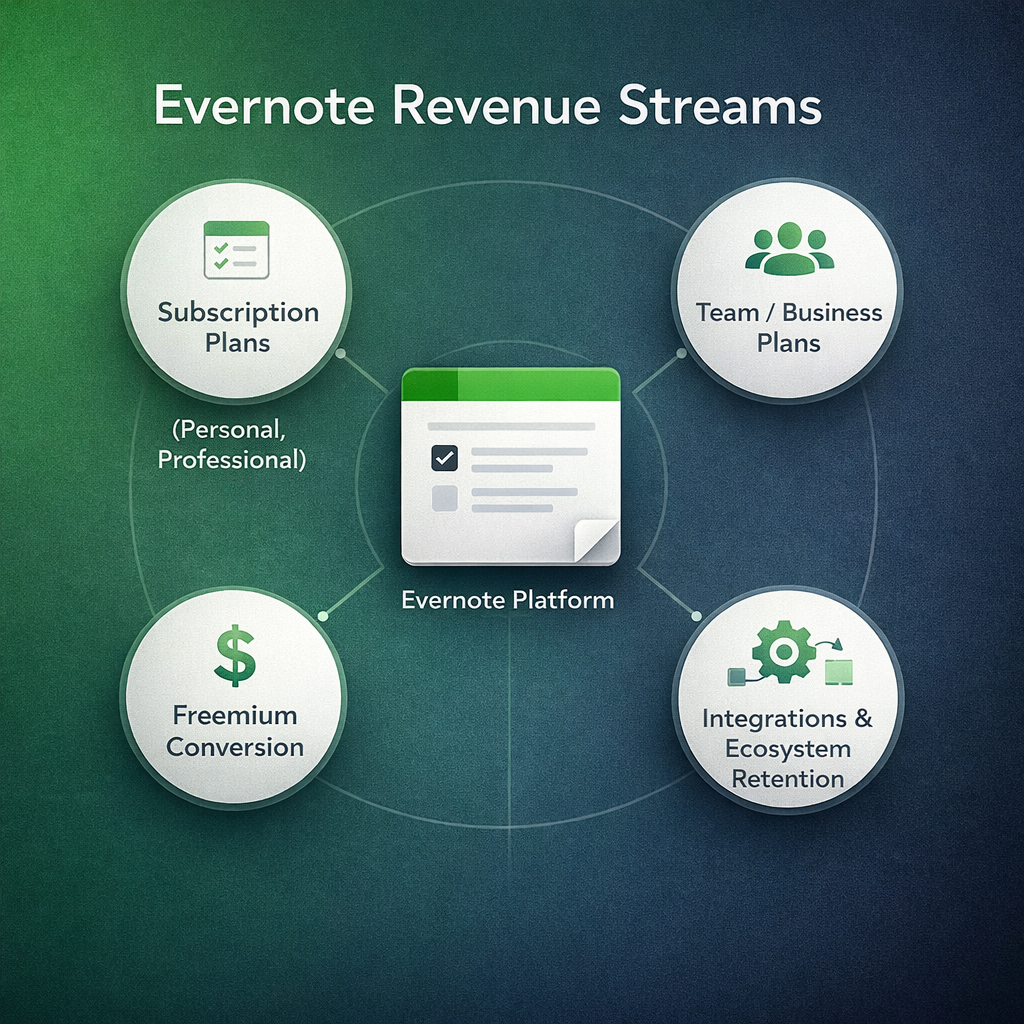
1. Subscription Plans — The Core Engine
This is where the real Evernote revenue comes from. They offer tiered plans:
- Evernote Free — limited features, device restrictions, small storage
- Evernote Personal — expanded storage, more uploads, better search, unlimited devices
- Evernote Professional — everything in Personal, plus AI features, integrations, and advanced tools
Each tier is designed to push you to the next one. You start free, hit a wall (usually the device limit or storage cap), and upgrade.
The pricing is offered monthly or yearly — yearly is always cheaper, which nudges users toward longer commitments. That’s smart. It reduces churn and locks in revenue.
2. B2B / Teams Plan — The High-Value Segment
Evernote Teams is where the bigger money lives.
This plan targets:
- Startups that need shared knowledge bases
- Remote teams that collaborate on projects
- Businesses that want admin controls and centralized billing
The features go beyond personal productivity — shared workspaces, team collaboration, admin dashboards, and centralized management. Businesses pay more per user, and they tend to stick around longer than individual subscribers.
B2B retention is one of the strongest revenue models in SaaS. Once a team builds workflows around a tool, switching costs are high.
3. Add-On Value Through Integrations
Evernote integrates with Google Drive, Slack, Microsoft Teams, and other tools. These aren’t direct revenue streams, but they matter a lot to the business model.
Here’s why: integrations increase stickiness. When Evernote lives inside your workflow — connected to your email, your calendar, your team chat — it becomes harder to leave. And harder to leave means higher retention. Higher retention means more subscription renewals.
Indirect monetization through integrations is underrated. It’s not about charging for the integration. It’s about making the product feel irreplaceable.
Evernote Freemium Strategy: The Growth Engine
The freemium model is Evernote’s acquisition engine, and it’s been central to how they grew to millions of users.
The free plan is genuinely useful — but limited. Key restrictions include:
- Device limits (free users can only sync across limited devices)
- Monthly upload caps (you run out of space faster than you think)
- Missing features like offline access, advanced search filters, and integrations
These aren’t random limitations. They’re upgrade triggers.
The people who hit these limits are exactly who Evernote wants as paid customers — heavy users, professionals, people who actually rely on the product daily.
Freemium works as a conversion funnel. You put a wide opening at the top (free access), and a narrowing path toward paid plans. Not everyone converts — but the ones who do are highly qualified customers.
Key Features That Drive Revenue
Features aren’t just product decisions. They’re pricing levers. Here’s how Evernote’s features justify the subscription cost:
- Note-taking and rich formatting — the core product that builds the habit
- Web Clipper — saves full pages, articles, and snippets from the browser (insanely useful)
- AI-powered search — finds exactly what you need, even in scanned documents
- Cross-device sync — seamless access everywhere (locked behind paid plans)
- Document scanning — turns physical notes and receipts into searchable text
Each of these features solves a real problem. And when users experience them on the free plan — then hit a paywall — the upgrade feels logical, not forced.
Target Audience
Evernote isn’t built for one type of person. Its audience is wide, but each segment uses it differently:
- Students — lecture notes, research organization, study systems
- Professionals — meeting notes, client briefs, project tracking
- Content creators — idea capture, research storage, editorial planning
- Businesses — team knowledge bases, shared workflows, onboarding docs
The smart thing about this breadth? Each segment has a natural upgrade path. Students become professionals. Professionals become team leads. Team leads buy Evernote Teams.
Evernote’s Competitive Advantage
Evernote’s strongest advantages aren’t flashy. They’re quiet and durable:
1. Simplicity — Evernote does note-taking really well. It doesn’t try to be a project manager, a CRM, and a database all at once (looking at you, Notion).
2. Search functionality — Evernote’s search is genuinely excellent. It can search inside PDFs, scanned handwriting, and images. That’s a meaningful differentiator.
3. Mature ecosystem — 15+ years of product development means Evernote is stable, well-integrated, and has mobile apps that actually work well.
For users who want focused simplicity — not a customizable everything-tool Evernote still wins.
Evernote vs Competitors
Here’s a clear-eyed comparison:
| Feature | Evernote | Notion | OneNote |
|---|---|---|---|
| Ease of Use | ⭐⭐⭐ High | ⭐⭐ Medium | ⭐⭐ Medium |
| Flexibility | ⭐⭐ Medium | ⭐⭐⭐ High | ⭐⭐ Medium |
| Search Power | ⭐⭐⭐ Excellent | ⭐⭐ Good | ⭐⭐ Good |
| Pricing | Paid tiers | Freemium | Free (Microsoft) |
| Best For | Focused note-taking | All-in-one workspace | Microsoft users |
Notion wins on flexibility and customization. But it has a steeper learning curve. Many users get overwhelmed building their “perfect system” instead of actually using it.
Microsoft OneNote is free and deeply integrated into Microsoft 365 — that’s a strong pull for enterprise users already in that ecosystem.
Evernote sits in the middle — not free like OneNote, not as flexible as Notion — but more focused and arguably easier to actually use day-to-day.
Evernote’s Growth Strategy
Evernote’s growth isn’t driven by one big lever. It’s a combination:
- Freemium acquisition — millions of free users create a massive top-of-funnel
- SEO and content marketing — Evernote ranks well for productivity and note-taking searches
- App ecosystem expansion — integrations with popular tools bring new users in through partner platforms
- Productivity positioning — they don’t market as “note-taking software.” They market as a productivity and knowledge management system. That’s a bigger category.
The long-term bet is that knowledge management becomes a category that enterprises take seriously — and Evernote wants to be the default answer.
Challenges in Evernote’s Business Model
Let’s be honest. Evernote has faced real challenges, and ignoring them would make this analysis useless.
1. Competition is relentless. Notion disrupted the market with a flexible, design-forward product. Google Keep is free and built into Android. OneNote is bundled with Microsoft 365. Evernote has to justify a paid subscription against multiple free alternatives.
2. Freemium conversion is hard. Most free users never pay. The math only works if your conversion rate is high enough — and the industry average is brutally low (often 2–5%).
3. Feature overload vs simplicity. Evernote has tried to add more features over the years to stay competitive. But their original edge was simplicity. Adding complexity risks alienating the users who chose them for being easy to use.
4. Trust issues after previous struggles. Evernote went through a rough patch — leadership changes, pricing increases, and some PR missteps around privacy policies. Rebuilding user trust takes time.
Future of Evernote
The next chapter for Evernote is likely shaped by three things:
- AI integration — Smart summarization, AI-assisted search, and auto-tagging are obvious plays. Evernote is already moving in this direction.
- Better collaboration — Real-time collaboration is table stakes now. Teams expect Google Docs-level co-editing.
- Productivity workflow focus — Rather than trying to compete with Notion on flexibility, doubling down on “capture and find” workflows could be a sharper positioning.
If Evernote can become the best tool for saving and retrieving knowledge — not trying to be everything — there’s a strong business there.
Key Takeaways
- Freemium is a growth engine, not a charity. Free users fund your acquisition cost.
- SaaS subscriptions = predictable revenue. That predictability is valuable for building a real business.
- Integrations drive retention, not just feature adoption.
- Retention beats acquisition — a loyal paid user is worth far more than 100 free sign-ups.
- Simplicity can be a competitive advantage, especially when competitors get complex.
Wrap Up: What Founders Can Learn From Evernote
Here’s what I think every founder should take away from the Evernote story.
Build for daily use. Evernote succeeded because people used it every single day. Not weekly. Daily. That frequency of use is what creates a habit — and habits are what keep users subscribed month after month.
Don’t overcomplicate the product. Evernote’s early success came from doing one thing well. The pressure to add features to compete is real, but complexity is a slow product killer.
Freemium is a business strategy, not just a pricing decision. The free plan isn’t generosity — it’s your best sales rep. Design it to show value and create natural upgrade triggers.
And finally — focus on solving a real, daily problem. Information overload isn’t going away. If anything, it’s getting worse. Evernote found a genuine problem and built something people actually wanted to pay for.
That’s still the lesson, 17 years later.
FAQs
Evernote uses a freemium SaaS business model, where users can access basic features for free and pay for advanced tools like more storage, integrations, and productivity features through subscriptions.
Evernote mainly makes money through:
Paid subscription plans (Personal, Professional, Teams)
Business and team collaboration tools
Premium features that encourage free users to upgrade
Yes, Evernote offers a free plan with limited features. Users can upgrade to paid plans if they need more storage, device access, or advanced productivity tools.
Evernote’s key revenue streams include:
Subscription plans
Team and business plans
Freemium-to-paid user conversions
Evernote targets:
Students
Professionals
Content creators
Businesses and remote teams
Anyone who needs to organize notes, tasks, and ideas can use Evernote.
Evernote allows users to start for free with limited features. As users become more active and need more functionality, they are encouraged to upgrade to paid plans.
Evernote generates steady revenue through subscriptions, but its profitability depends on user growth, retention, and competition from tools like Notion and OneNote.
Discover more from Business Model Hub
Subscribe to get the latest posts sent to your email.