If you’re looking for a quick answer: An e-scooter business model is a mobility-based business where companies provide electric scooters for short-distance travel. They make money through ride charges, subscriptions, and partnerships. It’s one of the fastest-growing segments in urban mobility right now.
What Makes E-Scooters a Real Business Opportunity
Let me paint a picture for you.
You’re in Bangalore. It’s 9 AM. Your office is 3 km away. Taking an auto will cost you 80 rupees. Calling an Uber will cost even more and take longer due to traffic. But there’s an e-scooter parked right outside your building. You unlock it with an app, pay 15 rupees, and you’re at your desk in 10 minutes.
That’s the problem e-scooter businesses are solving.
And smart founders turned that daily frustration into a scalable, repeatable business model.
Globally, the e-scooter market is expected to cross $41 billion by 2030. In India, cities like Hyderabad, Pune, and Delhi are already seeing electric scooter startups pop up in every corner. The demand is real. The problem is real. And the business opportunity is real.
Quick Answer: What Is an E-Scooter Business Model?
An e-scooter business model is a system where a company provides electric scooters to users for short-distance travel and earns money through pay-per-ride fees, monthly subscriptions, or direct scooter sales.
There are two main approaches:
- Sharing model — You don’t own the scooter. You rent it per ride or per month.
- Ownership model — You buy the scooter from the company directly.
Most startups today combine both. They start with rentals to build a user base. Then they push subscription plans for steady income.
What Is an E-Scooter Business Model, Really?
At its core, it’s a pay-per-use mobility business.
Think of it like a water dispenser in a mall. The machine is placed there. You pay each time you use it. The owner earns without doing anything extra after setup.
E-scooters work similarly. The company places scooters in high-traffic areas. Users pay to use them. The company earns repeatedly from the same asset.
The key difference between an e-scooter business and a regular vehicle rental is technology. Everything runs through an app. Locking, unlocking, payments, tracking — it’s all automated. That’s what makes it scalable.
Types of E-Scooter Business Models
Not every e-scooter company works the same way. Here are the main types.
Dockless Sharing Model
This is the most common model globally.
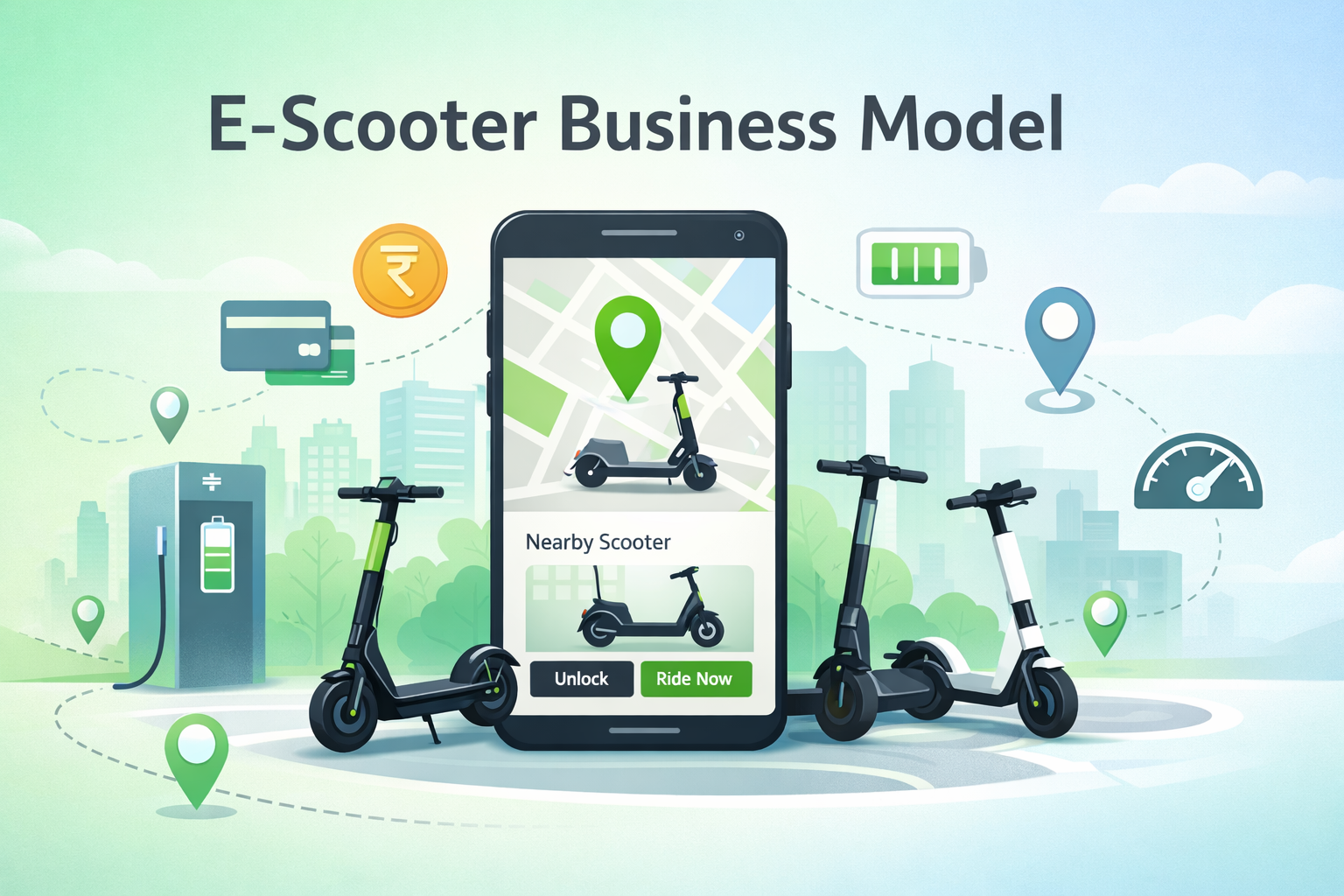
Users open an app, find a nearby scooter on the map, scan a QR code, and ride. When done, they just park it anywhere within the allowed zone.
Example: Lime and Bird built their entire empire on this model in the US. No fixed stations. No complicated setup. Just park and go.
The advantage is flexibility. The challenge is managing where scooters end up. Some cities hate this because scooters block sidewalks.
Station-Based Model
Here, scooters are picked up and dropped off at fixed stations.
Think of it like a metro station. You take a scooter from Point A. You return it to Point B. It’s more structured and easier to manage for the company.
This model works well in planned cities and campuses. It’s less flexible for users but gives the company more control over vehicle placement and charging.
Subscription Model
This is growing fast in India right now.
Instead of paying per ride, users pay a monthly fee. Say 1,500 rupees per month for unlimited 30-minute rides. It’s like a Netflix plan but for scooters.
Why it works: Predictable income for the company. Lower per-ride cost for the user. Everyone wins.
Companies like Bounce in India started experimenting with this model. It builds loyalty and reduces the friction of micro-payments every single day.
Ownership and Direct Sales Model
Some companies just sell you the scooter.
Example: Ola Electric. They manufacture and sell e-scooters directly to consumers. You buy it. You own it. They make money on the sale, and also on after-sales service, accessories, and software upgrades.
This model has higher upfront revenue per customer. But it’s more capital-intensive because you need manufacturing infrastructure.
How E-Scooter Companies Actually Work
Let me break it down step by step. It’s simpler than most people think.
App → Locate → Unlock → Ride → Pay
Here’s how the user journey works:
- Download the app — User signs up with phone number and payment details.
- Find a scooter — The app shows nearby scooters on a map.
- Unlock via QR or Bluetooth — User scans the code. Scooter unlocks in seconds.
- Ride — GPS tracks the route. Speed is monitored. The meter runs.
- End the trip — User parks and taps “End Ride” on the app.
- Payment is automatic — Deducted from the linked wallet or card.
The whole experience is designed to be frictionless. The less thinking required, the more rides happen.
On the backend, the company monitors all scooters in real time. They know which ones need charging, which are idle, and which have issues. A small operations team handles charging and maintenance.
Revenue Streams of an E-Scooter Business
This is where it gets interesting. E-scooter companies don’t rely on just one income source.
Pay-Per-Ride Charges
This is the most obvious one. Users pay for every ride. Typically it’s an unlock fee plus a per-minute charge.
Example: 10 rupees to unlock plus 2 rupees per minute. A 20-minute ride costs 50 rupees. Multiply that by hundreds of rides per day across a fleet and the numbers add up.
Subscription Plans
Monthly or weekly plans for regular users. This creates stable, recurring revenue.
It’s the dream of every SaaS founder — but applied to physical mobility. Once users subscribe, they tend to ride more frequently, which also increases brand loyalty.
Security Deposits
Most platforms collect a refundable deposit from new users. Say 500 to 1,000 rupees. While it’s technically refundable, holding thousands of deposits from thousands of users gives the company interest-free working capital.
Corporate and B2B Partnerships
This is underrated.
Companies partner with offices, IT parks, colleges, and residential societies. The business pays a flat fee to provide scooters for their employees or residents.
Imagine a tech park in Hyderabad with 5,000 employees. If even 500 use scooters daily, that’s a massive contract for the scooter company.
Advertising on Scooters
The body of a scooter is prime real estate.
Brands pay to wrap scooters in their advertising. In busy cities, a branded scooter gets seen by thousands of people daily. It’s like a moving billboard.
Data Monetization
This is more of a future revenue stream.
E-scooter companies collect massive amounts of mobility data. Where people travel, at what times, which routes are busiest. City planners, real estate developers, and advertisers would pay for this data.
It’s not mainstream yet. But it’s a serious opportunity.
Business Model Canvas for E-Scooter Business
Let me map this out clearly. If you’re a founder or student, this will help you understand the full picture.
Key Partners
- Scooter manufacturers and battery suppliers
- City governments and municipalities
- Charging infrastructure partners
- Payment gateway providers
- Insurance companies
Key Activities
- Fleet management and deployment
- App development and maintenance
- Scooter charging and repairs
- Customer support
- Regulatory compliance
Key Resources
- Fleet of electric scooters
- Mobile app and tech platform
- Charging stations or battery swap network
- Operations team
- GPS and IoT hardware on scooters
Value Propositions
- Affordable, short-distance urban travel
- No parking hassle
- Eco-friendly alternative to autos and cabs
- Easy to use with zero learning curve
- Solves the last-mile connectivity problem
Customer Relationships
- App-based self-service
- Push notifications for offers
- Subscription perks and loyalty rewards
- In-app customer support
Channels
- Mobile app (primary)
- Social media and digital marketing
- On-ground activation in high-traffic areas
- Corporate tie-ups and campus programs
Customer Segments
- Daily office commuters
- College students
- Tourists in new cities
- Last-mile users near metro or bus stations
- Corporate employees in large campuses
Cost Structure
- Scooter procurement and manufacturing
- Battery replacement and charging
- App development and server costs
- Operations and maintenance team
- Marketing and user acquisition
- City licensing and compliance fees
Revenue Streams
- Pay-per-ride fees
- Subscription plans
- Security deposits
- Corporate contracts
- Advertising
- Data licensing (future)
This canvas gives you the full business picture in one view. If you’re building a pitch deck or a business plan, start here.
Cost Structure: Where the Money Actually Goes
Most people see the revenue side and get excited. But the cost side is where businesses survive or die.
Scooter Procurement
A decent electric scooter for sharing purposes costs anywhere from 60,000 to 1.5 lakh rupees in India. If you deploy 100 scooters, that’s 60 lakh to 1.5 crore rupees upfront. Before a single rupee of revenue comes in.
Battery and Charging Infrastructure
Batteries are expensive and they degrade over time. Replacing battery packs is a major recurring cost. Companies using battery swapping (like Sun Mobility’s model) can reduce this, but the swap network itself needs investment.
Maintenance and Repairs
Shared scooters take a beating. Daily wear, vandalism, minor accidents — maintenance is constant. You need a reliable operations team to keep scooters road-worthy.
App Development and Tech
Building a good app is not cheap. You need GPS tracking, payment integration, real-time maps, customer support features, and backend dashboards. Budget at least 20 to 40 lakh rupees for a solid MVP.
Marketing and User Acquisition
Getting your first 1,000 users is hard. Referral programs, free rides, social media ads — it all costs money. Customer acquisition cost (CAC) needs to stay lower than the lifetime value (LTV) of each user.
City Licensing and Compliance
Every city has its own rules for shared mobility. Permits, insurance, safety certifications — these are real costs and real headaches, especially in India where regulations vary by state.
Key Metrics That Actually Matter
If you’re building or investing in an e-scooter business, watch these numbers.
Cost Per Ride
How much does it cost the company to complete one ride? Include depreciation, maintenance, charging, and ops. If cost per ride is 30 rupees and you charge 25, you’re losing money on every ride.
Utilization Rate
What percentage of your fleet is actually being used at any given time? A 30% utilization rate means 70% of your scooters are sitting idle. That’s wasted capital.
Rides Per Day Per Scooter
Most shared scooter businesses need 4 to 6 rides per day per scooter to break even. Anything below that and the math doesn’t work.
Lifetime Value (LTV)
How much does a user spend over their entire relationship with your brand? High LTV users are your subscribers and daily commuters. Low LTV users try it once and disappear.
Break-Even Per Scooter
At what point does a single scooter pay for itself? If a scooter costs 1 lakh rupees and earns 300 rupees per day, it pays for itself in about 333 days. Add maintenance costs and it’s closer to 500 days. That’s your real payback period.
Real Examples of E-Scooter Companies
Ola Electric
Ola went with the direct sales model. They manufacture scooters, sell to consumers, and are building a massive charging network. Their revenue is transaction-based (per sale) but they’re also building recurring revenue through software subscriptions and service packages. It’s an ambitious model with high capital requirements.
Lime
Lime is the global king of dockless shared scooters. They operate in 30+ countries. Their model is pure pay-per-ride with subscription options for frequent users. They’ve also started partnering with cities to become officially integrated into public transport networks.
Bird
Bird pioneered the dockless model in the US. They focused heavily on city partnerships and data sharing with municipalities. Their challenge has been unit economics — making each scooter profitable enough to cover operations. They’ve had to restructure multiple times, which shows how hard this business really is.
Bounce (India)
Bounce started in Bangalore with dockless scooter rentals. They shifted to a subscription model and also pivoted toward selling scooters directly. Their journey shows how Indian startups need to adapt their model to local user behavior and pricing sensitivity.
Why This Business Model Works
Let me be direct. The e-scooter model works because it solves a real, daily problem.
It fixes the last-mile problem. Metro stations, bus stops, railway stations — millions of people need to travel 1 to 5 km from these points. Autos are expensive. Walking is slow. E-scooters fit perfectly.
It’s cheaper than alternatives. A 3 km Uber ride might cost 80 to 100 rupees. An e-scooter ride for the same distance costs 20 to 30 rupees. The price difference is obvious.
Urban demand is growing. As cities expand and traffic gets worse, more people look for alternatives. E-scooters are fast, nimble, and park anywhere.
Sustainability is trending. Young users actually care about carbon footprint now. Electric mobility scores points for both cost and conscience.
Challenges You Can’t Ignore
I want to be honest here. This business looks easy from the outside. It’s not.
High Initial Capital
The hardware cost alone can sink you. You need hundreds of scooters before you can even test the model at scale. That’s a significant upfront investment with no guaranteed return.
Vandalism and Theft
Shared scooters are vulnerable. In India especially, vandalism and theft are real operational problems. GPS helps, but it doesn’t stop someone from damaging a scooter.
Battery Degradation
Batteries lose capacity over time. After 18 to 24 months, battery packs on shared scooters may need full replacement. That’s a huge recurring cost that can destroy margins.
Regulatory Uncertainty
City governments in India don’t have a unified policy for shared e-scooters. What’s allowed in Pune may not be allowed in Mumbai. Navigating this is exhausting and expensive.
Unit Economics Are Hard
This is the real killer. Getting each scooter to be profitable on its own is incredibly difficult. Lime and Bird — with hundreds of millions of dollars in funding — still struggle with this. For a bootstrapped Indian startup, it’s even harder.
Future of the E-Scooter Business
The future looks genuinely exciting, even if the present is tough.
Battery Swapping Will Change Everything
Instead of charging scooters for hours, riders swap depleted batteries for full ones in under 60 seconds. Companies like Sun Mobility are already building this infrastructure in India. It solves the biggest operational headache of this business.
Smart City Integration
Indian cities under the Smart Cities Mission are actively looking for mobility partners. E-scooter companies that align with city governments will get favorable licensing, dedicated lanes, and even subsidies.
Government Push for EVs
FAME II subsidies and state-level EV policies are reducing the cost of electric vehicles. This directly benefits e-scooter companies by lowering procurement costs.
AI-Powered Fleet Management
Predictive maintenance, demand forecasting, and dynamic pricing using AI will make operations dramatically more efficient. Companies that adopt this early will have a serious cost advantage.
How to Start an E-Scooter Business
Okay, let’s say you want to actually do this. Here’s a realistic starting path.
Choose Your Model First
Don’t try to do everything. Pick one. Either you’re selling scooters or renting them. Either you’re going dockless or station-based. Decide before you spend a single rupee.
Source Your Scooters
Look at manufacturers in Pune, Chennai, and Ahmedabad. Don’t import from China unless you have serious capital and are ready for customs delays. Negotiate for a small pilot batch of 20 to 50 scooters first.
Build or License an App
Building from scratch takes 6 to 12 months and significant budget. A faster path is licensing a white-label shared mobility app. There are platforms available that let you launch with your own branding in weeks.
Set a Clear Pricing Strategy
Don’t underprice to compete. Cover your costs first. Understand your cost per ride before setting your ride price. A common mistake is pricing too low to acquire users and then running out of money.
Launch in a Controlled Area
Start in one locality. One college campus, one residential colony, one office park. Master operations there. Then expand. Don’t spread thin trying to cover an entire city from day one.
Scale Gradually and Watch the Numbers
After your pilot, track utilization rate, cost per ride, and rides per day religiously. Only scale when the unit economics make sense. Expanding a broken model just accelerates losses.
Conclusion
Here’s my honest take after looking at this business deeply.
E-scooters are a real opportunity but they’re an operations business, not a tech business.
Most people get seduced by the app, the QR codes, the cool factor. But the real work is in maintaining a fleet, training a ground team, managing batteries, and fighting regulatory battles.
If you love logistics, problem-solving, and local markets this could be a great business for you.
If you’re looking for a passive income idea or a business you can run remotely this is probably not it.
The opportunity in India is massive. Fuel costs are rising. Traffic is getting worse. Climate awareness is growing. The demand is there. The question is whether you have the stomach for the operational grind.
If you do, go for it.
FAQs
It can be, but it takes time. Most companies reach per-scooter profitability in 12 to 18 months if utilization rates stay above 4 to 5 rides per day. The key is controlling maintenance costs and building a loyal subscriber base.
A small-scale pilot with 50 scooters will cost you roughly 50 lakh to 1 crore rupees. This includes scooter procurement, app licensing, operations setup, and initial marketing. A full city-wide launch needs significantly more.
Right now, the subscription model is showing the most promise in Indian urban markets. Indian users prefer predictable pricing over variable per-ride charges. B2B corporate contracts are also very strong for Indian cities.
The top three risks are unit economics (hard to make each scooter profitable), battery costs (high replacement cost over time), and regulatory uncertainty (policies vary by city and can change suddenly). Vandalism is a real operational risk too.
Discover more from Business Model Hub
Subscribe to get the latest posts sent to your email.