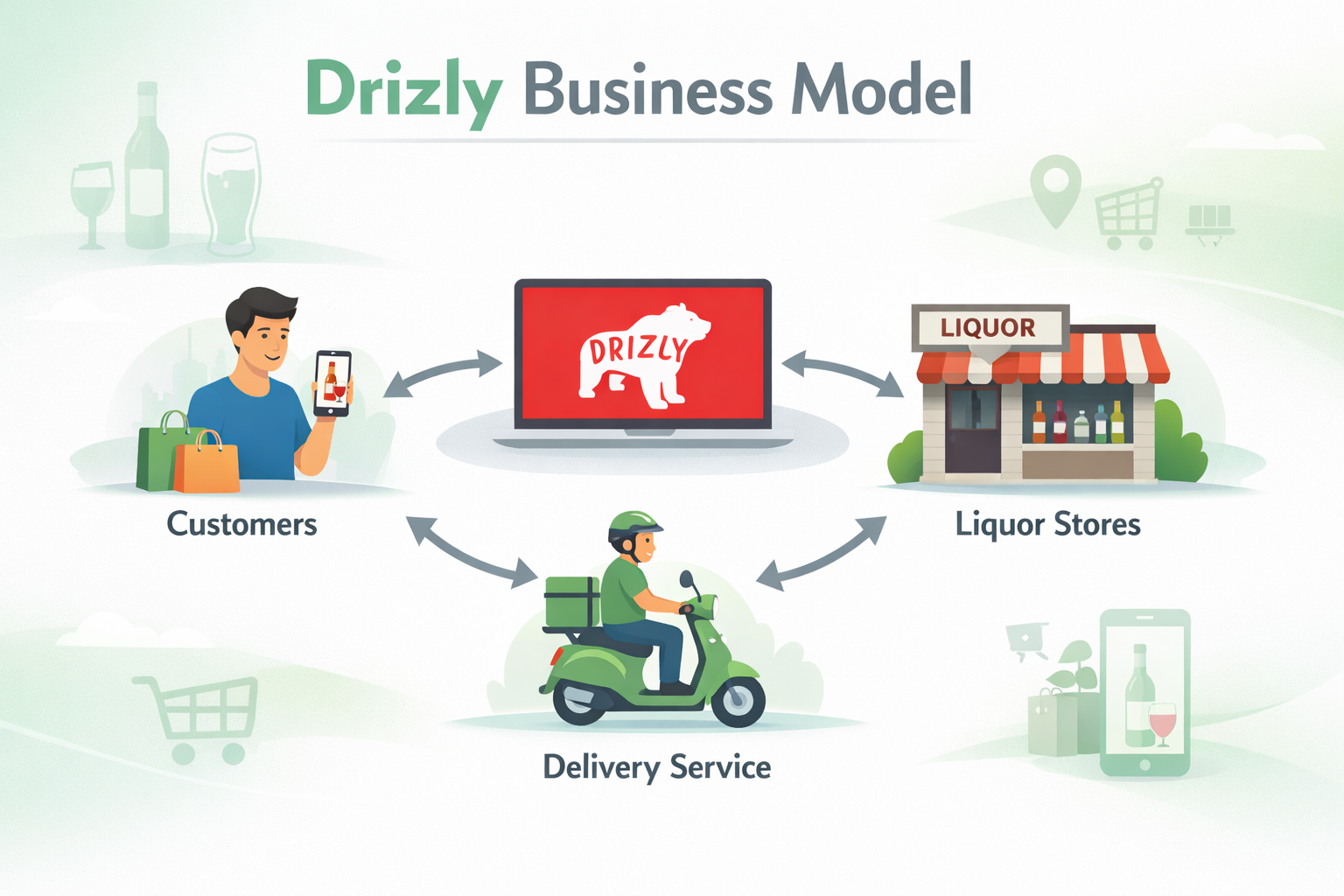
Drizly’s business model is built on a simple but powerful idea: connect local liquor stores with customers who want alcohol delivered to their door. The platform earns money through commissions charged to retailers, delivery fees paid by customers, service fees, and advertising revenue from alcohol brands.
It does not own a single bottle of alcohol. It never has. And that is exactly why it worked so well for nearly a decade.
What is Drizly?
Drizly is an on-demand alcohol delivery marketplace that was founded in 2012 by Nick Rellas, Justin Robinson, and Spencer Frazier in Boston, Massachusetts.
The premise was straightforward: people already ordered food, rides, and groceries from their phones. Why not alcohol?
At its peak, Drizly operated in over 1,400 cities across the United States and Canada, partnering with thousands of licensed local liquor stores to fulfill orders within 60 minutes or less.
In 2021, Uber acquired Drizly for approximately $1.1 billion, recognizing its dominant position in the alcohol delivery niche and the strategic value it brought to the Uber ecosystem.
A few key facts about Drizly at a glance:
- Founded in 2012 in Boston, MA
- Operated as a marketplace, not a retailer
- Available across the US and Canada at its peak
- Acquired by Uber in February 2021 for $1.1 billion
- Shut down by Uber in March 2023
The Core Idea Behind Drizly
The most important thing to understand about Drizly is that it was never a liquor store. It was a technology platform that made liquor stores more accessible.
This distinction matters enormously.
Instead of buying inventory, building warehouses, or hiring delivery fleets from scratch, Drizly plugged into an existing ecosystem of licensed retailers. It gave those retailers a digital storefront, order management tools, and access to a large customer base they could never have reached on their own.
This is what is called an asset-light marketplace model, and it is the same playbook used by:
- Uber (connects drivers to riders, owns no cars)
- Airbnb (connects hosts to guests, owns no properties)
- Uber Eats (connects restaurants to diners, owns no kitchens)
The genius of this model is scalability. Drizly could expand to a new city without investing millions in local infrastructure. It simply needed to onboard the right retail partners and flip the switch.
How Drizly Works
For customers, the experience was designed to be as smooth as ordering pizza. But behind that simplicity was a carefully structured operational model.
Here is how the process worked from start to finish:
Step One: Customer Opens the App or Website The user enters their delivery address. Drizly’s platform uses that location to surface inventory from licensed liquor stores in the area that are currently open and available for delivery.
Step Two: Browse Local Inventory Customers browse beer, wine, spirits, and mixers from nearby stores. The inventory shown is real-time, pulled directly from the retailer’s stock. Prices are set by the retailer, not by Drizly.
Step Three: Place the Order The customer selects items, reviews the cart, and checks out through the Drizly platform. Age verification is a required step, consistent with alcohol regulations.
Step Four: The Store Receives and Prepares the Order The order is pushed to the partner liquor store, where staff pick and pack it. The retailer is responsible for ensuring legal compliance, including checking ID at delivery.
Step Five: Delivery to the Door Delivery is handled either by the store’s own staff or through a third-party delivery partner. In most cases, the delivery person checks the customer’s ID upon arrival before handing over the order.
This structure kept Drizly out of direct regulatory risk while keeping operations lean and scalable.
Drizly Business Model Canvas
Understanding any business model is easier when you break it down into its core components. Here is how Drizly’s model looks across each dimension:
Customer Segments
Drizly served several distinct groups of customers:
- Individual consumers looking for convenience on a Friday night
- Party and event planners who needed to stock up for gatherings
- Corporate buyers arranging drinks for office events
- Gift purchasers using Drizly’s gifting features to send alcohol to friends or family
Value Proposition
The platform’s core promise was built around three things:
- Convenience: Alcohol delivered without leaving home
- Speed: Delivery in under 60 minutes in many markets
- Selection: Access to the inventory of multiple local stores in one place
Channels
Drizly reached customers through:
- Its iOS and Android mobile app
- Its website at drizly.com
- Later, integration within the Uber and Uber Eats apps post-acquisition
Customer Relationships
Drizly operated on a self-service model. Customers managed their own accounts, placed orders independently, and received automated order tracking. Support was available but the experience was designed to require minimal human interaction.
Key Partners
The entire model depended on a strong network of partners:
- Licensed local liquor retailers (the backbone of the platform)
- Payment processors like Stripe to handle transactions
- Delivery logistics partners in markets where stores did not have their own drivers
- Alcohol brands who paid for promotional placement on the platform
Key Activities
Running the Drizly platform required constant attention to:
- Building and maintaining the technology infrastructure
- Onboarding and supporting retail partners
- Managing logistics and delivery coordination
- Ensuring regulatory compliance across different states and jurisdictions
- Running marketing campaigns to drive consumer demand
Key Resources
What made Drizly valuable was not physical. Its most important assets were:
- The technology platform itself
- The retail partner network it spent years building
- Its brand recognition in the alcohol delivery category
- Consumer data and purchase behavior insights
Cost Structure
The major cost buckets for Drizly included:
- Technology development and platform maintenance
- Sales and marketing to acquire both retailers and consumers
- Customer support operations
- Regulatory and legal compliance
How Drizly Makes Money
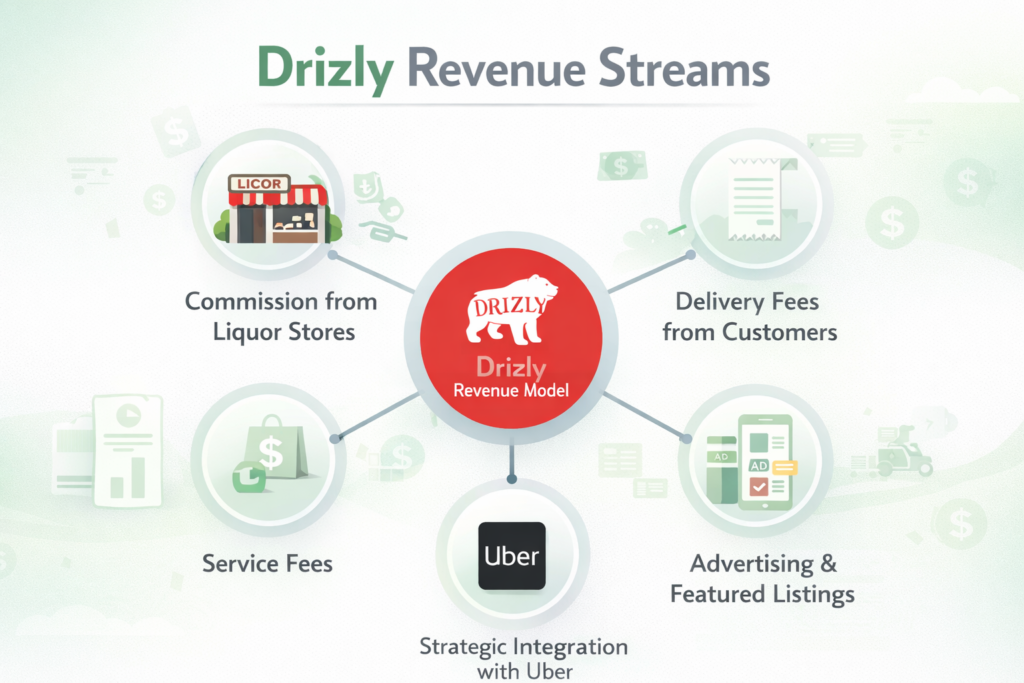
Drizly had multiple revenue streams working in parallel, each designed to extract value from different parts of the transaction.
Commission from Retailers
The primary revenue stream was a commission charged to liquor stores on every order placed through the platform.
When a customer ordered $80 worth of whiskey and wine, Drizly took a percentage of that transaction before passing the rest to the retailer. This commission typically ranged from around 15% to 20% depending on the market and the partnership terms.
This is a classic marketplace revenue model. The more volume flowing through the platform, the more commission Drizly collected. Growth compounded automatically.
Delivery Fees
In addition to commissions from retailers, Drizly charged delivery fees directly to customers.
These fees typically ranged from $5 to $10 per order, though they varied by market and order size. Some retailers offered free delivery above a certain cart value, which was usually subsidized or negotiated as part of the partnership terms.
Delivery fees served two purposes:
- They generated direct revenue
- They helped offset the cost of last-mile logistics
Service Fees
Beyond the delivery fee, Drizly also charged a service fee on orders. This is a platform usage charge that covers the cost of running the technology, processing payments, and supporting the transaction.
Service fees were often displayed separately from the delivery fee at checkout, and they typically amounted to a small percentage of the order total.
Advertising and Brand Promotions
This revenue stream is often underappreciated but was growing significantly before Drizly shut down.
Alcohol brands, including major players like Diageo, Anheuser-Busch, and Constellation Brands, paid Drizly for featured placement and promotional visibility on the platform.
This included:
- Sponsored product listings at the top of search results
- Banner ads within the app
- Curated brand pages and collections
- Targeted promotions and discounts funded by the brand
Think of it like Amazon Advertising, but for alcohol. Brands paid to be seen at the moment a consumer was actively deciding what to buy. The conversion rates on that kind of intent-based advertising are much higher than traditional media.
As Drizly grew its user base and collected more purchase data, this advertising business became increasingly valuable.
Strategic Synergy with Uber
After the 2021 acquisition, Drizly gained access to Uber’s vast delivery infrastructure, user base, and cross-promotion capabilities.
The integration allowed:
- Uber Eats users to order alcohol directly through the Uber Eats app
- Shared delivery infrastructure in some markets
- Cross-promotional offers between Uber and Drizly
This synergy had the potential to significantly lower Drizly’s customer acquisition costs and expand its geographic reach. The reason it ultimately did not pan out is a separate story.
Why Drizly’s Model Worked
For most of its existence, Drizly was considered one of the smarter business models in the on-demand space. Here is why:
No Inventory Risk Drizly never sat on stock that could go unsold. It never dealt with expiry, breakage, or warehouse costs. Every bottle belonged to the retailer until it was purchased.
Scalable by Design Adding a new city required onboarding retail partners, not building warehouses. That kind of growth has a very different cost curve.
High Consumer Demand for Convenience Alcohol is a high-frequency, high-value purchase category. Consumers who used Drizly tended to stick with it because the convenience was hard to give up.
Strong Local Partnerships Independent liquor stores had very little digital presence before platforms like Drizly came along. Drizly gave them technology they could not build themselves. In return, it got exclusivity and loyalty from those partners.
The Regulated Marketplace Moat This is perhaps the most underappreciated element of Drizly’s model. Alcohol is one of the most heavily regulated industries in the United States. Every state has different laws. Licenses are required at multiple levels. Delivery rules vary widely.
This complexity is exhausting for any new entrant trying to build a national platform from scratch. Drizly spent years navigating that regulatory landscape and building relationships with compliant retailers. That experience became a genuine competitive moat. New competitors could not simply copy the product. They had to replicate years of legal infrastructure and partner trust.
Challenges in Drizly’s Business Model
No business model is without friction, and Drizly faced some serious structural challenges throughout its life.
State-by-State Regulatory Complexity
Alcohol delivery is not legal everywhere in the same way. Some states allow direct-to-consumer delivery. Others require the order to be fulfilled and delivered by a licensed retailer. A handful of states restricted alcohol delivery altogether.
This made national expansion slow and expensive. Drizly needed dedicated compliance teams to navigate each new market.
Delivery Logistics
Unlike food delivery, alcohol delivery has an additional layer of friction: age verification at the door. Every delivery required a valid ID check, which added time to each drop and created operational complexity for delivery partners.
Competition from Larger Platforms
Over time, Instacart, DoorDash, and Uber Eats all entered the alcohol delivery space. These platforms had larger user bases, deeper pockets, and existing delivery networks. Competing on customer acquisition cost against these giants was increasingly difficult.
Data Security and Compliance
In 2020, Drizly suffered a significant data breach that exposed personal information of approximately 2.5 million customers. The FTC took action, and Drizly agreed to settle. This was a reminder that handling sensitive consumer data, especially alongside age-verification information, carries real risk.
Growth Strategy of Drizly
During its growth phase, Drizly pursued expansion along several vectors:
Geographic Expansion Drizly methodically expanded from major metros into secondary cities, building out its retailer network in each new market before launching to consumers.
Retailer Network Deepening Beyond adding new cities, Drizly worked to onboard more stores within existing markets, increasing coverage density so more customers could access delivery.
Leveraging the Uber Acquisition Post-acquisition, the strategy included deeper integration with Uber’s global platform, shared infrastructure, and the ability to reach Uber’s 100+ million active users.
Technology Improvements Drizly continuously invested in improving the consumer experience, including better search, faster checkout, real-time inventory accuracy, and improved delivery tracking.
Brand Partnerships The advertising business was an intentional growth area, with Drizly building a dedicated brand partnerships team to sell promotional inventory to alcohol companies.
Drizly vs Competitors
Drizly operated in an increasingly competitive landscape. Here is how it compared to its main rivals:
Drizly vs Instacart
| Factor | Drizly | Instacart |
|---|---|---|
| Focus | Alcohol only | Groceries + alcohol |
| Retailer Network | Liquor stores | Grocery chains |
| Regulatory Expertise | Deep, specialized | Broader but shallower |
| Brand Partnerships | Alcohol-specific | General CPG brands |
| User Intent | High purchase intent | Mixed intent |
Drizly’s advantage was niche specialization. A customer opening Drizly knew exactly what they wanted. That specificity made the platform more useful for alcohol brands buying advertising space and more efficient for consumers who did not want to search through grocery aisles to find a bottle of tequila.
Drizly vs Uber Eats
After the acquisition, Uber Eats and Drizly were technically on the same team. But before that, Uber Eats had been expanding into alcohol in several markets.
The acquisition resolved this overlap by giving Uber a dedicated alcohol platform with existing infrastructure and regulatory relationships, rather than trying to bolt alcohol delivery onto a food delivery product.
The Regulatory Advantage as a Competitive Moat
One thing that made Drizly structurally different from its competitors was its deep understanding of alcohol regulation at the state and local level.
Competitors entering the space quickly discovered that alcohol delivery is not like delivering burritos. The legal complexity slowed them down. Drizly had a head start of several years in building compliant systems, and that was not easy to replicate quickly.
Key Takeaways for Founders and Business Thinkers
Drizly’s story offers several lessons that go well beyond the alcohol industry:
Marketplace Models Beat Inventory Models By refusing to own inventory, Drizly avoided the capital intensity and operational risk that would have slowed it down significantly. The marketplace model let it scale with the network, not against it.
Local Partnerships Are a Serious Competitive Asset Drizly’s retail network was not just a supply chain. It was a relationship asset built over years. Those relationships created loyalty on both sides and made the platform harder to displace.
Regulation Can Be a Moat, Not Just a Hurdle Most founders look at heavily regulated industries and run the other way. Drizly leaned in. It built expertise in navigating alcohol regulations and turned that expertise into a barrier that kept competitors at bay.
Convenience-Driven Businesses Can Scale Remarkably Fast Once consumers experience the convenience of on-demand delivery for a high-frequency category like alcohol, behavioral change is sticky. Drizly benefited from strong retention among active users.
Even Great Models Can Be Undone by Strategic Decisions Drizly’s shutdown in 2023 was not because the model was broken. Uber decided to wind it down and integrate alcohol delivery directly into Uber Eats. This is a reminder that acquisition can sometimes be the end of a brand’s independent story, regardless of how sound its underlying model was.
FAQs
Drizly makes money through commissions charged to retail partners on each order, delivery fees charged to customers, service fees on transactions, and advertising revenue from alcohol brands paying for featured placement on the platform.
Drizly was not consistently profitable as an independent company. Like many marketplace startups, it prioritized growth over profitability during its scaling phase. Uber acquired it before it reached sustained profitability, and ultimately shut it down in 2023, suggesting the integration economics did not work out as planned.
Uber announced the shutdown of Drizly in February 2023, effective March 2023. The primary reason cited was to consolidate alcohol delivery under the Uber Eats platform rather than run two parallel consumer products. Uber wanted to simplify its app portfolio and reduce operational complexity.
No. Drizly officially shut down in March 2023. Uber redirected its alcohol delivery efforts to Uber Eats, where customers can still order alcohol in markets where it is available.
Drizly did not fail in the traditional sense. It was acquired for over a billion dollars, which most founders would consider a significant success. Its shutdown was a strategic decision by Uber to consolidate platforms, not a reflection of broken fundamentals. That said, increasing competition from Instacart, DoorDash, and Uber Eats itself made the standalone alcohol delivery category harder to defend.
No. Drizly never owned inventory. It operated as a marketplace that connected customers with licensed local liquor retailers. The stores owned the inventory and were responsible for legal compliance.
Delivery was handled either by the partner liquor store’s own staff or by third-party delivery contractors, depending on the market and the retailer’s setup.
Uber acquired Drizly in February 2021 for approximately $1.1 billion. Drizly was subsequently shut down in March 2023, with its alcohol delivery functionality absorbed into Uber Eats.
Discover more from Business Model Hub
Subscribe to get the latest posts sent to your email.