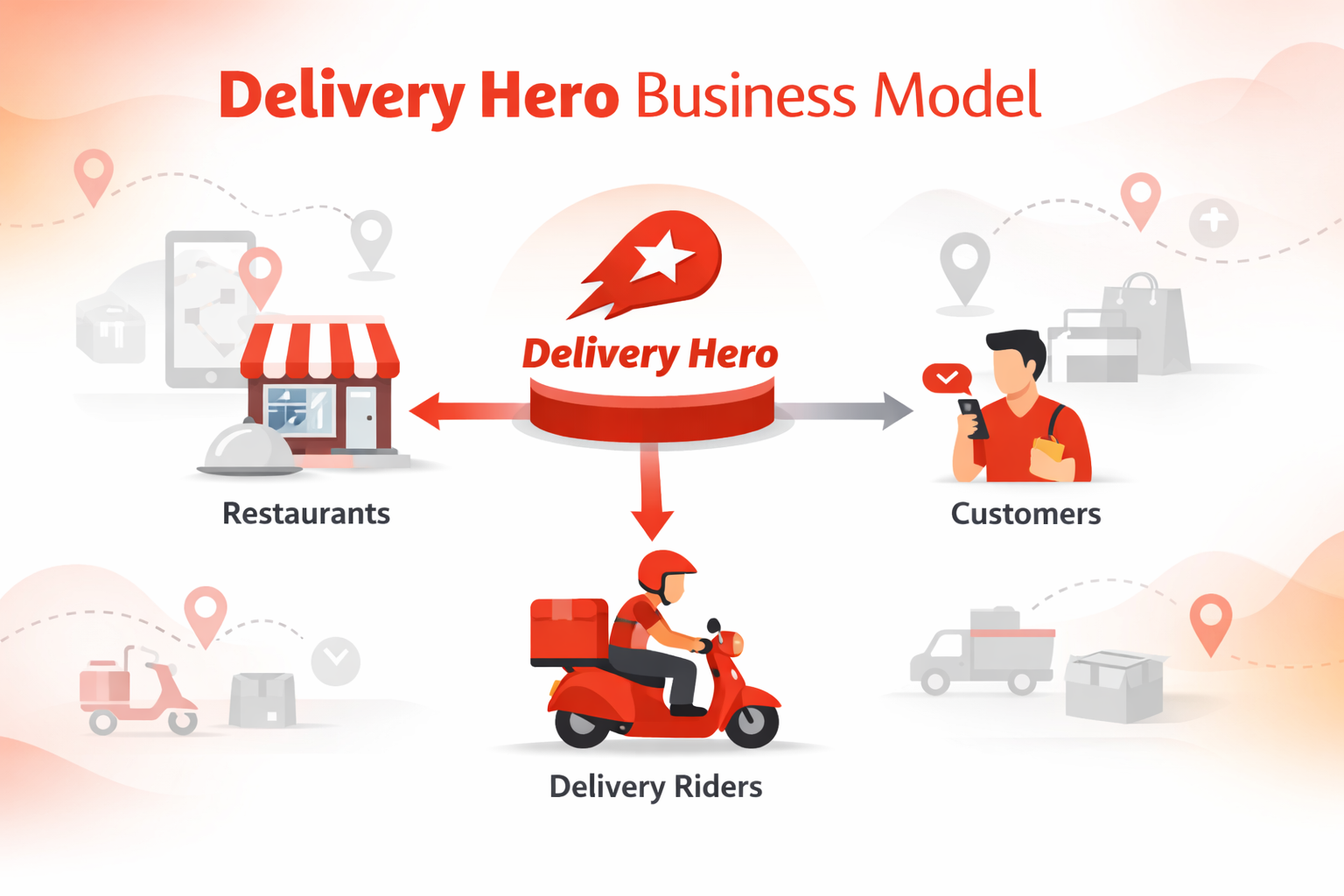
Delivery Hero operates a multi-sided marketplace business model that connects restaurants, customers, and delivery partners through its digital platforms. The company primarily earns revenue through:
- Restaurant commissions
- Delivery fees
- Advertising services
- Subscription programs
- Logistics services
It runs food delivery marketplaces across Asia, Europe, the Middle East, and Latin America, often operating through well-known local brands that customers trust in their own regions.
About Delivery Hero
Delivery Hero is one of the most recognizable names in the global food delivery industry, yet most people interact with it through its regional brands without ever knowing the parent company behind it.
Here are the key facts:
- Founded: 2011
- Founders: Niklas Östberg, Kolja Hebenstreit, Markus Fuhrmann, Lukasz Gadowski
- Headquarters: Berlin, Germany
- Industry: Online Food Delivery / Quick Commerce
- Countries of Operation: More than 70
The company has built its empire not by pushing a single brand worldwide, but by acquiring and operating local platforms that already have trust and recognition in their respective markets. Some of its most prominent brands include:
- Foodpanda (Asia-Pacific)
- Talabat (Middle East)
- PedidosYa (Latin America)
- Glovo (Europe and Africa)
This approach sets Delivery Hero apart from many of its global competitors and is central to understanding how the business actually works.
The Problem Delivery Hero Solves
To understand why Delivery Hero became so large, it helps to go back to the problems that existed before platforms like it came along.
Customers were dealing with:
- Very limited restaurant delivery options in most cities
- No easy way to browse menus, compare restaurants, or read reviews
- Slow, frustrating phone-based ordering processes
- Uncertainty around delivery times and order accuracy
Restaurants had their own set of challenges:
- Minimal digital presence or discoverability online
- No delivery infrastructure of their own
- Difficulty reaching new customers beyond their immediate neighborhood
- Heavy reliance on walk-in foot traffic
Delivery Hero stepped in and built a platform that solved both sides of this equation at the same time. Customers got a single app where they could browse hundreds of restaurants, place orders in minutes, and track delivery in real time. Restaurants got instant access to a massive customer base without needing to build any delivery infrastructure themselves.
This two-sided solution is exactly what makes the marketplace model so powerful.
Delivery Hero Business Model Overview
At its core, Delivery Hero operates what is known as a three-sided marketplace. Instead of connecting just buyers and sellers, it connects three distinct groups:
- Customers who want food delivered to their door
- Restaurants that want to reach more customers
- Delivery partners who want flexible earning opportunities
The flow looks like this:
Customer places order on the app → Restaurant receives and prepares the order → Delivery partner picks up and delivers → Customer receives food
Every transaction that flows through this loop generates revenue for Delivery Hero at multiple points. The platform charges the restaurant a commission, may charge the customer a delivery fee, and provides the logistics infrastructure that makes it all possible.
Why this model is so effective:
- More restaurants on the platform attract more customers
- More customers attract more restaurants to join
- More orders create more opportunities for delivery partners
- More delivery partners mean faster, more reliable delivery
This is the classic network effect at work. Once the flywheel starts spinning, it becomes very difficult for competitors to break in.
Delivery Hero Revenue Streams
This is where the business model gets genuinely interesting. Delivery Hero does not rely on a single income source. It has built multiple overlapping revenue streams that collectively make the business far more resilient than a simple delivery company.
Restaurant Commissions
This is the largest and most important revenue stream for the company.
Every time a customer places an order through one of Delivery Hero’s platforms, the restaurant pays a commission on that order. These commissions typically range from 15% to 35% of the order value, depending on the market, the restaurant’s agreement, and the level of visibility or features the restaurant chooses.
This model is similar to what other major platforms use:
- Uber Eats charges comparable commission rates
- DoorDash operates on a similar structure
- Just Eat Takeaway follows the same basic approach
What makes commissions so attractive as a revenue stream is their scalability. Delivery Hero does not need to increase prices or launch new products to earn more. It simply needs more orders to flow through the platform. As order volumes grow, commission revenue grows proportionally.
The challenge, of course, is that restaurants are increasingly aware of how much these commissions eat into their margins. This has led to growing pressure on platforms to lower rates, which is a tension the industry continues to navigate.
Delivery Fees
Beyond restaurant commissions, Delivery Hero also earns revenue directly from customers through delivery fees.
These fees are not fixed. They vary based on several factors:
- Distance between the restaurant and the customer
- Demand at a particular time of day (surge pricing)
- Location and the cost of operating in that market
- Order value in some cases
Delivery fees serve a dual purpose. They generate direct revenue for the platform and they help cover the cost of maintaining the logistics network. In markets where delivery costs are high, these fees become an important part of keeping operations financially viable.
One important thing to note is that delivery fees can be a source of customer friction. High fees sometimes lead customers to abandon their carts or choose competitors. This is why many platforms have moved toward subscription models that eliminate per-order delivery fees in exchange for a monthly payment.
Subscription Programs
Delivery Hero has invested heavily in subscription offerings across its various platforms. These programs typically offer:
- Unlimited free delivery for a flat monthly fee
- Discounts on orders
- Priority customer support
- Exclusive deals with partner restaurants
The subscription model mirrors what has worked well for competitors:
- DashPass by DoorDash
- Uber One by Uber Eats
- Prime delivery benefits within Amazon’s ecosystem
Subscriptions are valuable for several reasons. They provide predictable, recurring revenue that is not dependent on individual order volume. They also increase customer loyalty and average order frequency, since subscribers feel motivated to get their money’s worth by ordering more often.
For Delivery Hero, growing subscriber numbers across markets like Southeast Asia, the Middle East, and Latin America represents a significant long-term revenue opportunity.
Advertising and Sponsored Listings
This is one of the highest-margin revenue streams in the entire business model.
Restaurants on the platform can pay to increase their visibility in several ways:
- Top search placements so they appear first when customers browse
- Sponsored listings that are highlighted within category searches
- Featured restaurant ads on the app home screen
- Banner advertising within the platform interface
The logic is straightforward. When hundreds of restaurants compete for customer attention on the same platform, the ones willing to pay for better placement get more orders. This creates a self-funding advertising ecosystem where restaurant success on the platform directly drives ad spend back into Delivery Hero’s revenues.
This is structurally similar to how Amazon’s advertising business works. Amazon built a marketplace, and then built an advertising layer on top of it that generates enormous profits. Delivery Hero is following a comparable path.
As the platform matures in each market, advertising revenue tends to grow as a share of total income. Restaurants become more sophisticated about the return on investment from sponsored placements, and Delivery Hero benefits from increased competition for those placements.
Logistics Services
Not every restaurant has the ability to handle its own delivery operations. Many smaller restaurants, cloud kitchens, and new entrants on the platform rely entirely on Delivery Hero’s logistics network to fulfill orders.
These restaurants pay additional fees for:
- Access to delivery riders employed or contracted by the platform
- Order fulfillment and tracking infrastructure
- Last-mile delivery management
This logistics-as-a-service model creates an additional revenue layer beyond the basic marketplace commission. It also deepens the relationship between Delivery Hero and the restaurants on its platform, making it harder for them to switch to a competitor.
Building and maintaining a logistics network is expensive. It requires:
- Recruiting and managing delivery partners
- Investing in routing and dispatch technology
- Operating in real time across thousands of orders simultaneously
- Handling peaks during lunch and dinner rush hours
But once that infrastructure is in place, selling access to it as a service is highly scalable. Adding more restaurant clients to the logistics network does not require proportionally more investment.
Quick Commerce and Dark Stores
Perhaps the most strategically significant expansion of Delivery Hero’s business model in recent years has been its move into quick commerce.
Quick commerce refers to ultra-fast delivery of groceries, convenience items, and household essentials. Delivery Hero operates this through what are known as dark stores, which are small, strategically located fulfillment centers that are not open to the public but exist purely to fulfill rapid delivery orders.
These dark stores stock:
- Fresh groceries
- Packaged snacks and beverages
- Cleaning and household supplies
- Personal care items
- Convenience foods
The promise to customers is delivery within 15 to 30 minutes. This is not just food delivery anymore. It is an entirely new category of on-demand retail.
Competitors in this space include:
- Gorillas (now part of Getir)
- Getir
- Gopuff
- Zepto in India
For Delivery Hero, quick commerce represents a way to diversify beyond restaurant food delivery and capture a much larger share of the consumer spending that happens every day in groceries and convenience shopping. The total addressable market for grocery delivery is orders of magnitude larger than restaurant delivery alone.
The Delivery Hero Business Model Canvas
Breaking the model down into its core components helps clarify how all the pieces fit together.
Customer Segments:
- On-demand food delivery customers
- Restaurant and food business partners
- Grocery and convenience store partners
- Enterprise clients using logistics services
Value Proposition:
- Fast, convenient on-demand delivery for customers
- Customer acquisition and order management for restaurants
- Flexible earning opportunities for delivery partners
- Logistics infrastructure for businesses without delivery capabilities
Channels:
- Mobile apps across all major platforms
- Web ordering interfaces
- Partner integrations and APIs
- Third-party aggregators in some markets
Customer Relationships:
- Push notifications and personalized app experiences
- Loyalty and rewards programs
- Subscription memberships
- Customer support services
Revenue Streams:
- Restaurant commissions (15% to 35% per order)
- Customer delivery fees
- Subscription membership fees
- Advertising and sponsored placement fees
- Logistics service fees
- Quick commerce product margins
Key Resources:
- Proprietary delivery network and logistics technology
- Restaurant and merchant partnerships
- Consumer-facing mobile applications
- Brand portfolios in each regional market
- Data on customer preferences and behavior
Key Activities:
- Real-time order management and dispatch
- Delivery logistics and rider management
- Marketplace operations and merchant support
- Marketing and customer acquisition
- Technology development and platform maintenance
Key Partners:
- Restaurant and food merchant partners
- Independent delivery riders and couriers
- Payment gateway and financial service providers
- Cloud infrastructure providers
- Local regulatory bodies in each market
Cost Structure:
- Delivery rider payments and incentives
- Marketing and customer acquisition costs
- Technology infrastructure and development
- Dark store setup and inventory management
- Corporate operations and personnel
How Delivery Hero Scaled Globally
One of the most interesting aspects of Delivery Hero’s history is how it approached global expansion. Rather than slowly building market-by-market from scratch, the company pursued an aggressive acquisition strategy.
This approach had several distinct advantages:
- Speed: Acquiring an existing platform is far faster than building one
- Local knowledge: Established platforms already understand local customer preferences
- Existing user base: Acquisitions come with customers already using the product
- Brand trust: Local brands often have deeper trust than a foreign entrant
Major acquisitions that shaped the company include:
- Foodpanda, which gave Delivery Hero a massive presence across Southeast Asia and parts of Europe
- Glovo, which expanded coverage across Southern Europe, Eastern Europe, and parts of Africa
This acquisition-led strategy is a sharp contrast to competitors like DoorDash, which grew primarily by building organically within the United States before cautiously expanding internationally.
The tradeoff is cost. Acquisitions are expensive, and integrating multiple platforms with different technologies, cultures, and operating models is genuinely difficult. Delivery Hero has had to work hard to capture synergies across its portfolio while also allowing each regional brand to maintain the local identity that made it successful in the first place.
Competitive Advantages of Delivery Hero
Given the intense competition in food delivery globally, it is worth examining what actually differentiates Delivery Hero from its rivals.
Broad geographic footprint:
Operating in more than 70 countries gives Delivery Hero a scale that very few competitors can match. This global presence allows it to spread technology costs across more markets, negotiate better deals with shared technology vendors, and attract investment based on total addressable market size.
Localized brand strategy:
Rather than forcing every market to use the Delivery Hero name, the company lets regional brands operate under their own identity. Customers in Kuwait use Talabat. Customers in the Philippines use Foodpanda. This localization strategy reduces the brand friction that often occurs when a global company tries to impose a single identity on diverse markets.
Hybrid marketplace and logistics model:
Many early food delivery platforms operated purely as software marketplaces, connecting customers with restaurants that handled their own delivery. Delivery Hero built its own logistics infrastructure in parallel with the marketplace. This gives it more control over the delivery experience and opens up additional revenue streams through logistics services.
Quick commerce diversification:
By expanding into groceries and convenience items, Delivery Hero is reducing its dependence on restaurant food delivery and positioning itself to compete in a much larger market. This diversification also increases the frequency with which customers open the app, since grocery needs arise more often than restaurant delivery occasions.
Data advantages:
Operating at the scale Delivery Hero does generates enormous amounts of data about consumer behavior, restaurant performance, delivery patterns, and demand forecasting. This data can be used to:
- Improve delivery routing and efficiency
- Personalize recommendations for customers
- Optimize pricing dynamically
- Guide restaurant partners on menu and pricing decisions
Challenges in the Delivery Hero Business Model
No business model analysis is complete without an honest look at the difficulties involved. Delivery Hero faces several significant structural challenges.
High logistics costs:
Running a delivery network is expensive. Rider payments, fuel, vehicle maintenance, insurance, and the technology needed to coordinate thousands of simultaneous deliveries all add up. In many markets, these costs make it very difficult to reach profitability even with strong order volumes.
Thin operating margins:
Food delivery marketplaces are notoriously low-margin businesses. The combination of high logistics costs, significant marketing spend needed to acquire and retain customers, and competitive pressure to keep delivery fees low means that margins are often squeezed from multiple directions simultaneously.
Intense competitive pressure:
In almost every market where Delivery Hero operates, it faces competition from at least one well-funded rival. Competitors include:
- Uber Eats, which benefits from Uber’s enormous global brand and logistics expertise
- DoorDash, which has aggressively expanded outside the United States
- Just Eat Takeaway, which operates across much of Europe
- Local players in individual markets that have deep customer loyalty
This competition makes customer acquisition expensive and puts constant pressure on commission rates and delivery fees.
Regulatory challenges:
Operating in more than 70 countries means navigating 70 different regulatory environments. Issues around gig worker classification, data privacy, food safety standards, and local business regulations create ongoing compliance costs and operational complexity.
Profitability timeline:
Like many high-growth technology platforms, Delivery Hero has historically prioritized growth over profitability. Investors have generally supported this approach, but as market conditions have tightened and investor appetite for unprofitable growth companies has decreased, pressure to demonstrate a clear path to sustainable profits has intensified.
Future Strategy of Delivery Hero
Looking ahead, Delivery Hero is focused on several strategic priorities that reflect where the company believes the most significant opportunities lie.
Quick commerce expansion:
The build-out of dark store infrastructure for ultra-fast grocery and convenience delivery is a central pillar of the company’s future strategy. As consumers become more accustomed to 15 to 30 minute delivery windows for everyday essentials, the market opportunity continues to grow.
AI-driven logistics optimization:
Artificial intelligence is increasingly being used to:
- Optimize delivery routing in real time
- Predict demand surges and pre-position riders
- Reduce food preparation wait times by coordinating kitchen timing with rider arrival
- Personalize customer experiences based on order history and preferences
These improvements directly impact both customer satisfaction and operational costs, making AI investment a high-priority area.
Profitability focus:
After years of prioritizing growth, there is a clear strategic shift toward improving unit economics and reaching sustainable profitability. This involves:
- Exiting or restructuring underperforming markets
- Increasing average order values through upselling and promotions
- Growing high-margin revenue streams like advertising
- Reducing rider incentive costs as supply and demand balance out in mature markets
Grocery and retail partnerships:
Beyond operating its own dark stores, Delivery Hero is pursuing partnerships with established grocery retailers and convenience chains. These partnerships allow the platform to offer a wider range of products without bearing the full cost of inventory management.
Key Lessons for Founders and Entrepreneurs
The Delivery Hero story contains genuinely useful lessons for anyone building a marketplace or logistics business.
Marketplace models scale through network effects:
The more participants you have on both sides of the marketplace, the more valuable the platform becomes for everyone. Early focus on achieving critical mass in each market is essential, even if it means operating at a loss initially.
Logistics control creates competitive moats:
Platforms that control their own delivery infrastructure have a significant advantage over pure software marketplaces. They can guarantee service quality, offer faster delivery, and generate additional revenue from logistics services.
Advertising becomes a major profit center at scale:
Once a marketplace reaches sufficient scale, the advertising layer on top of it can become extremely profitable. Investing in advertising products early, even before they are a major revenue source, pays dividends as the platform grows.
Acquisitions can dramatically accelerate expansion:
Building from scratch in every new market is slow and expensive. Acquiring established local players brings immediate customers, brand recognition, and operational knowledge. The integration challenge is real, but the speed advantage can be decisive.
Localization matters more than most global companies acknowledge:
Consumers trust local brands. Allowing acquired platforms to retain their local identity while benefiting from shared technology and operational support is a smarter strategy than forcing a global brand on markets where it has no existing recognition.
Conclusion
The Delivery Hero business model is a masterclass in building a global platform through a combination of smart marketplace design, logistics investment, and strategic acquisitions.
By operating through localized brands across more than 70 countries, the company has managed to achieve global scale while maintaining the local relevance that keeps customers engaged. By building multiple revenue streams that span commissions, delivery fees, subscriptions, advertising, logistics services, and quick commerce, it has created a business that is far more resilient than any single-revenue-stream competitor could be.
The challenges are real. Margins are thin, competition is fierce, and the path to consistent profitability remains an ongoing work in progress. But the strategic foundations of the business, a powerful three-sided marketplace model, a diversified revenue structure, and a portfolio of trusted local brands, give Delivery Hero a genuine shot at becoming one of the defining commerce platforms of the coming decade.
Discover more from Business Model Hub
Subscribe to get the latest posts sent to your email.