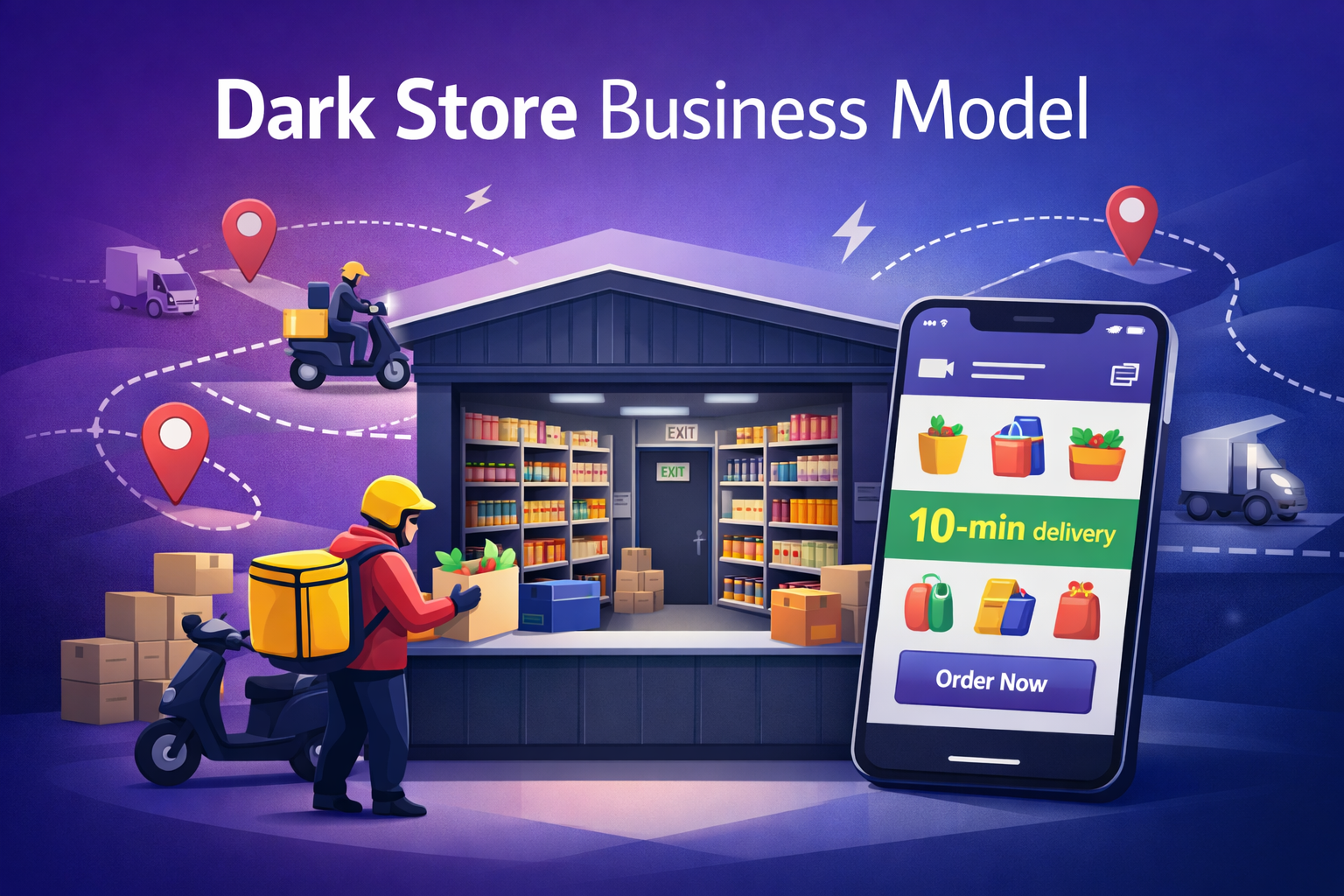
A dark store is a retail fulfillment center that looks like a grocery store on the inside but has zero customer access. No foot traffic, no shopping carts, no checkout lines. It exists solely to fulfill online orders as fast as possible.
Companies like Blinkit, Zepto, and Swiggy Instamart run their entire quick commerce operations through this model. You place an order on an app, a picker grabs your items from a dark store nearby, and a delivery rider brings it to your door, often in under 10 minutes.
This model is growing because speed has become the product. Groceries are the vehicle. Speed is what people are actually paying for.
What Is a Dark Store?
A dark store sits somewhere between a traditional retail store and a large distribution warehouse, but it is neither of those things.
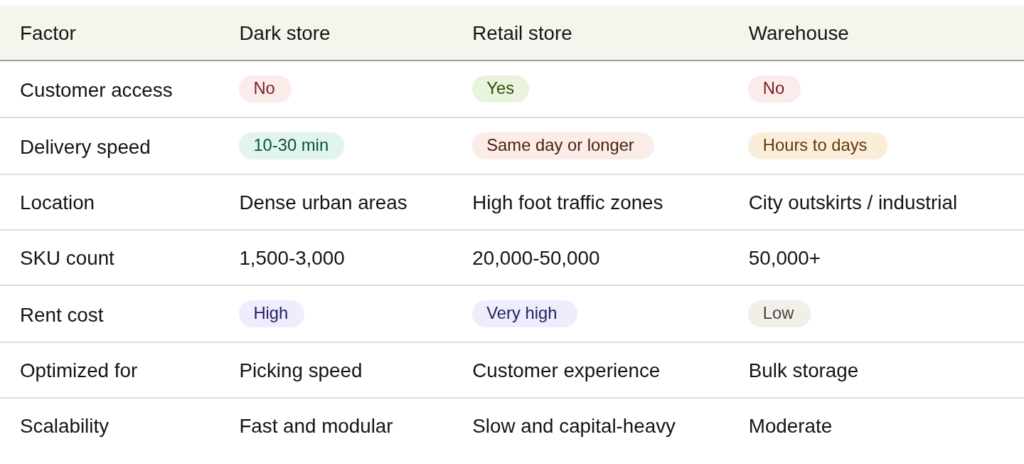
Traditional retail store: Designed for customers to walk in, browse, and purchase. High real estate cost justified by foot traffic. Revenue depends on in-store experience.
Warehouse: Large-scale storage facility located on city outskirts. Built for bulk storage, not fast local delivery. Not optimized for individual order picking at speed.
Dark store: A compact, hyperlocal facility located inside dense urban areas. Organized like a grocery store so pickers can move fast. Closed to the public. Stocked with a curated selection of high-demand products. Every design decision inside the store points to one goal: fulfill an order in under 3 minutes.
That combination of location (hyperlocal), inventory (curated), and operation (pure fulfillment) is what makes it a distinct model.
What Is the Dark Store Business Model?
The core idea is hyperlocal fulfillment at scale. Instead of delivering from one large warehouse on the edge of a city, quick commerce companies plant many small dark stores deep inside the city, close to where demand actually lives.
Each dark store typically covers a delivery radius of 2 to 3 kilometers. This tight radius is what makes 10-minute delivery possible. The math is simple: if a rider never has to travel more than 3 kilometers to a customer, and traffic is manageable, delivery happens in minutes.
The inventory inside a dark store is deliberately limited. A typical dark store carries 1,500 to 3,000 SKUs. A full-size supermarket carries 30,000 to 50,000. The selection is ruthlessly focused on what people actually order at 11 PM on a weeknight: eggs, bread, chips, beverages, personal care basics, and baby products.
This is the quick commerce bet: stock only what sells fast, put it close to customers, and build a system that can pick, pack, and dispatch an order in minutes.
How the Dark Store Model Works
Here is a clear step-by-step look at what happens from the moment you open an app to the moment a rider rings your doorbell.
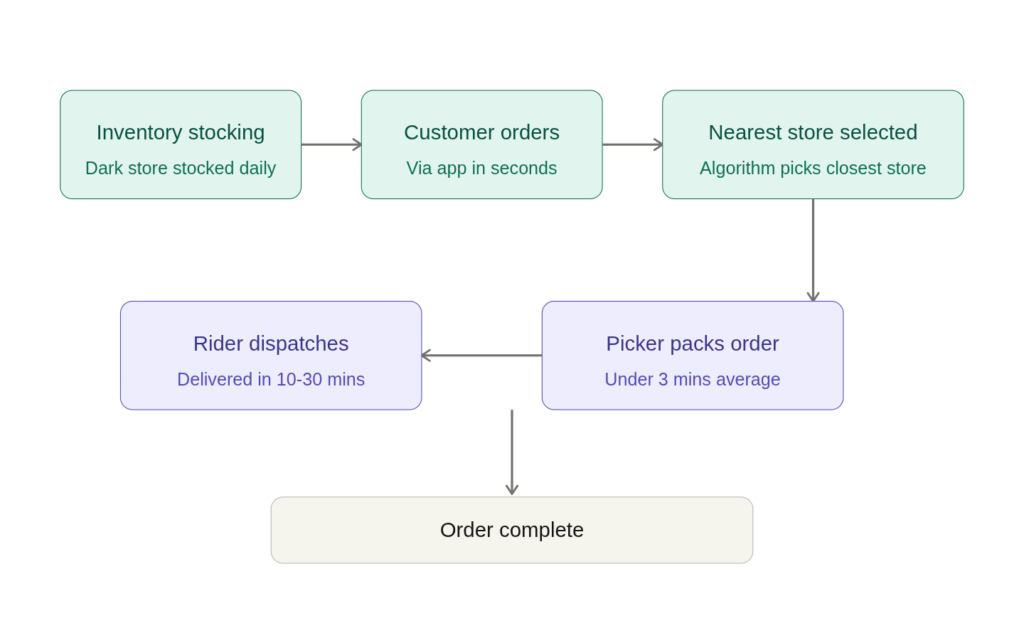
Step one: Inventory stocking. Dark stores are restocked every day, sometimes multiple times. Inventory decisions are driven by algorithms that analyze local demand patterns, time of day, weather, and upcoming events. A dark store near a college campus stocks differently than one near a family-heavy suburb.
Step two: Customer places an order. You open the app, add items to your cart, and check out. This takes less than 2 minutes for most users. The app already knows your location and shows delivery time estimates in real time.
Step three: Order is routed to the nearest dark store. The platform’s backend identifies which dark store is closest to you and has your items in stock. This routing is instant and fully automated.
Step four: A picker packs the items. Inside the dark store, a human picker (sometimes aided by a handheld scanner) moves through organized aisles to grab your items. The layout is designed for picking speed, not browsing comfort. Most orders are picked in under 3 minutes.
Step five: Delivery rider dispatches. The packed bag is handed to a rider waiting at the dark store. The rider covers the last mile on a bicycle or motorbike. The delivery radius is small enough that this leg rarely takes more than 8 to 12 minutes.
Key Components of the Dark Store Model
The dark store model is not just a warehouse with fast bikes. Several components have to work together.
Micro-warehouses in dense urban locations. Location strategy is everything. Dark stores are placed in high-density residential areas based on order density data. The rent is higher than a suburban warehouse, but the delivery radius shrinks enough to make speed viable.
Demand forecasting. Sophisticated forecasting systems predict what will sell today, tonight, and tomorrow morning. Getting this wrong means either stockouts (lost orders) or overstock (spoilage and waste). Both kill margins.
Inventory optimization. SKU selection is not random. Every product on the shelf is there because it earns its place through order frequency and margin. Slow-moving products get cut ruthlessly.
Last-mile delivery fleet. Most quick commerce companies rely on a mix of gig workers and contracted riders. Fleet management, surge coverage, and idle rider optimization are all active operational challenges.
Technology stack. The app, the order management system, the inventory system, and the routing algorithm all need to operate in real time, simultaneously, across hundreds of dark stores. This is genuinely hard engineering.
Revenue Model
Quick commerce companies generate revenue through several streams, not just product sales.
Product margins. The markup on groceries and household items is the core revenue source. Dark store operators buy at wholesale and sell at retail or near-retail prices. Margins on food are thin, typically 15 to 30%, which is why everything else on this list matters.
Delivery fees. Most platforms charge a delivery fee, especially below a certain order value threshold. This fee directly offsets logistics cost and incentivizes customers to order more per cart.
Surge pricing. During peak demand hours or bad weather, delivery fees increase. This helps manage rider demand and captures willingness-to-pay from customers who need delivery right now.
Brand promotions and ad placements. Consumer goods companies pay to have their products featured prominently on the app, similar to how they pay for shelf placement in a physical store. This is a high-margin revenue stream with no incremental fulfillment cost.
Private labels. Several platforms are building their own store brands. Private label products carry higher margins (sometimes 40 to 60%) and build platform loyalty. Blinkit and Zepto have both moved in this direction.
Cost Structure
Understanding where the money goes is essential to understanding why profitability has been so elusive for this model.
Rent for urban locations. Placing dark stores inside dense neighborhoods is expensive. Unlike logistics parks on city edges, these facilities sit in areas where commercial real estate is priced for retail, not storage.
Inventory holding and spoilage. Perishable goods that do not sell become direct losses. Managing spoilage while also maintaining availability is a daily balancing act.
Delivery costs. Last-mile delivery is the single biggest cost for most quick commerce companies. Rider pay, fuel, incentives, and fleet management add up quickly, especially in markets where order density is not yet high enough to make routes efficient.
Staff salaries. Pickers inside dark stores are typically full-time or part-time employees (not gig workers), since they need training and consistency. This is a fixed labor cost that exists regardless of order volume.
Technology infrastructure. Running real-time systems across hundreds of locations requires significant cloud infrastructure investment and engineering headcount.
Real-World Examples
Blinkit (India)
Blinkit (formerly Grofers) pivoted hard into quick commerce after Zomato acquired it. It operates across major Indian metros with a promise of 10-minute delivery. Blinkit focuses on high-density urban neighborhoods and uses a hub-and-spoke model where larger fulfillment centers support smaller dark stores. Its competitive advantage is Zomato’s delivery fleet and customer base.
Zepto (India)
Founded by two Stanford dropouts in 2021, Zepto scaled rapidly on a 10-minute delivery promise. The company has been aggressive about profitability, cutting loss-making dark stores and focusing on contribution margin improvement. Zepto has leaned into private labels and advertising revenue to improve unit economics.
Swiggy Instamart (India)
Instamart is embedded within Swiggy’s broader food delivery ecosystem. It benefits from Swiggy’s delivery infrastructure and customer relationships. The integrated app means a user can order both food and groceries in one session, which improves retention and average order frequency.
Getir (Turkey / Europe)
Getir pioneered the 10-minute delivery model and expanded aggressively into the UK, Germany, and the Netherlands before pulling back due to profitability pressures. It demonstrated both the massive demand for instant delivery and the brutal cost of operating it in markets where order density is not yet high enough to support the model financially.
Why Dark Stores Are Growing Fast
Several structural trends are converging to drive quick commerce adoption.
Instant gratification behavior. Consumer expectations around delivery speed have been ratcheted up by Amazon Prime, ride-sharing, and on-demand everything. Waiting 2 days for a delivery feels long. Waiting 2 hours feels inconvenient. Waiting 10 minutes feels reasonable.
Urban lifestyle changes. Smaller households, longer work hours, and less time for grocery shopping have made convenience a premium people will pay for. Running to a store for two items feels like a poor use of time when an app can deliver in minutes.
Smartphone penetration. In markets like India, near-total smartphone adoption among urban consumers has created a massive addressable market for app-based commerce. Ordering groceries from a phone is now a default behavior for younger demographics.
COVID-driven adoption. The pandemic forced millions of consumers who had never ordered groceries online to do so for the first time. Many of them never went back to traditional grocery shopping at the same frequency.
Rise of quick commerce as a category. Investor capital has created a competitive market where multiple platforms are racing to win consumer loyalty through speed. This competition has accelerated both adoption and infrastructure development.
Advantages of the Dark Store Model
Faster delivery than any traditional model. No other fulfillment model can consistently deliver in 10 to 30 minutes. That speed advantage creates a genuine moat for platforms that execute well.
Better inventory control. With a curated SKU list and demand forecasting, dark stores can track inventory at a granular level that traditional retail stores cannot match. Shrinkage and stockouts are more manageable.
Higher operational efficiency than retail. Without customers walking the floor, everything inside a dark store can be optimized for picker efficiency. Aisle layout, product placement, and bin organization are all designed around fulfillment speed, not browsing experience.
Scalable in urban areas. Opening a new dark store does not require the capital or lead time of opening a full retail location. A dark store can be set up in a few weeks in any commercial space with enough square footage. This makes rapid geographic expansion feasible.
Challenges and Problems
This is where honesty matters. The dark store model has real structural problems that have caused several well-funded players to either shut down or dramatically scale back.
High operational costs. Urban rent, labor, and delivery costs compound each other. A dark store in a prime urban location can have a very high fixed cost base before it fulfills a single order.
Thin margins on groceries. Grocery is one of the lowest-margin retail categories. Delivering a $5 bag of chips profitably when the delivery cost is $1.50 and the picker cost is $0.50 requires either a large delivery fee, high order volume, or significant advertising and brand revenue to subsidize the transaction.
Logistics complexity. Managing hundreds of dark stores, thousands of riders, real-time inventory, and demand spikes simultaneously is operationally intense. One broken link in the system destroys the delivery promise.
Demand unpredictability. A rainy evening generates 3x normal orders. A cricket match does the same. Staffing for peaks without overstaffing for troughs is a constant optimization problem with real costs on both sides.
Profitability has been elusive. Most quick commerce companies have operated at significant losses for years. Getir retreated from several markets. Gorillas sold to Getir. GoPuff restructured. Even the Indian players, despite massive scale, have been on a long journey toward contribution margin positivity. The model works at scale in high-density markets. Below that threshold, it bleeds cash.
Dark Store vs Traditional Retail vs Warehousing
Unit Economics
This is the section that determines whether the business is real or not.
Average order value (AOV). Most quick commerce platforms target an AOV of $8 to $15. Below this range, delivery economics are nearly impossible to make work. This is why platforms push minimum order values or structure delivery fees to incentivize larger baskets.
Cost per delivery. The fully loaded cost of picking, packing, and delivering one order typically runs $2.50 to $5.00, depending on city, order complexity, and rider efficiency. This includes picker wages, rider pay, and a share of fixed dark store costs.
Contribution margin. Contribution margin (revenue minus variable costs, before fixed costs) is the metric platforms focus on first. For many quick commerce companies, breaking even on contribution margin per order was a milestone that took 2 to 4 years. Positive contribution margin means each order is not actively destroying value, but it does not yet account for rent, tech, or corporate overhead.
Breakeven logic. A dark store breaks even when order volume is high enough that fixed costs (rent, staff, tech) are spread across enough orders. A dark store doing 500 orders per day in a dense neighborhood has very different economics than one doing 150 orders per day in a market still building awareness. High order density is the variable everything else depends on.
Future of the Dark Store Business Model
AI-based demand prediction. The next generation of dark store operations will use machine learning models that can predict demand at a granular level: not just what sells on a Tuesday, but what sells on a cold Tuesday evening when there is a major sporting event in that specific zip code. Better prediction means less spoilage, fewer stockouts, and leaner inventory.
Automation in picking. Several companies are experimenting with robotic picking systems inside dark stores. These reduce labor costs and can increase picking speed and accuracy. Adoption is still early, but the economics will improve as the hardware cost comes down.
Expansion to smaller cities. The obvious growth vector after saturating Tier 1 cities is moving into Tier 2 and Tier 3 markets. The unit economics are harder in smaller cities because order density is lower, but the competitive intensity is also much lower. Several Indian players are actively testing this expansion.
Private label growth. As platforms mature, private label becomes a major margin lever. A platform-owned brand of cooking oil or packaged snacks can carry 3x the margin of a national brand. This is where the business model starts to look genuinely profitable at scale.
Profitability as the defining focus. The era of growth-at-any-cost is over for quick commerce. Every major player is now laser-focused on contribution margin per order and path to overall profitability. The companies that survive the next 5 years will be the ones that solved the unit economics problem, not just the delivery speed problem.
Should You Start a Dark Store Business?
This is worth addressing directly rather than just listing bullet points.
Who should consider it. If you already operate in adjacent logistics infrastructure, have access to urban commercial real estate at reasonable rates, and have experience managing gig workforces, the dark store model is worth exploring seriously. It is also relevant for grocery chains looking to build a fulfillment-only channel to compete with app-first players.
When it works. Dense urban markets with proven app-based commerce adoption, tight delivery radius coverage, and a clear path to 300 to 500 orders per day per location. The model works when order volume makes fixed costs manageable.
When it does not work. If you are starting from zero in a market without existing quick commerce behavior, the customer acquisition cost alone will drain capital before the dark store finds its floor. It also does not work if your cost of urban real estate prices you out of a delivery fee structure customers will accept.
The capital reality. Setting up a single dark store correctly (technology, inventory, fixtures, staffing, marketing) costs somewhere between $50,000 and $200,000 depending on the market. You also need 6 to 12 months of operating runway before order density builds. Raising or allocating insufficient capital and underestimating the timeline to profitability is how most dark store ventures fail. This is a capital-intensive business that requires patience and precision.
Wrapping Up
The dark store model is one of the most capital-intensive, operationally complex, and margin-thin business models in retail. It is also genuinely changing how people buy everyday items.
Speed is the product. Not groceries. The platforms that understand this are the ones building real moats: 10-minute delivery is not a feature, it is the value proposition. Everything inside the dark store, every picker route, every inventory decision, every algorithm, exists to make that delivery time promise real, consistently.
The companies that will win are not necessarily the ones with the fastest delivery. They are the ones that figure out how to make that speed profitable.
Frequently Asked Questions
Blinkit is one of the most widely cited examples of a dark store operator. It runs hundreds of dark stores across Indian cities, with each store covering a 2 to 3 kilometer delivery radius. Zepto, Swiggy Instamart, and Getir (in Europe) are other notable examples. None of these locations are open to customers; they exist purely for order fulfillment.
As of now, most dark store businesses operate at or near break-even on a contribution margin basis, but few are fully profitable when accounting for corporate overhead, tech infrastructure, and customer acquisition costs. Zepto and Blinkit have made significant progress toward contribution margin positivity in India. The model is profitable in high-density corridors with mature order volumes. It is not yet reliably profitable at a company-wide level for most operators.
A single dark store setup in an urban market typically requires $50,000 to $200,000 in initial investment covering space buildout, inventory, technology integration, staffing, and marketing. Beyond setup, you need operating capital for 6 to 12 months before the location reaches order volumes that make the economics work. This number scales significantly if you are trying to build a multi-location network from the start.
Discover more from Business Model Hub
Subscribe to get the latest posts sent to your email.